Introduction to Christmas Story EYFS: Why a Christmas Story Unit Belongs in the Early Years
In many early years settings, a dedicated unit exploring a Christmas story EYFS theme can light up learning in magical, meaningful ways. This is not about a single festive activity or a one-off storytelling session; it is about planning an immersive, evidence-informed sequence that links literacy, language development, social-emotional growth, and understanding of the world to a child-friendly Christmas narrative. The Early Years Foundation Stage (EYFS) framework emphasizes play, progression, and child-centered inquiry. Within this framework, a well-chosen Christmas narrative becomes a vehicle for developing core skills, while also honoring children's diverse backgrounds and experiences of the festive season.
The aim of a Christmas story EYFS curriculum element is to create a safe, inclusive space where children encounter rich language, opportunity for role play, and opportunities to make meaning from a range of Christmas-themed stimuli. When done thoughtfully, a Christmas story EYFS experience supports phonics awareness, oral language growth, early reading behaviors, and early mathematical thinking—without turning learning into a mere pageant or competition. This guide offers a complete approach to planning, delivering, and assessing a Christmas story EYFS unit that is both educationally robust and joyful for little learners.
Understanding the Framework: How a Christmas Story Fits into EYFS
The EYFS sets out the standards for children from birth to the end of their reception year. It foregrounds seven areas of learning and development:
Communication and Language
Physical Development
Personal, Social and Emotional Development (PSED)
Literacy
Mathematics
Understanding the World
Expressive Arts and Design
Within this framework, a Christmas story EYFS unit can be designed to support Development Matters and, where relevant, the newer guidance like Birth to Five Matters as a more holistic reference for play-based learning. The story provides context for speaking and listening, for exploring materials and textures, for sharing experiences, and for connecting literacy with creative expression. By tying the narrative to age-appropriate goals, teachers can ensure that the unit is not merely a holiday novelty but a coherent part of the children’s progression.
Planning a Christmas Story EYFS Unit: A Step-by-Step Approach
Thoughtful planning is essential for a successful Christmas Story EYFS unit. Below is a step-by-step guide to help teachers structure a multi-week or multi-activity approach that is aligned with curriculum aims.
Choose the story or stories that will anchor learning. Classic Christmas tales, traditional stories, or culturally diverse winter narratives can serve as the core. Consider including a non-fiction element about winter traditions or animal stories that appear in wintery settings to broaden understanding beyond a single cultural lens.
Map the learning intentions for each area of the EYFS. Identify which literacy outcomes, communication goals, or mathematical concepts the unit will target. Create a simple progression plan showing how activities build from spoken language to early reading and early writing.
Plan the sequence of activities so there is a natural progression: storytelling sessions, role-play, exploration of text features, and then independent or guided tasks that reinforce concepts.
Design inclusive experiences that accommodate different abilities, languages, and experiences. Ensure that story choices reflect diversity and do not assume a single cultural perspective on Christmas.
Prepare a risk assessment and safety plan for all materials, especially small props, fabric, glitter, and any cooking activities. Consider allergies and choking hazards for younger children.
Consider assessment approaches—how you will observe, document progress, and share outcomes with families. Plan to collect evidence across the seven areas of learning.
Build home links by sharing story-based activities and simple prompts that families can do together, extending learning beyond the classroom and embracing family diversity in holiday traditions.
Effective Teaching Approaches for a Christmas Story EYFS
A successful Christmas story EYFS unit relies on purposeful, engaging teaching methods. The aim is to develop a love of language and a curiosity about stories while embedding developmental goals. Below are approaches that work well with most early years cohorts.
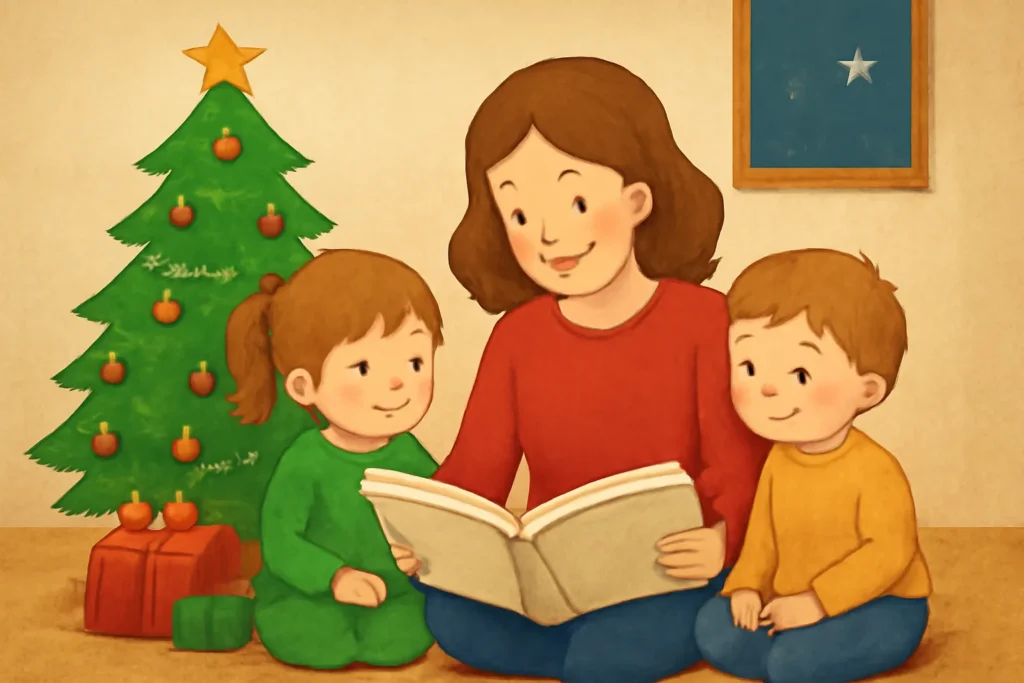
Shared reading and storytelling: Use big books, story cards, and interactive storytelling to model language, rhythm, and story structure. Encourage children to predict what might happen next, to recall events, and to retell parts of the story in their own words.
Dialogic reading: Ask open questions, invite children to contribute phrases, and give prompts that scaffold speaking and listening without interrupting the flow of the narrative.
Drama and role-play: Create a Christmas-themed dramatic area where children can act out roles from the story, re-enact pivotal moments, or improvise new scenes. Role-play supports PSED, communication, and imaginative thinking.
Multi-sensory exploration: Incorporate textures (felt, cotton snow, pine scent), sounds (bells, sleigh bells, chimes), and visuals (props, puppets) to deepen understanding and memory of the story.
Print-rich environments: Label the environment with written words, story prompts, and vocabulary relevant to the Christmas theme, strengthening early literacy and print awareness.
Integrated play-based learning: Tie literacy and numeracy goals to play-based tasks—e.g., counting decorations, sorting characters, matching cards to scenes, sequencing events from the story.
Literacy, Language, and Communication in a Christmas Story EYFS
A robust literacy strand in the Christmas story EYFS involves oral language development, listening comprehension, and early reading and writing concepts. Story-based learning naturally supports phonological awareness, vocabulary acquisition, and understanding narrative structure.
Key language goals within the Christmas story EYFS
Developing a growing vocabulary related to winter, Christmas, and story elements
Learning to retell events in the correct sequence
Describing characters, settings, and events using simple sentences
Beginning to read and write caption-level or word-level text
To achieve these goals, embed opportunities for sharing talk and language throughout the day. Use speak-and-lists, sentence stems, and visual supports to encourage all children to participate. A well-planned unit will include both guided and independent opportunities for children to practice expressive language and early reading strategies.
Below are sample activities aligned to EYFS learning areas. These ideas can be adapted for different Christmas stories or related winter themes.
Literacy and Communication
Read-aloud sessions with a story map or story balloon to sequence events. Children contribute a sentence about a character's choice at key moments.
Labelled story props that children handle while retelling scenes. Use a mix of text and pictures to support early readers.
Phonics play linked to story vocabulary: initial sounds of key characters or objects (e.g., S for Snow, C for Candy Cane).
Mathematics and Logical Thinking
Counting objects from the story (e.g., number of stars, bells, presents) and comparing quantities.
Patterning: creating patterns with garlands, lights, or coloured cards that reflect scenes from the story.
Sorting activities: sort characters by attributes (good/bad deeds, animals vs. people, toy counts).
Understanding the World
Exploration of different winter celebrations and winter weather through books, artefacts, and immersive play.
Discussion of where Christmas traditions come from and how they differ in families, cultures, and communities.
Simple science explorations around light and heat (tiny safe lanterns, LED candles) as a way to discuss how light is used in winter scenes.
Expressive Arts and Design
Making puppets or masks for characters and performing a short retelling of the story.
Art activities such as decorating a class card or a model of a nativity scene using a variety of textures and materials.
Music and song activities tied to the story, using simple percussion instruments to accompany actions within scenes.
Physical Development
Fine motor tasks such as cutting, threading beads to create mini decorations, or weaving to produce a snowflake garland.
Gross motor activities tied to story events: obstacle courses representing different scenes or action-reaction games during retellings.
Finger gym activities that strengthen pincer grip, essential for early writing and manipulating props used in story theatre.
A high-quality Christmas story EYFS experience must be inclusive and accessible to all learners. This includes children with different language backgrounds, SEND, or sensory needs. A few guiding principles help ensure equity and participation:
Choice and control: Allow children to select roles, props, or parts of the story that feel comfortable to them, gradually expanding opportunities for participation.
Visual supports and translation: Use pictures, symbols, and simple phrases to convey meaning. Provide bilingual resources and allow children to bring family language into the classroom.
Multi-sensory experiences: Use a variety of stimuli (sound, touch, texture, scent) to engage children with different sensory preferences and needs.
Flexible pacing: Some children may need more time to process a story, to practice retelling, or to join in singing; adjust the pace accordingly.
Collaborative roles: Encourage peer support and buddy systems so that stronger communicators can support others in a scaffolded way.
Assessment in the EYFS is ongoing, informal, and focused on authentic evidence of progress. In the context of a Christmas story EYFS unit, assessment helps teachers understand where each child is in their development and how to support next steps.
Administrative observations and notes during activities—what the child says, how they participate, and how they interact with peers.
Evidence across seven areas: Documentation of progress in language, literacy, math, physical development, understanding the world, PSED, and Expressive Arts and Design.
Short-term goals that align with the story theme, such as retelling a scene, naming characters, or counting story props.
Portfolios and learning journals: Gather photos, captions, and child voice recordings to demonstrate growth over time.
Christmas is celebrated in many ways around the world, and not all families observe the same traditions. A thoughtful approach to a Christmas Story EYFS should honor diversity and include alternative winter-themed narratives or holiday stories from diverse cultures. This inclusive approach helps children understand that families have different customs and that respect and curiosity about others are essential skills for lifelong learning.
The physical and print-rich environment of the classroom should reflect the Christmas story EYFS focus while supporting learning across the seven areas. Key environmental features include:
Cosy story corner with cushions, a small shelf of linked books, puppets, and soft lighting to create a welcoming space for listening and retelling.
Story displays that show character names, settings, and key events in simple words and pictures, offering a visual reference for children.
Themed invitation to play with role-play props, sensory trays, and construction materials that echo the narrative’s scenes.
Regulated noise levels and acoustics to ensure that every child can hear and participate in discussions and songs.
Visual timetables and routine cards related to the story activities to support predictability and independence.
Family involvement amplifies learning and ensures that the Christmas story EYFS experience is relevant to children’s lives outside school. Practical ways to engage families include:
Sending home simple prompts for rereading or family storytelling with a Christmas twist.
Providing ideas for home crafts and simple, safe activities that mirror classroom tasks—such as making a paper snowflake or a small ornament.
Inviting families to share winter or Christmas traditions, songs, or stories as part of show-and-tell activities.
Organizing a small, inclusive family event or tea time where parents can observe or participate in a story-related activity.
To illustrate how a Christmas-themed unit can unfold, here is a concise example of a one-week plan that centers around a classic Christmas story while incorporating EYFS goals. This sample can be adapted for longer units and different stories.
Monday: Read-aloud of the chosen Christmas story, introduce key characters, and create a simple story map. Focus on listening, speaking, and early comprehension.
Tuesday: Role-play area set up to reenact the first scene. Children practice short lines and actions, building confidence in verbal expression.
Wednesday: Create a simple sequence card activity. Children arrange cards that depict events from the story in the correct order.
Thursday: Thematic math activity—counting ornaments or arranging "presents" into groups by size or color, linked to story motifs.
Friday: Art and design—children craft a character mask or a decorative element from the story. End-of-week story sharing and reflection, with a small display of the week’s work.
Safety and wellbeing considerations are essential when planning a festive unit. In the context of a Christmas story EYFS unit, key safety measures include:
Assessing choking hazards for small components in crafts and sensory trays; ensuring that activities are age-appropriate and supervised.
Maintaining hygiene and safe handling of any food-related activities or materials used in cooking or snack-time experiences.
Ensuring accessibility of resources for children with SEND or diverse needs, including alternative formats or additional adult support where needed.
Adhering to school policies on respect, inclusion, and safeguarding during any group activities or performance-based tasks.
A well-designed Christmas story EYFS unit does not end with a display or a performance. Extending learning into the home and community reinforces learning, fosters family engagement, and honors the child's cultural context. Some ideas include:
Providing simple home activities with age-appropriate materials, such as a story-based handwriting practice sheet or a family-friendly retell prompt.
Suggesting short, shared reading opportunities with caregivers to build a routine around storytelling during the festive period.
Linking to community events or charitable activities that align with the values depicted in the story (e.g., giving, sharing, helping others).
Encouraging children to create a small “memory book” about their Christmas experiences and family traditions, which can be shared with peers.
To avoid repetition and to promote semantic breadth in titles, blurbs, and learning resources, educators and practitioners often use variations such as EYFS Christmas story units, early years Christmas storytelling, Christmas-themed stories in reception, early years literacy through Christmas narratives, and story-based Christmas activities for the EYFS. In planning and documentation, adopting multiple phrasings helps with accessibility, inclusivity, and searchability in digital classroom resources.
Assessment in the context of a Christmas story EYFS is not about testing knowledge; it is about understanding each child’s current abilities and their trajectory. Use a mix of qualitative notes, photographs, and representative samples of child work that demonstrate progress toward the seven EYFS areas. For example:
Evidence of oral language development through retelling and dialogue during role-play.
Examples of emerging early reading behaviors such as pointing to pictures and making predictions.
Annotated observations showing understanding of events and the ability to sequence stories.
Documentation of creativity and Expressive Arts and Design through art and music linked to the story.
A range of accessible, child-friendly assessment tools supports a robust policy of progress tracking in the Christmas story context:
Simple checklists tied to the objectives in each area of learning.
Photographs and videos of role-play, retellings, and craft activities that demonstrate participation and skill development.
Child voice recordings that capture their own language, recall, and understanding of the story.
Portfolios with a curated selection of work across the week or term to illustrate growth.
A carefully designed Christmas Story EYFS unit contributes to a child’s lifelong relationship with reading, storytelling, and collaborative learning. It provides a gentle, structured environment in which young learners can practice language, math, and social skills through a meaningful narrative. Importantly, it creates a sense of belonging and shared experience within the classroom. The joy of a well-told story—paired with intentional teaching and thoughtful inclusion—can ignite curiosity, resilience, and creativity that extends far beyond December.
This comprehensive guide outlines how to design, implement, and assess a Christmas Story EYFS unit that respects the EYFS framework, supports diverse learners, and fosters meaningful engagement with language, literacy, and social development. By combining deliberate planning, inclusive practice, engaging teaching approaches, and reflective assessment, educators can craft a Christmas narrative experience that is not only festive and fun but academically rigorous and developmentally appropriate. Whether you call it an EYFS Christmas story unit, a Christmas-themed storytelling block, or a winter narrative project, the core aim remains the same: to nurture curious, confident, and capable young learners through the magic of a story.









Leave a Reply