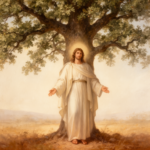
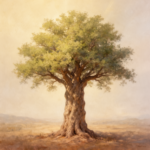
Absalom's Oak would have been a mature Quercus species, featuring a wide, sturdy trunk and spreading canopy. Leaves are lobed and deciduous, turning reddish in autumn. The tree produces acorns, which serve as a vital food source. Bark is rugged and fissured. It thrives in well-drained limestone soils and requires a temperate climate with sufficient rainfall, typical of the mountainous regions of ancient Israel. The robust structure symbolizes strength and longevity, fitting for a prominent biblical landmark.
Scientific Name
Quercus spp. (Debated: Quercus brachycera or Quercus ithaburensis)
Hebrew/Greek Name
עץ אלון (Ets Alon) - 'Oak Tree' in Hebrew
Common Names
Oak Tree, Alon
Native Habitat
Native to the Levant, particularly Israel, Lebanon, and Syria, the oak prefers limestone-rich soils, Mediterranean climates, and elevations ranging from 300 to 900 meters. It flourished historically in the hilly terrains of ancient Canaan and surrounding regions.
First Biblical Mention
Judges 4:5 – Under the oak in Ramah where Deborah judged Israel.
📖 Biblical References
Reference
Context
Significance
2 Samuel 18:9
Absalom's hair was caught in the oak as he was fleeing King David's men, leading to his death.
The oak stands as a silent symbol of tragic royal loss and the consequences of personal rebellion.
Judges 4:5
Deborah sat under an oak (Alon) between Ramah and Bethel, where she administered justice.
Represents wisdom, justice, and divine authority rooted in natural and sacred spaces.
✨ Symbolic Meaning in Scripture
The oak, in biblical symbolism, embodies strength, stability, and endurance. It signifies divine protection and steadfast faith, often linked to divine justice or judgment. The tree’s longevity and durability echo God's eternal covenant and the enduring nature of His promises. Its prominence in sacred spaces suggests a connection to divine wisdom and the stability of God's rule in Israel. Conversely, the downfall of Absalom beneath it highlights themes of tragedy, human vulnerability, and divine justice. Overall, the oak symbolizes both divine strength and the perils of personal pride and rebellion, serving as a spiritual marker of divine sovereignty and moral integrity.
Ancient Israelites used oak wood for building homes, furniture, and ceremonial objects due to its durability. Acorns were a minor but available food source after processing, while the tree also served as shade and refuge in sacred spaces. The oak's bark and leaves may have been used in traditional medicine, addressing ailments like inflammation and skin issues. Oaks held cultural significance in Near Eastern trade, symbolizing stability and divine protection, and were landmarks in territorial boundaries of ancient communities.
✡️ In Jewish Tradition
In Jewish tradition, the oak signifies strength and endurance, often representing divine protection and the Sinai revelation’s enduring covenant. Talmudic literature occasionally mentions oaks as trees of justice and integrity, emphasizing resilience in faith. The oak's association with Deborah underscores its symbolic value in judicial and divine authority within Jewish history and folklore.
✝️ In Christian Tradition
Christianity interprets the oak as a symbol of steadfast faith and divine strength. It appears in spiritual allegories representing moral resilience and divine protection. The story of Absalom's death under the oak can serve as a reminder of humility and divine justice, reinforcing the biblical themes of obedience and divine sovereignty within Christian theology.
Scholars generally identify the oak referenced as a species of Quercus native to Israel and the Levant, most likely Quercus ithaburensis or Quercus brachycera, due to historical presence and biblical descriptions. However, absolute consensus remains elusive owing to ancient botanic ambiguities. These species are characterized by broad lobed leaves, acorns, and robust wood, fitting biblical depictions.
🗺️ Where Is It Found Today?
Today, oak trees similar to the biblical species grow in Israel's mountainous and hilly regions, notably in the Carmel, Galilee, and Judean Hills. They remain prominent landmarks and cultural symbols in protected national parks and archaeological sites.
What is the significance of Absalom's Oak in the Bible?
Absalom's Oak symbolizes both tragedy and divine justice, marking the place of his death and serving as a reminder of the consequences of rebellion against divine authority.
Are the biblical oaks the same as today’s oak species?
Likely yes, though exact species are debated; the biblical oaks probably belong to native Levantine Quercus species such as Quercus ithaburensis.
How was oak wood used in ancient Israel?
It was primarily used for building structures, furniture, and ceremonial objects, valued for its durability and strength. Acorns served as a food source after processing.
✨ Did You Know?
Ancient oak wood has been found in archaeological sites dating back to the Bronze Age, indicating its widespread use and cultural importance. Additionally, fossilized acorns suggest that oaks have been a crucial part of the region's ecosystem for thousands of years, supporting both ancient and modern landscapes.








Leave a Reply