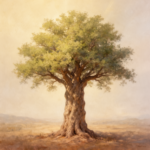
The Oak of Bashan is traditionally associated with large, majestic oaks, possibly Quercus spp. or Pistacia spp., characterized by broad, sprawling canopies and sizable trunks. The leaves are lobed or pinnate, providing dense shade, with flowers appearing in spring in catkins or small clusters, depending on species. Its fruit may be acorns or small drupe-like berries. These trees thrive in well-drained, rocky soils, favoring the Mediterranean climate of the Levant. They can grow up to 30 meters tall, with extensive, sturdy branches suitable for shelter and shade. Their hardy nature makes them prominent features in the hills and plains of Bashan, a region known for its fertile and forested landscape in biblical times.
Indigenous to the northern regions of modern Israel, Jordan, Lebanon, and Syria, particularly in the Bashan Plateau and surrounding highlands. They prefer Mediterranean climates with hot, dry summers and mild, wet winters, thriving in rocky, limestone-rich soils that are well-drained. Historically, these regions supported dense oak forests which supplied timber and shade.
First Biblical Mention
Ezekiel 27:6, around 6th century BCE
📖 Biblical References
Reference
Context
Significance
Ezekiel 27:6
The prophet Ezekiel describes ships with oaks of Bashan used in their construction, symbolizing strength and grandeur of Tarshish-dominated trade.
Represents strength, majesty, and the economic prosperity of Israel and allied nations, also symbolizing stability and divine provision.
Amos 2:9
God condemns Israel for destroying the weak and overharvesting the Oak of Bashan, hinting at exploitation of God's creation.
Reminds readers of responsible stewardship of God's gifts and the consequences of greed.
Psalm 80:10-16
The cedar and the oak are symbolic of Israel’s strength and divine blessing, with the Oak of Bashan representing national pride.
A symbol of God's blessing, strength, and the flourishing of His people.
✨ Symbolic Meaning in Scripture
The Oak of Bashan symbolizes strength, resilience, and divine provision throughout biblical theology. Its grandeur and durability reflect God's sustaining power and the stability of His people. The tree’s use in ships and constructions alludes to divine blessing and protection, while its exploitation in Amos warns against greed and neglect of God's creation. In biblical poetry and prophecy, the oak signifies unwavering faith, divine authority, and resilience in adversity. It embodies both divine blessing and the importance of responsible stewardship, serving as a metaphor for spiritual strength and divine approval or judgment. Thus, the Oak of Bashan stands as a robust emblem of divine strength, prosperity, and the need for righteous stewardship of God's gifts.
In ancient Israel and neighboring cultures, the Oak of Bashan was valued for its sturdy timber used in building ships, houses, and temples. The acorns may have served as food, while the trees provided shade and shelter for travelers and shepherds. Historically, oak wood was also employed in making tools and ceremonial objects, symbolizing strength and permanence. The region’s dense oak forests supported trade and craftsmanship, playing a vital role in local economies and religious practices, including offerings and sacrifices that celebrated God's provision through nature. Its association with Bashan’s lush landscape made it a symbol of prosperity and divine blessing, reflecting its importance in daily life and spiritual symbolism.
✡️ In Jewish Tradition
Jewish rabbinic literature often references the oak trees of Bashan as symbols of stability and divine strength. They are associated with the righteous and divine approval, with passages highlighting the importance of respecting nature as part of God's creation. The oak represents steadfastness in faith and the biblical virtue of humility before divine power. During festivals and prayers, the oak's emblematic significance underscores themes of rootedness and divine blessing, linking natural wisdom with spiritual teaching.
✝️ In Christian Tradition
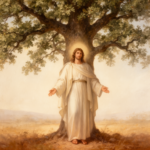
Christian interpretations view the Oak of Bashan as a symbol of strength, eternal life, and divine protection. Early Christian writers often associated large, sturdy oak trees with Christ’s spiritual protection and the righteousness of the faithful. The tree’s resilience is metaphorically linked to faith that endures trials, illustrating the stability found in Christ. It also symbolizes divine blessing, providence, and the renewal of life—qualities emphasized in Christian theology and liturgy.
Scholars debate the precise botanical identity, commonly suggesting Quercus subgenus or Pistacia spp. due to the region’s flora. Some propose the Cannon oak (Quercus coccifera) or Pistacia lentiscus as candidates. There is no scholarly consensus, partly because biblical descriptions lack specific botanical details. Alternative candidates include Lebanese cedar (Cedrus libani) or terebinth trees, but most agree that the biblical 'oak' refers broadly to large, resilient trees native to Bashan’s landscape.
🗺️ Where Is It Found Today?
Today, oak species like Quercus coccifera and Pistacia lentiscus still grow in Israel, Jordan, and Syria, particularly in the Bashan region's rocky highlands and forests. Protected areas like Mount Hermon and parts of the Golan Heights host remnants of these ancient forests, which continue to embody the region’s natural heritage.
Not conclusively; the biblical term likely refers to large, sturdy trees native to Bashan, which are commonly thought to be oaks or similar resilient species like Pistacia. There's ongoing scholarly debate about the exact species.
What does the Oak of Bashan symbolize in the Bible?
It symbolizes strength, resilience, divine blessing, and the stability of God's provision. It also serves as a metaphor for spiritual endurance and divine authority.
Can I see the Oak of Bashan today?
Yes, oak trees native to the Bashan region, such as Quercus coccifera and Pistacia spp., can still be found in northern Israel, Jordan, and Syria, especially in protected natural areas.
✨ Did You Know?
Some archaeobotanical findings suggest that ancient oak wood from Bashan regions was highly valued for shipbuilding, and excavations have uncovered timber artifacts dating back to biblical times. Remarkably, the durability of these trees may have contributed to their symbolic prominence in biblical texts, representing an enduring strength that transcends generations.







Leave a Reply