When you read about the fig tree in the Bible, you may wonder whether it always represents the same idea. The short answer is no. A fig tree can suggest abundance and peace, expose human shame, picture Israel, or warn about judgment. In some passages, it also becomes a vivid illustration of faith, spiritual fruit, and future hope.
That range of meaning makes context essential. The image of a fig tree in Genesis does not function exactly like the fig tree in Jesus’ teaching, and the tree mentioned by the prophets is not always making the same point as the tree in the Gospels. Understanding the tree’s place in biblical life helps clarify why the writers used it so often.
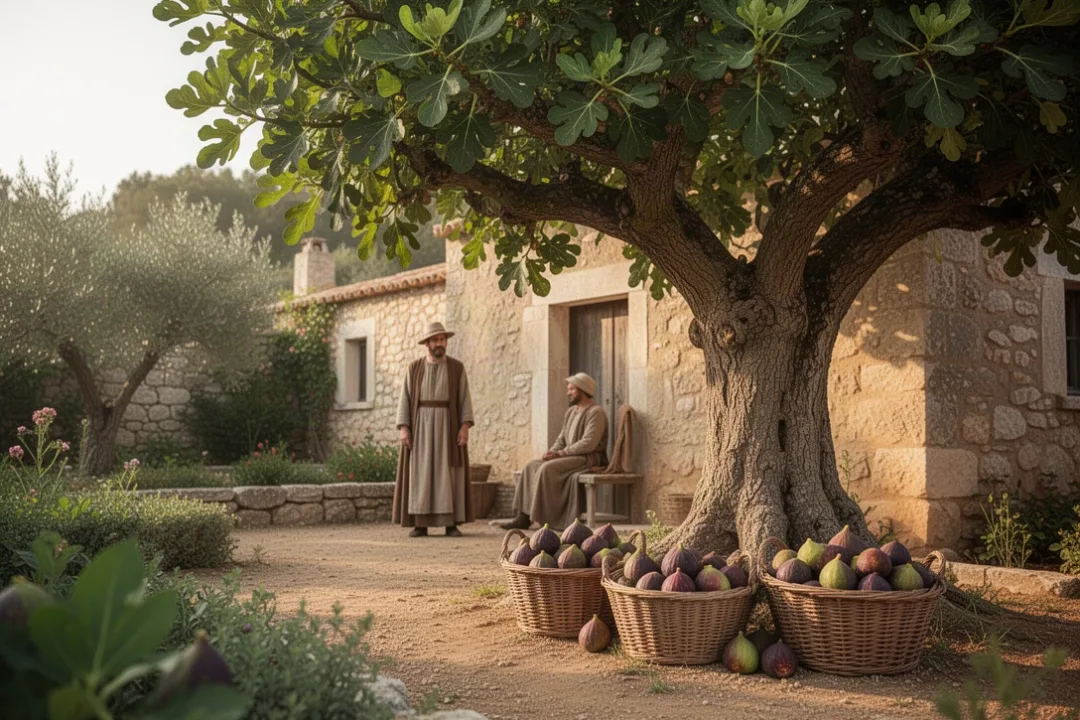
Fig trees were familiar and valuable plants in the lands of the Bible. They grew in the region around Israel and produced fruit that could be eaten fresh or dried for later use. A healthy fig tree represented food, shade, and household prosperity, while a damaged or fruitless tree suggested loss.
Figs could appear more than once during a growing season, depending on the variety and local conditions. The first crop was often associated with early figs, while the later crop was more substantial. This agricultural background helps explain why biblical writers sometimes judged a tree by whether it produced fruit when expected.
A fig tree also offered useful shade. Its broad leaves made it a natural place to sit or rest, especially in a hot climate. In 1 Kings 4:25, the picture of people living safely under their own vine and fig tree describes security and settled peace, not merely gardening.
The Bible often uses ordinary possessions to portray well-being. A person with a vine and fig tree has land, food, and the freedom to enjoy the results of labor. The same image can therefore communicate God’s blessing when the land is flourishing and the people are safe.
Fruit represents nourishment, productivity, and provision.
Shade suggests rest, safety, and a settled home.
Withered branches portray loss, judgment, or the end of expected blessing.
Fresh figs may signal abundance, while spoiled figs can represent corruption or rejection.
Reading tip: The fig tree does not carry one automatic meaning in every biblical passage. Ask what is happening around it, who mentions it, and whether the writer emphasizes fruit, leaves, shade, harvest, or destruction.
The fig tree as a picture of shame and human self-protection
The first biblical reference to a fig tree appears in the story of Adam and Eve. After disobeying God, they recognize their nakedness and sew fig leaves together to cover themselves, as described in Genesis 3. The leaves are not presented as a lasting solution; they show the couple trying to manage shame after sin has entered their relationship with God.
This scene gives the fig tree a significant early association with human vulnerability and self-made covering. Adam and Eve hide and make coverings before God provides garments for them. The tree itself is not condemned, but its leaves become part of the story’s image of fear, exposure, and inadequate human attempts to repair what has been broken.
The detail is also grounded in ordinary life. Fig leaves were large and suitable for covering, so the image would have been easy for ancient hearers to understand. Scripture often makes spiritual points through recognizable physical actions rather than abstract explanations.
That does not mean every later mention of a fig tree refers directly to Genesis. Biblical symbolism develops through repeated images, but each passage still needs to be read on its own terms. A fig tree can evoke earlier associations without carrying every possible meaning at once.
What the prophets mean when they mention fig trees
The prophets frequently use vines and fig trees to describe the condition of God’s people. When the nation is faithful and the land is secure, the image may express peace, prosperity, and restored community. When judgment falls, destroyed or absent figs portray the loss of blessing.
Hosea 9:10 compares Israel’s early relationship with God to finding early figs, presenting the image as something precious and pleasing. The comparison emphasizes delight and value. It does not mean that every mention of an early fig has a hidden code; the point comes from the prophet’s comparison between desirable fruit and Israel’s earlier devotion.
Jeremiah 24 describes two baskets of figs, one with very good figs and the other with figs too bad to eat. The vision distinguishes between groups of people affected by Jerusalem’s crisis. The good figs represent those whom God will ultimately preserve and restore, while the bad figs signify severe rejection and judgment.
Joel 1:7 describes a devastating invasion that strips bark and fruit from the fig trees. The damaged trees make the national disaster visible. Agricultural ruin becomes evidence that the people’s security has collapsed, affecting not only worship and politics but also the basic food supply.
Micah 4:4 uses the image of sitting under one’s vine and fig tree in a vision of future peace. The picture is personal and communal at the same time: people possess a secure place, enjoy their own harvest, and live without the threat of war. Zechariah 3:10 uses a similar image of inviting one another under vines and fig trees, linking the tree with reconciliation and confidence.
At other times, the loss of figs represents divine judgment. In Isaiah 34:4, the falling of figs forms part of a cosmic picture of upheaval. In Nahum 3:12, ripe figs that fall when shaken help portray a city that is vulnerable and ready to be taken. The exact emphasis varies, but the recurring idea is that what appears established can quickly become unstable under judgment.
These prophetic uses show why the fig tree can point in two opposite directions. A flourishing tree suggests God’s generous provision; a barren or ruined tree suggests the removal of protection and blessing. The surrounding prophecy determines which side of the image is in view.
How Jesus uses the fig tree in the Gospels
Jesus refers to fig trees in several different settings. He uses them in short lessons about recognizing evidence, in a parable about patience, in a saying about future events, and in the striking account of a tree that withers. These passages should not be flattened into one message.
The fig tree and the need for visible fruit
In Matthew 7:15–20, Jesus teaches that people can be recognized by their “fruits.” The teaching compares good and bad trees with the kind of life that comes from a person’s character. A healthy tree produces good fruit, while a bad tree cannot consistently produce what is good.
Because the wording is a biblical quotation in many English translations, it is better to focus on the meaning rather than treat the image as a botanical formula. Jesus is saying that outward conduct reveals inward character. Claims, appearances, or religious language do not provide the strongest evidence; a person’s life eventually shows what is taking root within.
Luke 6:43–45 makes a similar point with trees and fruit. The image connects a person’s words and actions with the condition of the heart. This is not a call to judge someone by a single mistake. It is a warning to pay attention to a settled pattern of behavior rather than relying on appearances.
The parable of the fruitless fig tree
In Luke 13:6–9, Jesus tells of a man who finds no fruit on a fig tree for three years. The owner wants it removed because it is using valuable ground, but the gardener asks for additional time to cultivate and fertilize it. The parable holds together patient mercy and serious accountability.
The tree receives further care, but the request for patience is not permission for endless fruitlessness. The story creates urgency: the opportunity to respond to God’s work should not be treated as unlimited. The gardener’s care shows mercy, while the owner’s expectation of fruit shows that mercy is meant to lead toward change.
Interpreters have connected this parable with the wider call to repentance in Luke 13. The passage does not provide a simple chart in which every character represents one person or group. Its force comes from the tension between delayed judgment and the expectation that a living tree should eventually produce fruit.
Matthew 21:18–22 and Mark 11:12–25 describe Jesus approaching a fig tree with leaves but finding no figs. The tree withers, and the surrounding events include Jesus’ action in the temple and teaching about faith and prayer. Because the accounts are arranged differently in Matthew and Mark, readers should pay attention to the narrative setting as well as the tree itself.
The unusual detail is that the passage mentions the season. Mark says it was not the season for figs, which has led to extensive discussion. The scene is not best understood as a lesson about Jesus losing patience with an ordinary plant. In the Gospel narrative, the tree functions as a prophetic sign connected with the temple’s failure to fulfill its purpose.
In Mark, the fig tree episode surrounds the account of Jesus driving commercial activity from the temple courts. This arrangement invites readers to connect the tree’s leaves without fruit with religious appearance without the justice, prayer, and faithful worship God desires. The temple looks active, but the surrounding actions suggest spiritual barrenness.
Matthew places the temple action and the withered tree in a more compressed sequence, then emphasizes faith and prayer. The central lesson is not that faith is a tool for getting any desired result. Jesus’ teaching concerns trusting God and praying in alignment with God’s purposes, while the broader context still includes judgment on empty religious display.
Important distinction: The withered fig tree should not be used to claim that every hardship proves a person or church lacks faith. In the Gospel story, the sign belongs to a particular prophetic confrontation and must be read with its temple context.
The fig tree as a sign in Jesus’ teaching about the future
In Matthew 24:32–35, Mark 13:28–31, and Luke 21:29–33, Jesus points to the seasonal changes of a fig tree. When its branch becomes tender and leaves appear, people recognize that summer is near. The lesson is about paying attention to recognizable signs, not calculating a precise date.
The tree’s seasonal pattern gives the disciples a familiar comparison. Just as new leaves indicate a coming season, the events Jesus has described indicate that something is approaching. The comparison encourages alertness, but it does not authorize confident predictions about the exact timing of future events.
Some readers treat the fig tree in this passage as a direct symbol for the nation of Israel. That interpretation has a long history, but the passage itself focuses first on the tree’s observable seasonal change. The main point is that the disciples should respond wisely to what they see rather than remain unaware.
Other important fig tree references in the New Testament
John 1:43–51 includes the conversation between Jesus and Nathanael. Jesus knows that Nathanael was under the fig tree before Philip called him. The text does not explain exactly what Nathanael was doing there, so it is unwise to build a detailed theory around the location.
The scene does show that Jesus possesses knowledge that surprises Nathanael. The fig tree may have been a private place of rest, prayer, study, or ordinary daily activity, but Scripture does not specify which. The important point is that Jesus’ knowledge leads Nathanael to recognize something about Jesus’ identity.
In James 3:12, James asks whether a fig tree can produce olives or a vine produce figs. The illustration supports his teaching about speech: a source should produce what fits its nature. James is not discussing agricultural impossibility for its own sake; he is exposing the contradiction of blessing God while using the same mouth to curse people made in God’s likeness.
Revelation 6:13 compares stars falling from the sky to figs dropping from a fig tree shaken by a strong wind. This is vivid apocalyptic imagery, designed to communicate cosmic disturbance. The comparison depends on the familiar experience of ripe figs falling when a tree is violently shaken.
These later references reinforce an important principle: the fig tree is a flexible biblical image. It can communicate knowledge, consistency, sudden upheaval, or spiritual evidence. Its meaning comes from the action and argument surrounding it, not from the plant alone.
The biblical references to fig trees invite self-examination, but they should be applied carefully. The question is not whether you can identify a secret meaning in every tree mentioned in Scripture. The better question is what kind of response the passage calls for: gratitude, repentance, alertness, trust, or hope.
First, the fig tree can remind you to distinguish appearance from fruit. Leaves make a tree look alive, but fruit demonstrates its productivity. In spiritual terms, public identity and religious vocabulary are not enough by themselves. Character, mercy, truthfulness, and faithful action provide more meaningful evidence.
Second, the tree represents the patience of God without suggesting that choices have no consequences. The gardener in Luke 13 asks for more time and care, which offers hope to people who need renewal. At the same time, the story refuses to treat fruitlessness as harmless or permanent.
Third, the tree can direct attention toward ordinary blessings. A home, a harvest, a safe place to sit, and food to share may seem unremarkable, yet biblical writers repeatedly treat these things as signs of peace. The image encourages gratitude for stability and daily provision rather than measuring well-being only by extraordinary experiences.
Fourth, the fig tree warns against false certainty. Its meanings are not interchangeable, and one passage cannot automatically settle every question about another. Careful readers compare the passage’s setting, literary form, historical situation, and central purpose before applying its image.
Read the whole passage instead of isolating the sentence that mentions the tree.
Identify the tree’s condition: fruitful, barren, leafy, damaged, shaken, or flourishing.
Notice the surrounding action: Is the tree connected with blessing, judgment, prayer, worship, or future hope?
Compare related passages without assuming they all make exactly the same point.
Apply the main lesson to your character and choices, not merely to symbolic speculation.
The broad biblical picture is both encouraging and challenging. God’s provision is pictured as a fruitful tree and a safe place to rest, while empty appearance and persistent fruitlessness are taken seriously. The image leaves room for patience, but it also calls for genuine change.
For that reason, the fig tree in the Bible is best understood as a context-dependent symbol of life before God. It can point to what people receive, what they produce, what they conceal, and what happens when expected fruit never appears. Its recurring presence turns an ordinary tree into a memorable way of thinking about faithfulness, judgment, and hope.
Frequently asked questions
What does the fig tree symbolize in the Bible?
Its meaning depends on the passage. A flourishing fig tree may represent peace, security, and God’s provision. A barren or damaged tree may symbolize judgment or spiritual failure. Fig leaves can suggest human efforts to cover shame, while fruit can represent visible character and faithful action.
Why did Jesus curse the fig tree?
In the Gospel accounts, the withered fig tree functions as a prophetic sign connected with Jesus’ actions in the temple. Its leaves without fruit portray outward religious appearance without the faithful worship and justice God desires. The episode also includes teaching about faith and prayer, so it should not be reduced to a lesson about getting whatever someone requests.
Does the fig tree represent Israel?
Sometimes biblical writers use a fig tree in connection with Israel or the people of God, especially in prophetic passages. However, it is not a universal symbol with that meaning in every verse. In Jesus’ teaching about seasonal signs, for example, the immediate point is recognizing that certain events are approaching.
What is the lesson of the fruitless fig tree in Luke 13?
The parable combines patience with accountability. The gardener asks for more time to cultivate the tree, showing mercy and continued care. Yet the owner still expects fruit. The story encourages repentance and change rather than presuming that patience means consequences will never come.








Leave a Reply