Charles G. Finney: Revivalist, Preacher, and Reformer
Charles G. Finney: Revivalist, Preacher, and Reformer
If you have heard Charles G. Finney described as either a pioneering evangelist or a controversial revival innovator, you may wonder which description is fair. Finney was both a major nineteenth-century revival preacher and a deeply debated religious thinker. His sermons drew large crowds, his methods influenced American Protestantism, and his work connected Christian conversion with moral reform, education, and opposition to slavery.
Charles Grandison Finney lived from 1792 to 1875. He trained as a lawyer rather than a seminary student, experienced a dramatic conversion as a young adult, and later became one of the best-known preachers of the Second Great Awakening. His ministry was especially influential in western and central New York, where repeated revival meetings earned the region the nickname the Burned-over District.
Finney was born in Warren, Connecticut, and grew up in a family that later moved to upstate New York. As a young man, he worked as a teacher and then studied law. He was preparing to practice in Adams, New York, when he began wrestling with questions about prayer, sin, salvation, and personal faith.
His conversion in 1821 became the defining event of his life. In his later memoirs, Finney described an overwhelming encounter with God in the woods near his law office. He interpreted the experience as a decisive surrender to Christ and soon began speaking publicly about religion. Although he had no formal theological degree, he was licensed to preach by Presbyterian leaders and began an itinerant ministry.
Finney’s importance rests partly on his view that revival was not simply a mysterious outpouring sent by God. He believed Christians had a responsibility to use appropriate means, pray earnestly, preach clearly, and call people to immediate repentance. That emphasis made revival seem more connected to human action and organization than many earlier Protestant traditions had allowed.
He also treated conversion as a beginning rather than an isolated emotional event. For Finney, genuine Christianity should produce obedience, moral seriousness, active benevolence, and reform. This conviction led him to support abolitionism, temperance, improved education, and other causes he believed reflected Christian duty.
The central point: Finney’s influence came from the combination of direct evangelistic preaching, deliberate revival organization, and a strong belief that Christians should work publicly against injustice.
Charles G. Finney’s early life and conversion
Finney was born on August 29, 1792, in Warren, Connecticut. His family moved to Oneida County, New York, while he was still young. He received the kind of practical education common in early nineteenth-century America and eventually taught school before beginning legal studies in Adams.
Finney’s religious background did not immediately make him an enthusiastic churchgoer. He later recalled feeling dissatisfied with formal religious practices and with what he considered unclear preaching. His legal training influenced his thinking: he valued precise arguments, direct evidence, and a decision that followed from careful reasoning.
In 1821, while studying law, he began reading the Bible and attending prayer meetings. His spiritual crisis centered on whether he was willing to place himself fully under God’s authority. The conversion experience he described afterward became the foundation for his preaching about personal responsibility and immediate decision.
Finney did not see conversion as merely accepting a set of doctrines. He described it as a change in the governing intention of a person’s life. In his framework, a sinner turned away from self-interest and chose obedience to God. This emphasis would later shape both his sermons and his disagreements with Calvinist teaching.
How Finney’s revival ministry developed
Finney began preaching in small communities and quickly gained a reputation for unusually forceful sermons. He spoke without relying heavily on a manuscript, questioned hearers directly, and pressed them to consider the consequences of refusing repentance. His legal background contributed to a style that was plain, analytical, and confrontational.
His early ministry took place during a period of expanding population, new towns, improved transportation, and strong religious competition. Large numbers of people were moving westward into New York and other states. Churches were trying to reach communities where established institutions were weak, and revival meetings offered a way to gather people who did not attend worship regularly.
Finney’s meetings often lasted for extended periods. A congregation might hear several sermons, attend prayer gatherings, speak with ministers, and make a public profession of faith. He believed repeated attention to the same spiritual question could break through indifference and lead people to act.
His campaigns in places such as Rochester, New York, brought him national attention. Newspapers and religious publications discussed his preaching, and ministers studied his methods. Supporters saw evidence of genuine conversion and community transformation. Critics saw emotional pressure, theatricality, or an unhealthy focus on visible results.
How Finney conducted a revival meeting
Finney’s approach was carefully organized, even though the meetings were presented as responses to spiritual need rather than performances. He expected local churches to prepare through prayer, cooperation, and personal conversations. He also believed ministers should understand the conditions of the community they were trying to reach.
A typical Finney campaign could include several connected practices:
Protracted meetings: Services continued over an extended period rather than ending after one ordinary worship gathering.
Direct appeals: Preaching addressed listeners personally and asked them to make a clear response.
Prayer for specific people: Congregations were encouraged to pray for named individuals rather than only discussing sinners in general terms.
Public religious decisions: Hearers might be invited to move forward, stand, or occupy a designated place to signal their concern about salvation.
Follow-up instruction: New converts were expected to join a church, change their conduct, and participate in Christian work.
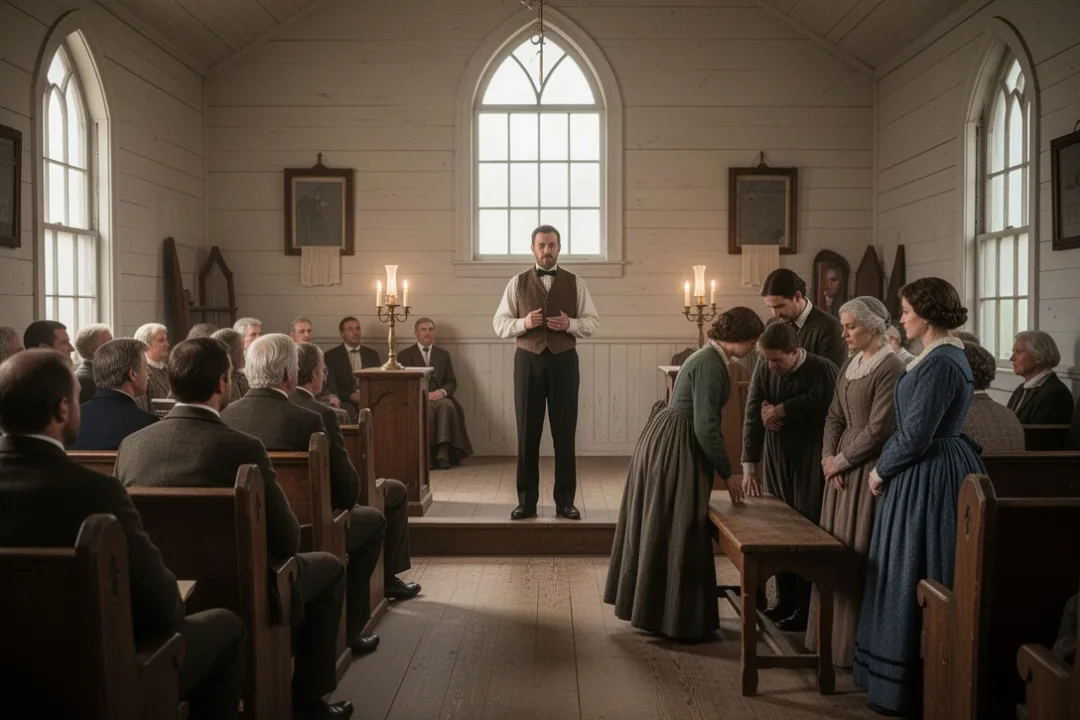
The practice most associated with Finney is the anxious bench. People who felt troubled about their spiritual condition could sit on a bench at the front of the meetinghouse while others prayed for them. Finney defended this practice as a practical way to help people stop postponing a decision.
Many later evangelists adapted this idea into altar calls or invitations to come forward. The exact forms differed, but the underlying principle remained similar: a person should not hide behind private emotion or vague intention. Finney wanted the hearer’s response to become identifiable and immediate.
His methods were not universally accepted. Some ministers argued that an outward action could be confused with genuine faith. Others objected that strong appeals might produce temporary excitement rather than durable Christian commitment. These concerns became part of the continuing debate over revivalism.
What Finney believed about conversion and human choice
Finney’s theology departed sharply from traditional Calvinist formulations on several points. He rejected the idea that people were unable to respond to God in any meaningful sense until first regenerated by a divine act. Instead, he stressed that people possess a real moral ability to choose obedience or disobedience.
For Finney, God did not force conversion by overriding the human will. He believed the Holy Spirit worked through truth, persuasion, prayer, and preaching, but the individual remained responsible for responding. This explains why his sermons often sounded like arguments presented in a courtroom: the listener was being called to make a moral decision.
He also distinguished between an emotional response and a lasting change of purpose. A person could feel fear, excitement, or sorrow without truly turning toward God. Finney therefore judged conversion by its continuing effects, including changed behavior, disciplined devotion, and practical love for others.
His understanding of sanctification was also demanding. Finney taught that Christians should pursue holiness seriously and could live in sustained obedience to God. He did not mean that believers would never face temptation or make mistakes, but he placed strong emphasis on the possibility and obligation of present moral victory.
Critics argued that this approach placed too much confidence in human will and moral effort. Supporters responded that Finney was defending responsibility, not denying divine grace. The debate reflects a larger difference between traditions that emphasize God’s decisive initiative and traditions that emphasize the individual’s obligation to respond.
Finney’s distinctive views on the atonement
Finney also challenged older explanations of Christ’s death. He did not accept the classic idea that Christ’s suffering functioned primarily as a direct substitution of punishment for particular sinners. Instead, he described the atonement in terms of God’s moral government.
In this framework, Christ’s death demonstrated the seriousness of sin and upheld the authority of God’s law. It made forgiveness possible while preserving the moral order of the universe. Finney believed God could forgive repentant sinners without treating disobedience as insignificant.
This position was controversial because many evangelical Christians regarded substitutionary atonement as central to the gospel. Finney’s critics believed his explanation weakened the biblical and theological meaning of Christ bearing sin on behalf of others. His defenders valued the way his view connected forgiveness with repentance, moral transformation, and the public seriousness of God’s justice.
Readers who encounter Finney’s sermons or Lectures on Systematic Theology should remember that he wrote within a nineteenth-century argument about free will, divine sovereignty, law, and moral agency. His terms do not always carry the same meaning across different Christian traditions. A fair reading requires attention to those differences rather than reducing his theology to a few revival slogans.
Why the Burned-over District shaped Finney’s ministry
The Burned-over District was a region of western and central New York known for intense religious activity during the early nineteenth century. The phrase suggested that the area had been repeatedly exposed to waves of revival and religious experimentation, leaving few communities untouched by the period’s spiritual movements.
The region included growing towns, recently settled areas, canal-connected communities, and people from varied religious backgrounds. It was fertile ground for itinerant preaching because many residents were open to new religious messages and because established churches did not always meet the needs of expanding populations.
Finney’s preaching fit this environment. He used accessible language, addressed ordinary moral concerns, and treated conversion as a decision that could happen in a local meetinghouse rather than only within an established religious hierarchy. His approach also matched a broader American tendency toward voluntary associations, organized campaigns, and individual choice.
His success cannot be explained by technique alone. Local pastors, prayer groups, social conditions, denominational competition, and the expectations of audiences all contributed to the revivals. Finney was a powerful leader, but he worked within a much larger religious and social movement.
In 1835, Finney joined the faculty of the newly established Oberlin Collegiate Institute in Ohio, later known as Oberlin College. He became professor of theology and eventually served as president. Oberlin became one of the most distinctive educational institutions in the country because it combined rigorous study, Christian reform, and opposition to slavery.
Finney’s connection with Oberlin broadened his influence beyond revival meetings. He trained ministers, taught theology, wrote extensively, and helped form a generation of religious leaders. His public role at the college gave his ideas a permanent institutional setting.
Oberlin admitted Black students and women during an era when many colleges excluded them. The institution’s policies and culture were not free from racial or gender limitations, and its history includes tensions and contradictions. Still, its openness was unusual for the period and was connected to a belief that education should prepare people for Christian service and public reform.
Finney viewed education as part of spiritual usefulness. Ministers needed more than emotional intensity; they needed biblical knowledge, intellectual discipline, and the ability to address social problems. His work at Oberlin helped move revivalism toward a model in which evangelism, higher education, and reform belonged together.
Charles G. Finney and opposition to slavery
Finney became an outspoken opponent of slavery. He regarded slavery as a grave moral evil and argued that Christian institutions should not compromise with it. At Oberlin, he supported the school’s antislavery identity and encouraged students to connect religious conviction with public action.
His abolitionism was part of a wider nineteenth-century evangelical reform tradition. Many revival-minded Christians believed that conversion should produce social responsibility. If a person claimed to love God while participating in or defending oppression, Finney believed that person’s conduct contradicted Christian obedience.
Finney’s reform commitments sometimes created conflict with churches and religious leaders who preferred to keep slavery separate from preaching. He rejected that separation. In his view, moral questions involving human dignity could not be excluded from Christian preaching simply because they were politically divisive.
His record should still be read with historical care. Antislavery Christians did not all hold identical views about race, citizenship, equality, or the use of political power. Recognizing Finney’s important opposition to slavery does not require treating every aspect of his social thought as identical to modern antiracist principles.
What Finney wrote in his major works
Finney’s most widely read works include Lectures on Revivals of Religion, Lectures on Systematic Theology, and his memoirs. Each work reveals a different side of his thought.
Lectures on Revivals of Religion: Explains his beliefs about prayer, preaching, organization, conversion, and the practical conditions that encourage revival.
Lectures on Systematic Theology: Presents his positions on God, morality, free will, sin, atonement, sanctification, and Christian duty.
Memoirs of Charles G. Finney: Tells the story of his conversion, ministry, travels, institutional work, and reflections on revival.
These books are valuable historical sources, but they are not neutral reports. Finney wrote to defend his understanding of revival and to explain why his methods were legitimate. His memoirs, in particular, show how he interpreted the events of his life rather than providing an independent record of every detail.
His writing style is direct and practical. He often defines a concept, describes its moral consequences, and then tells the reader what should be done. People studying him today may find his confidence striking, especially when he identifies specific human actions as conditions that affect the course of a revival.
Why Finney’s revival methods remain controversial
Finney’s supporters credit him with making preaching accessible, urging churches to take evangelism seriously, and helping many people make a clear profession of faith. They also value his insistence that Christian belief should affect public morality rather than remain a private sentiment.
His critics raise several recurring objections:
Emotional pressure: Public invitations and direct questioning could make people feel compelled to respond before they understood the commitment being requested.
Measuring spiritual results: Visible decisions might be counted as conversions even when lasting change was uncertain.
Human control of revival: His language about using means could sound as if revival were produced by a successful technique rather than received as an act of God.
Theological disagreement: His views of free will, sanctification, and the atonement differed from influential Calvinist and evangelical traditions.
Finney himself understood that religious excitement could be mistaken for conversion. He warned against relying on noise, numbers, or temporary enthusiasm. Yet his own language about the conditions of revival sometimes encouraged later readers to treat his approach as a formula.
A useful distinction: Finney did not simply invent the idea of revival, and he did not control every result of his meetings. He developed a deliberate approach to preaching and organization within a wider movement of American religious renewal.
How Finney influenced later evangelicalism
Finney helped establish patterns that became common in later American evangelism. These included the extended revival campaign, the public invitation, the decision-focused sermon, organized prayer for specific people, and close cooperation between local churches and visiting preachers.
Later evangelists did not always share Finney’s theology. Some adopted his methods while holding more traditional views of divine sovereignty and atonement. Others modified the anxious bench into an altar call or personal counseling session. Over time, his techniques became part of a broader evangelical culture.
His influence also reached beyond evangelistic meetings. The idea that religious conversion should produce social reform became important in many Protestant movements. Christian activism related to abolition, temperance, education, urban missions, and humanitarian work often reflected the same general conviction that faith should be visible in public conduct.
At the same time, modern revival practices cannot be attributed to Finney alone. Camp meetings, Methodist preaching, Baptist evangelism, frontier religion, Sunday schools, voluntary societies, and other forces shaped American Protestantism. Finney was a major organizer and interpreter of revival, not the sole source of every later practice associated with it.
How to evaluate Charles G. Finney today
A balanced evaluation begins by separating several questions. Was Finney an effective preacher? Many historical accounts indicate that he was. Were all of his theological claims accepted by other Christians? No. Did his methods influence later evangelism? Clearly. Did every reported conversion represent lasting faith? That cannot be established simply from meeting statistics or public responses.
It is also useful to read Finney in layers:
Read his biography as interpretation: Notice how he explains his conversion, calling, successes, and disappointments.
Study the historical setting: Consider the growth of New York and Ohio, revival competition, reform movements, and the changing role of voluntary religious organizations.
Compare his theology with other traditions: His views become clearer when set beside Calvinist, Wesleyan, Baptist, and Methodist teachings on grace and human choice.
Separate method from doctrine: A reader may assess public invitations or extended meetings independently from Finney’s ideas about the atonement.
Examine lasting effects: Ask how his practices influenced churches, education, reform, and expectations about visible religious decisions.
Finney’s legacy is strongest where these subjects overlap. He made preaching practical, personal, and urgent. He linked evangelism with disciplined action. He challenged churches to examine whether their worship led to changed lives and whether their theology addressed serious moral wrongs.
His weaknesses are equally significant. His confidence in human choice can appear to minimize divine initiative. His revival methods can encourage the assumption that spiritual life is measurable through public responses. His language about moral ability and perfection may place unrealistic pressure on believers or understate the complexity of sin and weakness.
For that reason, Charles G. Finney is best understood neither as a flawless model nor as a simple manipulator. He was a gifted nineteenth-century preacher whose convictions about free will, revival, reform, and Christian responsibility reshaped American religious life. Studying him helps explain why modern evangelical services often emphasize an immediate decision, a personal response, and a faith that should affect the wider community.
Where to begin if you want to study Finney
Start with a reliable biography or a historical introduction to the Second Great Awakening. Then read selected sections of Finney’s own works, especially his discussion of revival and his account of conversion. His arguments are easier to understand when you know the debates surrounding Calvinism, Methodism, abolition, and nineteenth-century higher education.
As you read, pay attention to repeated ideas: moral responsibility, the human will, prayer, immediate action, sanctification, and social reform. Also ask how Finney defines successful ministry. His answer is not limited to a crowded meeting; it includes obedience, church membership, consistent character, and active concern for others.
The most accurate picture is therefore a layered one. Charles G. Finney was a lawyer-turned-preacher, a revival strategist, a theologian, an educator, an abolitionist, and a controversial architect of modern evangelical practice. His work continues to matter because the questions he raised—how people change, how churches should call for repentance, and how faith should confront injustice—remain central to Christian life and public religion.
Frequently asked questions
What was Charles G. Finney best known for?
He was best known for leading nineteenth-century revival meetings and promoting methods such as extended services, direct appeals, and the anxious bench. He also became known for his teaching at Oberlin College, his opposition to slavery, and his theological emphasis on human moral responsibility. His approach influenced later evangelistic practices, including public invitations to make a visible religious decision.
Did Charles G. Finney believe revival could be organized?
Finney believed revival involved God’s work but also argued that churches had responsibilities that could encourage or hinder it. He emphasized prayer, clear preaching, cooperation, and earnest appeals to individuals. Critics thought this language made revival sound like a humanly controlled process, while Finney intended to stress disciplined obedience rather than a mechanical formula.
What was the anxious bench?
The anxious bench was a designated seat near the front of a meeting where people concerned about their spiritual condition could sit during a revival service. Ministers and other worshipers would pray and speak with them. The practice made a person’s spiritual concern public and immediate, but opponents worried that it could create pressure or confuse a visible response with lasting conversion.
Was Charles G. Finney a Calvinist?
Finney was raised around Presbyterian influences but rejected important Calvinist teachings, especially the idea that people lack meaningful ability to respond to God before regeneration. He strongly emphasized free moral choice and human responsibility. He also differed from traditional Calvinism in his account of the atonement and his teaching about the possibility of sustained Christian obedience.











Leave a Reply