Bernard of Clairvaux: life, teachings, and lasting influence
Bernard of Clairvaux: life, teachings, and lasting influence
Bernard of Clairvaux was one of the most influential Christian leaders of the twelfth century. As a Cistercian abbot, theologian, preacher, and adviser to popes and rulers, he helped shape both monastic life and the wider medieval church.
His influence reached well beyond the monastery he led at Clairvaux. Bernard promoted a stricter, simpler form of Benedictine observance, defended the papacy during a major schism, encouraged the Knights Templar, preached the Second Crusade, and developed a deeply personal theology of divine love. His reputation was powerful, but his career also reveals the tensions of medieval Christianity: humility alongside authority, contemplation alongside political action, and spiritual ideals alongside the violence of crusading.
Bernard of Clairvaux’s early life and entry into monasticism
Bernard was born in 1090 near Dijon in Burgundy, a region of present-day France. His family belonged to the lesser nobility, and he received the education expected of a young aristocrat. Medieval accounts describe him as intelligent, disciplined, and unusually serious about religious questions from an early age.
His mother, Aleth of Montbard, is remembered in later tradition as a strong influence on his religious formation. Bernard’s family connections also mattered because medieval monasteries often drew members from noble households. Entering religious life did not necessarily mean abandoning all social influence; people from prominent families could carry their education, networks, and authority into the church.
In 1112, Bernard entered the monastery of Cîteaux with a group of relatives and companions. Cîteaux had been founded in 1098 by monks seeking a more demanding interpretation of the Rule of Saint Benedict. Their movement became known as the Cistercian reform, named after Cîteaux’s Latin name, Cistercium.
The Cistercians criticized what they viewed as the wealth, elaborate ceremonies, and institutional entanglements of some older monasteries. They emphasized manual labor, common discipline, solitude, and a simpler liturgical life. Bernard’s decision to join Cîteaux gave the young community an exceptionally forceful advocate at a time when it was still relatively small and vulnerable.
Key idea: Bernard did not create the Cistercian movement, but his leadership made its ideals visible and influential throughout western Europe.
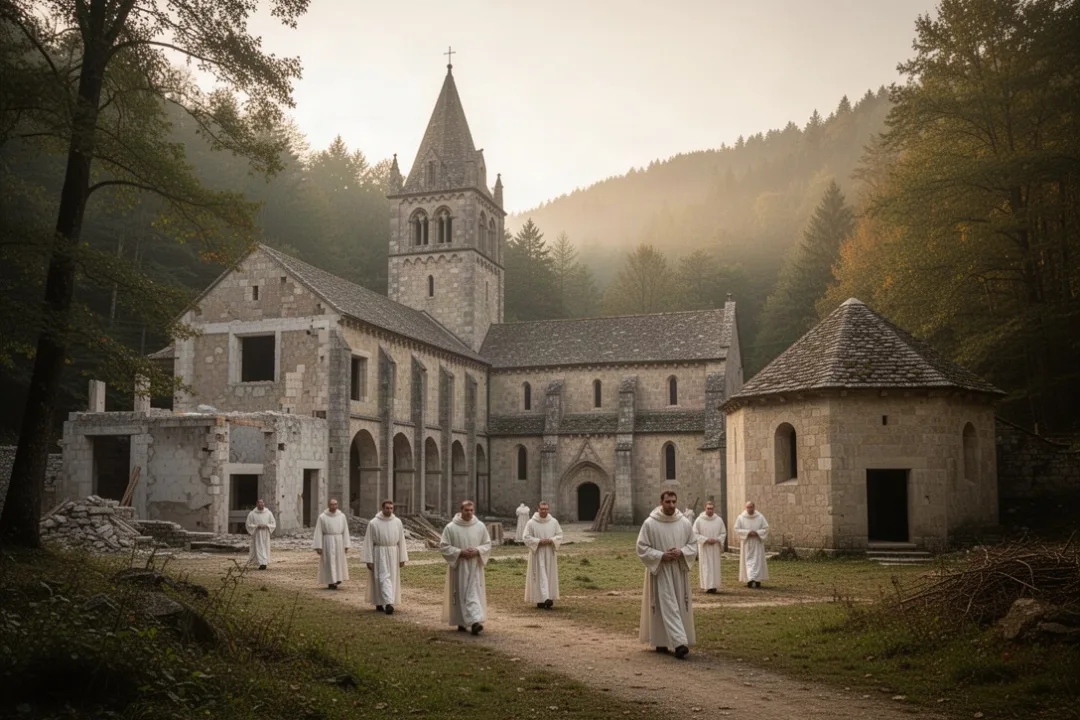
Only a few years after entering Cîteaux, Bernard was sent to establish a new monastery. In 1115, he and a small group of monks founded Clairvaux Abbey in a remote valley. The name means “clear valley,” and Bernard remained its abbot for the rest of his life.
The early years at Clairvaux were demanding. The monks faced poor conditions, limited resources, and the physical hardship of building a community in an isolated location. Bernard’s strict approach to discipline also placed pressure on the monks. Yet Clairvaux grew rapidly, eventually founding numerous daughter houses across Europe.
Bernard’s personal authority was central to that expansion. He was a compelling preacher and correspondent, able to communicate with peasants, abbots, bishops, nobles, and popes. His letters show a leader who could be gentle and reflective in one setting, then direct and sharply critical in another.
How Bernard shaped Cistercian monastic reform
Bernard believed that a monastery should help a person move from distraction and self-love toward humility, obedience, charity, and union with God. He did not present monasticism as a comfortable retreat from the world. For him, the monastery was a disciplined school in which the whole person—body, mind, desire, and will—was trained for love of God.
The Cistercian ideal favored plain architecture, restrained decoration, and a clear separation from the wealth associated with powerful institutions. Bernard’s own writings attacked excessive ornament in churches when he believed it distracted monks from prayer. His criticism was especially directed at elaborate visual imagery and luxurious settings that, in his view, encouraged curiosity rather than contemplation.
Bernard’s position was not simply an argument for ugliness or absolute austerity. He valued beauty, order, and the natural world as signs of divine creation. His concern was that monastic resources and attention should serve the spiritual purpose of the community rather than status, display, or entertainment.
He also supported the Cistercian system of organization. New monasteries remained connected to their founding houses, while a general chapter helped maintain common standards. This network allowed the reform to spread without becoming entirely dependent on one monastery or one charismatic abbot.
Bernard’s understanding of leadership combined strict standards with pastoral responsibility. He could demand fasting, silence, and obedience, but he also warned against discipline that crushed a person’s health or capacity for prayer. His sermons frequently return to the need for self-knowledge: people must recognize both their weakness and their dependence on divine grace.
Several themes defined his approach to reform:
Conversion of the heart: outward observance mattered because it trained inward desire, not because rules alone could save a person.
Moderation in authority: abbots had to govern firmly but remember that they were serving people entrusted to their care.
Separation from worldly ambition: monasteries should resist the pursuit of wealth, prestige, and political advantage.
Love as the goal of discipline: obedience was meant to lead toward freedom in charity rather than mere fear of punishment.
Clairvaux became a major center of Cistercian influence partly because Bernard’s writings circulated widely. His sermons, letters, and theological works were copied and read by monks, clergy, and educated laypeople. The abbey’s daughter houses extended his influence even farther, making Clairvaux one of the most important religious centers of the period.
Bernard’s theology of love and mystical prayer
Bernard is best remembered by many readers for his theology of love for God. His most famous theological work, On Loving God, describes love as something that develops through stages. A person may begin by loving oneself for one’s own sake, then learn to love God because God provides help and protection. Over time, that love can become less self-centered and more freely directed toward God.
Bernard’s account is often called a sequence of four degrees or stages of love. The exact experience differs from person to person, and Bernard did not present spiritual growth as a simple ladder that human effort could climb without grace. His point was that love can be purified: it can move from fear and self-interest toward delight in God’s goodness itself.
The four stages are commonly summarized in this way:
Loving oneself for one’s own sake: the ordinary human starting point, shaped by survival and personal desire.
Loving God for personal benefit: turning to God because divine help, forgiveness, and protection are needed.
Loving God for God’s sake: beginning to value God’s goodness apart from what one receives.
Loving oneself in relation to God: a mature condition in which the self is received and understood through divine love.
Bernard’s fourth stage should not be confused with self-worship. He meant that a person can come to accept the self as God intended it, freed from both vanity and despair. This vision combines humility with hope. Human beings are dependent on God, but they are not worthless or rejected.
His approach to mystical theology was rooted in experience, Scripture, and careful reflection. Bernard did not treat mystical union as an escape from ordinary moral life. Love of God had to appear in patience, repentance, mercy, and the reordering of desire.
Bernard’s sermons on the Song of Songs are among his most influential works. He preached them primarily for monks, interpreting the biblical poem as a dialogue between God and the human soul, or between Christ and the church. The bride and bridegroom imagery allowed him to discuss longing, intimacy, absence, grace, and spiritual transformation.
He did not simply treat the Song of Songs as a coded history of individual events. Instead, he used its poetic language to describe the soul’s relationship with God. The beloved may feel God’s presence, lose the sense of that presence, and seek God again. This movement gave Bernard a vocabulary for the changing emotional experience of prayer.
His style was highly biblical but not limited to literal explanation. He combined close attention to scriptural images with psychological insight. For readers interested in Christian mysticism, Bernard remains important because he connects intellectual theology with the lived experience of prayer.
Bernard also wrote extensively about Christ’s humanity. He encouraged meditation on Christ’s birth, suffering, compassion, and death. In his view, Christ’s human life provides a path by which people can approach the invisible God. This emphasis helped shape later medieval devotion, particularly forms of prayer centered on Christ’s humanity and passion.
Bernard’s role in church politics and the papal schism
Although Bernard valued withdrawal from worldly affairs, his reputation repeatedly drew him into public controversies. He became a trusted adviser to church leaders during a period when the papacy faced competing claims and serious political pressure.
In 1130, two men were elected as pope: Innocent II and Anacletus II. The division created a major schism. Bernard supported Innocent II and worked to persuade rulers and church leaders that Innocent was the legitimate pope. His influence helped Innocent secure wider recognition in France and elsewhere.
Bernard’s support was not based only on institutional loyalty. He believed that a divided church threatened Christian unity and required a clear resolution. He traveled, wrote letters, and advised powerful figures, using his reputation as a spiritual authority to strengthen Innocent’s position.
This work illustrates a central tension in Bernard’s life. He criticized clerical wealth and political ambition, yet he became deeply involved in the political structures of the church. His aim was reform and unity, but achieving those aims required negotiation with kings, bishops, and papal officials.
Bernard also criticized churchmen when he believed they had become too concerned with power or luxury. His letters could be severe, especially when addressing bishops whose behavior seemed inconsistent with their office. At the same time, he accepted that the church needed administration, law, property, and public authority to function.
His relationship with the philosopher and theologian Peter Abelard became one of the best-known intellectual conflicts of the period. Abelard’s methods emphasized dialectical reasoning and the careful analysis of theological questions. Bernard feared that some of Abelard’s formulations weakened the mystery of faith or encouraged intellectual pride.
In 1140, a church council at Sens condemned a number of propositions associated with Abelard. Bernard played a leading role in the controversy. Modern readers often see the dispute as more complicated than a simple conflict between faith and reason. Both men were sophisticated thinkers, and the dispute involved theology, personality, institutional authority, and competing ideas about how theology should be practiced.
Bernard did not reject reason altogether. He used argument, interpretation, and theological distinctions throughout his own works. His concern was that logic should serve the truth of faith rather than become an independent display of intellectual skill. He placed humility before God at the center of theological learning.
Bernard, the Knights Templar, and the Second Crusade
Bernard was closely connected with the early development of the Knights Templar, a military religious order founded to protect pilgrims and support the defense of the Latin Christian states in the eastern Mediterranean. He did not found the order, but he became one of its most influential advocates.
At the request of church leaders and Templar supporters, Bernard wrote In Praise of the New Knighthood. The work presented the Templars as a new type of religious vocation: men who combined monastic discipline with military service. Bernard argued that they could fight without pursuing personal glory or wealth, provided that their purpose was defense and their conduct remained subject to religious discipline.
His argument was controversial because it attempted to reconcile Christian asceticism with armed violence. Bernard distinguished between killing for private ambition and fighting in a sanctioned religious cause, but modern readers may still find the reasoning troubling. The treatise helped give the Templars an influential spiritual justification, even though the reality of warfare rarely matched the ideals he described.
Historical caution: Bernard’s praise of the Templars reflects the religious and political assumptions of twelfth-century Latin Christianity. It should be read as evidence of that world, not as a timeless endorsement of violence.
Bernard’s most consequential public campaign came with the Second Crusade. After the fall of Edessa in 1144, Pope Eugenius III—himself a former Cistercian monk connected with Bernard—asked him to promote a new crusade. Bernard preached the campaign in France and helped persuade King Louis VII and other nobles to take the cross.
His preaching gave the crusade a powerful spiritual framework. Participants were urged to see the expedition as an act of penitence and service rather than merely a military venture. Bernard also emphasized the forgiveness and spiritual privileges associated with taking part.
The crusade began with considerable enthusiasm but ended in failure. The armies suffered from logistical problems, political disagreements, military setbacks, and the unsuccessful siege of Damascus in 1148. Bernard faced criticism afterward because his preaching had helped generate confidence that the expedition would succeed.
He defended the religious purpose of the crusade while acknowledging that human sin and poor conduct could have contributed to defeat. That response did not satisfy everyone, and the failure damaged his public reputation. The episode remains one of the clearest examples of the limits of Bernard’s authority: his words could mobilize thousands, but he could not control the politics, strategy, or moral behavior of a large military expedition.
Bernard’s involvement in crusading complicates the image of him as a purely contemplative mystic. He believed that prayer, sacrifice, and public responsibility belonged together. Yet his support for crusading also shows how religious conviction could reinforce warfare and institutional power in the medieval church.
Bernard’s death, canonization, and continuing influence
Bernard died at Clairvaux in 1153. By then, his monastery had become one of the most important Cistercian centers in Europe, and his writings had circulated far beyond Burgundy. He was canonized in 1174 by Pope Alexander III.
In 1830, Pope Pius VIII declared Bernard a Doctor of the Church, a title given to theologians whose teaching has particular importance for Christian doctrine and spiritual life. He is often called the “Mellifluous Doctor,” a reference to the sweetness and eloquence associated with his preaching and writing.
His influence continued through several different traditions. Cistercian and Trappist communities preserved his monastic ideals, while later mystical writers drew on his account of love and prayer. His sermons on the Song of Songs shaped medieval spirituality, and his Christ-centered devotion influenced writers who emphasized meditation on Christ’s suffering and compassion.
Bernard also left a mark on Marian devotion. Some prayers and hymns later associated with him were not actually written by him, so individual attributions should be checked carefully. His genuine writings nevertheless show strong respect for Mary as a model of faithful response to God and as an important figure in the church’s understanding of Christ.
Readers today may approach Bernard from several directions:
As a mystic: his writings explore longing, silence, spiritual dryness, grace, and the transformation of desire.
As a monastic reformer: he offers a demanding account of simplicity, discipline, work, and communal responsibility.
As a theologian: he explains Christian faith through Scripture, love, humility, and Christ’s humanity.
As a public churchman: his career shows how a monk could influence popes, rulers, councils, and international conflict.
As a historical figure: his support for crusading and the Templars requires careful attention to the relationship between spirituality and violence.
Bernard’s legacy is therefore larger than a single doctrine or institution. He helped establish Clairvaux as a model of Cistercian reform, gave medieval theology an influential language of divine love, and demonstrated the public power of monastic leadership. His life also resists simple admiration. The same conviction that inspired compassion, humility, and prayer could be directed toward controversy and war.
That combination explains why Bernard of Clairvaux remains a significant figure. He was not merely a secluded abbot or a political operator. He was a religious leader who believed that the inner life of love should reshape communities, institutions, and public action—even when the results were mixed and sometimes deeply troubling.
Frequently asked questions
What is Bernard of Clairvaux best known for?
Bernard is best known for strengthening the Cistercian reform, founding and leading Clairvaux Abbey, writing about divine love and mystical prayer, supporting Pope Innocent II during a papal schism, promoting the Knights Templar, and preaching the Second Crusade. His sermons on the Song of Songs became especially influential in medieval Christian spirituality.
Was Bernard of Clairvaux a founder of the Knights Templar?
No. The Knights Templar already existed when Bernard became involved with them. He supported the order by writing a defense of its religious vocation, commonly known as In Praise of the New Knighthood. His work helped explain how members could combine monastic discipline with military service, but he did not establish the order himself.
What did Bernard of Clairvaux teach about love?
Bernard described spiritual growth as a gradual purification of love. A person may begin by loving God because of personal need, then learn to love God for God’s own goodness. Mature love, in his view, also allows a person to accept the self as created and sustained by God rather than driven by vanity or despair.
Why is Bernard’s role in the Second Crusade controversial?
Bernard used his considerable preaching authority to encourage the Second Crusade and presented participation as a penitential religious duty. The campaign later failed because of military, political, and logistical problems. His involvement is controversial because it shows how Christian ideals of devotion and sacrifice were joined to organized warfare, with consequences he could not control.











Leave a Reply