Antioch was one of the most important cities of the ancient Mediterranean, serving as a center of trade, government, scholarship, and early Christianity. Founded on the Orontes River in the Hellenistic period, it grew into a cosmopolitan city whose influence reached from Syria and Anatolia to the wider Roman world.
The name Antioch usually refers to Antioch on the Orontes, the ancient city near modern Antakya in southern Turkey. It can also refer to several other ancient settlements, including Antioch of Pisidia, so the historical setting matters. The city on the Orontes is the Antioch associated with the apostles Paul and Barnabas, the early Christian community described in Acts, and the famous claim that Jesus’ followers were first called Christians there.
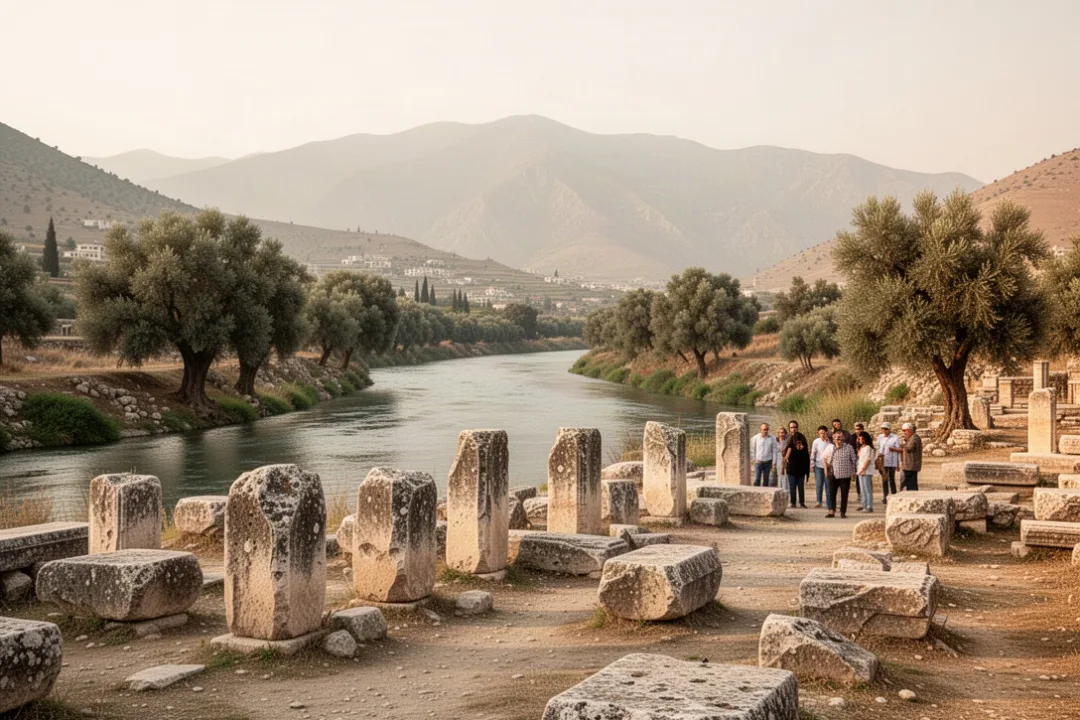
Ancient Antioch stood beside the Orontes River, close to the eastern Mediterranean coast and near routes connecting inland Syria with Cilicia, Mesopotamia, and the port of Seleucia Pieria. Its position gave it access to fertile agricultural land, mountain passes, river transport, and maritime trade.
Modern Antakya lies in Hatay Province in southern Turkey, close to the border with Syria. The ancient city was not confined to the exact footprint of the present-day urban center. It spread across parts of the valley and nearby slopes, while important suburbs and neighboring settlements developed along the river and toward the coast.
Antioch’s geography helped shape its character. The city was close enough to the Mediterranean to participate in international commerce, but far enough inland to function as a regional administrative and cultural capital. Goods, soldiers, officials, travelers, and religious teachers passed through the area for centuries.
The surrounding region also influenced the city’s identity. Antioch occupied a crossroads between the Greek-speaking eastern Mediterranean, the Semitic-speaking Levant, and the Anatolian interior. Greek culture, Syrian traditions, Roman institutions, Jewish communities, and later Christian practices all contributed to its changing social life.
Names can cause confusion: Antioch on the Orontes is generally the city meant in discussions of Paul, Barnabas, and the first Christians. Antioch of Pisidia was a separate city farther west in central Anatolia and also appears in the New Testament.
How Antioch developed from a Hellenistic foundation into a Roman capital
Antioch was founded around 300 BCE by Seleucus I Nicator, one of the rulers who inherited part of Alexander the Great’s empire. Seleucus named the city after his father, Antiochus. The settlement formed part of the Seleucid kingdom, a large Hellenistic state that controlled much of the Near East after Alexander’s death.
The new city was planned according to Hellenistic urban principles. Greek settlers were brought to the area, and the city developed public spaces, monumental buildings, administrative facilities, and institutions associated with Greek civic life. It was not an isolated colony: Antioch grew in a region already inhabited by diverse local populations.
Under the Seleucids, Antioch became the main political center of Syria. The royal court, army, merchants, and officials gave the city a population and level of activity that smaller regional settlements could not match. Its location also allowed the rulers to oversee important roads and maintain contact with the Mediterranean coast.
Rome took control of Syria in the first century BCE, and Antioch became one of the empire’s leading eastern cities. It served as an important Roman provincial capital and a base for military operations, imperial administration, and diplomacy. Roman authority brought new building programs, roads, aqueducts, public baths, temples, theaters, and colonnaded streets.
Ancient writers describe Antioch as a large and lively city, though their accounts sometimes include exaggeration or criticism. Its population included people from different ethnic, religious, and social backgrounds. Wealthy families, soldiers, enslaved people, artisans, merchants, farmers, immigrants, and religious communities all formed part of the urban population.
The city was also known for public entertainment and civic spectacle. Chariot racing, theater, festivals, processions, and religious ceremonies helped shape public life. Antioch’s residents could be deeply attached to their city while also participating in the wider culture of the Roman Empire.
Earthquakes repeatedly damaged Antioch. The city’s location near active geological zones made destruction and rebuilding recurring parts of its history. Major earthquakes occurred during both the Roman and Byzantine periods, sometimes killing large numbers of people and requiring extensive imperial reconstruction.
One severe earthquake struck in the sixth century during the reign of Justinian. Antioch was subsequently affected by warfare and another devastating earthquake, and its population and political importance declined over time. These disasters did not erase the city immediately, but they weakened its ability to recover its earlier scale.
Why Antioch matters in the history of Christianity
Antioch holds a central place in the story of early Christianity. A Christian community formed there during the first generations after Jesus’ death, when followers of Jesus were spreading beyond Jerusalem into the larger Roman world. The city’s diverse population and strong connections to other regions made it an important base for missionary activity.
The New Testament’s Book of Acts describes believers from different backgrounds gathering in Antioch. Acts 11:26 says that the disciples were first called Christians there. The statement identifies Antioch as an early place where the movement became publicly recognizable as a distinct community, although Christians continued to understand themselves within the larger history of Israel and Judaism.
Antioch was associated with Barnabas and Paul. According to Acts, Barnabas worked with the local community and brought Paul to the city. The two taught there for an extended period before traveling on missionary work. Antioch therefore functioned not only as a congregation but also as a sending center for Christian expansion.
The city’s church faced questions that affected Christianity far beyond Antioch. One major issue concerned how non-Jewish followers of Jesus should enter the movement and whether they were required to observe all Jewish customs. Acts 15 and Paul’s Letter to the Galatians reflect disputes connected with this wider debate.
These texts should be read carefully. They preserve different perspectives and theological arguments rather than providing a neutral modern report. Together, however, they show that Antioch was a place where Jewish and non-Jewish believers worshiped, disagreed, negotiated, and helped shape Christian identity.
Antioch later became one of the great centers of Christian theology. Teachers and bishops associated with the city contributed to debates about scripture, worship, church organization, and the nature of Christ. The city’s Christian importance continued through late antiquity, even as political power shifted and rival centers grew.
The Church of Saint Peter and the cave tradition
A rock-cut sanctuary commonly known as the Church of Saint Peter is one of Antakya’s best-known religious landmarks. Christian tradition connects the cave with the apostle Peter and with the earliest Christian community in Antioch. The site is especially meaningful to pilgrims because it preserves a physical setting linked, in tradition, with the city’s apostolic past.
The tradition should be distinguished from what can be established with certainty. The cave’s exact role in the first-century community is difficult to prove, and the visible structure reflects many later changes. Even so, the site demonstrates how Antioch’s Christian memory has been preserved through worship, pilgrimage, and local tradition across many centuries.
Antioch also became associated with influential Christian writers, including John Chrysostom, who was born and educated in the city before becoming a major preacher and bishop elsewhere. The Antiochene Christian tradition developed its own approaches to biblical interpretation and theological education, contributing to the intellectual history of the eastern Roman Empire.
Antioch remained significant under the Byzantine Empire, the eastern continuation of Roman rule. Its churches, monasteries, schools, and bishops connected it to the religious and political life of Constantinople. The city also served as a frontier center, positioned near territories contested by Byzantine and Persian powers.
Control of Antioch changed repeatedly. Persian armies captured the city at different points, and Arab Muslim forces took it in the seventh century. Under Muslim rule, Antioch became part of a broader Syrian political world, though its population and institutions changed over time.
The city experienced new periods of importance during the medieval conflicts between Muslim powers and the Byzantine and western European states. Crusader forces captured Antioch in 1098 during the First Crusade and established the Principality of Antioch. The principality lasted for nearly two centuries and became one of the major Crusader states.
Medieval Antioch was not simply a European settlement. Its population included local Christians, Muslims, Jews, Armenians, Greeks, Syriac-speaking communities, merchants, soldiers, and visitors from across the Mediterranean. Political control could change while the city retained layers of language, faith, and custom.
Muslim forces under the Mamluk Sultanate captured Antioch in 1268. The conquest marked a major turning point. Warfare, population loss, changing trade routes, and repeated natural disasters reduced the city’s former prominence. The urban center never again recovered the scale and influence it had possessed during its ancient and early Byzantine periods.
Antioch later became part of the Ottoman Empire. Its long-term history continued through villages, religious institutions, agricultural communities, and regional commerce, even though the ancient metropolis had declined. In the modern period, the city became known as Antakya and formed part of the Republic of Turkey.
Modern Antakya reflects this layered past. Its cultural identity has been shaped by Turkish, Arab, Armenian, Greek Orthodox, Syriac, and other communities, although the balance and visibility of these groups have changed through migration, political events, and demographic shifts. Food, religious buildings, language, and family traditions all preserve traces of the region’s complex history.
How the 2023 earthquake affected Antakya’s heritage
On February 6, 2023, powerful earthquakes struck southern Turkey and northern Syria, causing catastrophic loss of life and widespread destruction. Antakya was among the cities most severely affected. Homes, businesses, roads, religious buildings, museums, and historic structures were damaged or destroyed.
The disaster affected more than individual monuments. It disrupted neighborhoods, displaced residents, scattered communities, and damaged the living cultural practices that made Antakya distinctive. Historic heritage is not limited to stones and facades; it also includes places of worship, markets, family businesses, foods, crafts, and relationships between communities.
Some landmarks survived with damage, while other structures required stabilization, restoration, or complete reconstruction. Conditions can change as recovery proceeds, so visitors should verify current access, opening hours, transportation, and safety guidance before planning a trip. A site shown in an older guidebook may be closed, altered, or undergoing conservation.
Heritage recovery involves difficult decisions. Restorers must balance structural safety, historical authenticity, community needs, and future resilience. Rebuilding an old street or religious building is not only a technical task. It also raises questions about who will return, how local traditions will be supported, and how the city’s history will be represented.
For responsible visits: Treat damaged areas as active recovery zones, follow local instructions, avoid entering unstable structures, and support locally owned businesses and community-led cultural projects when access is permitted.
Visitors interested in Antioch’s history usually encounter several periods in a compact regional setting, though the archaeological remains are not as continuously visible as those of some better-preserved ancient cities. The experience depends on museums, religious landmarks, scattered ruins, the landscape, and the modern city’s cultural life.
Hatay Archaeology Museum: The museum has been known for its collections of mosaics, sculpture, coins, and other artifacts from Antioch and the surrounding region. Because the 2023 earthquake affected cultural institutions, check its current location, condition, and schedule before visiting.
Church of Saint Peter: This rock-cut sanctuary carries strong apostolic and pilgrimage traditions. Its significance comes from both the physical cave and the long memory of Antioch as an early Christian center.
Ancient city areas: Archaeological remains around Antakya and the wider Orontes valley can help identify the scale and setting of ancient Antioch. Many features are fragmentary, buried, damaged, or difficult to interpret without local guidance.
Old urban neighborhoods: Historic houses, courtyards, religious buildings, lanes, and commercial spaces once expressed Antakya’s multicultural character. Access and survival vary considerably after the earthquake.
The Orontes landscape: The river and surrounding valley explain why Antioch developed where it did. Looking at the geography helps connect the ancient city’s agriculture, transport, defense, and regional trade.
Food is another way to understand the region’s cultural history. Antakya’s cuisine reflects Levantine, Anatolian, Arab, and Mediterranean influences, with dishes and techniques shaped by local agriculture and the city’s diverse communities. Restaurants and food businesses have faced major disruption, so availability may change as reconstruction continues.
A thoughtful visit should allow time for context rather than treating Antioch as a single monument. Useful preparation includes reading a basic map of ancient Syria, learning the difference between Antioch on the Orontes and Antioch of Pisidia, and checking current information from official or local sources.
Confirm the current conditions. Check museum openings, transportation, road access, and any restrictions related to reconstruction.
Plan for multiple periods. Include Hellenistic, Roman, Byzantine, Islamic, Crusader, Ottoman, and modern history rather than focusing on one era alone.
Use local expertise. A qualified local guide can explain sites that are scattered, damaged, or not clearly marked.
Respect religious spaces. Follow rules about clothing, photography, quiet, and access, especially at churches, mosques, shrines, and cemeteries.
Leave room for the living city. Antakya is not only an archaeological site; it is also a community rebuilding homes, institutions, businesses, and cultural life.
How Antioch differs from other cities with the same name
The ancient world contained several cities called Antioch because rulers of the Seleucid dynasty used the name widely. The most famous was Antioch on the Orontes, near modern Antakya. It was the large Syrian metropolis associated with early Christianity and the Roman province of Syria.
Antioch of Pisidia stood in a different part of Anatolia, near modern Yalvac in Turkey. It appears in Acts as a place visited by Paul and Barnabas. Although both cities had Hellenistic foundations and connections to Roman administration, they should not be combined into one location.
Other settlements also carried the name Antioch or a related form. When reading ancient history or the New Testament, look for an additional geographical label such as “on the Orontes” or “of Pisidia.” That small distinction prevents major errors about journeys, political settings, and archaeological sites.
Antioch on the Orontes remains especially important because several histories meet there: Hellenistic kingship, Roman urban life, Jewish diaspora communities, early Christian missions, Byzantine theology, medieval warfare, Ottoman society, and modern heritage recovery. Its story is not one uninterrupted rise and fall, but a long sequence of adaptation, destruction, rebuilding, and cultural change.
Frequently asked questions
Is Antioch the same place as modern Antakya?
Yes, modern Antakya occupies the area of ancient Antioch on the Orontes in southern Turkey. The ancient city covered a broader area than the present urban center, and archaeological remains are distributed across the surrounding valley. Antakya is also the modern name commonly used for the city and its local cultural traditions.
What does the Bible say about Antioch?
The Book of Acts presents Antioch as an important early Christian community. It describes believers from different backgrounds gathering there, Paul and Barnabas teaching in the city, and the disciples being called Christians there. The city also played a role in debates about the relationship between Jewish practice and non-Jewish followers of Jesus.
Can you still visit Antioch after the 2023 earthquake?
Some areas and landmarks may be accessible, but conditions vary because Antakya suffered extensive damage and remains involved in reconstruction and heritage recovery. Check current official information before traveling. Do not enter damaged buildings or restricted areas, and follow local instructions around archaeological, religious, and active construction sites.
Why are there several ancient cities called Antioch?
Seleucid rulers founded or renamed multiple settlements after members of their royal family, especially Antiochus. The best-known is Antioch on the Orontes near Antakya. Antioch of Pisidia, mentioned in Acts during Paul’s travels, was a separate city in central Anatolia. Geographic labels are essential for identifying which Antioch a source means.





Leave a Reply