Galatia: Where it was and why it matters in the Bible
Galatia: Where it was and why it matters in the Bible
Galatia was an ancient region in central Anatolia, the Asian part of modern Turkey. In the New Testament, the name refers to communities of Christians connected with Paul’s missionary work and to the churches addressed in the Letter to the Galatians.
The biblical term can be confusing because “Galatia” had both a regional meaning and a narrower ethnic-historical meaning. It could describe the territory around the Galatian tribes near modern Ankara, or a larger Roman province that included parts of southern and central Anatolia. That distinction affects how readers understand Paul’s journeys and the audience of his letter.
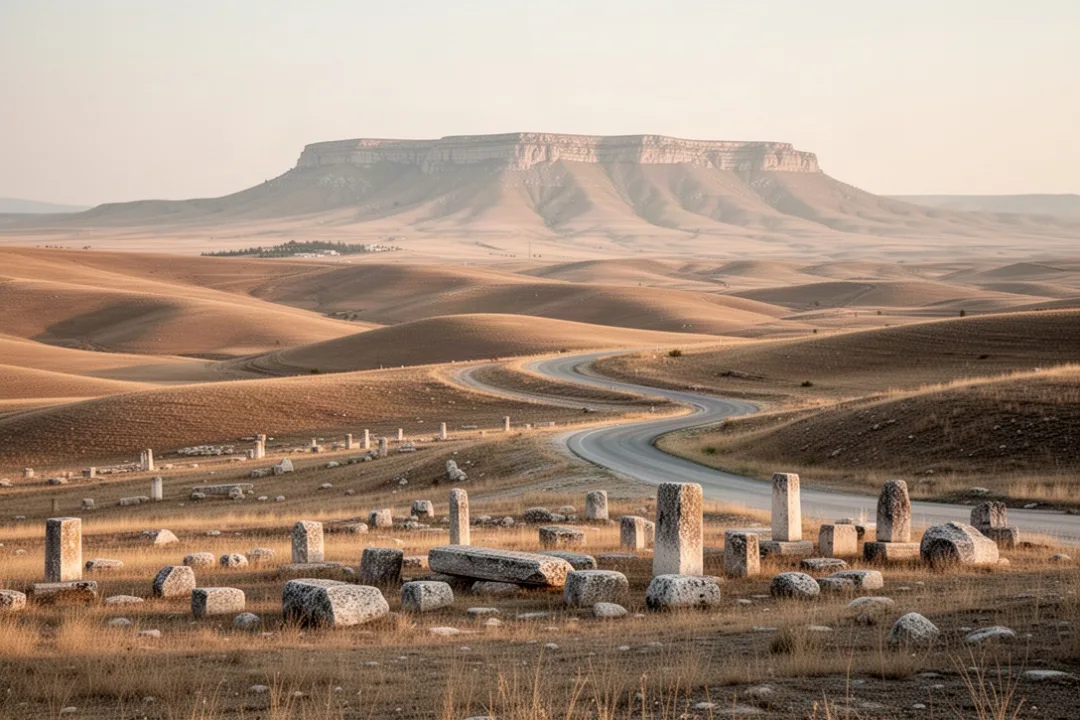
Galatia was not a single city. It was a territory in the central highlands of Anatolia, a broad plateau marked by dry plains, rolling hills, and important roads connecting western, southern, and eastern parts of Asia Minor. The region lay north of Lycaonia and Cappadocia and inland from the Mediterranean coast.
The name came from Gaulish-speaking Celtic groups who moved into Anatolia during the third century BC. Ancient writers connected these people with migrations from Europe into the eastern Mediterranean. After settling in central Anatolia, they became known as Galatians, a name related to the Greek word for Gauls.
These communities did not remain culturally isolated. Over time, the Galatians interacted with Greek-speaking populations, older Anatolian peoples, and the ruling powers that controlled the region. Their language, religion, political institutions, and local identities developed within a mixed environment rather than existing as a simple continuation of western European Celtic culture.
The three major Galatian tribal groups
Ancient sources commonly associate Galatia with three tribal groups: the Tectosages, the Trocmii, and the Tolistobogii. Their settlements were concentrated in central Anatolia, especially around the areas later associated with Ankara, Pessinus, and northern-central parts of the region.
The tribes had their own leaders and political structures, but Galatia also became connected to larger Hellenistic kingdoms and neighboring states. One major center was Ancyra, the ancient city that later became Ankara, the capital of modern Turkey. Pessinus was another important religious and commercial center.
Galatia’s location gave it strategic value. Armies and merchants could move across the Anatolian plateau through routes that linked the Aegean world with Syria, Mesopotamia, and the Black Sea region. Control of the area mattered to rulers because it provided access to roads, agricultural land, and military territory.
How Galatia became part of the Roman world
Galatia came under Roman influence after the struggles among the Hellenistic kingdoms that followed Alexander the Great’s conquests. The Romans gradually expanded their authority in Anatolia, using alliances, military intervention, and provincial administration to secure the region.
In the first century BC, Galatia was ruled by client kings connected to Rome. The most significant was Deiotarus, a Galatian ruler who supported Roman interests during the civil wars of the late Republic. After the client-king system ended, Rome turned Galatia into a province during the reign of Augustus.
The Roman province of Galatia was larger than the original tribal homeland. Its boundaries changed over time, and Roman administrators sometimes grouped distant areas together for political and military reasons. This broader provincial use of the name is central to the question of which Christians Paul meant when he wrote to “the churches of Galatia.”
Roman provincial administration did not erase local identities. People could identify themselves by city, tribe, ethnic background, language, religious tradition, or imperial province. A person living in the province of Galatia did not necessarily belong to one of the original Galatian tribes.
Key distinction: “Galatia” can mean the original Galatian heartland in central Anatolia or the larger Roman province. Biblical interpretations often differ because they assign different meanings to the same geographic name.
Where Galatia was in relation to modern Turkey
Ancient Galatia was located in the interior of modern Turkey, mainly around the central Anatolian plateau. Its core area included the region near present-day Ankara, although the Roman province extended beyond that central zone at various times.
The landscape was very different from the coastal cities of western Asia Minor. Central Anatolia had a more continental climate, with hot, dry summers and cold winters. Travel across the plateau could be difficult, especially outside the main roads or during severe weather.
Several places connected with Paul’s ministry were located in or near the southern part of the Roman province of Galatia. These included Antioch of Pisidia, Iconium, Lystra, and Derbe. Their location has led many readers to connect Paul’s work in Acts with the churches addressed in the Letter to the Galatians.
The exact boundaries of ancient provinces should not be placed too neatly on a modern map. Roman territories changed, and ancient authors sometimes used regional names in different ways. A modern map can show approximate relationships, but it cannot always settle the historical meaning of a term by itself.
How the Book of Acts describes Paul’s work in Galatia
The Book of Acts describes Paul and his companions traveling through parts of southern and central Asia Minor. In the first missionary journey, they visited cities including Antioch of Pisidia, Iconium, Lystra, and Derbe. Acts later describes Paul revisiting communities in the same broad region.
These visits involved public preaching, disputes with local opponents, the formation of Christian communities, and the appointment of local leaders. The accounts also portray physical danger, resistance, and the need to encourage believers who were living within complicated religious and political settings.
Acts refers to travel through the region of Galatia and Phrygia, and it later uses language about the “Galatian country” or territory. These references show that Galatia was a recognized geographic area connected with Paul’s movements, but they do not provide every detail needed to identify the recipients of the letter with certainty.
The southern cities associated with Paul
Antioch of Pisidia was a Roman colony and an important settlement in the interior. In Acts, Paul speaks in the synagogue there and presents Jesus within the story of Israel’s Scriptures. The response includes both interest and opposition, a pattern that appears repeatedly in Acts.
Iconium was another major city on the route. Paul and Barnabas preached there, and the message attracted both Jewish and non-Jewish hearers. Acts describes a divided response, followed by threats that caused the missionaries to leave for nearby towns.
Lystra and Derbe were smaller centers in the southern Anatolian interior. The events associated with Lystra include the healing of a man unable to walk, confusion about the missionaries’ identity, and later hostility toward Paul. Derbe is presented as a place where many people became disciples before the missionaries retraced their route.
These stories help explain why the churches in Galatia may have faced pressure from multiple directions. They were not formed in a religious vacuum. They lived among Jewish communities, traditional local religions, civic customs, Roman authority, and diverse populations shaped by travel and trade.
Why scholars debate the audience of Galatians
The central geographic question is called the North Galatian or South Galatian theory. The North Galatian view identifies the readers with communities in the traditional Galatian heartland, farther north around the region of Ankara. The South Galatian view identifies them with churches in cities such as Antioch of Pisidia, Iconium, Lystra, and Derbe.
Both views attempt to explain the evidence from Paul’s letter and Acts. The debate is not about whether Galatia existed; it is about how Paul and Luke used the name and which group of churches received the letter.
The case for the South Galatian view
Supporters of the South Galatian view point out that Acts gives a clear account of Paul’s missionary activity in several southern cities that were part of the Roman province. These communities were established early in Paul’s ministry and appear to fit the letter’s description of churches that Paul personally founded or visited.
This view also emphasizes Roman administrative language. If Paul used “Galatia” as the name of a province, the southern churches could properly be called Galatian churches even though they were not located in the original tribal center.
Another argument concerns travel. The southern cities were positioned along routes that Paul is clearly described as using. The New Testament provides less direct evidence for a missionary visit to the northern tribal heartland, although that absence does not prove Paul never traveled there.
The case for the North Galatian view
Supporters of the North Galatian view understand “Galatia” primarily as the ethnic and geographic homeland of the Galatian people. They argue that Paul’s language may fit communities in the northern part of the region rather than cities in the southern province.
They also point to the way Acts describes Paul’s travels. Some readers believe the references to Galatia and Phrygia suggest a journey into northern territory, where Paul may have established churches that Acts does not describe in detail.
The letter itself does not name the individual towns receiving it. As a result, its internal evidence cannot identify the location with complete certainty. The debate remains open because both interpretations account for important details in the New Testament.
North Galatian theory: the audience lived in the traditional Galatian heartland in central Anatolia.
South Galatian theory: the audience lived in southern cities within the Roman province of Galatia.
Main issue: whether “Galatia” is being used primarily as an ethnic region or a Roman administrative province.
Practical reading point: the letter’s theological argument remains meaningful even if the exact map location cannot be settled.
What Paul addresses in the Letter to the Galatians
The Letter to the Galatians responds to a serious dispute about the basis of belonging to the people of God. Some teachers were insisting that non-Jewish believers needed to adopt particular parts of Jewish law, especially circumcision, in order to be fully accepted as members of the Christian community.
Paul argues that people are made right with God through faith in Christ, not by relying on works of the law as the basis of their status. He presents Abraham as an important example and uses the story of God’s promise to show that the gospel is not restricted to one ethnic group.
Paul’s argument is not a rejection of the Jewish Scriptures. He repeatedly reasons from them and treats them as authoritative within his explanation. His concern is that Gentile believers should not be required to become Jews in order to receive the full standing promised through Christ.
Why circumcision became a major issue
Circumcision was a visible sign of covenant identity within Judaism. For Gentile converts, requiring circumcision raised a larger question: would faith in Christ be sufficient, or would they need to enter the Jewish covenant community according to its traditional boundary markers?
Paul treats the demand for circumcision as a threat to the truth of the gospel he preached. His concern was not merely about one physical practice. He believed the demand changed the foundation of salvation by making ethnic and legal observance necessary for acceptance.
The argument also had social consequences. If some believers were considered incomplete until they adopted Jewish practices, Christian communities could become divided into higher and lower groups. Paul insists that shared faith in Christ creates a new kind of unity that cannot be based on ancestry or ritual status.
What freedom means in Galatians
Galatians presents Christian freedom as release from the need to earn acceptance through the law. This freedom is not permission to harm others or act selfishly. Paul connects freedom with loving service, self-control, and responsibility toward the community.
His well-known discussion of the “fruit of the Spirit” in Galatians 5:22–23 describes qualities such as love, joy, peace, patience, kindness, goodness, faithfulness, gentleness, and self-control. The passage presents spiritual maturity as a transformed way of living rather than a checklist used to prove superiority.
Paul also contrasts destructive patterns such as hostility, jealousy, rivalry, anger, and division with the life shaped by the Spirit. His message challenges both legalism and selfishness: believers are not accepted because they perform religious works, but their freedom should produce conduct that benefits others.
Reading tip: Galatians 5 should be read together with Galatians 1–4. Paul’s call to freedom rests on his understanding of the gospel, God’s promise, Christ’s work, and the equal standing of Jewish and Gentile believers.
How Galatians is organized and how to read it
The letter begins with a forceful defense of Paul’s apostleship and the message he received. He then recounts key events from his relationship with other early Christian leaders, including a confrontation with Peter over table fellowship between Jewish and Gentile believers.
The middle sections develop Paul’s theological case. He appeals to the Galatians’ own experience, the story of Abraham, the purpose of the law, and the new status of believers in Christ. Galatians 3 and 4 are especially important for understanding how Paul connects promise, faith, law, slavery, sonship, and inheritance.
The final section applies the argument to community life. Paul calls believers to stand firm in freedom, serve one another in love, restore those who fall into wrongdoing, carry one another’s burdens, and practice generosity. The letter therefore moves from a dispute about identity to a practical vision of a transformed community.
Read the opening chapters as a defense of the gospel. Paul explains why the message he preached does not depend on approval from human authorities.
Track the promise-and-law argument. Pay attention to how Abraham and the law function in Paul’s reasoning.
Separate freedom from self-indulgence. Galatians defines freedom through love, service, and life shaped by the Spirit.
Notice the communal emphasis. The letter addresses relationships, conflict, restoration, and the treatment of other believers.
Common mistakes when studying Galatia
Galatia is easy to misunderstand when readers assume that an ancient place-name always had one fixed boundary. Historical geography was often more flexible than a modern state map, and the same term could describe a people, a region, or a Roman province.
Another mistake is treating the Letter to the Galatians as an abstract argument about religious rules. Paul is responding to a real conflict involving identity, social belonging, leadership, and the status of Gentile believers. The theological claims make more sense when those community tensions remain visible.
Do not assume Galatia was a city. It was a region and, under Rome, a province with several important cities.
Do not equate every resident of the province with a Celtic Galatian. Provincial populations were diverse.
Do not treat Acts and Galatians as identical accounts. They are different writings with different purposes and emphases.
Do not claim the audience’s location is certain. The North and South Galatian theories both have serious arguments.
Do not reduce “works of the law” to ordinary good deeds. In Galatians, the phrase is connected to the dispute over covenant identity and Jewish boundary practices.
Do not read Christian freedom as independence from moral responsibility. Paul links freedom with love and service.
Why Galatia matters for understanding early Christianity
Galatia shows how quickly the early Christian movement crossed ethnic, geographic, and cultural boundaries. The churches associated with the region included people shaped by Jewish tradition, local Anatolian customs, Greek language and education, Roman administration, and the diverse movement of travelers through the empire.
The conflict addressed in Galatians reveals that expansion created difficult questions. How could Gentiles join a movement rooted in Israel’s Scriptures? What practices marked membership in the community? Who had authority to define the gospel? These were practical questions with consequences for meals, worship, marriage, leadership, and social relationships.
Paul’s answer centers on Christ and faith rather than ancestry or the adoption of Jewish ethnic identity. He presents the church as a community in which distinctions such as Jew and Greek no longer determine a person’s standing before God. That claim was theological, but it also challenged established social boundaries.
Galatians remains significant because it holds together two ideas that are sometimes separated. Acceptance does not depend on earning status, yet genuine freedom changes how people treat one another. Paul’s message opposes both religious pride and careless self-interest.
Galatia’s significance for visitors and students today
Modern travelers exploring central Turkey can encounter landscapes connected with ancient Galatia, although many ancient sites are associated more specifically with the southern cities of the Roman province. Archaeological remains, inscriptions, roads, theater structures, religious sites, and city plans help show how Roman Anatolia functioned.
Ancient locations should be approached with care because names and boundaries changed across centuries. A site may have had one identity under a Hellenistic ruler, another under Rome, and yet another in later Byzantine or Islamic periods. The survival of a modern name does not automatically prove that it marks the same ancient settlement.
For Bible study, a useful approach is to combine a historical map with the texts of Acts and Galatians. Mark the cities named in Acts, compare the routes, and then ask whether the letter’s language sounds more like a provincial address or a reference to an ethnic homeland. This method makes the uncertainty productive rather than frustrating.
The most important point is clear even where the map remains debated: Galatia was a real region of central Anatolia, and its churches stood at the intersection of Jewish Scripture, Gentile inclusion, Roman power, and local cultures. The Letter to the Galatians speaks into that setting by defending a gospel in which faith in Christ, not ethnic status or ritual identity, determines belonging.
Frequently asked questions
Is Galatia a country, city, or region?
Galatia was an ancient region in central Anatolia, not a modern country or a single city. Under Roman rule, Galatia also became the name of a province with changing boundaries. Important centers included Ancyra, later known as Ankara, and several southern cities connected with Paul’s ministry.
Where is Galatia located today?
Galatia was mainly in the interior of modern Turkey, around the central Anatolian plateau. Its traditional heartland was near Ankara, while the Roman province extended farther south and included places such as Antioch of Pisidia, Iconium, Lystra, and Derbe.
Did Paul visit Galatia?
Acts describes Paul traveling through areas identified with Galatia and visiting several cities in the southern part of the Roman province. Scholars disagree about whether the churches in Paul’s letter were there or in the northern Galatian heartland. The New Testament does not resolve the geographical question completely.
What is the main message of Galatians?
Galatians argues that people belong to God through faith in Christ rather than through adopting ethnic or ritual requirements associated with Jewish law. Paul also teaches that Christian freedom should express itself through love, service, spiritual maturity, and care for the wider community.









Leave a Reply