Goliath in the Bible: Who He Was and Why He Matters
Goliath in the Bible: Who He Was and Why He Matters
Goliath was a Philistine champion from Gath whom David defeated with a sling and one stone. His story appears in 1 Samuel 17, where an apparently powerless shepherd faces a heavily armed warrior and refuses to measure the battle by human strength alone.
The account has remained one of the Bible’s best-known narratives because it combines a dramatic personal conflict with a larger struggle between Israel and the Philistines. Goliath is not merely a large man opposing a young shepherd. He represents military power, intimidation, pride, and confidence in visible strength. David’s response centers on trust in God rather than on armor, size, or battlefield experience.
Goliath’s main story is found in 1 Samuel 17. The setting is a confrontation between the Israelites and the Philistines in the hill country. The two armies face one another across a valley, and Goliath repeatedly challenges Israel to send out a representative for single combat.
He is identified as a Philistine from Gath, one of the important Philistine cities. Gath is also associated with other formidable warriors, including descendants of the Rephaim or unusually powerful fighters mentioned later in Israel’s history.
Goliath is mentioned again in the accounts of David’s later military campaigns. 2 Samuel 21:19 describes Elhanan killing a man identified in the Hebrew text as Goliath the Gittite. 1 Chronicles 20:5 gives a related account and describes Elhanan as killing Lahmi, the brother of Goliath. These passages create a textual and interpretive question that readers should not ignore.
The simplest reading of the main narrative is that David killed the famous Goliath in 1 Samuel 17. The later passages may refer to another warrior connected with Goliath, or they may preserve a textual difference that was clarified differently in Chronicles. Either way, the story of David and Goliath remains distinct from the later battle notices.
Central fact: Goliath’s defeat is presented not as a contest between equal soldiers, but as a confrontation in which David’s trust in the God of Israel overturns an overwhelming human advantage.
What happens in the story of David and Goliath
The narrative develops through a series of clear movements. Each one adds to the contrast between Goliath’s appearance and David’s confidence.
The Philistine army challenges Israel. The two forces stand on opposite sides of a valley, but neither side immediately gains the advantage.
Goliath comes forward to issue a challenge. He proposes representative combat: one Israelite should fight him, with the outcome determining the result for both armies.
Israel’s soldiers become frightened. Saul and the army see Goliath’s size, armor, and experience, and they respond with fear rather than confidence.
David arrives at the camp. He has been sent by his father Jesse to bring provisions and check on his older brothers, who are serving with the army.
David hears Goliath’s defiance. He is disturbed that the Philistine is insulting Israel’s army and, by implication, the God of Israel.
David offers to fight. King Saul doubts him because David is young and has no record as a professional warrior.
David rejects Saul’s armor. He tries the king’s equipment but does not use it because he is not accustomed to fighting in it.
David chooses familiar tools. He takes his staff, selects five smooth stones from a stream, and approaches with his sling.
David strikes Goliath. A stone hits the Philistine in the forehead, and Goliath falls face down.
David completes the victory. He uses Goliath’s own sword to kill him, after which the Philistine army retreats and Israel pursues it.
This sequence matters because the victory does not depend on a hidden military advantage. David does not reveal superior armor or a secret combat technique. He relies on a weapon he already knows and on the conviction that Goliath’s challenge is ultimately a challenge against God.
Who Goliath was and what the Bible says about him
Goliath is called a champion, meaning that he represents the Philistine side in single combat. The Hebrew wording can also carry the sense of a man who stands between armies, which fits his role as a professional fighter sent to determine the outcome without a full battle.
His identity as a man of Gath connects him to a city known for powerful enemies of Israel. Gath was one of the major Philistine centers, and the city later appears in stories involving David. David himself eventually lives among the Philistines under the protection of Gath’s king, Achish, although that later period is separate from the confrontation in 1 Samuel 17.
Goliath’s public behavior is as significant as his physical description. He does not quietly wait for battle. He comes forward day after day, presents himself as unbeatable, and taunts Israel’s soldiers. His words are designed to create paralysis before weapons are even used.
The narrative emphasizes that the Israelites judge the situation by what they can see. Goliath is armed, trained, and experienced. David sees the same facts, but he interprets them differently: the Philistine is not simply challenging an army; he is defying the living God.
How large was Goliath according to the biblical text?
The Hebrew Masoretic Text gives Goliath’s height as six cubits and a span in 1 Samuel 17. A cubit was an ancient unit based broadly on the length from the elbow to the fingertips, while a span measured roughly the width of an extended hand. Because ancient measurements varied, the exact modern equivalent cannot be stated with complete certainty.
Using a common estimate, six cubits and a span would place Goliath at roughly nine feet or somewhat taller. The figure is striking, and the biblical narrative clearly intends readers to recognize him as an extraordinarily imposing warrior.
Several ancient textual traditions give a different measurement. The Greek Septuagint and some ancient Hebrew evidence preserve four cubits and a span, which would place him closer to six and a half or seven feet, depending on the cubit used. That height would still make him exceptionally large in the ancient world.
These differences should be handled carefully. They do not erase the story’s central point, and they do not allow a modern reader to determine Goliath’s exact height with precision. The text consistently portrays him as a formidable, intimidating fighter whose size contributes to Israel’s fear.
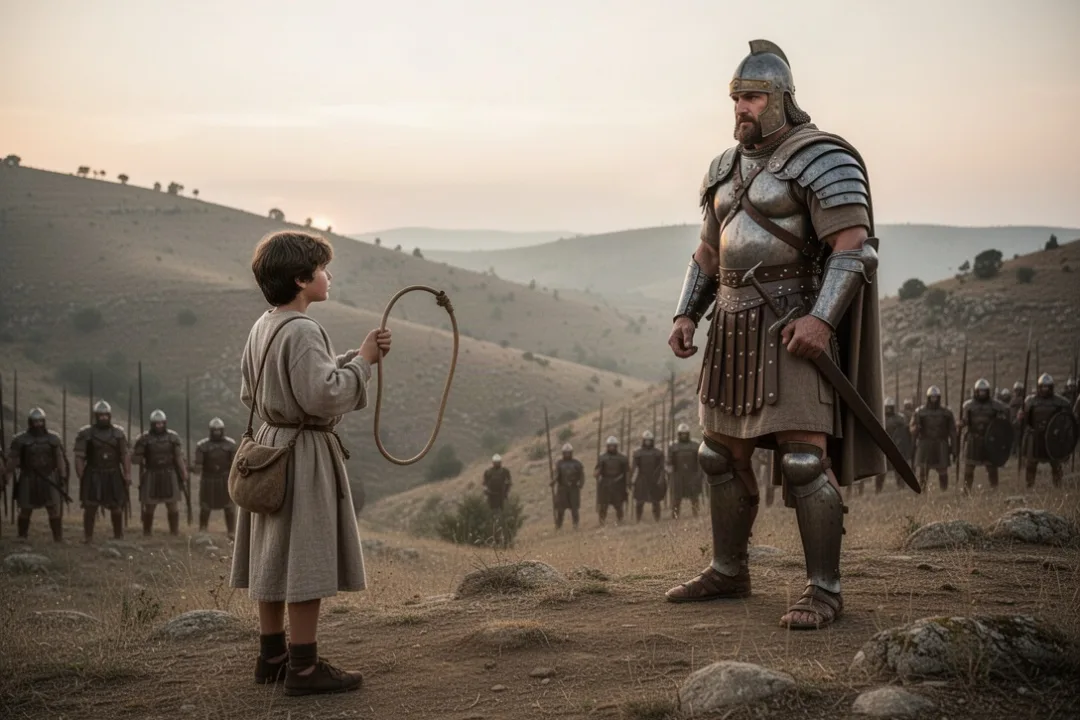
1 Samuel 17 gives unusual attention to Goliath’s equipment. He wears a bronze helmet, a coat of mail, bronze leg coverings, and a bronze javelin. His primary weapon is described as a large spear, and the account also mentions a sword and a shield-bearer who walks ahead of him.
The armor communicates more than historical detail. It presents Goliath as the complete professional soldier: protected, prepared, and supported by the military technology of his culture. His shield-bearer adds another layer of intimidation because even his equipment is accompanied by a servant or assistant.
The text also gives the weight of parts of his armor. The exact modern conversion is uncertain, but the details emphasize that Goliath’s equipment is substantial. He is not an ordinary infantryman. He has been equipped to dominate single combat and to make his opponent feel defeated before the fight begins.
David’s lack of armor creates the opposite impression. He carries a staff, a sling, and stones selected from a stream. The contrast is deliberate:
Goliath trusts visible military strength; David trusts God’s power and uses a familiar tool.
Goliath approaches as a trained champion; David approaches as a shepherd who has defended his flock.
Goliath is surrounded by symbols of war; David is marked by simplicity and mobility.
Goliath expects fear to decide the conflict; David believes the result will reveal that Israel’s God is not powerless.
The sling should not be confused with a child’s toy. In the ancient world, a trained slinger could use a sling as a serious weapon. Its effectiveness came from speed, accuracy, and the ability to strike an exposed area from a distance. David’s confidence is therefore not based on magic. He uses a real weapon, but he understands the weapon as an instrument rather than the source of victory.
Why David refuses Saul’s armor
King Saul gives David his own armor, but David removes it because he has not tested or practiced with it. This small moment carries several meanings. First, David does not pretend to be a soldier he is not. Second, the king’s equipment cannot compensate for a lack of familiarity. Third, the story keeps the focus on God rather than on royal resources.
Saul’s armor is also symbolically important because Saul himself is described earlier as standing taller than many of the Israelites. He appears suited to kingship and warfare, yet he does not step forward to meet Goliath. David, who seems less qualified by appearance, acts with greater confidence.
David’s choice does not mean that armor, training, or military preparation are always wrong. The Bible contains many accounts in which Israel uses organized armies and ordinary weapons. The point here is that the symbols people expect to produce victory cannot replace courage, obedience, and trust in God.
Why David chooses five stones
David selects five smooth stones, although only one is needed to bring Goliath down. The text does not explicitly explain why he chooses five. Readers have proposed practical explanations, such as preparation for continued fighting, but the narrative does not require a symbolic interpretation.
Some interpreters connect the five stones with the other powerful warriors associated with Goliath in 2 Samuel 21 and 1 Chronicles 20. That connection is possible as a devotional observation, but the Bible does not directly say that David chose five stones because five specific enemies would later appear. A careful reading distinguishes what the text states from what later interpretation suggests.
The important detail is that David comes prepared. Faith does not make him careless. He selects suitable stones, carries a weapon he knows, and moves toward the enemy. His confidence and practical readiness work together rather than standing in opposition.
What David says before fighting Goliath
David’s speech before the battle explains his understanding of the event. He rejects the idea that the contest will be determined by sword and spear alone. He declares that the Lord can save without relying on conventional military power and that the result will show the Philistines and Israel that the God of Israel is present.
David’s words are not a claim that he has no danger. Goliath is still armed, stronger, and more experienced. Instead, David places the danger inside a larger framework: the opponent’s size does not make him sovereign, and Israel’s weakness does not mean God has been defeated.
David also identifies the spiritual offense in Goliath’s challenge. The Philistine has not merely mocked individual soldiers. He has treated Israel’s God as though the Lord were one powerless deity among many. David’s response is therefore an act of loyalty and public witness as well as an act of courage.
David’s confidence rests on the belief that the Lord saves by means greater than human weapons.
Why Goliath is defeated with a sling
The sling turns the expected battle pattern upside down. Goliath anticipates a close-range fight in which his armor, sword, and strength will dominate. David refuses that arrangement. He remains at a distance, uses speed and accuracy, and targets an unprotected part of the warrior’s body.
The stone strikes Goliath’s forehead, and he falls face down. The detail of falling forward can be read as a physical result of the blow, but it also fits the narrative’s larger reversal. The man who demands submission from Israel is himself brought down before the representative of Israel’s God.
David then takes Goliath’s sword and uses it to kill him. This ensures that the victory is complete and public. The Philistines can no longer claim that Goliath merely stumbled or suffered a temporary injury. Their champion has been decisively defeated, and his own weapon becomes part of the sign of his downfall.
After Goliath falls, the Philistine army loses its confidence and flees. Israel’s soldiers pursue them. The result shows how one champion’s defeat can transform an entire army’s emotional state: the fear that had held Israel in place moves to the Philistine side.
How Goliath represents fear and intimidation
Goliath’s most effective weapon before the stone is his ability to shape what the Israelites believe about the battle. He defines himself as unbeatable, defines Israel as weak, and demands that the soldiers accept his version of reality. His taunts are repeated over many days, allowing fear to grow through repetition.
This pattern explains why the narrative spends time describing the soldiers’ reactions. The Israelites are not unaware of God’s existence, but they allow visible circumstances to become larger than their faith. David interrupts that pattern by asking who this uncircumcised Philistine is to defy the armies of the living God.
Goliath therefore functions as more than a villain in a single event. He is a picture of opposition that tries to control people through fear. The story does not suggest that every difficult enemy will fall in an identical way. It does show that intimidation does not have the final authority, even when the threat appears overwhelming.
What Goliath teaches about faith and courage
The story’s faith is active rather than passive. David remembers earlier experiences protecting his father’s sheep from a lion and a bear. He interprets those rescues as evidence of God’s faithfulness, then applies that memory to the new crisis.
David does not claim that his past automatically guarantees an easy future. Instead, he sees continuity between God’s help in hidden work and God’s help in a public challenge. The shepherd’s field has prepared him to act with courage on a national stage.
Several practical lessons emerge from David’s response:
Remember what God has already helped you endure. Past faithfulness can strengthen present courage without removing the seriousness of the current threat.
Use the abilities and tools you actually know. David does not imitate Saul or rely on equipment he cannot handle.
Do not let an opponent define the entire situation. Goliath emphasizes his size; David emphasizes God’s character and authority.
Separate confidence from arrogance. David is bold, but he does not boast that his own strength is the source of victory.
Act when action is required. David’s faith leads him toward Goliath rather than allowing him to remain safely behind the army.
These principles should not be used to blame people who are afraid or facing circumstances beyond their control. The biblical story is not a promise that every physical danger can be overcome through personal bravery. Its emphasis is that faithful action can be possible even when fear is real and resources appear inadequate.
How Goliath connects to David’s rise as king
The victory over Goliath is a major step in David’s public emergence. Before this event, David is primarily known within his family and as a musician serving Saul. Afterward, the people recognize him as a courageous military figure, and his relationship with Saul becomes increasingly complicated.
The story also contrasts David with Saul. Saul is the established king, but he is unable or unwilling to face the champion. David is not yet king, yet he acts with the kind of trust and decisive leadership expected from Israel’s anointed ruler.
This does not mean David becomes morally perfect after defeating Goliath. Later chapters show serious failures, conflicts, and sins in his life. The episode establishes his faith and courage at a particular moment; it does not present him as a flawless hero.
The narrative also warns against evaluating leadership by appearance alone. Saul looks kingly, and Goliath looks invincible. David appears young and inexperienced. Yet the person who seems least suited to the task becomes the one through whom deliverance comes.
How the later references to Goliath should be understood
The later references require some care because the wording differs between 2 Samuel 21:19 and 1 Chronicles 20:5. In 2 Samuel, the Hebrew text associates Elhanan with the killing of Goliath the Gittite. In Chronicles, Elhanan kills Lahmi, the brother of Goliath.
One common explanation is that Chronicles preserves or reflects a reading that distinguishes Lahmi from the famous Goliath. Another possibility is that the underlying textual tradition developed differently in the two passages. Translational and copying issues may also be involved, especially because the wording about “brother” can be understood in more than one way in the broader textual history.
Readers do not need to force these verses into a simplistic answer. The main narrative clearly identifies David as the one who defeated the Goliath who challenged Israel. The later notices concern other battles and related warriors, and the differences are best discussed with attention to the Hebrew text, ancient translations, and the literary context of each passage.
Reading tip: Do not treat the height measurements or later textual differences as the central message. They are genuine questions for study, but the narrative’s main emphasis is God’s deliverance through an unlikely servant.
What Goliath means in Christian interpretation
Christian readers have often understood Goliath as a picture of evil, oppression, temptation, or any force that appears stronger than God’s people. That application can be meaningful when it remains connected to the biblical story rather than turning Goliath into a generic slogan for every problem.
Some Christian interpretations also view David as a representative figure whose victory benefits the entire community. Israel does not defeat Goliath through the strength of every soldier. One person stands in the conflict, wins, and gives the frightened army a reason to advance. This representative pattern has influenced later theological reflection about David’s role in the biblical story.
At the same time, David should not be reduced to a simple allegory. He is a real character within Israel’s history as presented by the biblical narrative, and the episode has concrete details: a valley, two armies, a challenge, a sling, a stone, and a defeated champion. The spiritual meaning grows from those details rather than replacing them.
How to read the story responsibly today
Goliath’s story is often used to encourage people facing impossible odds, but responsible application requires balance. The account does not teach that every underdog will win, that every large enemy is secretly weak, or that careful planning is unnecessary. It teaches that visible power is not the highest measure of reality and that faith can produce courageous action.
It also should not be used to glorify violence or encourage people to confront danger recklessly. David’s situation is a specific military conflict within the Bible’s account of Israel. Applying its message today should focus on trust, integrity, courage, and resistance to intimidation, not on treating personal opponents as enemies to destroy.
A thoughtful reading can ask several questions:
What fear is controlling the people involved in the situation?
Which facts are being emphasized, and which are being ignored?
What abilities or resources has God already provided?
Is the proposed action faithful and responsible, or merely impulsive?
Does confidence come from pride, or from trust in God’s character?
Goliath remains memorable because the story makes the contrast unmistakable. A heavily armed champion expects the world to submit to what it can see. A young shepherd sees the same champion but refuses to believe that size, armor, and reputation determine the final outcome.
Why the story of Goliath still matters
Goliath’s importance comes from the way the Bible joins spiritual confidence to concrete action. David prays through his understanding of God, remembers past deliverance, chooses a suitable weapon, approaches the threat, and acts with precision. The story does not separate faith from responsibility.
It also exposes the weakness of appearances. Goliath looks invulnerable, Saul looks like the obvious warrior, and David looks unprepared. Yet the outcome reveals that God’s purposes are not limited by the resources people consider impressive.
For readers studying the passage, the most useful focus is not simply the question of how tall Goliath was. His height helps explain the fear surrounding him, but the deeper issue is who receives trust when human power appears decisive. In the biblical narrative, Goliath falls because the champion of visible strength meets a servant who acts in confidence that the living God is greater.
Frequently asked questions
Was Goliath a real person in the Bible?
Goliath is presented as a real Philistine warrior from Gath in the biblical narrative, especially in 1 Samuel 17. The text describes his challenge, equipment, defeat, and connection to later battles. Questions about the historical details, including his height and the later references to a man named Goliath, are studied through the Hebrew text and ancient manuscript traditions.
How tall was Goliath in the Bible?
The Masoretic Text describes Goliath as six cubits and a span tall, often estimated at roughly nine feet or more. The Septuagint and some ancient Hebrew evidence give four cubits and a span, which would still make him exceptionally tall. Because ancient measurement systems varied, his precise height cannot be established with certainty.
Did David kill Goliath with one stone?
David struck Goliath in the forehead with a stone from his sling, causing him to fall. David then took Goliath’s sword and killed him, completing the victory. The phrase “one stone” describes the blow that brought Goliath down, while the narrative also includes the sword as part of the final act.
Who killed Goliath according to 2 Samuel and 1 Chronicles?
The main story in 1 Samuel identifies David as Goliath’s killer. A later passage in 2 Samuel associates Elhanan with killing Goliath the Gittite, while 1 Chronicles describes Elhanan as killing Lahmi, Goliath’s brother. These differences likely reflect textual or interpretive issues, and the passages may refer to related but distinct warriors.








Leave a Reply