Shepherds in the Bible: Their work, role, and meaning
Shepherds in the Bible: Their work, role, and meaning
Shepherds in the Bible were people who cared for sheep, protected them from danger, found pasture and water, and kept the flock together. They appear in some of Scripture’s most important scenes, including the stories of Abraham, Moses, David, the birth of Jesus, and Jesus’ teaching about the Good Shepherd.
The word also carries a wider meaning. Biblical writers use shepherding as a picture of leadership, protection, responsibility, and God’s care for his people. To understand these passages, it helps to know both what shepherds actually did and why their work became such a strong religious image.
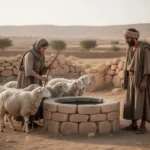
Shepherding was demanding outdoor work rather than a peaceful scene of animals grazing on a hillside. A shepherd had to move a flock between available sources of grass and water, often across dry or uneven land. The work required close attention because sheep could wander, become injured, or be threatened by wild animals and thieves.
Flocks might include sheep and goats, and the animals provided meat, milk, wool, skins, and offerings. A family’s flock could represent a major part of its wealth. Caring for the animals therefore involved both daily labor and serious economic responsibility.
A shepherd’s routine could include:
Leading the flock to suitable pasture and dependable water
Searching for animals that had strayed from the group
Guarding the flock during the day and, when necessary, at night
Helping injured, weak, or newborn animals
Separating animals when they needed different care
Moving the flock according to weather, season, and available vegetation
Shepherds often used a staff as a practical tool. It could help with balance, guide an animal, or pull a sheep away from danger. A rod could also serve as a defensive weapon. The familiar biblical pairing of “rod and staff” in Psalm 23 reflects the different ways a shepherd guarded and guided the flock, although the passage should be read as poetic imagery rather than as a technical description of equipment.
Shepherds did not always live far from settled communities. Some worked near a family’s village, while others traveled with the animals for longer periods. The exact routine varied by region and season. In a land where water and vegetation were unevenly distributed, a shepherd’s knowledge of the landscape could determine whether the flock remained healthy.
Useful context: Biblical shepherds were responsible for living animals that represented real household wealth. References to lost, injured, scattered, or endangered sheep therefore describe practical problems as well as spiritual ideas.
The work could also be socially difficult. Shepherds spent long periods outdoors, away from ordinary settled life. Some people may have viewed the occupation as low-status or rough, even though flocks were valuable and the work was essential. Scripture’s use of shepherds in important stories can therefore emphasize both their humble position and their considerable responsibility.
Why shepherds matter in major biblical stories
Shepherds appear repeatedly in the biblical narrative because the occupation was familiar to many ancient readers and because it provided a natural setting for stories about calling and leadership. Several major figures began as shepherds or lived closely connected to flocks.
Abraham, Isaac, and Jacob
The patriarchs are portrayed as owners of substantial flocks and herds. Their wealth, movements, family tensions, and agreements with neighboring groups often involved animals and grazing land. In Genesis, conflicts between the herdsmen of Abraham and Lot show how growing flocks could create pressure when nearby pasture could not support everyone.
Jacob’s years working for Laban also involve sheep, goats, breeding, and questions of fair compensation. These episodes are not simple farming stories. They show how family relationships, wealth, labor, and deception could all be connected to the management of animals.
After leaving Egypt, Moses lived in Midian and worked as a shepherd for his father-in-law. According to Exodus 3, he was caring for the flock when he encountered God at the burning bush. The setting matters because Moses’ years in the wilderness prepared him to understand the terrain through which he would later lead Israel.
His shepherding background also fits the Bible’s recurring pattern: a person with an apparently ordinary or hidden role receives a larger responsibility. Moses would become the leader of a people, but the narrative first presents him as someone who knows how to guide a vulnerable group through difficult country.
David’s early life
David was keeping his father’s sheep when the prophet Samuel came to Bethlehem to identify Israel’s future king, as described in 1 Samuel 16. David was the youngest son and was not initially included when his brothers were presented. His work in the fields placed him outside the center of attention, yet the story portrays him as courageous and capable.
When David later explains his readiness to face Goliath, he refers to protecting his father’s flock from a lion and a bear, according to 1 Samuel 17. The account connects shepherding with bravery, alertness, and personal responsibility. These qualities help explain why the Bible later uses shepherd language for kingship.
The shepherds at Jesus’ birth
Luke 2 describes shepherds staying in the fields near Bethlehem at night when angels announced Jesus’ birth. The shepherds went to see the child and then shared what they had heard. Luke does not present them as influential officials or wealthy patrons. They are working people who receive the announcement and become early witnesses to the event.
The scene highlights several themes. The message comes to people engaged in ordinary labor, the news is connected with peace and salvation, and the shepherds respond by going, seeing, and telling others. Their presence also connects Jesus’ birth with Israel’s long history of shepherds, flocks, kings, and promises of divine care.
Abraham’s household: Flocks reveal wealth, movement, and disputes over land.
Moses: Shepherding forms part of his preparation for leading Israel.
David: The shepherd becomes a model for courageous kingship.
Bethlehem’s shepherds: Working people become witnesses to Jesus’ birth.
How shepherds symbolize leaders and communities
Ancient political language often compared rulers to shepherds because a leader was expected to protect, guide, and provide for a people. Biblical writers use this comparison in both positive and negative ways. A faithful leader acts for the good of the community; a corrupt leader uses the flock for personal advantage.
In the Hebrew Bible, Israel’s kings and other officials are sometimes condemned as bad shepherds. Ezekiel 34 criticizes leaders who feed themselves instead of caring for the flock. The chapter describes scattered, weak, injured, and lost sheep to show how failed leadership harms ordinary people. God then promises to seek the sheep and care for them himself.
Jeremiah 23 also condemns rulers who scatter the people and presents God’s intention to raise responsible shepherds. The image is powerful because it turns abstract political failure into something visible: animals left without food, protection, direction, or medical care.
Good shepherd imagery communicates several duties:
Presence: A leader stays attentive to the condition of the people.
Protection: A leader responds to threats rather than abandoning the vulnerable.
Provision: A leader works to ensure that basic needs are not ignored.
Justice: A leader does not exploit the community for personal benefit.
Restoration: A leader seeks those who are lost, injured, or pushed aside.
This symbolism also applies to the community as a whole. The flock is not merely a collection of individuals; it is a group that needs wise direction and mutual care. At the same time, biblical passages do not reduce people to animals. The metaphor emphasizes dependence and responsibility while affirming that human beings make moral choices.
Some passages reverse the image. Psalm 100 describes God’s people as the sheep of his pasture, stressing that they belong to God and depend on his care. Psalm 23 presents God as the shepherd who provides rest, guidance, protection, and companionship in danger. The psalm’s language is personal, but it also reflects the wider biblical belief that God is responsible for the well-being of the people.
Read the metaphor carefully: When a biblical leader is called a shepherd, the title is a moral responsibility, not simply an honor. The leader is judged by how well the vulnerable are fed, protected, guided, and restored.
What Jesus means by the Good Shepherd
In John 10, Jesus uses shepherd imagery to describe his relationship with his followers. He contrasts the true shepherd with thieves, strangers, and hired workers who do not accept the same responsibility for the sheep. The central point is not that every detail of the illustration corresponds to a separate doctrine. It is that Jesus presents himself as a leader who knows, protects, guides, and gives himself for his people.
Jesus says that the sheep recognize the shepherd’s voice, a picture of relationship and trust. The shepherd knows the sheep, and the sheep respond to him. This language presents faith as more than agreement with information; it involves recognizing and following a person who can be trusted.
The passage also emphasizes sacrifice. Jesus describes the good shepherd as one who lays down his life for the sheep, in contrast with a hired worker who runs away when danger comes. Christians understand this as a reference to Jesus’ death and the self-giving character of his mission.
John 10 includes other important ideas:
Jesus knows his followers: The relationship is personal rather than anonymous.
Jesus gathers people: The flock includes people who must be brought together under one shepherd.
Jesus protects life: His purpose is connected with abundant, lasting life.
Jesus accepts costly responsibility: His care is demonstrated through self-sacrifice.
The shepherd image is connected with other New Testament descriptions of Jesus. Hebrews 13 refers to him as the great Shepherd of the sheep. First Peter 5 calls him the Chief Shepherd while teaching church leaders to care for the people entrusted to them. Revelation uses lamb and shepherd imagery in a striking way, presenting the Lamb as the one who leads people to life-giving water.
These passages create a rich but coherent picture. Jesus is both the sacrificial Lamb and the shepherd who leads. He is not portrayed as a distant ruler who gives instructions from safety. His authority is linked with knowledge, presence, service, and willingness to suffer for those he leads.
How the Bible uses lost sheep and sheepfold imagery
Sheep are repeatedly described as vulnerable to wandering. That does not mean the Bible teaches that every individual is foolish in exactly the same way. The image expresses how easily people can become separated from safety, community, truth, or faithful direction.
In Luke 15, Jesus tells a parable about a shepherd who leaves the ninety-nine sheep in the open country to search for one that is lost. The story appears alongside parables about a lost coin and a lost son. Its emphasis is the value of the individual who has been found and the joy that follows restoration.
Matthew 18 uses similar imagery when discussing a wandering member of the community. The passage calls attention to the importance of not treating a vulnerable person as disposable. Different Christian traditions interpret details of these passages in different ways, but the central concern remains clear: people who are lost matter, and their restoration should be pursued.
The sheepfold provides another important image. A fold is a protected place where animals can be kept together, especially at night. In John 10, the fold helps communicate security, belonging, and the distinction between trustworthy care and predatory behavior.
Still, the image should not be used to justify controlling behavior. Biblical shepherding is not a license for leaders to demand unquestioning obedience or to shield themselves from accountability. The same Scriptures that speak of following a shepherd also condemn leaders who exploit the flock. A Christian leader who uses fear, manipulation, secrecy, or financial pressure is acting against the moral direction of the metaphor.
How to read shepherd passages accurately today
When you encounter shepherd imagery in the Bible, begin with the immediate passage rather than assuming every reference means the same thing. A shepherd may represent God, a king, a community leader, Jesus, or an ordinary worker. The surrounding verses reveal whether the image focuses on provision, authority, danger, judgment, sacrifice, or restoration.
These questions can help:
Who is the shepherd? Identify whether the text names God, a human leader, Jesus, or a character in a story.
What does the shepherd do? Look for actions such as feeding, searching, guarding, scattering, exploiting, or laying down a life.
What condition are the sheep in? They may be safe, lost, hungry, injured, scattered, or under threat.
What problem does the image address? The passage may be responding to fear, failed leadership, sin, grief, persecution, or social division.
How does the image fit the whole book? A metaphor in a psalm may work differently from one in a prophetic warning or Gospel parable.
It also helps to distinguish between the occupation and the symbol. Real shepherds did not spend every hour carrying lambs or standing in picturesque fields. They performed repetitive, dirty, risky work. That reality gives the biblical metaphor its force: care is shown through sustained attention, practical help, and courage under pressure.
For personal reflection, shepherd passages can raise concrete questions about trust and responsibility. Are you seeking wise guidance rather than following every persuasive voice? Do you notice people who are isolated or vulnerable? If you hold authority at home, at work, in a church, or in a community group, are people safer and stronger because of your leadership?
For church leaders, the New Testament’s shepherd language carries a direct warning. First Peter 5 instructs elders to care for God’s people willingly and eagerly, not by domineering over them or using leadership for dishonest gain. The exact wording differs across Bible translations, but the principle is consistent: spiritual authority must be expressed through service, integrity, and care.
Shepherds therefore remain more than a seasonal image connected with Christmas. They help explain biblical ideas about God’s character, human leadership, spiritual danger, community belonging, and sacrificial love. From the fields of Bethlehem to Jesus’ teaching in John 10, the image points to a form of care that is attentive, protective, and willing to seek the one who has become lost.
Frequently asked questions
Why were shepherds important in biblical times?
Shepherds cared for animals that supplied food, wool, milk, skins, wealth, and sacrificial offerings. Their work required knowledge of pasture, water, weather, animal health, and protection from predators or thieves. Because flocks were economically valuable, shepherds carried serious responsibility. The occupation also became familiar language for describing kings, religious leaders, and God’s care for Israel.
Why did God announce Jesus’ birth to shepherds?
Luke 2 presents shepherds as ordinary workers who were watching their flocks at night. Their inclusion emphasizes that Jesus’ birth was announced to humble people, not only to rulers or religious elites. They then became witnesses who shared what they had heard. The scene also connects Jesus with the Bible’s recurring shepherd themes of care, leadership, and God’s attention to the overlooked.
What is the difference between a good shepherd and a bad shepherd?
A good shepherd protects, feeds, guides, searches for the lost, and accepts responsibility for the flock. A bad shepherd neglects vulnerable people, exploits those in his care, or uses leadership for personal benefit. Ezekiel 34 and Jeremiah 23 strongly criticize failed leaders, while John 10 presents Jesus as the Good Shepherd whose care includes personal knowledge and self-sacrifice.
Does “shepherd” refer only to Jesus in the New Testament?
No. Jesus is the central and highest example of shepherd imagery, but the New Testament also uses shepherd language for church leaders and spiritual caregivers. First Peter 5 calls Jesus the Chief Shepherd while instructing elders to care for the community without domination or greed. Human leaders therefore serve under Jesus’ authority and are accountable for how they treat people.











Leave a Reply