Moses was the central leader through whom God, according to the Bible, brought the Israelites out of Egyptian slavery and formed them into a covenant people.
His story appears chiefly in the books of Exodus, Leviticus, Numbers, and Deuteronomy, with additional references throughout the Hebrew Bible and the New Testament. Moses is also a major prophet in Christianity and Islam, where he is known as Musa. His life combines rescue, revelation, law, political leadership, personal failure, and a final view of the land his people would inherit.
Moses is presented as the person who stood between the Israelites and the Egyptian ruler, confronted Pharaoh, and demanded freedom for an oppressed people. He did not act as an independent military conqueror. Instead, the biblical account describes him as a prophet and spokesman who carried out God’s commands, often with the assistance of his brother Aaron.
After the Israelites left Egypt, Moses led them through the wilderness and helped establish their religious and social life. At Mount Sinai, he received the covenant instructions that included the Ten Commandments and many other laws. These teachings addressed worship, justice, community responsibilities, property, festivals, sacrifice, and treatment of vulnerable people.
Moses also served as an intercessor. When the people complained, rebelled, or turned toward other forms of worship, he repeatedly appealed to God for mercy. His leadership was therefore not limited to giving orders; it included mediation, teaching, judgment, prayer, and crisis management.
How Moses’ early life begins in Egypt
According to Exodus, Moses was born into an Israelite family during a period when the Egyptian king had ordered that newborn Hebrew boys be killed. His mother placed him in a basket among the reeds of the Nile, where Pharaoh’s daughter found him. The child was raised in the royal household, while his own mother was able to nurse him for a time.
The story gives Moses a divided identity. He was born an Israelite but grew up connected to the Egyptian court. That background helps explain why he could move between two worlds, yet it also left him with a deep concern for his oppressed birth community. The name Moses is traditionally connected with being drawn out of the water, although the exact linguistic history of the name remains debated.
As a young man, Moses saw an Egyptian beating an Israelite. He killed the Egyptian and then fled when the act became known. Exodus presents this event as the turning point that forced him away from Egypt and toward a new life in the land of Midian.
Why Moses lived in Midian before returning to Egypt
In Midian, Moses helped defend the daughters of a priest named Reuel, also called Jethro in the biblical narrative. He married Zipporah, one of the priest’s daughters, and became a shepherd. This period lasted for many years and placed him far from royal power, military authority, and the immediate struggles of the Israelites.
The wilderness experience shaped the kind of leader Moses became. He learned the demands of shepherding, the geography of the desert, and the patience required to care for a vulnerable group. The man who later guided a nation had first spent years living as an outsider and tending animals in a difficult landscape.
While Moses was tending sheep near Mount Horeb, the Bible describes his encounter with God in the burning bush. The bush burned without being consumed, and Moses received a call to return to Egypt. God revealed a divine name and commissioned Moses to tell the Israelites that their God had heard their suffering.
Moses resisted the assignment. He questioned his authority, worried that the Israelites would not believe him, and said that he was not an effective speaker. God appointed Aaron to help him communicate. This exchange makes Moses an unusual biblical hero: his calling begins not with confidence, but with reluctance and repeated objections.
Important distinction: The biblical account presents Moses as God’s chosen messenger, not as a self-appointed revolutionary. His authority comes from the divine commission described in Exodus, while Aaron often serves as his public spokesman.
Moses and Aaron went before Pharaoh with a demand that he release the Israelites so they could worship their God. Pharaoh refused, and Exodus describes a series of ten plagues that struck Egypt. The narrative interprets these events as judgment on Pharaoh’s oppression and as a demonstration of the power of Israel’s God.
The final plague involved the death of Egypt’s firstborn. The Israelites were instructed to mark their houses with blood from a sacrificial animal so that the plague would pass over them. This event is associated with the origin of Passover, the Jewish festival that remembers Israel’s deliverance from slavery.
After Pharaoh finally allowed the Israelites to leave, he changed his mind and pursued them. The people reached a body of water identified in Hebrew as the Yam Suph, often translated as the Red Sea. Moses stretched out his hand, and the biblical account says the waters divided, allowing the Israelites to cross before returning over the Egyptian army.
The crossing is one of the best-known scenes in the story, but its central meaning is broader than a dramatic escape. The Exodus marks the transformation of the Israelites from an enslaved population into a people with a shared story, worship, law, and relationship with God. Moses functions as the leader who guides that transformation.
What happened at Mount Sinai
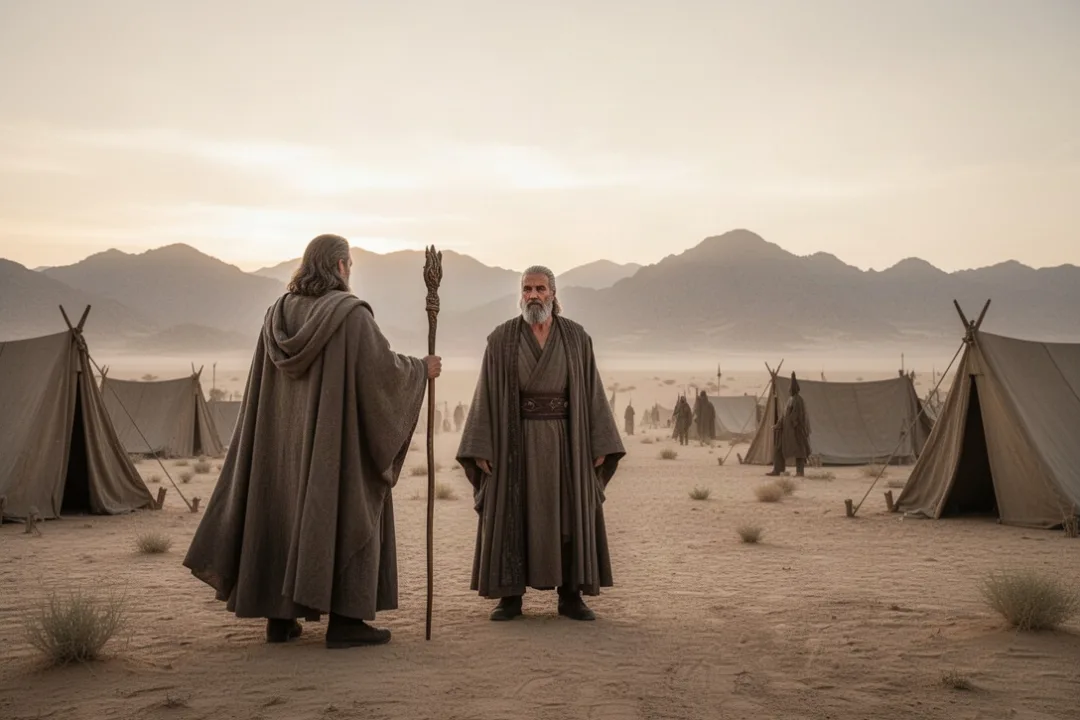
After the escape from Egypt, the Israelites traveled to Mount Sinai. There, Moses ascended the mountain and received the covenant instructions. The Ten Commandments are the most familiar part of this revelation, but the Sinai material includes a much larger body of teaching.
The covenant established mutual obligations. Israel was called to worship one God, reject idols, observe sacred time, honor parents, protect human life, remain faithful in marriage, respect property, and avoid false testimony and coveting. Other laws addressed debt, servants, injury, theft, courts, agriculture, religious festivals, and care for people without family protection.
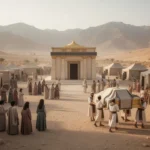
The Tabernacle, or portable sanctuary, was another major part of Moses’ work. Its design provided a structured place for worship during the wilderness years. Priests, sacrifices, sacred objects, and ritual duties were organized around it, with Aaron and his descendants given the priestly role.
The biblical narrative also includes a serious crisis at Sinai. While Moses was on the mountain, the people made and worshiped a golden calf. Moses broke the stone tablets in anger, confronted the rebellion, and then pleaded for the people. The episode shows both the fragility of the covenant and Moses’ willingness to stand between God’s judgment and the community.
How Moses led a difficult wilderness community
The journey from Egypt to the promised land took the Israelites through a long period of wandering. The people faced hunger, thirst, fear, conflict, and uncertainty. The biblical account describes God providing food called manna and water in the desert, while Moses dealt with repeated complaints and disputes.
Moses did not govern alone. Aaron served as priest and spokesman, Miriam is identified as a prophet and leader, and elders helped share administrative responsibility. Moses’ father-in-law Jethro advised him to appoint capable judges so that he would not personally handle every dispute. This advice produced a more sustainable system of leadership.
One of the defining failures of the wilderness period occurred when the Israelites reached the edge of Canaan. Scouts were sent to examine the land, but most returned fearful of its inhabitants and discouraged the people. Only Joshua and Caleb urged confidence. The people refused to enter, and the biblical account says that the older generation would wander and die in the wilderness before a new generation entered the land.
This story explains why Moses did not simply lead the first generation straight from Egypt into Canaan. The journey became a period of testing, instruction, punishment, and preparation. It also shows that freedom from slavery did not instantly create trust, unity, or responsible self-government.
Why Moses was not allowed to enter the promised land
Near the end of the wilderness journey, the people again lacked water. God instructed Moses to speak to a rock, but Moses struck it with his staff and spoke in a way the biblical narrative treats as failing to honor God. As a result, Moses was told that he would see the promised land but would not enter it.
The precise wording and details vary across the related passages, including Numbers 20 and Deuteronomy 32. The central point remains consistent: Moses’ leadership had limits, and even the greatest human leader was accountable to the covenant’s demands.
Moses climbed Mount Nebo and viewed the land from a distance. Deuteronomy says that he died there at the age of 120, and that his burial place was unknown. Joshua then succeeded him and led the Israelites across the Jordan River into the land.
The ending is deliberately bittersweet. Moses completed the essential work of liberation, covenant formation, and preparation, but he did not personally complete the final stage. His story places faithfulness, consequence, and succession alongside achievement.
What Moses’ name and titles mean in the Bible
Moses is described with several overlapping roles. He is a prophet because he receives and communicates God’s word. He is a lawgiver because he delivers the covenant teachings. He is a leader because he organizes and guides Israel, and he is an intercessor because he repeatedly pleads for the people.
Deuteronomy presents Moses as a uniquely important prophet within Israel’s history. Later biblical writers compare other leaders with him, often using Moses as the standard for prophetic authority. In the New Testament, Moses remains central to discussions of the law, the Exodus, faith, and the relationship between Israel’s scriptures and the message about Jesus.
In Judaism, Moses is traditionally called Moshe Rabbenu, meaning “Moses our teacher.” This title reflects his role as the teacher of the Torah and the mediator of Israel’s covenant. Jewish tradition also associates him with receiving and transmitting the written and oral dimensions of Torah, though interpretations differ across Jewish communities.
How Judaism, Christianity, and Islam understand Moses
For Judaism, Moses is the greatest prophet and the central human figure in the Torah. His significance rests especially on the Exodus, the Sinai covenant, and the giving of the Torah. Jewish worship and identity continue to draw heavily on the Passover story and the laws connected with Moses.
Christianity accepts Moses as a foundational figure in the Bible and sees the Mosaic law as part of the story that leads toward Christ. The Gospels portray Moses as present in the religious world of Jesus, while later Christian writings discuss the relationship between Moses’ covenant and the new covenant. Christians differ in how they understand the continuing role of specific Mosaic laws.
Islam honors Moses, known as Musa, as one of the most frequently mentioned prophets in the Quran. Islamic accounts emphasize his confrontation with Pharaoh, his miracles, his mission to the Israelites, and his conversation with God. The Quranic presentation overlaps with the Bible in important ways but also includes distinctive details and emphases.
These traditions share a broad picture of Moses as a divinely appointed leader who confronts oppression and teaches a community. They differ in theology, narrative detail, and the meaning they assign to his law and prophetic role. Treating all three traditions as identical would obscure their real differences.
What historical evidence exists for Moses and the Exodus
The question of whether Moses can be confirmed by external historical evidence remains unsettled. No widely accepted Egyptian record directly identifies Moses, the plagues, or the large-scale Exodus described in the Bible. Archaeology has not produced a definitive artifact that proves the biblical account in all its details.
At the same time, the absence of a direct record does not settle every question about the story. Ancient royal inscriptions often emphasized victories and omitted embarrassing events, while enslaved populations and mobile groups were not always documented in surviving records. Scholars examine Egyptian history, the geography of the Sinai, ancient settlement patterns, and the development of Israelite identity when evaluating the biblical traditions.
The earliest external reference to a people called Israel appears on the Merneptah Stele, an Egyptian inscription generally dated to the late 13th century BCE. It shows that a group known as Israel existed in Canaan by that period. It does not mention Moses or describe the Exodus.
Scholars therefore hold a range of views. Some accept a historical core involving the movement of a group from Egypt and later combine it with the biblical traditions. Others see the Exodus narrative as a national origin story shaped over time from different memories and traditions. Academic conclusions vary because the evidence is limited and the biblical text has a religious purpose as well as a narrative one.
Use careful wording: The Bible identifies Moses as the leader of the Exodus, but historians cannot independently verify every event in his life. Separating religious belief, textual interpretation, and archaeological evidence produces a more accurate answer.
Common mistakes when learning who Moses was
Calling him only a lawgiver: Moses was also a liberator, prophet, judge, organizer, intercessor, and teacher.
Assuming the Bible gives a modern biography: The biblical books focus on covenant, worship, identity, and divine action rather than supplying a complete chronological record.
Confusing Moses with Joshua: Moses led the Israelites out of Egypt and through the wilderness; Joshua succeeded him and led the people into Canaan.
Forgetting Aaron and Miriam: Moses’ leadership was supported and sometimes challenged by close family members and other community leaders.
Treating every tradition as interchangeable: Jewish, Christian, and Islamic accounts honor Moses but do not present exactly the same narrative or theology.
Presenting the Exodus as historically proven: The story is foundational to faith, but external evidence does not confirm all its details.
Ignoring Moses’ failures: His anger, reluctance, and disobedience are part of the biblical portrait and make his leadership more complex.
How to read the story of Moses responsibly
Begin with the primary biblical passages rather than isolated famous scenes. Read Exodus 1–20 for Moses’ early life, call, confrontation with Pharaoh, escape from Egypt, and the beginning of the Sinai covenant. Exodus 32–34 shows the golden calf crisis and Moses’ intercession.
Then read Numbers 11–14 and 20–21 for the wilderness conflicts, the refusal to enter Canaan, and the event that prevents Moses from entering the promised land. Deuteronomy 31–34 presents Moses’ final instructions, his commissioning of Joshua, his view of the land, and his death.
A careful reading should distinguish the text’s different purposes:
Historical questions: Ask what external evidence can and cannot establish about Egypt, Canaan, and the movement of ancient peoples.
Literary questions: Notice repeated patterns such as oppression, divine call, resistance, deliverance, complaint, judgment, and renewal.
Theological questions: Consider what the text says about God, covenant, justice, worship, human freedom, and leadership.
Tradition questions: Compare Jewish, Christian, and Islamic interpretations without assuming that one tradition speaks for all three.
It also helps to read Moses as a leader under pressure rather than as a flawless icon. He fears rejection, struggles with public speaking, loses his temper, and depends on others. Yet he continues to return to the task of guiding a difficult community toward a shared moral and religious life.
Why Moses still matters
Moses remains influential because his story addresses several enduring questions: How does an oppressed people become free? What obligations come with freedom? How should a community be governed? What makes a leader legitimate? And how should people respond when a calling exceeds their confidence?
His legacy is preserved in Passover, Jewish law, biblical studies, Christian theology, Islamic scripture, religious art, literature, and public discussions of justice. Many later movements have appealed to the Exodus as a symbol of liberation, although those uses should be distinguished from the ancient text’s own setting and meaning.
Moses is therefore best understood through several roles at once. He was the biblical liberator of Israel, the mediator of the Sinai covenant, the teacher of Torah, the prophet who confronted Pharaoh, and the imperfect leader who prepared a people for a future he would not enter himself.
Frequently asked questions
Was Moses a real historical person?
The Bible presents Moses as a historical leader, but surviving external evidence does not independently confirm his identity or every event associated with him. The Merneptah Stele confirms that a people called Israel existed in Canaan by the late 13th century BCE, but it does not mention Moses or the Exodus. Historians therefore disagree about how much historical memory lies behind the biblical account.
Where can I read the story of Moses?
The main narrative is found in Exodus, beginning with Moses’ birth and continuing through the Exodus from Egypt and the covenant at Sinai. Numbers covers much of the wilderness journey, while Deuteronomy presents Moses’ final speeches and death. Genesis provides the family background of the Israelites, and later biblical books refer back to Moses as a prophet and lawgiver.
Did Moses write the first five books of the Bible?
Jewish and Christian traditions have long associated Moses with the Torah, or Pentateuch, and many readers refer to it as the “Law of Moses.” Modern biblical scholarship generally examines the five books as texts shaped from multiple sources and edited over time. Deuteronomy itself describes Moses’ death, so the question of authorship is more complex than simple individual authorship.
What is Moses most famous for?
Moses is best known for leading the Israelites out of Egyptian slavery, an event remembered in Passover. He is also famous for receiving the Ten Commandments and the wider covenant laws at Mount Sinai. His other major roles include serving as a prophet, judging disputes, organizing the wilderness community, and preparing Joshua to lead Israel after his death.







Leave a Reply