Mount Sinai mountain: location, history, and meaning
Mount Sinai mountain: location, history, and meaning
Mount Sinai mountain is traditionally identified with Jebel Musa in Egypt’s southern Sinai Peninsula, although the Bible does not provide enough geographical detail to prove the identification.
For thousands of years, people have connected this rugged mountain region with the biblical account of Moses receiving divine law. The name carries religious meaning far beyond one summit: Mount Sinai represents covenant, revelation, wilderness, and moral responsibility in Jewish and Christian tradition. Islamic tradition also honors Moses and the mountain, usually called Tur Sina or Jabal Musa in Arabic.
What Mount Sinai mountain means in religious tradition
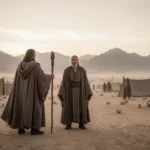
The mountain’s central importance comes from the Book of Exodus. After the Israelites leave Egypt, they travel through the wilderness and arrive at a mountain where Moses encounters God. The narrative describes thunder, fire, cloud, and a powerful divine presence, then presents Moses as receiving commandments for the community. The mountain is therefore associated with revelation and the formation of a people, not simply with a scenic location.
Exodus chapters 19–24 describe the covenant made at Sinai. In broad terms, the covenant establishes a relationship between God and Israel and sets out obligations governing worship, justice, personal conduct, and community life. The Ten Commandments are part of this larger setting, but the Sinai tradition includes many other laws and instructions as well.
Mount Sinai is also connected with several other biblical scenes. Exodus 32–34 recounts the episode of the golden calf, Moses’ anger, and his return to the mountain. In the story, the stone tablets are broken and later renewed, making the mountain a setting for both human failure and restored covenant. The book of Deuteronomy retells the wilderness experience with its own emphasis and uses the name Horeb for the mountain associated with the covenant.
Mount Sinai is remembered as a place where freedom from slavery became a life shaped by law and responsibility.
The mountain’s meaning is not limited to the moment of receiving commandments. The Israelites’ journey shows that escape from oppression does not by itself create a stable society. At Sinai, the biblical story links liberation with ethical duties, communal order, and accountability. That idea helps explain why the mountain remains important in religious teaching, art, music, pilgrimage, and public discussion.
Key distinction: Mount Sinai mountain is a traditional geographical identification, while “Sinai” in the Bible also refers to a wider wilderness region and to the covenant tradition connected with it.
Where Jebel Musa and the traditional Sinai site are located
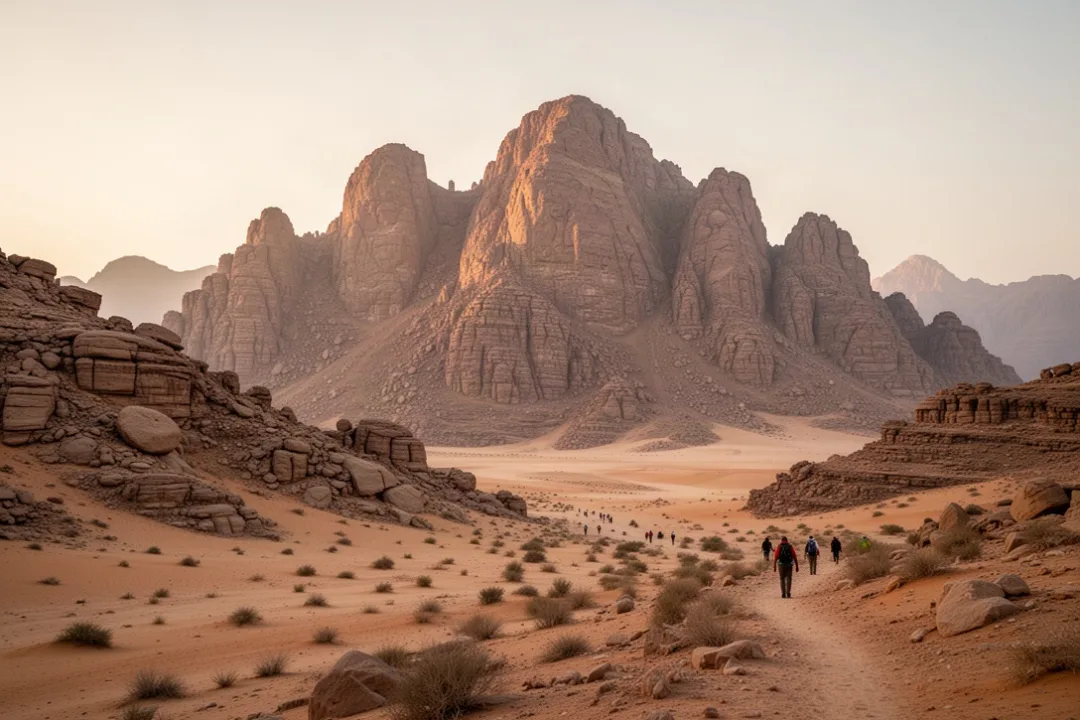
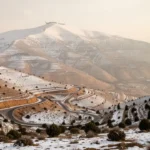
Jebel Musa, Arabic for “Mountain of Moses,” stands in the southern Sinai Peninsula of Egypt. It is part of a high, rocky mountain range near the town of Saint Catherine. The area lies inland from the Gulf of Aqaba and is surrounded by stark desert valleys, granite ridges, and other high peaks.
Jebel Musa rises to approximately 2,285 meters, or about 7,500 feet, above sea level. It is not the highest mountain in Egypt. That distinction belongs to nearby Mount Catherine, also called Jebel Katarina, which reaches roughly 2,629 meters. The close relationship between these peaks can cause confusion when visitors refer generally to “Mount Sinai” as an entire mountain landscape rather than one summit.
The traditional site is associated with Saint Catherine’s Monastery, an ancient Christian monastery at the foot of the mountain. The monastery sits beside the narrow valley of Wadi el-Deir and has served for centuries as a religious center, a place of scholarship, and a destination for pilgrims. The surrounding area is now part of the Saint Katherine Protectorate, which protects desert ecosystems, mountain habitats, and cultural sites.
Several features are commonly connected with the pilgrimage route:
The Steps of Repentance: a steep route of stone steps traditionally counted as thousands, leading toward the summit.
The Camel Trail: a longer path that winds up the mountain and is less direct than the stairway.
The summit chapel: a small Christian structure near the top, associated with the traditional pilgrimage destination.
The nearby summit of Ras Safsafa: a ridge sometimes proposed as a more plausible setting for the biblical mountain because of its broad view over the surrounding plain.
The landscape helps explain why the site has remained compelling to visitors. The mountains are dry and severe, with little vegetation at higher elevations, while lower valleys may contain springs, acacia trees, and small settlements. Sunrise and sunset can dramatically change the color of the granite slopes, but the setting is physically demanding and exposed.
What the Bible says about Sinai, Horeb, and Moses
The Bible does not give modern coordinates for Mount Sinai. Instead, it describes the Israelites’ movements through a sequence of wilderness locations after leaving Egypt. Those place names are difficult to match with certainty to modern geography, and the text sometimes uses Sinai and Horeb in ways that have generated different interpretations.
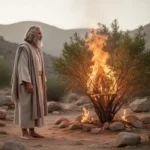
In Exodus 3, Moses encounters God at Horeb while tending sheep in the land of Midian. The passage places the burning bush at “the mountain of God,” but it does not identify the peak by a modern name or explain its exact relationship to the later Sinai encampment. In Exodus 19, the Israelites arrive at Sinai after crossing the wilderness, and Moses goes up the mountain as the covenant is established.
The biblical descriptions include boundaries around the mountain, a cloud or smoke covering it, and restrictions on approaching it at certain moments. These details communicate holiness and danger within the story. They are theological and literary descriptions, not a topographic survey that can be plotted precisely on a current map.
Another important passage appears in 1 Kings 19. The prophet Elijah travels to Horeb, where he experiences a divine encounter after fleeing into the wilderness. The account refers to wind, earthquake, fire, and then a quiet form of communication. Readers have often connected this scene with the Sinai tradition, even though the narrative does not settle the mountain’s exact location.
Paul’s Letter to the Galatians refers to Sinai in a discussion of the law and the relationship between different covenant traditions. The letter’s argument is theological rather than geographical. It shows how the name Sinai had become a recognized symbol in early Christianity, even when writers were not attempting to identify a physical summit.
Why the mountain’s location cannot be proven from the text alone
The biblical itinerary contains names whose meanings and locations are uncertain. Some places may have changed names over time, while others may refer to broad regions rather than one settlement. Ancient travel descriptions also do not provide the kind of precise measurements used by modern geography.
Archaeology can reveal patterns of settlement, trade, worship, and travel, but it has not produced a universally accepted inscription or artifact identifying Jebel Musa as the biblical mountain. The absence of such evidence does not automatically disprove the tradition. It does mean that faith, historical tradition, geography, and archaeology must be kept distinct when discussing the site.
How Jebel Musa became the traditional Mount Sinai
The association between Jebel Musa and biblical Sinai developed over many centuries. Early Christian monks and pilgrims traveled into the southern Sinai wilderness, seeking places connected with Moses, Elijah, and other biblical figures. By late antiquity, the region around Jebel Musa had become a major center of Christian monastic life.
Saint Catherine’s Monastery is central to that history. Tradition links the monastery with Saint Catherine of Alexandria, a Christian martyr whose relics are said to be preserved there. The monastery was built in the sixth century under the Byzantine emperor Justinian I, although monks had already lived in the region before the main fortified complex was constructed.
The monastery’s location was chosen partly for its religious associations and partly for practical protection. Its fortified walls, remote setting, water source, and mountain surroundings helped sustain a monastic community in a difficult environment. Over time, the site’s churches, manuscripts, icons, and inscriptions made it one of the most significant surviving centers of early Christian culture.
The traditional identification was strengthened by pilgrim accounts, monastic memory, maps, and religious practice. These traditions made Jebel Musa the mountain most commonly meant by “Mount Sinai” in Christian pilgrimage writing and in many modern travel materials. Tradition does not equal archaeological proof, but it is historically important evidence of how communities have remembered and used the landscape.
Islamic tradition also treats the region with reverence. The Quran mentions Mount Sinai, or Tur Sina, in connection with Moses and divine blessing. It also refers to Moses’ encounter with God and to the sacred valley of Tuwa in other passages. Islamic sources and local customs have contributed to the mountain’s continuing importance, even though the details of religious interpretation differ from Jewish and Christian accounts.
Jebel Musa is therefore a shared sacred landscape rather than a site belonging to one tradition alone. Jewish memory centers on the covenant and the giving of the law. Christianity connects the mountain with the biblical narrative and the long history of monasticism. Islam honors Moses as a prophet and recognizes the mountain within its own scriptural framework.
Other proposed locations and the evidence behind them
Jebel Musa is the best-known traditional candidate, but it is not the only proposal. Researchers and religious writers have suggested mountains in different parts of the Sinai Peninsula, the northern Sinai region, the Negev, and areas east of the Gulf of Aqaba. A smaller number of theories place the biblical mountain in northwestern Arabia. These proposals vary widely in their use of biblical geography, ancient place names, geology, and travel routes.
Supporters of Jebel Musa often point to the long-standing Christian tradition, the mountain’s dramatic appearance, its association with Saint Catherine’s Monastery, and the surrounding wilderness. The nearby plain and ridges also allow visitors to imagine a large encampment and a visible mountain boundary, although such impressions do not establish what happened in antiquity.
Some alternative theories focus on the movement of the Israelites from Egypt toward the promised land. They question whether the southern Sinai Peninsula fits every part of the biblical itinerary, particularly when the text is read alongside references to Midian and the Gulf of Aqaba. Other scholars caution that modern attempts to reconstruct the route may assume more geographical precision than the ancient narrative provides.
Claims about a “smoking” or blackened mountain are especially unreliable. A dark volcanic summit is sometimes presented as evidence for the biblical fire at Sinai, but the traditional Jebel Musa range is primarily granite, and geological appearance alone cannot identify the biblical location. Burn marks, mineral colors, and volcanic formations can have ordinary natural explanations.
Useful questions for evaluating a proposed site include:
Does the location fit the biblical place names without forcing uncertain identifications?
Could the surrounding terrain plausibly support the movement and encampment described in the narrative?
Is there evidence of ancient travel, settlement, worship, or inscription at the site?
Does the proposal rely on established scholarship or mainly on visual resemblance and modern speculation?
Are religious tradition and archaeological evidence being presented separately and honestly?
No proposed mountain has gained universal acceptance. Many scholars treat the question as unresolved because the available textual and archaeological evidence is limited. For that reason, it is more accurate to say that Jebel Musa is the traditional Mount Sinai than to state that its identity has been conclusively proven.
How to describe it accurately: Call Jebel Musa the traditional or most widely recognized location of Mount Sinai, and acknowledge that the biblical mountain’s exact location remains debated.
What visiting Mount Sinai mountain is like today
Visitors who travel to the traditional site usually stay in or near Saint Catherine and arrange transportation and local guidance for the mountain route. Access conditions can change because of weather, security requirements, local regulations, or temporary closures. Checking current information before traveling is essential.
The ascent is physically strenuous. The direct staircase is steep and uneven, while the longer trail takes more time but generally offers a gradual approach. Some visitors use camels for part of the longer route, but the final section still requires walking. A sunrise climb often begins during the night, when temperatures can be very cold even though the surrounding desert is hot during the day.
Prepare for the mountain rather than treating it as an ordinary sightseeing stop:
Wear sturdy shoes with reliable traction for loose rock and irregular steps.
Carry enough water and bring food for the length of the hike.
Dress in layers, covering shoulders and legs respectfully at religious sites while allowing for major temperature changes.
Bring a flashlight or headlamp for a pre-dawn ascent; a phone light may not be sufficient.
Use an authorized local guide when required and follow instructions from local authorities.
Allow extra time for the descent, which can be hard on knees and ankles.
Saint Catherine’s Monastery may have limited visiting hours and may close on particular religious days. It is an active religious community and a historic site, not merely a museum. Visitors should follow photography rules, remain quiet in worship areas, dress modestly, and avoid touching religious objects unless invited.
Altitude, cold, dehydration, darkness, and loose terrain can create real risks. People with heart, respiratory, mobility, or balance problems should seek medical advice before planning the climb. Families traveling with children should consider the difficulty of the route, the late-night start, and the demands of the descent rather than relying on the mountain’s moderate elevation alone.
The surrounding region offers more than the summit. Visitors may explore desert valleys, Bedouin cultural landscapes, nearby high peaks, and the monastery complex. Responsible travel means using established paths, carrying waste out, conserving water, respecting local communities, and avoiding damage to plants, rock formations, or archaeological remains.
Whether you approach Mount Sinai mountain as a pilgrim, a history traveler, or a student of geography, the place is best understood on several levels at once. Jebel Musa is a physical mountain in Egypt, a center of Christian monastic history, a landscape honored in Islam, and the traditional setting for one of the most influential covenant narratives in the Bible. Those meanings can be appreciated without claiming more certainty about the ancient location than the evidence allows.
Frequently asked questions
Is Mount Sinai mountain the same as Jebel Musa?
Jebel Musa is the traditional Christian identification of Mount Sinai mountain. It stands in southern Egypt near Saint Catherine’s Monastery and has been associated with Moses and the biblical covenant for many centuries. However, the Bible does not give modern coordinates, and historians and archaeologists have not reached universal agreement that Jebel Musa is the exact biblical site.
How high is Mount Sinai mountain?
Jebel Musa, the mountain most commonly identified as Mount Sinai, is about 2,285 meters, or approximately 7,500 feet, above sea level. Nearby Mount Catherine is higher, reaching roughly 2,629 meters. Visitors sometimes confuse the two because they belong to the same rugged mountain region around Saint Catherine in southern Sinai.
Can you climb Mount Sinai mountain?
Visitors can generally climb the traditional mountain by a steep staircase route or a longer trail commonly called the Camel Trail, subject to current local rules and conditions. The hike can involve darkness, cold, loose rock, dehydration, and a demanding descent. Sturdy footwear, water, warm layers, a light, and current guidance are essential.
Why is Mount Sinai important in the Bible?
Mount Sinai is important because the biblical narrative places Moses’ encounter with God and the establishment of the covenant with Israel there. Exodus 19–24 connects the mountain with the commandments and laws that shape the community. The site also represents the relationship between liberation, worship, ethical conduct, and responsibility.



Leave a Reply