Mount Horeb: Location, meaning, and biblical history
Mount Horeb: Location, meaning, and biblical history
Mount Horeb is the mountain where Moses encountered God through the burning bush and later received the covenant law, according to the Bible. It is also the place where the prophet Elijah went after fleeing from Queen Jezebel. In many biblical passages, Horeb and Mount Sinai appear to refer to the same mountain, although the exact location remains uncertain.
Most traditional identifications place Horeb in or near the southern Sinai Peninsula, with Jebel Musa being the best-known candidate. Scripture, however, does not provide enough geographical detail to prove that identification, and other locations have been proposed in the Sinai, northwestern Arabia, and the broader region around Edom.
The names Horeb and Sinai occur in different biblical passages describing related events. Exodus commonly uses Sinai when recounting Israel’s arrival at the mountain after leaving Egypt, while Deuteronomy frequently uses Horeb when Moses reviews the covenant and the people’s experience in the wilderness.
Many readers therefore understand the two names as referring to one sacred mountain or mountain region. Another possibility is that Horeb was the larger mountainous area and Sinai was a particular peak within it. The biblical text does not settle the question with a modern-style map or precise boundary.
The distinction may also reflect different traditions, settings, or ways of describing the same place. A passage in Exodus can refer to Sinai while another passage in the Pentateuch refers to Horeb, yet both place Moses and Israel at the mountain where God revealed himself and established the covenant.
Helpful distinction: “Mount Horeb” and “Mount Sinai” are often treated as alternate names for the same biblical location, but the precise relationship between the names is not certain.
The main biblical events associated with Mount Horeb
Mount Horeb is not significant only because of its name. It functions as a setting for several major moments in biblical history, especially the calling of Moses, Israel’s covenant with God, and Elijah’s renewal of purpose.
Moses sees the burning bush: God calls Moses while he is tending sheep near Horeb, traditionally identified with the “mountain of God.”
Moses receives his commission: He is sent to lead the Israelites out of slavery in Egypt.
Israel encounters God after the exodus: The people camp near the mountain and enter into a covenant.
The covenant law is given: Moses receives divine instruction for the community’s worship and social life.
Israel’s rebellion is remembered: Horeb becomes connected with the golden calf and the breaking of the covenant tablets.
Elijah reaches Horeb: After a crisis in his prophetic ministry, Elijah travels to the mountain and receives renewed direction.
These events give Horeb a layered meaning. It is a place of revelation, commissioning, covenant, failure, correction, and renewed vocation. The mountain is not presented as a destination that matters merely because of its scenery. Its importance comes from what happens there between God and his people.
How Moses encountered God at Horeb
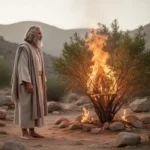
The first major Horeb story appears in Exodus 3. Moses is living in Midian and working as a shepherd when he comes to a mountain associated with God. There he sees a bush burning without being consumed, and God calls to him from the fire.
The episode begins with a striking contrast: an ordinary wilderness task becomes a sacred encounter. Moses is not searching for a famous shrine or performing a religious ceremony. He is tending animals when he is drawn toward a mysterious sign and hears a call that changes his life.
God instructs Moses to remove his sandals because the ground is holy. The passage presents holiness as something created by God’s presence, not as a quality that the landscape possesses independently. Horeb becomes sacred because God reveals himself there.
The encounter also addresses Moses’ past. God identifies himself as the God of Abraham, Isaac, and Jacob and tells Moses that he has heard the suffering of the Israelites in Egypt. Moses is then given the difficult task of confronting Pharaoh and leading the people out of slavery.
Exodus 3–4 portrays Moses as hesitant and aware of his limitations. He questions his authority, worries that the Israelites will not believe him, and expresses concern about his ability to speak. The story’s emphasis is that the mission depends on God’s presence rather than Moses’ confidence.
What happened at Horeb after the exodus
After leaving Egypt, the Israelites travel through the wilderness and arrive at the mountain. Exodus 19–24 describes preparations for a covenant ceremony in which the people are called to become a distinctive community under God’s direction.
The mountain is surrounded by powerful images: thunder, cloud, fire, smoke, and a loud sound. These details communicate the majesty and danger of divine holiness. The people are warned not to treat the mountain casually, and Moses acts as an intermediary between the community and God.
The covenant includes commands concerning worship, loyalty, justice, responsibility, and relationships. The law is not portrayed as a collection of private spiritual advice. It establishes the foundation for a people who are expected to practice faithfulness in public and personal life.
Deuteronomy presents Moses looking back on this event years later. In that retelling, Horeb becomes the name associated with the moment when Israel heard God’s words and accepted the covenant. Moses reminds the people that they did not see God in a physical form, warning them against reducing divine worship to an image.
This emphasis is especially important for understanding the mountain’s role. Horeb is a place of encounter without physical representation. The people hear, respond, and enter a covenant, but the biblical account resists the idea that God can be contained in a statue or ordinary object.
Why the golden calf is part of Horeb’s story
The mountain is also linked to one of Israel’s most serious failures. While Moses is on the mountain, the people ask Aaron to make a visible object of worship. The result is the golden calf, an act that the biblical narrative treats as a breach of the covenant.
The story appears in Exodus 32 and is revisited in Moses’ speech in Deuteronomy 9. Horeb therefore represents both the giving of the covenant and the community’s immediate violation of it. The mountain is not remembered as a place where the people behaved perfectly. It is also the setting for fear, impatience, idolatry, anger, and intercession.
Moses comes down carrying tablets inscribed with the covenant instructions and breaks them when he sees the people’s worship. The action symbolizes the broken relationship. Later, Moses intercedes for Israel and receives renewed tablets, showing that judgment and restoration remain connected in the story.
This part of Horeb’s significance can be useful when reading the Bible as a whole. Sacred places do not automatically produce faithful people. The mountain provides revelation, but the people must still choose how to respond to what they have received.
How Elijah’s visit gives Horeb a different meaning
Horeb appears again in 1 Kings 19, when Elijah travels there after a period of intense conflict and fear. He has confronted the prophets of Baal on Mount Carmel, faced threats from Jezebel, and reached a point of exhaustion and despair.
Elijah’s journey to Horeb echoes the earlier journey of Moses. He travels through the wilderness for an extended period and arrives at the mountain of God. There, he takes shelter in a cave and is asked why he has come.
The account describes a powerful wind, an earthquake, and a fire, but God’s communication follows these dramatic signs through a quiet, subdued sound. The passage does not necessarily mean that God is never present in power. Instead, it shows Elijah that divine guidance cannot be reduced to spectacular displays.
Elijah tells God that he has been zealous but feels alone and threatened. God responds by giving him specific tasks, including anointing new leaders and calling Elisha to continue the prophetic work. Elijah’s encounter at Horeb is therefore not simply a retreat. It becomes a moment of correction, reassurance, and renewed assignment.
When Moses encounters God at Horeb, he is sent toward a mission he does not want to undertake. When Elijah arrives, he is exhausted from a mission he has already undertaken. Together, the stories show the mountain as a place where God meets people at the beginning, middle, and breaking point of their service.
Where Mount Horeb may have been located
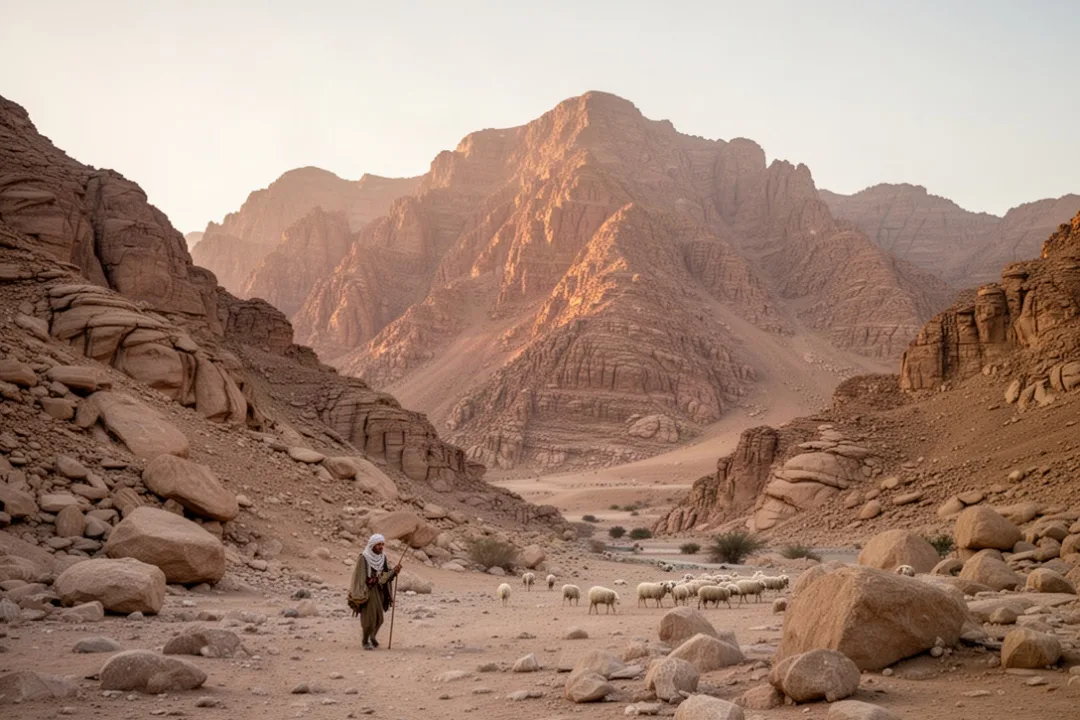
The exact location of Horeb cannot be established with certainty from the biblical text or surviving historical evidence. The most widely known tradition places it in the southern Sinai Peninsula, a rugged region of granite mountains and desert valleys.
Several geographical clues influence the discussion. Moses is associated with Midian before returning to Egypt, and Midian is generally connected with areas east of the Gulf of Aqaba, though the boundaries of ancient regions were not fixed in the same way as modern countries. The Israelites also travel through a wilderness landscape after leaving Egypt.
The Bible names several places along the wilderness route, but identifying those names on a modern map is difficult. Ancient place names may have changed, multiple locations may have shared similar names, and the narrative does not provide enough measurements or coordinates for a definitive reconstruction.
Commonly proposed areas include:
Southern Sinai: This is the dominant traditional setting in Jewish, Christian, and later pilgrimage traditions.
Jebel Musa: Often identified with Mount Sinai, this mountain stands near Saint Catherine’s Monastery in Egypt.
Ras Safsafeh: A nearby peak that some have suggested may better fit certain descriptions of a broad gathering place.
Other Sinai ranges: Some researchers have proposed mountains elsewhere in the peninsula rather than the traditional peaks.
Northwestern Arabia or the broader Midian region: A minority of proposals place the mountain east of the Gulf of Aqaba, though these theories remain disputed.
Arguments for a particular location often depend on how a reader interprets the exodus route, the geography of Midian, the meaning of biblical place names, and later tradition. None of these factors alone proves an identification.
Travel and research caution: Modern claims that identify Horeb with absolute certainty usually go beyond what the biblical text and historical evidence can demonstrate.
Why Jebel Musa became the traditional identification
Jebel Musa, Arabic for “Mount Moses,” became closely associated with biblical Mount Sinai through centuries of Christian tradition. The mountain is located in the southern Sinai highlands, near the monastery traditionally linked with Saint Catherine.
Christian pilgrims and monastic communities helped preserve the identification of the area with the biblical mountain. The tradition’s age and continuity make it historically significant, even though a longstanding tradition is not the same as archaeological proof.
The surrounding landscape also fits broad features of the biblical account: a remote wilderness, steep mountains, caves, and isolated valleys. Such similarities can make the traditional location compelling to visitors, but they do not establish that Jebel Musa was the exact mountain described in Exodus or Deuteronomy.
For visitors, the mountain is part of a larger religious and cultural landscape that includes ancient monasteries, desert routes, and sites associated with Moses. Access conditions, local regulations, weather, and security considerations can change, so travelers should check current official guidance rather than relying on old pilgrimage accounts.
What the name Horeb may mean
The Hebrew name Horeb is commonly associated with a root connected to dryness, desolation, or a parched place. That meaning fits the wilderness setting, but the exact etymology and original nuance are not completely certain.
The name may evoke the physical character of the region: dry valleys, sparse vegetation, exposed rock, and a landscape that depends on limited water sources. It can also reinforce the biblical contrast between a seemingly barren place and the life-changing presence of God.
Readers should avoid treating the name’s possible meaning as a complete explanation of the mountain. Biblical place names can carry associations, but their significance is determined by the stories connected with them as well as by word origins.
How Horeb differs from other biblical mountains
Horeb belongs to a wider biblical pattern in which mountains are settings for divine revelation, leadership, worship, and testing. Comparing these locations helps clarify what is distinctive about Horeb.
Mount Ararat: Associated with Noah’s ark coming to rest after the flood, though the biblical text does not identify one precise modern peak.
Mount Moriah: Linked with Abraham’s test and later with the temple tradition in Jerusalem.
Mount Carmel: The setting of Elijah’s public confrontation with the prophets of Baal.
Mount Zion: Associated with Jerusalem, kingship, worship, and God’s presence among his people.
Mount of Olives: Connected with important events in the later Gospel narratives and the geography of Jerusalem.
Horeb is especially associated with covenant formation and prophetic calling. It is both a place where a nation receives its identity and a place where individual servants are redirected. Its stories stretch from Moses’ first commission to Elijah’s personal crisis.
A careful reading should separate what the Bible explicitly says from later assumptions. The text clearly connects Horeb with Moses, the burning bush, the covenant, and Elijah. It does not provide a modern coordinate, a universally accepted name for a present-day peak, or an archaeological marker that settles the debate.
These steps can help when studying the subject:
Read the surrounding chapters: Begin with Exodus 3–4, Exodus 19–34, Deuteronomy 4–10, and 1 Kings 19 rather than isolated references.
Compare the names: Notice when a passage says Horeb and when it says Sinai, without assuming that every use proves a separate mountain.
Track the narrative purpose: Ask what each story teaches about calling, covenant, rebellion, worship, or renewal.
Separate geography from theology: A debate about the mountain’s location should not obscure the meaning of the events described there.
Check claims against evidence: Treat sensational identifications and unsupported archaeological claims with caution.
Bible translations may also differ in how they render certain place names and descriptions. Consulting more than one translation or a reputable study resource can reveal where wording reflects interpretation. The central themes, however, remain clear even when the geography is debated.
What Mount Horeb means for readers today
For many religious readers, Horeb represents the possibility that ordinary places and difficult seasons can become settings for transformation. Moses is called while working in the wilderness, and Elijah receives direction after reaching emotional and physical exhaustion. Neither encounter depends on the person feeling ready.
Horeb also presents a demanding view of spiritual experience. Encountering God does not remove responsibility. Moses must return to Egypt, confront power, and lead a difficult community. Elijah must leave the cave and continue his work. Revelation leads to action rather than serving as an escape from it.
The mountain’s stories also preserve the tension between faithfulness and failure. Israel receives the covenant and then breaks it. Moses becomes an intermediary for a rebellious people. Elijah experiences a public victory and then collapses in fear. Horeb therefore speaks to human inconsistency as well as divine patience.
Whether or not a modern visitor can identify the exact peak, the biblical importance of Horeb does not depend on reaching one particular summit. Its enduring meaning comes from the narratives: God calls, forms, corrects, listens to, and recommissions people in the wilderness.
Frequently cited Bible passages about Horeb
The following references provide a useful reading path for anyone studying the mountain:
Exodus 3:1–15: Moses encounters the burning bush and receives his commission.
Exodus 17:1–7: Horeb is mentioned in connection with water from the rock, although the passage’s geography and sequence should be read carefully.
Exodus 19–24: Israel arrives at Sinai, receives covenant instructions, and enters into a formal relationship with God.
Exodus 32–34: The golden calf, Moses’ intercession, and the renewal of the covenant are described.
Deuteronomy 4–5: Moses recalls Horeb and emphasizes Israel’s hearing of God’s words without seeing a physical form.
Deuteronomy 9–10: Moses remembers the golden calf and the replacement of the covenant tablets.
1 Kings 19:1–18: Elijah travels to Horeb, encounters God, and receives renewed instructions.
Reading these passages together shows why the mountain has remained important across Jewish and Christian interpretation. Horeb is not merely a disputed point on a map. It is a biblical symbol of revelation in the wilderness, covenant responsibility, and renewed calling.
Frequently asked questions
Are Mount Horeb and Mount Sinai the same mountain?
Most Jewish and Christian interpreters understand Horeb and Sinai as names for the same mountain or the same mountain region. Some scholars think Horeb may have been a broader area and Sinai a specific peak. The Bible uses both names in related narratives but does not explain their relationship with enough geographical detail to settle the matter.
Where is Mount Horeb located today?
Its exact modern location is unknown. The traditional identification places it in southern Egypt’s Sinai Peninsula, especially near Jebel Musa and the region around Saint Catherine. Other proposals place it elsewhere in the Sinai or in areas associated with ancient Midian east of the Gulf of Aqaba. None of these identifications has universal scholarly agreement.
What happened to Moses at Mount Horeb?
Moses encountered God near Horeb through the sign of a burning bush. He was commissioned to lead the Israelites out of Egypt and told that God had heard their suffering. Later, Horeb or Sinai became the setting for Israel’s covenant, the giving of divine instruction, and Moses’ intercession after the golden calf incident.
Why did Elijah go to Mount Horeb?
Elijah went to Horeb after fleeing from Jezebel and experiencing fear, exhaustion, and discouragement. At the mountain, he encountered God through a quiet and powerful revelation rather than only through dramatic natural signs. God then gave him specific tasks and directed him to prepare Elisha as his successor, renewing his prophetic purpose.




Leave a Reply