Mount Tabor: Biblical history, meaning, and travel guide
Mount Tabor: Biblical history, meaning, and travel guide
Mount Tabor is a distinctive, rounded mountain in Lower Galilee, northern Israel, rising above the Jezreel Valley. It is best known in Christian tradition as the possible site of Jesus’ Transfiguration, although the Gospel accounts do not name the mountain.
The mountain also appears in the Hebrew Bible in connection with Deborah, Barak, and the defeat of Sisera. Its elevated position, isolated shape, and broad views over the surrounding valleys have made it a significant landmark for both biblical history and Christian pilgrimage.
Mount Tabor stands in the eastern part of Lower Galilee, near the modern communities of Kfar Tavor and Daburiyya. It rises prominently from the landscape at the edge of the Jezreel Valley, making it easy to distinguish from the lower hills and agricultural fields around it.
The mountain reaches approximately 588 meters above sea level. It is not the highest peak in the region, but its isolated, symmetrical form gives it unusual visual importance. Unlike a long mountain ridge, Tabor appears as a single dome rising above the plain.
From its upper slopes, visitors can see across much of the Jezreel Valley, toward Lower Galilee and, on clear days, in the direction of Mount Carmel, the Jordan Valley, and the hills of Samaria. The exact view depends on weather, haze, and the direction you face.
Mount Tabor is sometimes confused with other biblical mountains in northern Israel. It is distinct from Mount Carmel, associated with the prophet Elijah, and from Mount Hermon, a much higher mountain farther north. It is also not the same as Mount of Beatitudes or the traditional sites around the Sea of Galilee.
Geographic clue: Mount Tabor’s isolated, rounded profile is one of the easiest ways to recognize it from the Jezreel Valley. Its prominence comes as much from its shape and position as from its elevation.
Why Mount Tabor matters in the Bible
Mount Tabor is mentioned in several biblical passages, but its role is clearest in the Book of Judges. In Judges 4, the prophetess Deborah instructs the military leader Barak to gather troops and take position at Mount Tabor. The Israelite force then descends toward the army of Sisera, the commander serving the Canaanite king Jabin.
The story describes a conflict between Israel and the Canaanite power centered at Hazor. Sisera’s forces possess military advantages, including chariots, while Barak’s troops assemble at Tabor. The narrative presents Israel’s victory as dependent on divine intervention and courageous leadership rather than on military strength alone.
According to Judges 4, Sisera flees after the battle and finds temporary refuge in the tent of Jael, who later kills him. Judges 5 retells the victory in poetic form, celebrating Deborah and Barak and describing the conflict through vivid images of nature and battle.
The mountain’s role in this story is strategic as well as symbolic. A force gathered on elevated ground could observe movement across the valley and choose when to descend. Tabor therefore functions as a real military landmark while also representing a place where an apparently weaker group receives the opportunity to confront a stronger enemy.
Mount Tabor is also named in other biblical passages. Hosea 5:1 mentions Tabor alongside Mizpah and Shittim in a prophetic criticism of Israel’s leaders. Psalm 89 refers to Tabor and Hermon as mountains that rejoice in God’s name, using the landscape as poetic imagery rather than recounting a specific event.
Was Jesus’ Transfiguration on Mount Tabor?
Christian tradition has identified Mount Tabor as the site of the Transfiguration of Jesus. The event is described in Matthew 17, Mark 9, and Luke 9. In those accounts, Jesus takes Peter, James, and John up a high mountain, where his appearance changes, Moses and Elijah appear, and the disciples receive a revelation of his identity and mission.
The Gospel writers do not name the mountain. They simply describe it as a high mountain. For that reason, Mount Tabor is a traditional identification rather than a certainty established by the biblical text.
Some scholars and Christian interpreters have proposed Mount Hermon instead, particularly because it is much higher and lies near the setting of events in the northern part of the Gospel narratives. Others have pointed out that a settlement or fortress on Tabor may have made it less likely as a secluded location during certain periods. These arguments do not eliminate the Tabor tradition, but they explain why the site is described as probable or traditional rather than proven.
The identification of Tabor with the Transfiguration became especially influential in early Christian pilgrimage. Churches and monasteries were established on or near the summit over the centuries, and the mountain developed into one of the major sacred sites associated with Jesus’ life.
For Christian visitors, the significance of Tabor does not depend entirely on proving that the Transfiguration occurred there. The mountain provides a setting for reflecting on the biblical scene: Jesus in prayer, the witness of Moses and Elijah, and the disciples’ recognition of divine glory.
Matthew 17, Mark 9, and Luke 9 describe the Transfiguration on a high mountain but do not identify it by name.
The Basilica of the Transfiguration on Mount Tabor
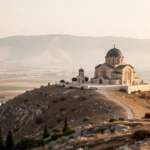
The most prominent building on the summit is the Basilica of the Transfiguration, a Roman Catholic church administered by the Franciscan Custody of the Holy Land. The present basilica was designed by the Italian architect Antonio Barluzzi and completed in the early twentieth century.
Its design emphasizes the mountain’s association with the Transfiguration. The church has a central structure flanked by two towers, traditionally understood to evoke the biblical presence of Moses and Elijah beside Jesus. The architecture uses warm stone, arches, and a strong connection between the interior worship space and the surrounding landscape.
Inside, the central apse contains artwork associated with the Transfiguration. Light entering the church contributes to the sense of height and openness, while the crypt below provides a quieter place for prayer. The building is intended not merely as a monument but as a functioning place of worship.
Two smaller chapels are associated with Moses and Elijah. Their arrangement reflects the Gospel story, in which these figures appear with Jesus. Visitors should remember that the basilica expresses Christian interpretation and devotion; it does not constitute archaeological proof of the exact location of the Gospel event.
Older remains around the summit also reflect the mountain’s long religious history. Archaeological evidence points to earlier Christian buildings, including churches and monastic structures from the Byzantine period. Later construction and restoration changed the appearance of the site, but the summit still preserves traces of successive generations of worship.
The grounds around the basilica offer opportunities for quiet observation. Depending on access and conditions, you may be able to walk near the church, look across the valley, and notice how the building occupies the summit rather than hiding the mountain’s natural prominence.
How the mountain’s landscape shaped its history
Mount Tabor’s importance is closely tied to its physical setting. The mountain rises above routes crossing the Jezreel Valley, one of the most significant agricultural and travel regions in the northern land of Israel. Control of the valley affected movement between the coast, Galilee, and the interior.
Its position also made Tabor a useful observation point. From the upper slopes, people could monitor activity across the plain, while the mountain itself offered a defensible position. The biblical account in Judges takes advantage of this geographical reality: Barak gathers at Tabor before moving into battle.
The mountain’s appearance gives it a second kind of significance. A rounded peak standing alone against a broad plain naturally attracts attention. Biblical poetry uses Tabor as an image of permanence and majesty, placing it alongside Hermon as a recognizable expression of the created world.
For pilgrims, the climb and the change in perspective can carry spiritual meaning. The valley looks different from above, and familiar biblical places become part of a larger landscape. The experience can help connect individual stories in Scripture with the roads, fields, ridges, and settlements that surround them.
At the same time, the mountain is not an isolated wilderness. The summit contains religious buildings, access roads, and visitor activity. A thoughtful visit holds both realities together: Tabor is a natural landmark and a developed sacred site shaped by centuries of human use.
What you can see from Mount Tabor
The summit views are one of the main reasons people visit. The western and southwestern outlooks extend across the Jezreel Valley toward Mount Carmel and the hills beyond. Looking north and northeast, you can see the lower Galilean landscape, with agricultural areas and ridges forming layers toward the horizon.
On exceptionally clear days, distant landmarks may be visible, but haze is common and can limit the view. The best experience often comes from studying the nearer landscape rather than expecting every distant mountain to be identifiable.
The Jezreel Valley: broad fields and transport routes spread out below the mountain.
Lower Galilee: rounded hills and cultivated areas form the northern and western backdrop.
Mount Carmel: the long ridge may be visible toward the west or southwest in clear conditions.
Nearby villages: communities around the base help show the mountain’s scale and position.
Religious architecture: the basilica and surrounding grounds occupy the summit plateau.
Bring your attention to the relationship between the mountain and the valley rather than viewing the panorama as a simple photograph. The position of Tabor explains why it became useful for military observation, memorable in poetry, and powerful in pilgrimage tradition.
Practical tips for visiting Mount Tabor
A visit to Mount Tabor usually combines a drive to the upper area with time inside or around the basilica. Access arrangements can vary, and religious sites may have changing opening hours, worship schedules, or restrictions. Check current information before setting out, especially if you are traveling on a religious holiday or planning to attend a service.
The road to the summit is winding and can be narrow in places. Some visitors use local transportation from the lower area rather than driving all the way up themselves. If you are traveling independently, confirm current road and parking arrangements before relying on a particular plan.
These practical habits can make the visit smoother and more respectful:
Wear suitable shoes: paths and outdoor areas may be uneven, even when the main church is easy to reach.
Carry water: the summit can feel exposed and warmer than expected, especially during the dry season.
Dress modestly: shoulders and knees should generally be covered when entering a church or chapel.
Check worship times: services may limit access to certain parts of the basilica.
Allow time for the view: rushing from the vehicle to the church misses much of the mountain’s setting.
Protect the landscape: remain on marked paths and avoid climbing on archaeological remains.
Plan for weather: clouds, wind, heat, and haze can change conditions quickly on an exposed summit.
Respectful-visit tip: Treat the basilica as an active place of worship, not only as a tourist attraction. Keep voices low, follow posted instructions, and avoid photography during services or in areas where it is restricted.
Common mistakes people make when researching Mount Tabor
Mount Tabor is surrounded by traditions that are easy to repeat without distinction. Clear research separates what the Bible states directly, what Christian tradition identifies, and what modern visitors can observe on the ground.
Calling the Transfiguration location certain: The Gospels name a high mountain but do not call it Tabor. Tabor is the traditional site, not an explicit biblical identification.
Confusing Tabor with Mount Hermon: Both have been discussed in connection with the Transfiguration, but they are separate mountains in different parts of the region.
Assuming every summit structure is ancient: The present basilica is modern, even though earlier churches and religious communities occupied the mountain.
Ignoring the Book of Judges: The mountain’s biblical importance is not limited to Christian tradition. Judges 4 and 5 connect it with Deborah and Barak.
Expecting an untouched archaeological site: Tabor is a living pilgrimage destination with roads, churches, visitors, and maintained grounds.
Planning only for the church: The relationship between the summit and Jezreel Valley is central to understanding the mountain’s historical importance.
These distinctions do not make the site less meaningful. They make your understanding more accurate and allow you to appreciate the mountain through several layers: biblical narrative, Christian tradition, archaeology, architecture, and geography.
Mount Tabor in Jewish and Christian memory
In Jewish Scripture, Tabor is remembered through stories and poetry. The account of Deborah and Barak presents the mountain as a place of assembly and military action, while Psalm 89 uses it as a poetic image of the natural world rejoicing before God.
In Christian memory, Tabor became closely connected with the Transfiguration. That association shaped the construction of churches, the development of pilgrimage routes, and the way generations of visitors have interpreted the summit. The basilica gives physical form to a tradition grounded in the Gospel accounts but not confirmed by a named location.
The mountain therefore carries different kinds of authority for different visitors. A biblical reader may focus on Judges. A Christian pilgrim may come to pray in connection with the Transfiguration. A traveler interested in history may study the remains of earlier communities and the development of the modern church.
These perspectives can exist together without treating them as identical. Understanding the difference between historical evidence and religious tradition is especially valuable at sacred sites, where belief, memory, and landscape often overlap.
How to understand Mount Tabor on a biblical trip
Mount Tabor works well as part of a broader northern Israel itinerary. Its location places it within reach of other sites connected with Galilee, the Jezreel Valley, and the Jordan Valley. Travel time depends on your starting point, traffic, weather, and the number of places you plan to visit.
Before arriving, read Judges 4 and 5 along with Matthew 17, Mark 9, and Luke 9. Since Bible translations vary, using the references rather than relying on a remembered quotation helps you compare the accounts accurately. Pay attention to the different purposes of each passage: Judges tells a story of conflict and deliverance, while the Gospel accounts focus on Jesus’ identity and mission.
At the mountain, consider three questions:
What does the valley explain? Look at the terrain and imagine how elevation affected movement, observation, and battle.
What does the summit symbolize? Notice how height functions in biblical stories as a setting for revelation, prayer, or encounter.
What belongs to tradition? Distinguish the unnamed mountain of the Gospel narratives from the later identification with Tabor.
This approach keeps the visit grounded. You do not have to choose between spiritual meaning and historical care. The mountain can be appreciated as a real place with a documented landscape, a long religious history, and a tradition that has influenced Christian worship for centuries.
Why Mount Tabor remains significant
Mount Tabor remains memorable because several kinds of meaning converge in one clearly defined landscape. It is a mountain named in the Hebrew Bible, a traditional setting for the Transfiguration, a site of Christian worship, and a viewpoint over one of northern Israel’s major valleys.
Its significance does not come only from its height. Tabor’s isolated shape made it visible and strategically useful; its biblical associations gave it narrative importance; and the basilica transformed the summit into a continuing place of prayer and pilgrimage.
Whether you visit for biblical study, Christian devotion, architecture, archaeology, or landscape, the mountain rewards careful attention. Look beyond the question of whether every tradition can be proven with certainty. The broader story of Tabor lies in how geography, Scripture, memory, and worship have continued to shape one another.
Frequently asked questions
Is Mount Tabor definitely the mountain of the Transfiguration?
No. Matthew 17, Mark 9, and Luke 9 describe the event on a high mountain but do not identify it by name. Mount Tabor became the traditional Christian site, while Mount Hermon has also been proposed. The tradition is historically significant, but the biblical text does not establish the location with certainty.
What biblical event happened on Mount Tabor?
Judges 4 places Barak’s forces at Mount Tabor before their battle against Sisera’s army. The mountain is also mentioned in Judges 5 and in biblical poetry. Deborah’s leadership, Barak’s military role, and the defeat of Sisera are the principal events directly associated with Tabor in the Hebrew Bible.
Can visitors go inside the Basilica of the Transfiguration?
Visitors can generally enter the basilica when it is open, but access may change because of services, religious holidays, maintenance, or local arrangements. Dress modestly, speak quietly, and follow instructions from staff or religious personnel. Confirm current opening times before traveling, particularly if your schedule is limited.
How long should you spend at Mount Tabor?
Allow at least one to two hours for a focused visit, including the basilica, surrounding grounds, and viewpoints. You may need longer if you are walking, studying the archaeological remains, attending worship, or waiting for clear weather. Travel time to and from the mountain should be planned separately.





Leave a Reply