Deborah in the Bible: Her story, leadership, and legacy
Deborah in the Bible: Her story, leadership, and legacy
Deborah in the Bible appears in Judges 4–5 as a prophetess, judge, and respected leader of Israel. She settles disputes beneath the “Palm of Deborah” in the hill country of Ephraim and delivers God’s direction to Barak during a national crisis. Her story reaches its fullest expression in the victory song recorded in Judges 5.
Deborah does not fight in the battle herself, but she provides spiritual direction, summons Barak, accompanies him, and recognizes that the final honor will go to a woman. That prediction is fulfilled when Jael kills Sisera, the commander of the Canaanite army. Deborah’s account combines leadership, courage, prophecy, military strategy, and worship.
Judges 4 introduces Deborah as a prophetess and the wife of Lappidoth. The biblical text gives no extended family history, so many details about her background remain unknown. Her authority comes from the role she performs: people come to her for judgment, and she speaks with confidence about God’s command.
Deborah lived during the period of the judges, the unsettled era between Israel’s settlement in Canaan and the establishment of the monarchy. Israel repeatedly turned away from God, experienced oppression, cried out for help, and received deliverance through a judge. Deborah served during one of these cycles.
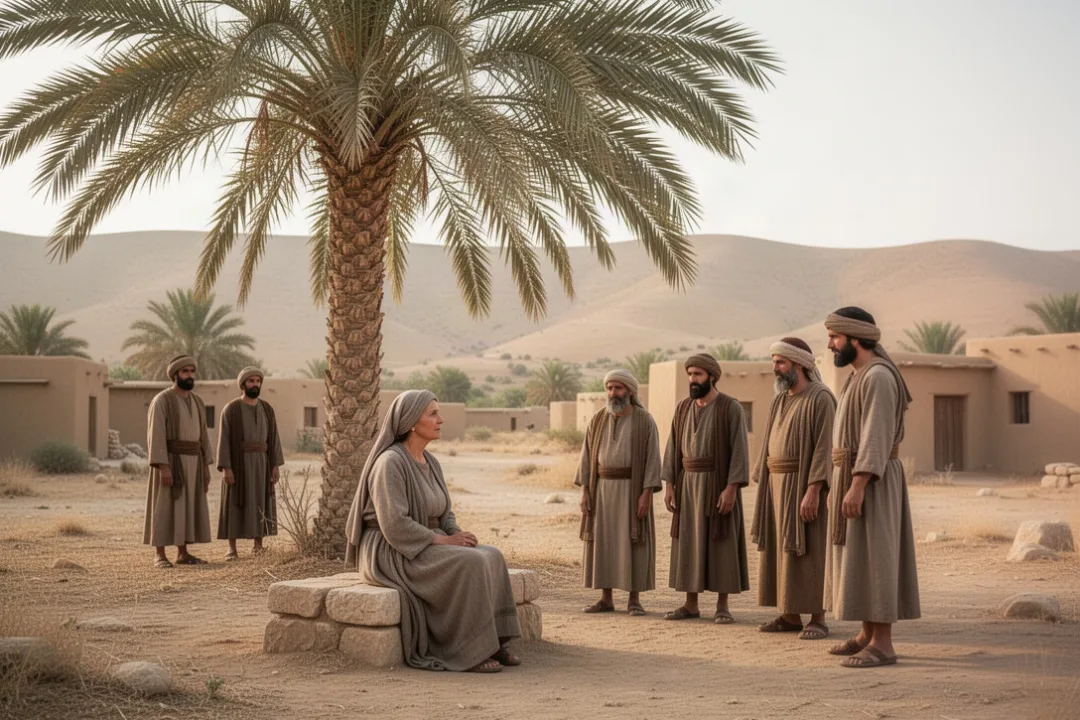
Judges 4 describes her sitting beneath a palm tree between Ramah and Bethel in the hill country of Ephraim. Israelites traveled to her for decisions, suggesting that she was trusted as a wise and capable public authority. The scene is not presented as a private devotional moment. It shows Deborah carrying out a recognized responsibility among the people.
Her name is also associated with another woman in Genesis 35:8: Rebekah’s nurse, who is buried beneath an oak near Bethel. These are generally understood as two different Deborahs. The Deborah of Judges is identified by her work as a prophetess and judge, while Genesis refers to a woman connected with Rebekah’s household.
Keep the two women distinct: Deborah the judge appears in Judges 4–5. Deborah the nurse of Rebekah appears in Genesis 35:8. The Bible gives them the same name but places them in different settings and generations.
Why Israel needed Deborah’s leadership
Israel was being oppressed by Jabin, king of Canaan, whose capital was Hazor. His military commander was Sisera, and Judges 4 emphasizes that Sisera had nine hundred iron chariots. In the ancient world, chariots gave an army a major advantage, especially on suitable open ground.
The oppression had lasted twenty years before the Israelites cried out to the Lord. The length of the crisis helps explain the urgency of Deborah’s actions. This was not a minor border dispute or a single raid. It was a sustained period of domination that had weakened Israel and created fear among its people.
Judges 5 adds poetic details about the condition of the land. The song portrays roads as dangerous, villages as abandoned, and ordinary life as disrupted. These images show that military oppression affected much more than the battlefield. Travel, commerce, farming, and community life all suffered.
Deborah’s leadership begins with discernment. She identifies the real crisis, communicates God’s direction, and calls another leader to act. Her role demonstrates that spiritual leadership can include public judgment, strategic counsel, and practical mobilization.
What Deborah told Barak
Deborah summoned Barak, son of Abinoam, from Kedesh in Naphtali. She told him that the Lord had commanded him to gather ten thousand men from Naphtali and Zebulun and lead them to Mount Tabor. The Lord would draw Sisera and his forces toward the Kishon River, where Israel would gain the victory.
The account presents Deborah’s message as a direct commission, not a suggestion based merely on military probability. She tells Barak what God has commanded and where the battle will unfold. Her prophetic role therefore shapes the entire campaign.
Barak responds that he will go only if Deborah goes with him. Deborah agrees, but she tells him that the honor associated with the victory will not belong to him. The Lord will give Sisera into the hand of a woman.
The text does not necessarily frame Barak’s request as simple cowardice. He may have wanted the presence of the recognized prophet through whom God had spoken. Still, Deborah makes clear that his dependence on her will affect the way the victory is remembered. The narrative then places Deborah beside Barak as the troops move toward battle.
Deborah receives and communicates the divine command.
Barak gathers the fighting force from the northern tribes.
The battle takes place under God’s direction, not merely through human numbers or equipment.
A woman receives the decisive honor, overturning ordinary expectations about military glory.
How the battle against Sisera unfolded
Barak gathers ten thousand men from Zebulun and Naphtali and moves to Mount Tabor. Sisera responds by assembling his chariots and troops. Deborah tells Barak to act because the day of victory has arrived.
Judges 4 says the Lord throws Sisera’s army into confusion before Barak’s attack. The Canaanite forces flee, and Sisera abandons his chariot and escapes on foot. The powerful commander who had appeared to control the battlefield becomes a fugitive.
Judges 5 provides poetic language that helps explain the defeat. The song describes the heavens and the stars as participating in the conflict and says the Kishon River swept the enemy away. Readers commonly understand this as a reference to conditions that made the chariots ineffective, perhaps heavy rain and flooding, although the narrative does not provide a modern meteorological explanation.
The contrast is central: Sisera’s chariots represent technological and military strength, while the battle turns through forces beyond his control. The victory is attributed to the Lord, and Israel’s successful response depends on following the command given through Deborah.
Barak pursues the fleeing army toward Harosheth-hagoyim. Sisera leaves the battlefield and reaches the tent of Jael, the wife of Heber the Kenite. He expects safety because Heber’s household has peaceful relations with Jabin’s people.
How Jael fulfilled Deborah’s prophecy
Jael comes out to meet Sisera and invites him into her tent. He asks for water, but she gives him milk and covers him. When he tells her to stand at the entrance and deny his presence if anyone asks, she agrees.
While Sisera sleeps from exhaustion, Jael takes a tent peg and a hammer and drives the peg through his temple into the ground. Judges 4 presents the act plainly and says that Sisera dies. Barak arrives later while pursuing Sisera and finds that the commander has already been killed.
This episode can be difficult for modern readers because it contains violence and deception. The text does not treat Jael’s action as a general instruction for everyday behavior. It places the act within an ancient war narrative in which Sisera is an enemy commander and Israel is under oppression.
Jael’s action also completes the word Deborah spoke to Barak. The woman who receives the decisive honor is not Deborah but Jael. The story therefore resists a simple expectation that the visible military leader will receive all the credit.
Read the story as a whole: Deborah’s role is not reduced because Jael performs the final act. Deborah provides the prophetic direction, accompanies the campaign, and interprets the victory; Jael completes the defeat of Sisera in an unexpected way.
What Judges 5 adds to Deborah’s story
Judges 5 records the Song of Deborah, a victory poem attributed to Deborah and Barak. It is one of the oldest poetic passages in the Bible and gives a different perspective from the prose account in Judges 4.
The song begins by praising the Lord and honoring the willingness of Israel’s leaders and people. It recalls a time when the land trembled before the Lord and describes God as coming from the southern regions. The poetic language emphasizes divine presence and power rather than offering a step-by-step military report.
Deborah presents herself as a mother in Israel, a phrase that conveys protective, community-centered leadership. She is not described as a biological mother to the nation. Instead, the image suggests that she acted for the welfare of the people and helped restore life to a damaged community.
The song names tribes that joined the battle and questions the absence of others. Zebulun and Naphtali are praised for risking their lives, while several tribes are portrayed as hesitating or remaining occupied with local concerns. This section shows that unity was costly and that the victory depended on active participation.
Judges 5 also praises Jael as the most blessed among women connected with the tent. The song spends significant attention on Sisera’s mother, who waits for her son to return and imagines that he is dividing captured goods. Her expectation creates a sharp contrast with reality: Sisera will not return because he has been defeated.
The poem ends by asking that the Lord’s enemies perish while those who love him rise like the sun. It then states that the land had peace for forty years. The period of peace shows the practical result of the victory, but the song’s main emphasis remains God’s deliverance and the people’s response.
What Deborah’s leadership teaches about women and authority
Deborah is one of the Bible’s clearest examples of a woman exercising recognized public authority over a nation. She is not merely present near a male leader. She judges disputes, speaks prophetically, summons Barak, directs the timing of the campaign, and travels with the army.
The narrative does not pause to defend her right to lead. Her authority is shown through the trust people place in her and through the accuracy of the word she delivers. That presentation matters because Deborah’s leadership is treated as part of the ordinary operation of God’s deliverance in Israel’s crisis.
Her story also avoids reducing leadership to one personality type. Deborah is decisive, but she is not portrayed as seeking personal fame. She directs attention to God’s command and recognizes the contributions of others. She works with Barak rather than replacing him, and she acknowledges Jael’s decisive role.
At the same time, Deborah’s example should not be turned into a simplistic formula about every leadership question. Different Christian traditions interpret biblical passages about women’s roles in different ways. A responsible reading begins by acknowledging what Judges actually says: Deborah exercised substantial authority and was presented positively within the narrative.
Practical ways to study Deborah without missing the context
The story becomes clearer when you read both chapters together and pay attention to what each one emphasizes. Judges 4 gives the narrative sequence, while Judges 5 interprets the victory through poetry, praise, tribal participation, and warning.
Read Judges 4 first. Mark the people, places, commands, and turning points: Deborah, Barak, Jabin, Sisera, Jael, Mount Tabor, and the Kishon River.
Read Judges 5 next. Notice which events receive expanded attention, especially the tribes that joined, those that stayed away, and the contrast between Jael and Sisera’s mother.
Track the source of authority. Ask when Deborah speaks as a judge, when she delivers God’s message, and when she offers encouragement or interpretation.
Separate the characters’ roles. Deborah provides direction, Barak leads the troops, and Jael kills Sisera. Treating them as interchangeable hides the story’s structure.
Consider the social consequences. The victory ends oppression and restores peace, so the story concerns the safety and stability of a whole community.
Compare translations carefully. Differences in wording can affect how you understand titles, poetic images, and descriptions of the battle.
It can also help to distinguish what the text states from what later tradition or speculation adds. The Bible does not tell us Deborah’s age, appearance, education, or detailed personal history. Those gaps should remain gaps rather than being filled with invented certainty.
Common mistakes when interpreting Deborah’s account
Calling Deborah only a military leader. She is explicitly identified as a prophetess and judge, and those roles are essential to the story.
Ignoring Judges 5. The victory song is not an optional appendix; it gives theological and poetic interpretation to the events.
Assuming Barak accomplished everything alone. He led the troops, but Deborah supplied the prophetic direction and Jael killed Sisera.
Confusing Deborah with Rebekah’s nurse. The two women appear in different biblical books and have different identities.
Making the story mainly about personal empowerment. Deborah’s leadership matters, but the text focuses strongly on God’s deliverance, Israel’s response, and the end of oppression.
Using the narrative as a simple rule for violence. Jael’s action belongs to a specific ancient war account and should be interpreted within that setting.
Overstating unknown details. The text does not provide a complete biography, so claims about her private life should be labeled as speculation.
What Deborah reveals about faith and courage
Deborah’s courage is shown through action rather than dramatic self-description. She speaks when the nation is threatened, calls Barak to responsibility, and goes with him when he asks for her presence. Her confidence rests on the conviction that God has already spoken and will act.
Her example also shows that courage can include clarity, persistence, and discernment. Deborah does not rush into battle without direction. She identifies the appointed leader, communicates the command, chooses the moment, and remains present when the risk becomes real.
Barak’s dependence on Deborah highlights another dimension of courage. Strong leadership does not always mean working alone. Barak accepts the need for Deborah’s presence, and the campaign succeeds through cooperation among Deborah, Barak, the participating tribes, and Jael.
The story further teaches that God’s deliverance may arrive through unexpected people. The victory does not follow the conventional path in which the famous commander defeats the opposing commander. Instead, the enemy leader falls in a tent at the hand of a woman outside the expected center of power.
Where Deborah appears in the Bible
Deborah’s main account is found in Judges 4–5. Judges 4 provides the prose narrative of oppression, the call of Barak, the battle, Sisera’s escape, and Jael’s action. Judges 5 preserves the song that celebrates and interprets the victory.
She is not a major figure elsewhere in the Bible. Genesis 35:8 mentions another Deborah, Rebekah’s nurse, but does not connect that woman with the judge in Judges. References to the Deborah of Judges usually focus on her role as a prophetess, judge, and leader during Israel’s conflict with Jabin and Sisera.
For a focused study, read Judges 4–5 in one sitting, then compare the prose and poetry. You can also read the surrounding chapters in Judges to understand the repeated pattern of Israel’s disobedience, oppression, crying out, and deliverance.
Why Deborah’s story still matters
Deborah’s account matters because it presents leadership as a responsibility exercised for the protection and restoration of others. She is respected not because the story gives her a glamorous biography, but because she listens, judges wisely, speaks clearly, and acts when her people are in danger.
Her story also preserves several voices and forms of service. Deborah offers prophetic direction, Barak leads soldiers, the tribes choose whether to participate, and Jael brings the enemy commander’s flight to an end. The victory is remembered as a shared response to God’s deliverance rather than as the achievement of one person alone.
Most of all, Judges 4–5 asks readers to notice how God works through unexpected people and overturns expected patterns of honor. Deborah is a woman with public authority, Jael is the one who defeats Sisera, and the proud Canaanite military power collapses. The final memory is not of human strength by itself, but of faithful action in response to God’s direction.
Frequently asked questions
Was Deborah a prophet or a judge?
She was both. Judges 4 identifies Deborah as a prophetess, meaning she communicated God’s direction, and says that Israelites came to her for judgment. Her role combined spiritual discernment, public decision-making, and leadership during a national crisis. The text does not present these responsibilities as separate careers but as parts of her service to Israel.
Did Deborah personally fight in the battle?
The Bible does not describe Deborah as a combatant. She accompanied Barak and the army, encouraged him to act, and gave the prophetic instruction that shaped the campaign. Barak led the troops, while Jael later killed Sisera. Deborah’s authority was decisive even though she was not described as carrying a weapon in battle.
Was Deborah married to Lappidoth?
Judges 4:4 describes Deborah as the wife of Lappidoth, although the verse provides no additional information about him. Some interpretations discuss the meaning of the Hebrew expression, but the safest reading is to follow the common translation and identify Lappidoth as her husband. The Bible does not offer a fuller account of their marriage or household.
What is the Song of Deborah about?
The Song of Deborah in Judges 5 celebrates Israel’s victory over Sisera and praises the Lord as the true deliverer. It honors the tribes that joined the fight, criticizes those that stayed away, praises Jael, and uses poetry to describe the battle. It ends by recalling a forty-year period of peace for the land.











Leave a Reply