When you are facing a conflict that seems bigger than your strength, you may wonder where to place your confidence. Jehovah Nissi answers with a name for God: “The Lord is my banner.” It points to the Lord as the one who gathers, leads, protects, and gives his people strength in the middle of a battle.
The name appears after Israel’s fight with the Amalekites in Exodus 17:8-16. Moses builds an altar and gives it the name Jehovah Nissi, also written Yahweh-nissi in some translations and study resources. The phrase does not mean that God is a literal flag. It describes God as the visible center of his people’s loyalty and the source of their confidence.
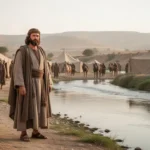
Israel had recently left Egypt and was traveling through the wilderness when the Amalekites attacked at Rephidim. Joshua led the fighting men into the valley, while Moses stood on a hill with the staff associated with God’s power and deliverance.
As long as Moses held up his hands, Israel gained ground. When he became tired and lowered them, Amalek began to prevail. Aaron and Hur supported Moses’ hands until sunset, and Joshua’s forces defeated the attackers. Afterward, Moses built an altar and named it Jehovah Nissi.
The passage connects the name with God’s active help, but it also shows that help through the cooperation of his people. Moses prayed and remained present; Joshua led the army; Aaron and Hur supported Moses. The victory was not presented as the achievement of one remarkable individual.
Core meaning: Jehovah Nissi teaches that God is the rallying point for his people. The name emphasizes dependence on him rather than confidence in personal strength, military ability, or human leadership alone.
What “The Lord is my banner” means
In the ancient world, a banner could identify a group and help people gather around a common leader. On a confusing battlefield, a standard showed where a particular army stood. It represented belonging, direction, and shared purpose.
Calling God a banner therefore expresses several related ideas. God gives his people an identity. He brings them together. He leads them through danger. He is the one they can look toward when fear, confusion, and opposition threaten to scatter them.
The word “my” also matters. Jehovah Nissi is not only a general statement that God rules over battles. It is a confession of personal trust: the Lord is my banner. The speaker identifies with God and chooses to stand under his authority.
At the same time, the name should not be reduced to a promise that every conflict will end exactly as you want. Exodus 17 records a specific victory in Israel’s history. It does not authorize people to label every personal desire as God’s battle or assume that faith guarantees an easy outcome.
Four ideas contained in the name Jehovah Nissi
The name becomes easier to understand when you separate its main themes. Each one reflects something visible in the account of Israel’s battle with Amalek.
God gathers: He gives his people a center of unity when circumstances are chaotic.
God leads: He is not merely a symbol of comfort but the Lord whose direction matters.
God sustains: He provides strength through prayer, faithful action, and the support of others.
God receives the glory: The altar directs attention to what God did rather than turning the victory into a monument to Moses or Joshua.
These ideas work together. A banner is useful because it identifies where people belong, but Jehovah Nissi goes further: God is both the rallying point and the powerful Lord who acts on behalf of his people.
How Exodus 17 explains dependence on God
Moses’ raised hands show ongoing dependence
Moses’ posture on the hill was tied to the battle below. The text does not present his raised hands as a magic technique. Instead, the scene portrays a continuing appeal to God and a visible reminder that Israel’s success depended on more than weapons or battlefield skill.
When Moses grew tired, the battle did not become a private test of his endurance. Aaron and Hur brought a stone for him to sit on and held up his hands. Their actions show that spiritual dependence is not passive. It includes receiving help, accepting limits, and allowing others to share responsibility.
Joshua’s action shows that faith includes obedience
Joshua and the fighting men did not remain in the camp while Moses prayed. They went into the valley and fought the attackers. The passage holds prayer and action together rather than treating them as competing choices.
Jehovah Nissi does not encourage avoidance of every difficult responsibility. Trust in God can involve making a hard call, having a necessary conversation, protecting someone vulnerable, doing honest work, or seeking wise counsel. Dependence on God is compatible with disciplined effort.
Aaron and Hur show why support matters
Moses could not keep his hands raised without help. Aaron and Hur recognized the need and responded practically. Their role prevents readers from imagining that spiritual strength always looks like independence or constant visible confidence.
Sometimes honoring Jehovah Nissi means being the person who needs support. At other times it means noticing that someone else is exhausted and offering steady, concrete help. God’s care often reaches people through faithful companions.
The altar turns a victory into worship
After the battle, Moses built an altar. That response matters because Israel’s victory could easily have become a story about exceptional soldiers, brilliant tactics, or Moses’ spiritual authority. The altar gave the community a physical place to remember God’s role.
Worship keeps success from becoming self-worship. It also helps people remember God’s faithfulness after the immediate pressure has passed. Naming the altar Jehovah Nissi made the meaning of the event clear: the people were to honor the Lord as the one who stood at the center of their deliverance.
Jehovah Nissi and the meaning of God’s name
“Jehovah” is a traditional English form associated with the Hebrew divine name represented in many modern Bibles as YHWH or translated as “the LORD.” “Nissi” is commonly connected with the Hebrew word for a banner, standard, or signal. Together, Jehovah Nissi is usually rendered “The Lord is my banner.”
Some translations and Hebrew discussions present the name with slightly different transliterations, including Yahweh-nissi. These differences reflect conventions for representing Hebrew sounds in English. They do not change the central meaning of the passage.
There is also a grammatical detail behind many study discussions. The phrase in Exodus 17 is linked with a banner or standard, but readers do not need to settle every linguistic question to understand the theological point. Moses named the altar to proclaim that the Lord was Israel’s source of victory and identity.
What Jehovah Nissi does not mean
Because the name uses battle imagery, it can be misunderstood. The passage should not be used to turn ordinary disagreements into holy wars or to claim that God automatically endorses one person’s anger, ambition, or political cause.
It also does not teach that every Christian should expect visible victory over every opponent. The Bible includes faithful people who suffer, wait, lose earthly security, and remain obedient without receiving an immediate change in circumstances.
It does not mean God approves every conflict: Human motives and methods still require moral evaluation.
It does not mean prayer replaces responsibility: Israel prayed, but Joshua and the army also acted.
It does not mean strong believers never grow tired: Moses needed Aaron and Hur.
It does not mean success proves superior faith: God’s presence cannot be measured only by visible results.
It does not mean the phrase is a guarantee of personal prosperity: Its original setting is a specific act of God’s help in Israel’s history.
Used carefully, the name produces humility. You can ask God for help without assuming that your preferred outcome is automatically his will. You can stand firmly for what is right while examining whether your methods show the character of the Lord you claim to follow.
A wise boundary: Use Jehovah Nissi as a name of trust and worship, not as a slogan for hostility. God’s banner calls his people to faithful obedience, courage, humility, and care for others.
The original event involved a military attack, but the name can shape how you respond to many kinds of pressure. A job crisis, family conflict, illness, grief, temptation, or season of uncertainty may feel like a battle, even when no human opponent is involved.
In those situations, Jehovah Nissi reminds you to ask where your identity comes from. If your worth depends entirely on achievement, approval, control, or winning, every setback can feel like a threat to your existence. Seeing the Lord as your banner gives you a steadier center.
That does not remove practical problems. It changes the place from which you face them. Instead of asking only, “How can I prove myself?” you can also ask, “What kind of faithfulness does God ask of me here?”
When you feel outnumbered
Israel’s situation looked dangerous, and many personal situations feel similarly disproportionate. Jehovah Nissi does not require you to deny the facts. You can acknowledge limited resources, real risks, and genuine fear while still refusing to treat those facts as the final authority over your hope.
A useful prayer may name the threat plainly, ask for wisdom, and surrender the result. This kind of prayer is not a way to manipulate God into granting a preferred outcome. It is a practice of placing the crisis under his authority.
When you are exhausted
Moses’ tiredness is part of the account, not an embarrassing detail to ignore. If you are worn down, the name Jehovah Nissi does not tell you to perform strength for everyone around you. It gives you permission to seek support and make wise changes.
That may mean asking a trusted person to pray with you, contacting a pastor or counselor, taking needed rest, or addressing a practical source of strain. Receiving help can be an expression of faith, especially when pride would otherwise keep you isolated.
When you are tempted to claim all the credit
Success can create a different spiritual danger from failure. After a breakthrough, you may begin to believe that your discipline, intelligence, or persistence alone produced the result. Remembering Jehovah Nissi turns achievement into gratitude rather than self-glorification.
This does not deny your effort. Joshua really did lead the troops, and Aaron and Hur really did support Moses. It recognizes that abilities, opportunities, relationships, and endurance are gifts to steward rather than reasons to place yourself at the center.
A practical way to pray with the name Jehovah Nissi
You do not need a special formula to use this name in prayer. The value lies in bringing its meaning into an honest conversation with God. Consider moving through these steps when you are under pressure:
Name the conflict accurately. Describe what is happening without exaggeration, denial, or vague religious language.
Confess misplaced confidence. Acknowledge where you have relied only on control, reputation, money, talent, or another person.
Recognize God’s authority. Address the Lord as the one who gives direction and defines what faithfulness looks like.
Ask for the next obedient step. Seek wisdom for today rather than demanding a complete explanation of the future.
Receive appropriate help. Identify people who can pray, advise, encourage, or assist with practical needs.
Record God’s faithfulness. After the crisis, remember what you learned and give thanks without claiming more certainty than the experience provides.
A prayer might sound like this in your own words: “Lord, you are my banner. I am afraid and I do not control the outcome. Help me act with courage, truth, and love. Show me where I need support, and keep my confidence rooted in you rather than in my ability to win.”
Jehovah Nissi alongside other names of God
Biblical names for God often highlight a particular way people encountered or confessed his character. Jehovah Nissi emphasizes the Lord’s role as the one who gathers and gives victory. Other names focus on his provision, peace, healing, shepherding, or righteousness.
These names should not be treated as separate gods or as mechanical phrases that force a particular result. They are ways Scripture directs attention to the one true God and to aspects of his relationship with his people.
Jehovah Jireh: associated with the Lord’s provision in the account of Abraham and Isaac.
Jehovah Shalom: connected with Gideon’s encounter and the Lord as peace.
Jehovah Rapha: associated with the Lord’s ability to heal and restore.
Jehovah Rohi: commonly understood as “The Lord is my shepherd,” drawing on Psalm 23.
Jehovah Tsidkenu: associated with the Lord as righteousness in Jeremiah.
Jehovah Nissi belongs in that larger biblical pattern. It does not reduce God to one function, such as giving victories. It directs worship toward the Lord who remains faithful in battle, uncertainty, waiting, and ordinary obedience.
The story in Exodus 17 is communal from beginning to end. Israel faces a shared threat, Joshua leads others, Moses stands with the staff, and Aaron and Hur keep him steady. That makes it difficult to use Jehovah Nissi as a purely private slogan.
If God is your banner, you are called to consider the people who stand with you and the people who need your support. A congregation, family, or small group can practice this by praying together, sharing burdens honestly, and refusing to make one exhausted leader carry every responsibility.
Community also offers correction. Other believers may help you notice when you are confusing faith with recklessness, courage with anger, or spiritual conviction with personal preference. Their counsel will not always be perfect, but wise community can protect you from interpreting every impulse as divine direction.
Questions to ask when facing a difficult situation
Applying Jehovah Nissi requires discernment, not a quick label. These questions can help you examine your response before you declare that God is fighting for your position:
What exactly is the conflict, and what part of it is within my responsibility?
Am I seeking God’s will, or am I asking him to bless an outcome I have already chosen?
Does my planned response reflect truth, justice, courage, and love?
Who can offer mature, honest counsel?
What practical action belongs to me, and what result must I release to God?
How can I remain faithful if the outcome is slower or different than I hope?
These questions move the focus from winning at any cost to living under God’s authority. They also preserve the balance seen in Exodus 17: prayer without passivity, action without self-reliance, leadership without isolation, and victory without pride.
Why Jehovah Nissi remains a meaningful name for worship
Jehovah Nissi gives language to a deep human need: the need to know where to stand when circumstances are unstable. The name says that God is not distant from the struggles of his people. He is the one they can gather around, trust, and honor.
It also corrects two opposite errors. One error is despair, the belief that your strength and resources are the only forces available. The other is presumption, the belief that invoking God’s name guarantees your preferred success. The biblical picture offers something more grounded: trusting God while acting faithfully within your limits.
When you say, “The Lord is my banner,” you are making a statement about allegiance. You are acknowledging that your identity is not finally established by the conflict in front of you. You are asking for courage to obey, humility to receive help, wisdom to choose your actions, and faith to leave the outcome in God’s hands.
Frequently asked questions
Is Jehovah Nissi the same as Yahweh Nissi?
Yes. Jehovah Nissi and Yahweh Nissi are different English transliterations connected with the divine name represented by YHWH. “Jehovah” is a traditional English form, while “Yahweh” is commonly used in many modern biblical studies. Both expressions refer to the name given to the altar in Exodus 17 and are generally translated “The Lord is my banner.”
Is Jehovah Nissi a promise that Christians will always win?
No. Exodus 17 records a particular victory in Israel’s history, not a guarantee that every believer will receive a desired earthly outcome. The name calls you to trust God, obey faithfully, seek wise support, and remain humble. Faith includes courage during hardship and perseverance when circumstances do not change quickly.
How can I use Jehovah Nissi in prayer?
You can use the name while honestly describing your situation and asking God for wisdom, courage, and strength. A prayer may recognize the Lord as your source of identity and help, then ask what faithful action belongs to you. It is also appropriate to ask for support from trusted people instead of treating prayer as a reason to carry every burden alone.
Why did Moses build an altar after the battle?
The altar gave Israel a lasting reminder of God’s help. Naming it Jehovah Nissi directed attention away from human achievement and toward the Lord as the source of the victory. It also turned a military event into an act of worship, helping the community remember God’s faithfulness rather than relying only on its own strength or celebrating individual leaders.











Leave a Reply