Jehovah Shammah: meaning and biblical significance
Jehovah Shammah: meaning and biblical significance
Have you ever walked into an empty room, faced an uncertain decision, or wondered where God is in a difficult season? Jehovah Shammah is a biblical name that speaks directly to that question. It means “the LORD is there” and appears at the end of the book of Ezekiel, where the prophet describes a restored city bearing this name.
The name offers a clear message: God’s presence is not absent from his people. In Ezekiel’s vision, the city’s future identity is connected to the Lord dwelling among his people. For Christians and Jews, Jehovah Shammah can therefore serve as a reminder of God’s nearness, faithfulness, and promise to restore, while its original setting keeps the meaning grounded in a specific prophetic vision.
Jehovah Shammah is a traditional English rendering of a Hebrew name associated with Ezekiel 48:35. The phrase is commonly explained as “the LORD is there” or “the LORD is present.” “Jehovah” is a traditional form used in some English translations and Christian teaching for the divine name, while “Shammah” comes from a Hebrew word connected with being there or being present.
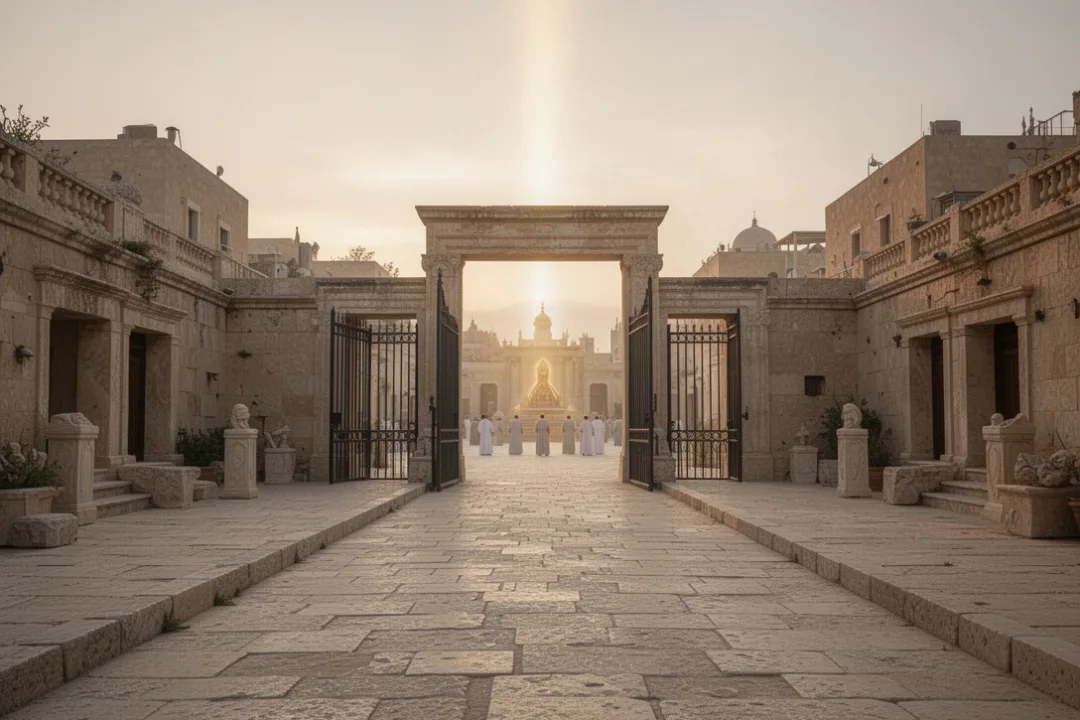
The name is not first introduced as a personal title for an individual. It is given to a city in Ezekiel’s prophetic vision. After describing the allocation of land, the city’s gates, and the arrangement of the tribes, Ezekiel says that the city will be called Jehovah Shammah. The name identifies what makes the restored city distinctive: the Lord’s presence among his people.
This setting matters because a name can lose some of its force when it is removed from its passage. Jehovah Shammah is more than a general statement that God is everywhere. In Ezekiel, it is tied to the return of divine fellowship after judgment, exile, and the loss of Jerusalem’s former glory.
Core meaning: Jehovah Shammah means “the LORD is there.” In Ezekiel 48, the name describes a restored city whose defining feature is God’s presence with his people.
Where Jehovah Shammah appears in Ezekiel 48
Ezekiel 48 forms the closing chapter of a larger vision that begins in Ezekiel 40. The prophet sees a future arrangement of the land, the temple area, the priests, the tribes of Israel, and the city. The vision follows earlier chapters in which Jerusalem and the temple had been associated with corruption, judgment, and the departure of God’s glory.
By the end of the book, the picture has changed. The land is organized, worship has a defined place, and the city has gates named after the tribes of Israel. The chapter ends by naming the city Jehovah Shammah. This ending gives the vision a theological center: restoration is ultimately about God living among his people, not only about buildings, borders, or political stability.
Ezekiel 48:35 is the key reference. It does not present Jehovah Shammah as a phrase spoken during an ordinary conversation or as a name given to a prophet. Instead, it comes as the final designation of the city in a vision of renewal. The name therefore functions as a promise attached to a restored community.
The book’s structure makes this especially meaningful. Earlier, Ezekiel describes the departure of the Lord’s glory from the defiled temple in chapters 8–11. Later, in chapters 43–48, the vision turns toward a renewed sanctuary, ordered worship, and a city marked by divine presence. The movement from departure to return helps explain why the final name carries such weight.
Why God’s presence matters in the biblical story
Throughout Scripture, God’s presence is connected with guidance, protection, worship, covenant, and holiness. God’s presence does not merely make people feel better; it shapes how they live and how they understand their relationship with him. The Bible repeatedly presents the Lord as one who stays with, leads, corrects, and restores his people.
In the early biblical story, God’s presence is associated with the garden, the tabernacle, and the temple. The tabernacle gave Israel a visible center for worship as the people traveled through the wilderness. The temple later became a fixed place associated with the Lord’s name and glory. These settings show that biblical faith treats God as both transcendent and near.
That nearness is never permission to treat sacred things casually. In Ezekiel, the departure of God’s glory follows serious rebellion and injustice. His presence is a gift, but it is also connected with holiness and accountability. Jehovah Shammah should not be reduced to the idea that God approves everything people do simply because he is near them.
The name also speaks against despair. Exile could make Israel feel as if its relationship with God had ended. Ezekiel’s vision answers that fear with a future in which the Lord is again present among a restored people. Jehovah Shammah therefore carries both comfort and correction: God has not abandoned his purposes, and restored life must be ordered around him.
How Jehovah Shammah relates to exile and restoration
Ezekiel prophesied during a period when many people from Judah had been taken into exile in Babylon. Jerusalem had suffered destruction, and the temple had been deeply compromised. The people faced not only political loss but also a spiritual crisis: Had God rejected them permanently?
Ezekiel’s message includes severe warnings about sin and judgment, but it also contains visions and promises of renewal. The Lord speaks of cleansing, a new heart, a new spirit, the revival of dry bones, and a future restoration. These promises do not erase the seriousness of the past. Instead, they show that judgment is not the last word in the prophetic picture.
Jehovah Shammah belongs to this restorative movement. The future city is not described as an ordinary rebuilt settlement. Its name announces that restoration reaches its fullest meaning when God’s presence is restored to the center of communal life. Land, identity, justice, worship, and divine fellowship are brought together.
For a reader facing loss, the name can be deeply reassuring, but it should be used with care. Ezekiel’s vision does not promise that every painful situation will immediately become easy. It points to God’s long-term faithfulness and to a future shaped by his presence. That hope can sustain people while they wait, grieve, repent, and work for what is right.
Jehovah Shammah and other biblical names for God
The Bible uses many names and descriptive titles to reveal different aspects of God’s character. Jehovah Shammah belongs to a group of expressions that connect the divine name with a particular action, provision, or relationship. Comparing them can clarify what makes this name distinctive.
Jehovah Jireh: traditionally associated with the Lord’s provision in Genesis 22, especially in the story of Abraham and Isaac.
Jehovah Rapha: connected with the Lord as healer in Exodus 15:26, where God speaks about healing and obedience.
Jehovah Nissi: associated with the Lord as a banner in Exodus 17:15, following Israel’s conflict with Amalek.
Jehovah Shalom: associated with the Lord as peace in Judges 6:24, after Gideon encounters the angel of the Lord.
Jehovah Tsidkenu: connected with “the LORD our righteousness” in Jeremiah 23:6 and 33:16.
Jehovah Shammah: associated with the Lord’s presence in Ezekiel 48:35.
These expressions should not be treated as a mechanical formula for getting a particular result. They are better understood as faithful descriptions of how Scripture presents God. Jehovah Jireh does not mean that every desire will be supplied on demand, and Jehovah Shammah does not mean that every circumstance will feel peaceful. Each name belongs to a particular passage and theological setting.
Jehovah Shammah is especially distinct because its central emphasis is not first provision, healing, victory, or peace. It is presence itself. The name says that the Lord is there with his restored people. His presence may bring provision, healing, victory, and peace, but those gifts flow from relationship with him rather than replacing it.
Many Christians use Jehovah Shammah as a devotional reminder that God is present in ordinary life. That application can be meaningful when it reflects the biblical context. The name encourages believers to remember that God is not limited to a church building, a worship service, or a dramatic spiritual experience.
At the same time, God’s presence should not be confused with a constant feeling of comfort. A person may trust that God is near while experiencing grief, anxiety, silence, or confusion. Faith in God’s presence is not identical to emotional certainty. The name can support someone who feels alone without pretending that loneliness disappears instantly.
For Christians, the theme of divine presence is also connected with Jesus and the Holy Spirit. The New Testament presents Jesus as “God with us” in Matthew 1:23, using language that emphasizes God’s nearness in Christ. Jesus also promises his continuing presence with his disciples in Matthew 28:20. These references do not erase Ezekiel’s original setting, but they help explain why many Christians see Jehovah Shammah as part of a broader biblical theme.
The Holy Spirit is likewise described as present with and within believers in passages such as John 14–16 and 1 Corinthians 6:19. This does not turn Jehovah Shammah into a slogan detached from Ezekiel. Rather, it gives Christians another way to reflect on the Bible’s continuing emphasis that God does not leave his people without his presence.
How to practice awareness of God’s presence
Jehovah Shammah can shape daily habits without requiring complicated routines. The goal is not to force a spiritual feeling but to make room for honest attention, obedience, and gratitude. A short practice can help you connect the meaning of the name with real decisions and relationships.
Begin with the biblical reference. Read Ezekiel 48:35 and the surrounding chapter. Notice that the name belongs to a restored city and a communal vision, not merely to a private moment.
Name your present situation honestly. Tell God where you feel alone, afraid, distracted, or thankful. Awareness of his presence does not require pretending that everything is fine.
Ask what faithfulness looks like. Consider whether you need to apologize, tell the truth, serve someone, set a wise boundary, or persevere in a responsibility.
Practice attention during ordinary tasks. Pause before work, a difficult conversation, or a major decision and remember that your actions take place before God.
Look for the communal dimension. Share burdens with trusted believers and contribute to a community marked by justice, compassion, worship, and practical care.
End with remembrance. Record one way you experienced help, correction, comfort, or strength. This is not proof that every event had an obvious explanation; it is a practice of gratitude and reflection.
These habits keep the name connected to relationship and obedience rather than using it as a charm. A person can say “Jehovah Shammah” repeatedly and still avoid the responsibilities that come with living before God. The biblical vision points toward a people and a city ordered around the Lord, so personal devotion should also affect how you treat others.
Practical reminder: When you remember that God is present, ask not only, “How can God make me feel better?” but also, “How should I live faithfully in God’s presence right now?”
Common mistakes when explaining Jehovah Shammah
The phrase is simple, but several common explanations can make its meaning less accurate. Avoiding these mistakes helps you use the name with both confidence and respect for its biblical context.
Treating it as a standalone promise for every circumstance: Ezekiel 48 describes a prophetic vision of a restored city. It should not be used to guarantee that every immediate problem will resolve in a particular way.
Ignoring the setting in Ezekiel: The name comes after themes of judgment, exile, temple restoration, land, worship, and community. Removing those themes can make the phrase sound like a vague statement about positive feelings.
Confusing presence with approval: God’s nearness does not mean that every action, attitude, or institution is pleasing to him. Ezekiel connects God’s presence with holiness and accountability.
Assuming believers must always feel God’s presence: Scripture includes seasons of lament, silence, fear, and waiting. Trusting that God is present may continue even when emotional awareness is weak.
Using the name as a formula: Repeating a divine name does not control God or guarantee a desired outcome. Biblical names invite worship, understanding, and faithful response.
Replacing community with private spirituality: Ezekiel’s vision is communal. Jehovah Shammah points to God dwelling among a people, so the name should encourage care for others rather than isolation.
Another mistake is assuming that the traditional spelling “Jehovah” settles every question about Hebrew pronunciation. English Bibles and Christian traditions use several forms for the divine name, including “Yahweh” and “the LORD.” The important point here is the meaning and function of the complete expression: the Lord is there.
Jehovah Shammah in prayer and worship
You can use the theme of Jehovah Shammah in prayer by acknowledging God’s presence, asking for wisdom, and committing to faithful action. A prayer may focus on a hospital room, a family conflict, a new job, a season of grief, or a decision that has no easy answer. The name gives language for saying that God is present even when circumstances remain unresolved.
A balanced prayer might include several movements:
Recognition: Acknowledge God as the Lord who is present.
Honesty: Describe fear, loneliness, anger, uncertainty, or gratitude without disguising it.
Submission: Ask for the willingness to obey rather than only asking for a preferred outcome.
Intercession: Pray for the people and community affected by the situation.
Hope: Look toward God’s promise of restoration without making a prediction about timing.
Worship can also use Jehovah Shammah to move beyond individual comfort. If God’s presence defines the restored city, then worship should lead toward justice, reconciliation, hospitality, and care for vulnerable people. A church that sings about God’s nearness while neglecting suffering neighbors has missed part of the name’s communal force.
What Jehovah Shammah teaches about hope
The name presents hope as more than escape from trouble. In Ezekiel, hope includes a restored place, a renewed relationship, ordered worship, and a community gathered around God’s presence. That is a fuller vision than simply receiving relief from one painful circumstance.
Jehovah Shammah also shows that hope can be anchored in God rather than in ideal conditions. The city is called “the LORD is there” because of who is present, not because human life has become independent of difficulty. Biblical hope looks toward a future in which God’s purposes are made complete, while also shaping faithfulness in the present.
For someone in grief, this may mean holding onto God’s character when answers are limited. For someone making a moral decision, it may mean choosing integrity because life is lived before God. For a congregation, it may mean building a community where people experience practical care that reflects the Lord’s presence.
Jehovah Shammah therefore answers the question, “Where is God?” with a promise rooted in Scripture: the Lord is there with his people. The phrase does not deny suffering, remove the need for repentance, or guarantee immediate comfort. It points to the God who remains faithful, restores what has been broken, and makes his presence the defining reality of a renewed community.
Frequently asked questions
Is Jehovah Shammah the name of a person?
No. In Ezekiel 48:35, Jehovah Shammah is the name given to a restored city in the prophet’s vision. The phrase describes the city’s defining reality: the Lord is present among his people. Some devotional writing applies the name personally, but its original biblical reference is a city, not an individual.
How do you pronounce Jehovah Shammah?
English speakers commonly pronounce it “juh-HO-vuh SHAM-uh” or “juh-HO-vuh SHAM-ah.” Pronunciation can vary because Hebrew names are transliterated in different ways. You may also encounter forms based on “Yahweh,” but the central meaning remains “the LORD is there.”
Does Jehovah Shammah mean God is physically present everywhere?
The phrase emphasizes God’s presence, but Ezekiel uses it in a specific prophetic setting: a restored city associated with God dwelling among his people. It should not be treated as a complete definition of divine omnipresence. The name highlights covenant fellowship, restoration, and God’s central place in the community.
How can I use Jehovah Shammah in a difficult season?
Read Ezekiel 48:35 in context, acknowledge your circumstances honestly, and remember that God’s presence does not require constant positive feelings. Let the name guide both prayer and conduct: seek wisdom, practice faithfulness, accept support from others, and allow hope in God’s restoration without demanding a specific immediate outcome.







Leave a Reply