Pergamum: Meaning, history, and biblical significance
Pergamum: Meaning, history, and biblical significance
Pergamum was an ancient Greek and Roman city near modern Bergama in western Turkey. In the Bible, it is best known as one of the seven churches addressed in Revelation, where Christians faced pressure from pagan worship, imperial power, and competing teachings.
The city stood on a dramatic hill above the Caicus River plain and became a major center of politics, culture, medicine, and religion. Its ruins include a steep theater, temples, a library, an important healing complex, and the remains of the famous Pergamum Altar.
Where Pergamum was located and why the city mattered
Pergamum, also called Pergamon, was located in the region of Mysia in northwestern Asia Minor. The site lies near the modern Turkish town of Bergama, roughly inland from the Aegean coast and north of ancient Smyrna, now Izmir. Its position gave the city access to fertile land, regional roads, and routes connecting the interior with coastal settlements.
The most prominent part of the city occupied a high, naturally defended hill. This upper city, or acropolis, contained royal buildings, temples, public spaces, and monuments. A larger lower city developed around the hill, including commercial and civic areas. The arrangement made Pergamum visually imposing: visitors approaching across the plain could see the royal center rising above them.
Pergamum became especially powerful under the Attalid dynasty, a Hellenistic royal family that ruled the city and surrounding kingdom for several generations. The Attalid rulers invested heavily in architecture and learning, turning Pergamum into a cultural center that competed with other major Greek cities, particularly Alexandria.
In the second century BC, the kingdom of Pergamum came under Roman control through the bequest of its last Attalid ruler, Attalus III. Rome reorganized the region, and Pergamum remained an influential urban center. It did not lose its importance simply because political control changed hands. Its temples, institutions, monuments, and religious traditions continued to shape public life during the Roman period.
Quick answer: Biblical Pergamum refers to the ancient city now represented by the archaeological site near Bergama, Turkey. Its letter in Revelation speaks to a Christian community living inside a powerful center of pagan religion and Roman authority.
The city’s significance came from several strengths working together:
Royal patronage: The Attalid kings made Pergamum a prestigious capital and decorated it with monumental buildings.
Intellectual life: Its library and schools helped establish a reputation for scholarship.
Medical care: The nearby Asklepion became one of the ancient world’s best-known healing centers.
Religious importance: Temples and cults connected the city with Greek, Roman, and local traditions.
Political visibility: Roman imperial worship gave the city a public role in honoring the emperor.
How Pergamum developed under Greek and Roman rule
Pergamum’s rise began before it became a major Hellenistic capital, but the city expanded dramatically under the Attalid kings. The rulers used architecture to communicate wealth, legitimacy, and cultural authority. Public buildings were not merely practical structures; they displayed the dynasty’s claim to lead the region and preserve Greek civilization.
One of the city’s most famous features was its library. Ancient sources associate Pergamum with a large collection of written works and with the production of parchment, although the traditional story that parchment was invented there should be treated cautiously. Parchment was used in many places, but Pergamum became strongly associated with its manufacture and with the rivalry between its library and Alexandria’s.
The city also became known for monumental religious architecture. The Pergamum Altar, commonly identified with the Altar of Zeus, was decorated with an extensive sculpted frieze showing the battle between the Olympian gods and the Giants. The monument expressed divine order overcoming chaos and reflected the political ideals of the Hellenistic kingdom.
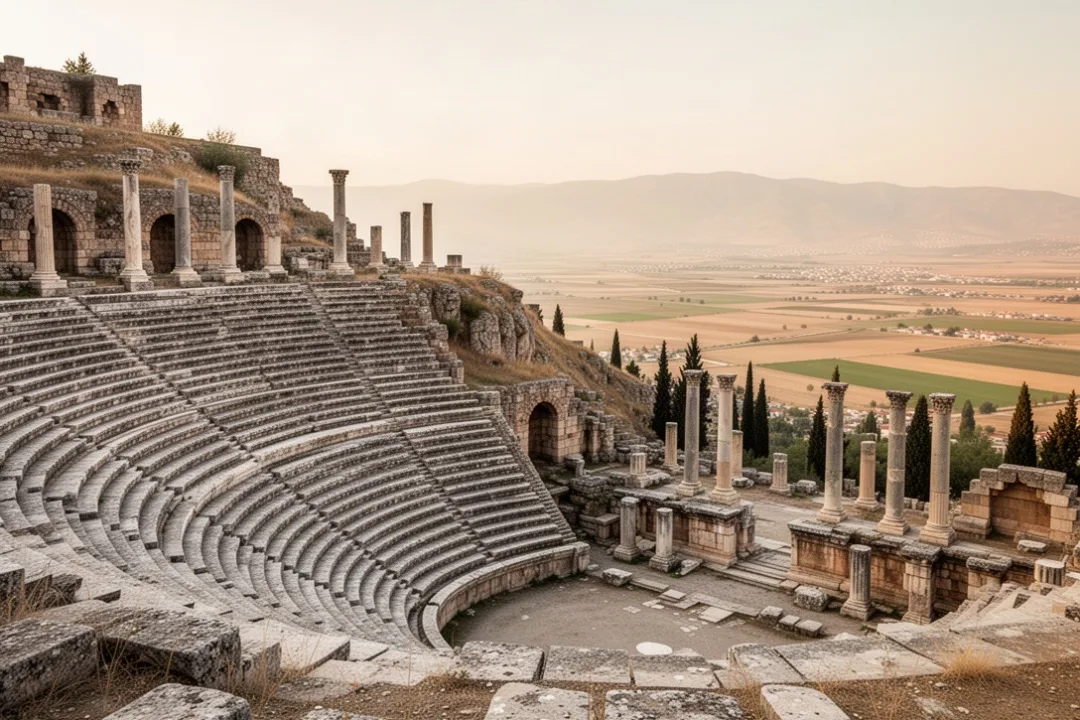
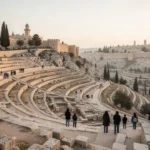
The acropolis included a large theater built into the hillside. Its steep arrangement gave spectators a clear view of performances and of the landscape below. The theater also reveals how Pergamum’s builders adapted grand public architecture to difficult terrain. Instead of flattening the hill, they used its slope to create a striking civic space.
After Rome absorbed the kingdom, Pergamum remained an important city in the Roman province of Asia. Roman authorities and local elites continued to build and restore temples, baths, roads, and public institutions. A Roman temple dedicated to the emperor Trajan stood on the acropolis, showing how imperial loyalty and traditional religion could be expressed through the same urban landscape.
Roman Pergamum was not simply a Greek city with Roman rulers placed above it. The city developed a layered identity. Greek myths, royal memories, local cults, Roman administration, and imperial worship existed together. That mixture helps explain why religious allegiance could become a public and social issue for the Christian community.
What the Bible says about the church in Pergamum
Pergamum appears in Revelation 1–3, within the messages to the seven churches of Asia. The letter to the church in Pergamum is found in Revelation 2:12–17. It presents the risen Christ as the speaker and addresses the congregation’s faithfulness, its weaknesses, and the promise given to those who overcome.
The letter begins by identifying Christ with the image of a sharp, two-edged sword. The image fits the setting because Roman authority was associated with the power of the sword. The message places ultimate judgment and authority with Christ rather than with the empire or its representatives.
The church is commended for holding firmly to its allegiance even while living where Satan’s throne is said to be. The wording is vivid and has generated several interpretations. It may refer to Pergamum’s concentration of temples and cults, its importance in emperor worship, the imposing Altar of Zeus, or the city’s general reputation as a center of spiritual opposition to the Christian faith.
The letter also mentions Antipas, described as a faithful witness who was killed in the city. Revelation does not provide a detailed biography of Antipas, and later traditions about him should be separated from what the biblical text itself says. The essential point is that at least one Christian witness had suffered death, and the church was urged to remember that faithfulness.
Yet the letter does not praise the whole congregation without qualification. Some members are accused of holding to the teaching of Balaam, while others are connected with the teaching of the Nicolaitans. The reference to Balaam recalls the Old Testament account in which Israel was led toward idolatry and sexual immorality, especially in the narrative associated with Numbers 22–25.
Revelation uses this earlier story as a warning about compromise. The concern is not simply that Christians encountered pagan beliefs. It is that some within the church may have accepted practices that conflicted with exclusive loyalty to God. The connection with food sacrificed to idols suggests participation in meals or ceremonies tied to pagan worship, although the exact practices at Pergamum cannot be reconstructed with certainty.
The Nicolaitans are mentioned elsewhere in Revelation, but the New Testament does not give enough information to describe their movement confidently. Several early Christian writers offered explanations, yet those accounts were written later and do not produce a complete historical picture. The safest reading is that the group represented a form of teaching or behavior the letter considered incompatible with Christian faithfulness.
The warning is direct: the church must repent. The letter is therefore balanced. It recognizes courage under pressure, remembers a martyr, exposes internal compromise, and calls the congregation to change. The problem is not merely persecution from outside. A church can resist public hostility while still becoming careless about the beliefs and practices it permits within its own community.
What the promises to Pergamum mean
The letter promises several things to those who overcome. The first is hidden manna. Manna recalls God’s provision for Israel in the wilderness. In the Pergamum setting, the image may contrast faithful dependence on God with participation in meals connected to idolatry. The promise points to divine nourishment and acceptance rather than to the food offered in pagan religious settings.
The second promise is a white stone with a new name written on it, known only to the one who receives it. The exact symbolism is uncertain. Ancient stones could be used in different social, legal, and religious contexts, so no single explanation can be stated as proven. Possibilities include a token of admission, a sign of acquittal, a mark of honor, or a private symbol of belonging.
The new name suggests a personal identity granted by God. In Scripture, a new name can signify a changed relationship, a new role, or divine recognition. The promise to Pergamum’s faithful believers therefore answers the public pressures of the city with a different source of identity. Their status does not depend on civic honor, imperial approval, or participation in the dominant religious culture.
The phrase “hidden manna” should not be treated as a code for a specific object that archaeologists must locate. Revelation uses symbolic language to communicate spiritual realities. Its images draw from Israel’s Scriptures and from the cultural world familiar to its first readers, but they are presented within a prophetic vision rather than as straightforward descriptions of physical artifacts.
For modern readers, the letter raises several practical questions:
Can a community honor members who remain faithful under pressure while still confronting harmful teaching?
How should believers distinguish respectful participation in society from religious compromise?
Which sources of identity compete with spiritual allegiance?
Does public success hide internal weakness?
What does repentance look like when the problem is accepted as normal by the surrounding culture?
The letter’s message is not that every contact with wider society is automatically corrupt. Christians in Pergamum lived, worked, traded, and worshiped within a complex city. The warning concerns unfaithful accommodation: adopting practices or beliefs that make devotion to Christ secondary to social acceptance, economic advantage, or civic expectations.
Why Pergamum is associated with Satan’s throne
The phrase “Satan’s throne” is one of the most discussed expressions in the letter. It should not be reduced to one certain explanation, because Revelation does not identify the phrase explicitly. Several features of Pergamum may have contributed to the image, and more than one may have been in view.
Pergamum possessed an unusually prominent collection of temples and monuments. Its acropolis carried the visual and religious weight of the city. The great altar associated with Zeus may have looked like a throne from a distance or may have represented the city’s concentrated pagan power in the minds of Christians.
Another possibility is the city’s connection with imperial worship. Pergamum was an important center for honoring Roman emperors, and public loyalty to Rome could be expressed through religious ceremonies. For Christians who confessed Jesus as Lord, emperor worship presented more than a private theological disagreement. It could signal whether a person accepted the religious claims woven into civic life.
The city was also associated with the worship of Asclepius, the Greek god of healing, whose symbol was a serpent. Some interpreters connect the serpent imagery with Satan, but that link should be handled carefully. The letter does not name Asclepius, and the serpent had different meanings in different religious contexts. The healing cult may contribute to the overall picture of Pergamum’s religious environment, but it does not prove a single interpretation of the phrase.
The language may also describe the city as a center of opposition to the church rather than point to one monument. Revelation regularly uses symbolic images to portray spiritual powers through political and religious realities. Pergamum’s temples, imperial cult, civic pressure, and persecution could together make the city seem like a place where hostile power had established a seat.
Read the phrase in context: “Satan’s throne” does not require the conclusion that one specific ruin was literally Satan’s throne. It is better understood as prophetic imagery connected with Pergamum’s concentrated religious authority and the pressure placed on Christians.
What visitors can see at ancient Pergamum today
The archaeological site offers a clear picture of the city’s dramatic setting. The acropolis rises above the modern plain, and visitors can see how buildings were positioned to make use of the hillside. The surviving remains do not preserve every structure intact, but the layout conveys the scale of the ancient royal and religious center.
The theater is among the most striking remains. Its seating climbs the slope, and the view from the upper sections extends across the surrounding countryside. The theater’s steepness is a reminder that the city was designed vertically. Processions, temples, and public gatherings would have been experienced against the backdrop of the hill and the plain below.
The ruins also include remains associated with the Temple of Trajan, the Altar of Zeus, the library area, royal palaces, and other civic structures. The original Pergamum Altar is not preserved in its original setting. Much of its surviving sculptural material is held in the Pergamon Museum in Berlin, although the museum’s status and access arrangements can change, so travelers should check current information before planning a visit.
Below the acropolis lies the Asklepion, the ancient healing center. Patients came to the sanctuary seeking treatment, and the complex included spaces for rituals, rest, exercise, and medical care. Ancient healing involved religious practices as well as physical treatments, so the Asklepion illustrates how medicine and worship could be closely connected in the ancient world.
Another important monument in modern Bergama is the Red Basilica, a large Roman-period structure built of brick and later associated with different religious uses. It is often connected with the worship of Egyptian deities, although the building’s history is complex. Its presence adds to the evidence that Pergamum was religiously diverse and architecturally ambitious.
Visitors who want to understand the site should allow time for both the acropolis and the Asklepion. Helpful preparation includes:
Read Revelation 2:12–17 before visiting so the biblical references have a clear setting.
Study a site plan, since many structures are easier to understand as part of the city’s original layout.
Notice the relationship between the hilltop monuments and the plain below.
Compare royal, civic, medical, and religious spaces rather than viewing the ruins as isolated stones.
Check current transportation, opening hours, ticketing, and museum arrangements before traveling.
The archaeological remains cannot answer every question about the Christian congregation. They can, however, make the letter’s setting more concrete. The church was not living in an abstract “pagan world.” It existed among imposing temples, civic ceremonies, healing traditions, imperial expectations, social networks, and public symbols of power.
Pergamum remains significant because its history brings together the biblical text and a visible ancient landscape. The city was celebrated for learning and architecture, known for healing and religious monuments, and shaped by Roman authority. Revelation presents the Christian community within that environment: commended for endurance, warned against compromise, and promised a lasting identity grounded in faithfulness rather than public power.
Frequently asked questions
Is Pergamum the same place as Pergamon?
Yes. Pergamum is the common English form of the ancient city’s name, while Pergamon is another widely used form. The ruins are near modern Bergama in western Turkey. The biblical city in Revelation and the archaeological site visited today refer to the same ancient urban center.
What happened to the church at Pergamum?
The New Testament does not provide a later history of the congregation. Revelation shows that the church endured serious pressure and honored at least one martyr, but it also contained members accused of compromising with idolatrous practices. Later traditions should be treated cautiously because they are not confirmed by the biblical text.
Why was Pergamum important in the ancient world?
Pergamum was important because it served as a Hellenistic royal capital and later remained a major Roman city. It was known for monumental architecture, a prominent library, the Asklepion healing center, religious sanctuaries, and its role in imperial worship. Its hilltop acropolis still reflects the city’s political and cultural ambition.
Can you visit biblical Pergamum today?
Yes. The archaeological remains near Bergama include the acropolis, theater, temple ruins, and other public monuments. The Asklepion lies nearby, and the Red Basilica is in modern Bergama. Conditions, hours, transportation, and museum access can change, so confirm current details with official local sources before traveling.







Leave a Reply