Babylon is both a real ancient city and a powerful biblical symbol of human pride, oppression, exile, and rebellion against God. Its meaning depends on where the name appears: a historical account may refer to the Mesopotamian capital, while a prophetic or New Testament passage may use Babylon to represent a corrupt society or ruling power.
The English name Babylon comes through Greek and Latin forms from the ancient name Bābilim or Bāb-ilim. In Akkadian, the name is commonly understood as “gate of the god” or “gate of the gods.” It reflected Babylon’s importance as a major religious and political center in ancient Mesopotamia.
The Hebrew Bible usually writes the name as Babel. In Genesis 11, the story of the Tower of Babel connects the name with the Hebrew idea of confusion, because God confuses the language of the people building the tower. This is a biblical wordplay on the name rather than a straightforward explanation of its original Akkadian etymology.
That difference matters. The historical name expressed Babylon’s claimed religious greatness, whereas the biblical wordplay emphasizes the limits of human ambition. The same city could present itself as a gateway to divine power and be portrayed by Scripture as a place where pride leads to disorder.
Core idea: Babylon’s meaning has two layers: its historical name points to a “gate of the god,” while its biblical symbolism often points to pride, confusion, domination, and judgment.
Why Babylon matters in biblical history
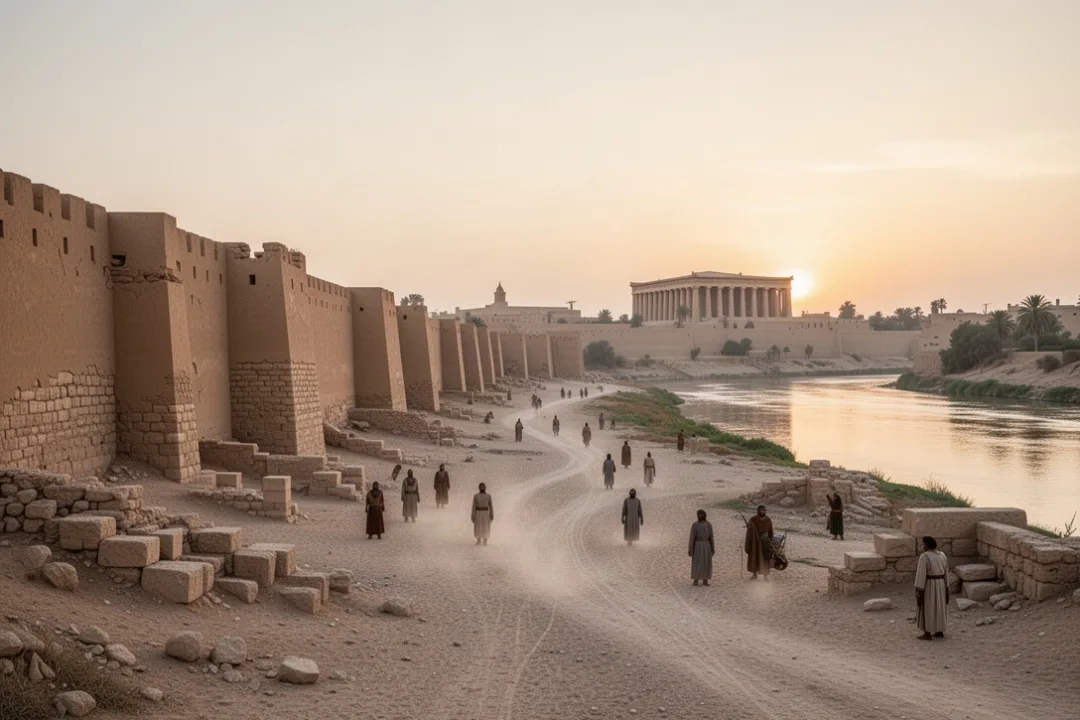
Babylon stood in southern Mesopotamia, in the region between the Tigris and Euphrates rivers. Its ruins are in present-day Iraq, near the modern city of Hillah. For long periods, the city was one of the most influential centers of government, religion, scholarship, architecture, and commerce in the ancient Near East.
Its biblical significance grew especially during the rise of the Neo-Babylonian Empire. Under kings such as Nebuchadnezzar II, Babylon became a dominant regional power. The empire conquered Jerusalem, destroyed the First Temple, and deported many people from Judah to Babylon. Those events shaped Israelite memory and became central to the Bible’s use of Babylon as a symbol.
Babylon therefore represents more than a distant foreign nation. For the people of Judah, it was the place associated with military defeat, forced displacement, the loss of Jerusalem, and life among foreign customs and religious practices. At the same time, the exile became a period of spiritual reflection, prophetic hope, and renewed attention to Israel’s relationship with God.
The Babylonian exile was not described in Scripture only as a political disaster. Prophets interpreted it as judgment for persistent injustice and idolatry, while also promising that God would not abandon the covenant people. Babylon became an instrument of judgment in some passages, yet the empire itself was later condemned for violence, arrogance, and cruelty.
How to understand Babylon’s meaning step by step
Identify the setting. Ask whether the passage refers to the historical city, the empire that ruled from it, or a symbolic power.
Look at the surrounding language. Words about exile, armies, kings, wealth, idols, sexual immorality, or judgment can show which aspect of Babylon is emphasized.
Separate history from symbolism. Babylon was a real place, but biblical writers also used its reputation to communicate broader spiritual and moral ideas.
Notice the contrast with God’s people. Babylon often represents a world organized around human glory, while Jerusalem or the people of God represent worship, covenant, and restoration.
Read the ending of the passage. Prophetic texts often move from Babylon’s apparent strength to its downfall, showing that oppressive power is temporary.
This approach prevents two common errors. One is treating every mention of Babylon as a reference to the same historical event. The other is assuming that every use of the name refers only to a vague idea of evil. The meaning develops across the Bible, and the specific passage should guide the interpretation.
Babylon in Genesis and the Tower of Babel
Genesis 11:1-9 describes people settling in a plain and building a city with a tower that reaches toward heaven. Their stated purpose includes making a name for themselves and preventing themselves from being scattered. God responds by confusing their language, and the people are dispersed.
The story presents collective pride as the central problem. The builders are not condemned simply for making a city or using advanced construction. The concern is their attempt to secure greatness, unity, and fame on their own terms, apart from humble dependence on God.
The tower also illustrates how human cooperation can be used for the wrong purpose. Shared language and organized labor are not evil in themselves. In the story, however, social unity becomes a means of self-exaltation. Babylon therefore begins in the biblical narrative as a picture of civilization turned toward human glory rather than faithful worship.
The confusion of languages explains why the place is called Babel within the story. This gives the name a memorable spiritual association: pride produces confusion, and self-made greatness cannot replace obedience to God. Later biblical references to Babylon echo this first portrait of ambitious power brought low.
Babylon as the empire that conquered Judah
In Kings, Chronicles, Jeremiah, Ezekiel, and Daniel, Babylon appears as a major political power. Its armies conquered Jerusalem and carried many Judeans into exile. The city’s name became inseparable from the trauma of losing the land, the monarchy, and the Temple.
Jeremiah presents Babylon in several ways at once. It is an instrument used in the judgment of Judah, yet it is also guilty of violence and arrogance. Jeremiah 25 and related passages describe the coming domination of Babylon over surrounding nations, while later chapters announce that Babylon itself will face judgment.
Isaiah also portrays Babylon as proud and eventually humbled. Isaiah 13–14 uses elevated poetic language to describe the fall of Babylon and the collapse of an arrogant ruler. Some readers connect parts of this language with Satan because of later Christian interpretation, but the immediate context concerns Babylon and its king. Good interpretation keeps the original setting in view before drawing wider theological applications.
Ezekiel 17 and other prophetic passages refer to Babylon’s political power and its influence over Judah. Daniel places Jewish exiles inside the Babylonian court, where they must remain faithful while serving under foreign rulers. These accounts show that Babylon was not only an enemy outside the community; it was also the environment in which exiles had to make difficult decisions about identity, worship, work, and loyalty.
What Babylon means during the exile
During the exile, Babylon symbolizes displacement and the challenge of remaining faithful in an unfamiliar culture. The exiles were separated from their homeland and Temple, yet biblical texts insist that God’s presence and authority were not limited to Jerusalem. Babylon became a setting in which faith had to be practiced away from familiar religious institutions.
Jeremiah 29 tells the exiles to seek the welfare of the city where they live while awaiting God’s future restoration. That instruction gives Babylon a more complex meaning. The exiles are not told to approve every belief or practice in the empire, but neither are they told to become useless or hostile neighbors. They are to live responsibly, pray, build households, and remain faithful within a society that does not share their covenant identity.
Daniel illustrates this tension through stories involving food, prayer, royal commands, and public loyalty. Daniel and his companions serve in Babylon’s government, learn its language, and interact with its officials, but they refuse to treat the empire’s power as ultimate. Their example suggests that life in “Babylon” can involve wise participation without surrendering worship.
For this reason, Babylon can symbolize the pressure to adapt completely to a dominant culture. The biblical response is neither automatic withdrawal nor uncritical assimilation. It is discernment: serve where you can, resist what violates faithfulness, and remember that every earthly kingdom has limits.
Babylon as a symbol of pride and oppression
Across the prophetic books, Babylon’s symbolic force comes from the combination of power, luxury, violence, and self-confidence. It is not merely a city with many buildings or a wealthy population. It represents a system that uses influence to dominate others and then treats its success as proof of its own greatness.
Babylon’s rulers claim permanence, but the prophets repeatedly announce that the empire will fall. This contrast between apparent strength and eventual judgment is one of the name’s most important meanings. Babylon may look secure because of its walls, armies, wealth, and political reach, yet no human institution is beyond accountability.
The symbol also exposes the moral cost of empire. Conquest may be celebrated by rulers, but the Bible remembers the suffering of the conquered. Deportation, destruction, forced labor, and cultural pressure are not erased by impressive architecture or administrative skill.
That does not mean every government, city, or wealthy society should automatically be labeled Babylon. The symbol is strongest when it identifies a pattern: power that exalts itself, exploits the vulnerable, demands misplaced loyalty, and resists moral judgment. Applying the term responsibly requires humility and attention to the biblical text.
Babylon in Daniel’s visions
The book of Daniel gives Babylon both a historical and symbolic role. In Daniel 1, the Babylonian court attempts to shape the identity of young Judean exiles through education, names, language, and royal service. The story asks whether people can live within a powerful culture without allowing that culture to define their ultimate allegiance.
Daniel 2 presents a dream of a large statue representing a sequence of kingdoms. Babylon is identified with the golden head. Gold communicates splendor and status, but the statue as a whole is temporary and vulnerable. A stone not made by human hands destroys the image, expressing the idea that God’s kingdom ultimately outlasts human empires.
Daniel 3 shows the pressure of public conformity through Nebuchadnezzar’s image and command to worship it. The three Jewish men refuse, even though obedience would be safer. Their resistance does not take the form of a political rebellion; it is a refusal to give divine honor to a ruler’s image.
Daniel 4 focuses on Nebuchadnezzar’s pride. The king boasts about Babylon’s greatness, and the narrative depicts his humiliation before his reason and status are restored. The lesson is stated clearly in the story: God can humble those who walk in pride.
Daniel 5 describes the writing on the wall during a royal feast. Babylon’s leaders celebrate while the kingdom faces judgment. The scene brings together several recurring themes: careless luxury, contempt for sacred things, arrogance, and the sudden end of political power.
The New Testament uses Babylon most prominently in Revelation 17 and 18. There, “Babylon the Great” is portrayed as a wealthy and corrupt power connected with rulers, merchants, luxury, persecution, and spiritual unfaithfulness. The imagery draws heavily on the Old Testament’s portrait of Babylon while expanding the symbol for a later audience.
Revelation does not present Babylon as only a geographical location. It describes a system with international influence, economic reach, political relationships, and cultural seduction. Its downfall affects kings, merchants, and shipmasters, showing that the symbol includes both political domination and commercial dependence.
The woman called Babylon in Revelation 17 is linked with immorality and with the persecution of God’s people. In prophetic symbolism, sexual language can describe covenant unfaithfulness and the seduction of people into alliances that betray God. The imagery is moral and spiritual as well as political.
Revelation 18 then mourns Babylon’s collapse. Those who benefited from its wealth grieve because their profits disappear. Heaven, however, celebrates the end of a power associated with exploitation and violence. The contrast shows that Babylon’s prosperity has been built at the expense of others.
Christians interpret Revelation’s Babylon in different ways. Some understand it as a reference to imperial Rome, especially because Rome dominated the world known to the first Christian readers. Others see it as a continuing symbol of any empire or civilization that combines idolatry, economic injustice, political arrogance, and persecution. Both approaches recognize the text’s connection to earlier biblical descriptions of Babylon.
Is Babylon another name for Rome?
In some early Christian interpretation, Babylon became a coded or symbolic way to refer to Rome. The reason is clear: Rome was the dominant imperial power in the New Testament period, and Christians experienced pressure, exclusion, and persecution under various authorities. First Peter 5:13 mentions Babylon, and many readers have understood that reference as a symbolic name for Rome, although interpretations differ.
Revelation’s Babylon also resembles Rome in its imperial scale, wealth, military influence, international commerce, and relationship with subordinate rulers. Yet the symbol is broader than a simple one-to-one replacement. Revelation draws on the whole biblical memory of Babylon, including Babel, the exile, prophetic judgment, and the downfall of arrogant kingdoms.
It is therefore more accurate to say that Rome may be one historical expression of the Babylon pattern than to claim that the word always means Rome. Biblical symbolism can address a particular first-century situation while also presenting a wider warning about systems that demand ultimate allegiance and profit from injustice.
What “Babylon” can mean in Christian life today
Many Christians use Babylon as a metaphor for a culture organized around wealth, status, domination, pleasure, or self-sufficiency. The metaphor can help people examine the values shaping their choices. It may raise questions about consumerism, political idolatry, economic exploitation, racial or national pride, and indifference to suffering.
Still, the label should not be used casually. Calling an opponent or an entire country “Babylon” can become a way to condemn others while ignoring similar patterns in one’s own community. The biblical prophets directed judgment first toward the people and leaders who were accountable to God, not merely toward outsiders.
A careful modern application asks specific questions:
Does this institution treat power as more important than truth or human dignity?
Who benefits from its wealth, and who carries the cost?
Does it pressure people to give ultimate loyalty to a ruler, nation, market, or ideology?
Are vulnerable people protected, ignored, or exploited?
Does success produce humility and responsibility, or pride and contempt?
These questions preserve Babylon’s ethical meaning without turning the word into a vague insult. The point is not to identify a convenient villain. The point is to recognize how prideful systems work and how easily people become involved in them.
Babylon and the Christian contrast with Jerusalem
Revelation places Babylon and the New Jerusalem in strong contrast. Babylon is associated with luxury built on exploitation, corrupt alliances, spiritual unfaithfulness, and sudden collapse. The New Jerusalem represents God’s presence, healing, justice, open access, and lasting peace.
This contrast develops a major biblical theme: two ways of organizing life. One seeks glory through domination and accumulation; the other receives glory from God and offers life to the nations. One city falls because its greatness depends on violence and deception; the other endures because it belongs to God.
The contrast also corrects a narrow understanding of spirituality. Babylon’s problem is not only private immorality or incorrect worship. Its sins affect trade, politics, labor, public life, and the treatment of human beings. Biblical holiness therefore includes how communities use wealth and power, not just what individuals believe in private.
At the same time, the New Jerusalem is not simply an improved human empire. Its defining feature is God’s presence. The biblical hope is not that people will build a perfect Babylon through better organization, but that God will bring a renewed creation where justice and worship belong together.
“Confusion” comes from the wordplay in Genesis 11. It is a meaningful biblical association, but it is not the complete original meaning of the ancient name. In other passages, Babylon emphasizes exile, military power, wealth, pride, or judgment rather than confusion itself.
Babylon is not only a symbol of sexual immorality
Revelation uses sexual imagery, but Babylon’s corruption includes much more: political influence, economic exploitation, idolatry, violence, luxury, and persecution. Reducing the symbol to personal sexual behavior misses the larger critique of a society built on corrupt power.
Babylon does not mean every large city
The biblical writers were not condemning urban life, architecture, trade, or cultural achievement as such. Babylon becomes a negative symbol when these capacities serve pride, oppression, false worship, and injustice. A city’s size does not make it Babylon; its values and actions matter.
Babylon is not simply a prediction about one modern nation
Some interpreters identify Babylon with a particular present-day country, economic system, religious institution, or political power. Such proposals vary widely and should not be presented as universally established. The enduring biblical warning is more reliable than forcing every detail into a single modern identification.
How to study a passage about Babylon responsibly
Begin by reading the entire passage rather than isolating the name. Determine who is speaking, who is being addressed, what historical crisis is present, and whether the writing is narrative, prophecy, wisdom, or apocalyptic vision.
Next, compare the passage with earlier uses of Babylon. Revelation, for example, cannot be understood well without recognizing its echoes of Genesis, Isaiah, Jeremiah, Daniel, and the exile. The Bible often builds meaning by reusing familiar images in a new setting.
Finally, distinguish what the text clearly says from what an interpretation adds. A passage may clearly condemn arrogance and oppression without identifying a particular twenty-first-century institution. Careful reading allows the warning to remain powerful without claiming certainty where the text does not provide it.
Practical reading tip: When you encounter Babylon in Scripture, ask three questions: What did Babylon represent to the original audience, what behavior is being condemned, and how does the passage show God’s response to that behavior?
Babylon’s meaning is ultimately a warning about misplaced glory. The city’s historical power, the exile it caused, and its later symbolic use all point to the same moral reality: human kingdoms can appear invincible while building their future on pride, coercion, and injustice. Scripture remembers Babylon not because it was powerful alone, but because its power was treated as ultimate.
That warning also carries hope. The prophets and Revelation insist that oppressive systems do not have the final word. Babylon falls, exiles are remembered, and God’s purposes continue beyond the rise and collapse of any empire. The name therefore calls for both honest self-examination and confidence that arrogance, exploitation, and false glory will not last forever.
Frequently asked questions
What does Babylon mean in Hebrew?
In Hebrew, Babylon is written as Babel. Genesis 11 connects the name with the idea of confusion because God confuses the language of the tower builders. This is a biblical wordplay, not necessarily the original historical meaning of the city’s name. The ancient Akkadian name is commonly associated with “gate of the god” or “gate of the gods.”
Why is Babylon considered evil in the Bible?
Babylon is not portrayed as evil merely because it was foreign or powerful. Its negative image comes from conquest, arrogance, idolatry, oppression, luxury built on suffering, and hostility toward God’s people. Biblical writers also show that God could use Babylon as an instrument of judgment while still holding the empire accountable for its violence and pride.
Does Babylon in Revelation refer to Rome?
Many interpreters believe Revelation’s Babylon symbolically refers to Rome because Rome was the dominant imperial power facing the first Christians. Others understand Babylon as a broader image of corrupt political, economic, and religious systems. The symbol draws on the Old Testament’s Babylon, so it can address Rome’s historical setting while also expressing a wider warning about oppressive power.
What is the difference between Babel and Babylon?
Babel is the Hebrew form of the name, especially familiar from the Tower of Babel in Genesis 11. Babylon is the form commonly used for the ancient city and empire in English translations. They refer to the same basic name, but the biblical story gives Babel an association with confused language, while later passages emphasize Babylon’s empire, exile, pride, wealth, and judgment.











Leave a Reply