Bel and the Dragon is the common English name for a pair of stories associated with the prophet Daniel. They appear in Greek versions of Daniel and are usually printed as Daniel 14 in Catholic Bibles. In Orthodox traditions, the stories are also treated as part of Scripture, although the exact arrangement and wording can vary between editions.
Most Protestant Bibles do not include the work among the canonical books. Many Protestant editions print it in a separate section called the Apocrypha, while some omit it altogether. The story therefore has a different status depending on the Christian tradition reading it.
The work is not one continuous adventure. It contains two connected episodes set in Babylon:
Daniel exposes the deception of the priests who serve the idol Bel.
Daniel disproves the claim that a living dragon deserves worship and then destroys it.
Both episodes focus on the same central question: Can an image, animal, or religious institution truly be a god? Daniel answers by testing claims against observable evidence. The priests make confident assertions, but their hidden actions reveal the truth.
The stories also continue the portrait of Daniel found elsewhere in the book. He is not presented primarily as a military hero. Instead, he uses careful observation, logical reasoning, and courage before a powerful king. His faith in Israel’s God is expressed through his refusal to accept false worship and through his ability to expose fraud.
Essential distinction: Bel and the Dragon belongs to the Greek additions to Daniel. It is biblical Scripture for some churches, deuterocanonical or canonical in those traditions, and Apocrypha for many Protestant readers.
How Daniel exposes the priests of Bel
The first story begins with a Babylonian king who believes that Bel is a living god. The king provides the idol with substantial quantities of food and drink each day. At night, the priests enter the temple through a concealed passage and consume the offerings themselves. By morning, the food has disappeared, and the king assumes that Bel has eaten it.
Daniel refuses to accept the explanation. He points out that an idol made by human hands cannot eat or drink. The king responds that Bel must be alive because the offerings vanish. Daniel then proposes a test that shifts the argument away from appearances and toward evidence.
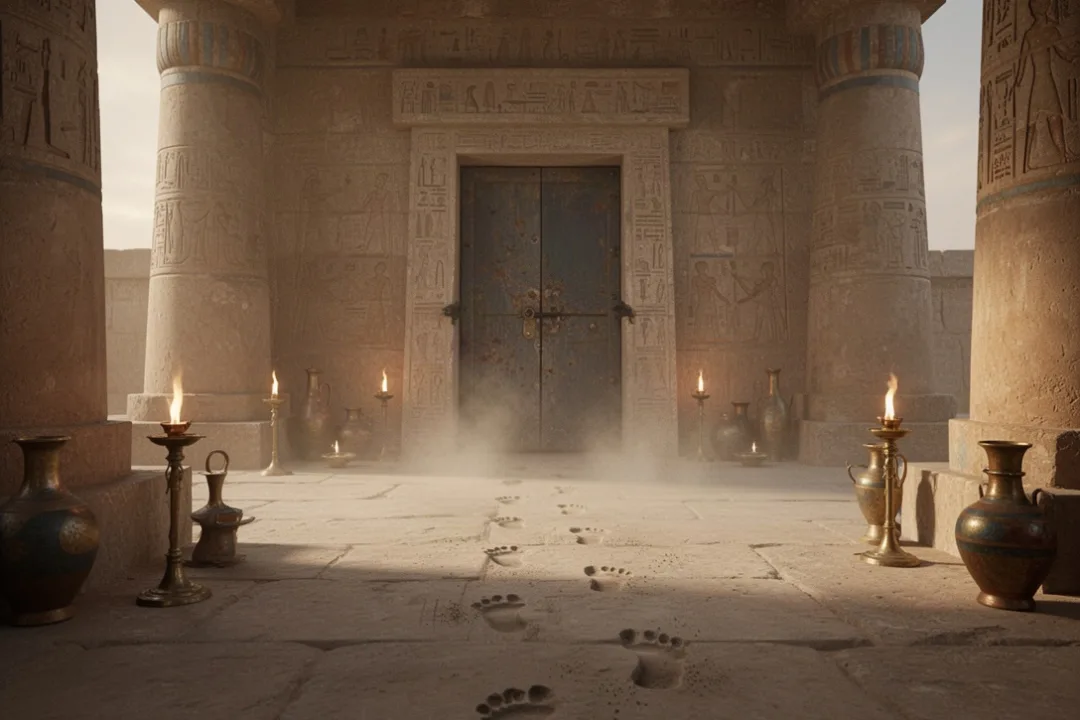
The king allows the priests to leave the temple before the doors are sealed. Daniel orders ash or fine dust to be spread across the floor of the sanctuary. The temple is then closed and marked with the king’s seal. No one should be able to enter without breaking that seal.
The priests believe the test will support their claim. They secretly enter the temple through the hidden passage, as they have done before, and consume the offerings. They leave without disturbing the main entrance. The following morning, the king sees that the food has disappeared and is ready to credit Bel again.
Daniel asks him to examine the floor. The dust reveals footprints belonging to the priests, their families, and servants. The tracks lead to the concealed entrance beneath or near the temple. Daniel has turned an invisible deception into physical evidence.
The king discovers that the priests have been stealing the food. Their secret access to the temple exposes the entire religious performance as a fraud. The idol has not eaten anything, and the priests have used the appearance of a miracle to maintain their authority.
The king then permits Daniel to destroy the idol and its temple. The story describes the temple’s objects being removed and the building being demolished. The priests are also punished for their deception. The episode ends with the false god’s apparent power completely discredited.
The footprints are more than a clever trick. They represent evidence that can be examined by anyone, including the king who initially trusts the priests. The priests depend on secrecy, controlled access, and the king’s willingness to accept their explanation. Daniel introduces a simple test that makes their hidden behavior visible.
This method gives the story a courtroom-like quality. There is an accusation, a claim, a test, physical evidence, and a public verdict. Daniel does not ask the king to rely only on his personal authority. He creates conditions under which the claim can be checked.
The episode also criticizes the use of religious office for personal gain. The priests are not merely mistaken about Bel; they knowingly manipulate the king and consume offerings intended for the idol. Their religious system is shown as a human institution sustained by deception.
Daniel’s challenge is not simply that Bel cannot eat; it is that a claim of divine power should not be protected from examination.
The story does not suggest that every religious mystery can be reduced to a laboratory experiment. Its immediate target is narrower: a concrete claim that an idol consumes food. Since the priests make that claim publicly, Daniel tests it with a concrete method.
How Daniel defeats the living dragon
The second episode begins after the king has accepted Daniel’s argument about Bel. The king points to a dragon or living creature and insists that Daniel cannot deny its reality. Because the creature is alive, the king reasons, it may have a stronger claim to worship than a statue.
Daniel agrees that the creature is alive but rejects the conclusion that it is divine. The story draws a clear distinction between being alive and being God. A living creature may be impressive, dangerous, or unusual without deserving religious worship.
Daniel offers to prove that the dragon is not a god. The king gives him permission. Daniel prepares a mixture made from materials such as pitch, fat, and hair. When the dragon eats it, the mixture causes the creature to burst or die. The precise details differ across translations and textual traditions, but the basic point remains the same: the dragon can be killed because it is a creature, not a deity.
The episode uses an intentionally direct form of reasoning. A god should not be vulnerable in the same way as an ordinary animal. Daniel’s demonstration is not a general argument about every living thing; it is a dramatic exposure of the king’s mistaken worship of this particular creature.
After Daniel destroys the dragon, the people become angry. They accuse the king of abandoning their religion and allowing Daniel to attack the traditional worship of Babylon. The king feels pressured by the public reaction and eventually hands Daniel over to the people.
Daniel is thrown into a pit containing lions. This links the story with the better-known account in Daniel 6, in which Daniel survives the lions’ den after refusing to obey a royal command that conflicts with his worship of God. In the Bel and Dragon account, Daniel remains in the pit for several days.
A prophet named Habakkuk is directed by an angel to bring food to Daniel. Habakkuk is in Judea, while Daniel is in Babylon, so the angel transports him by his hair to the pit. Habakkuk gives Daniel the meal, and then he is taken back home. Daniel is preserved until the king releases him.
The ending reinforces the story’s religious message. The king recognizes the power of Daniel’s God, while the gods and religious claims connected with Bel and the dragon have failed. The narrative presents divine protection and truthful testimony as stronger than royal pressure or popular anger.
What Bel means and what the story criticizes
Bel is a title meaning “lord.” In the Babylonian setting, it is commonly associated with Marduk, the chief god of Babylon. The story does not provide a detailed account of Babylonian theology. Instead, it uses the recognizable figure of Bel as the focus of a Jewish critique of idolatry.
In the ancient Near East, worship could involve images, temples, priests, sacrifices, processions, and offerings. An idol was not always understood by its worshipers as a simple piece of stone or metal. It could function as a visible representation of a deity and as the focal point of the deity’s earthly cult.
Bel and the Dragon simplifies that religious world for the purpose of a sharply drawn story. It presents the idol as unable to act and the priests as exploiting the king’s trust. The narrative’s central claim is that the physical object is not itself the divine power it represents.
The attack on Bel resembles themes found elsewhere in Jewish Scripture. The Hebrew prophets repeatedly contrast the living God with handmade images. They describe idols as objects that have mouths but cannot speak, eyes but cannot see, and hands but cannot act. Those passages should be read as theological arguments rather than as technical descriptions of how every ancient worshiper understood an image.
Bel and the Dragon adds a detective story to that prophetic criticism. Instead of merely declaring that an idol is powerless, Daniel reveals how people create the appearance of power around it. The priests supply the practical explanation for the miracle: they secretly consume the food.
The dragon story expands the criticism beyond manufactured images. Even a living and frightening creature does not become divine simply because people treat it as sacred. The text challenges confusion between power and deity. A creature may possess strength, but it remains dependent, vulnerable, and subject to death.
The work also questions religious authority when it is insulated from scrutiny. The priests control access to the temple and claim special knowledge about Bel. Daniel’s test removes their control by making the temple floor speak through the footprints.
Idols are not self-authenticating: a statue’s presence does not prove that it possesses divine power.
Priestly claims can be tested: religious status does not make a dishonest explanation true.
Life is not the same as divinity: a living creature remains a creature.
Public pressure does not establish truth: the crowd’s anger does not undo Daniel’s evidence.
These themes explain why the stories have continued to interest readers beyond their ancient setting. The work raises questions about authority, evidence, manipulation, and the difference between appearance and reality.
How Bel and the Dragon relates to Daniel and Jewish literature
Bel and the Dragon shares several features with the larger Book of Daniel. It is set in Babylon, centers on a Jewish believer living under foreign rule, and portrays Daniel as faithful to Israel’s God in a hostile environment. It also places Daniel before a king who must decide whether to trust official religious claims or Daniel’s testimony.
At the same time, the stories have a distinctive style. The main Daniel narratives often involve dreams, visions, empires, and symbolic beasts. Bel and the Dragon is more like a courtroom tale or wisdom story. The action depends on a trap, a test, and the interpretation of evidence.
The collection associated with Daniel contains other Greek additions as well. These include the Prayer of Azariah and the Song of the Three Young Men, inserted into Daniel 3 in many Christian editions, and the story of Susanna, commonly printed as Daniel 13 in Catholic Bibles. Bel and the Dragon is commonly printed after them as Daniel 14.
These additions do not appear in the same form in the Hebrew and Aramaic Masoretic text of Daniel. They are preserved especially through Greek textual traditions, including the Septuagint and the version associated with Theodotion. The relationship between these Greek forms is complex, and scholars compare different manuscripts and translations when studying the text.
The original language and date of composition are subjects of scholarly discussion. The stories most likely arose during the Hellenistic period or in a related later setting, but assigning a precise date or identifying a single author would go beyond what the evidence securely establishes. They were eventually attached to Daniel because their setting, hero, and themes fit the book.
Reading note: A heading such as “Daniel 14” identifies the story’s place in a particular biblical edition. It does not mean every Jewish or Christian Bible has always counted these chapters in the same way.
The story’s Babylonian setting also has literary significance. Babylon represents a powerful foreign culture with impressive religious institutions and royal authority. Daniel lives within that world without accepting its worship. His loyalty is not expressed by withdrawing from public life; he works within the royal environment while refusing to call a false god the true God.
That pattern connects Bel and the Dragon with the broader theme of faithful identity under empire. Daniel’s opponents possess access, influence, and public support. Daniel has none of those advantages, yet he can expose their deception because he remains willing to question what everyone else accepts.
How to read the story responsibly today
Bel and the Dragon works on several levels, and readers do not have to choose only one. It can be read as a theological argument against idolatry, a wisdom tale about testing claims, a satire of corrupt religious officials, and a story about faithfulness under political pressure.
For a Christian reader, the first question may be canonical: Does my church regard this text as Scripture? Catholic and Orthodox readers generally encounter it within their biblical tradition. Many Protestant readers encounter it as valuable ancient religious literature without granting it the same canonical status as Daniel’s Hebrew and Aramaic chapters.
For any reader, it helps to distinguish the story’s ancient concerns from modern assumptions. The text is not a neutral report about Babylonian religion, and it should not be used as a complete description of Marduk worship or ancient temple practice. It is a Jewish narrative designed to show the superiority of Israel’s God.
The stories also reward close attention to how claims are established. The king accepts the priests’ explanation because the food disappears. Daniel asks what other explanation might account for the same event. He changes the conditions, seals the temple, and spreads dust on the floor. His investigation shows that an unexplained event is not automatically a miracle.
That lesson can be applied without turning the text into a modern science manual. Daniel is not presenting a general theory of all religious experience. He is showing the value of asking specific questions:
What exactly is being claimed?
What evidence supports the claim?
Could another explanation account for the same evidence?
Who benefits if people accept the claim?
Can the claim be tested without giving one side complete control?
The story also asks how communities should respond when a popular belief is challenged. The people do not calmly reconsider the evidence after the dragon dies. They become angry and turn against Daniel. Their reaction illustrates how religious or political loyalty can become attached to identity, making evidence feel like an attack on the community itself.
Daniel’s conduct is not passive. He speaks clearly, designs a test, exposes wrongdoing, and accepts personal danger. Yet the story’s emphasis remains on truth rather than personal triumph. Daniel does not replace Bel with another image or seek the priests’ authority for himself. He directs worship away from created things and toward God.
Readers can therefore approach Bel and the Dragon with both faith and historical awareness. Its setting is ancient, its literary style is dramatic, and its canonical status differs among traditions. Its enduring questions are still recognizable: What deserves worship, how should authority be tested, and what should you do when evidence contradicts a powerful public claim?
Frequently asked questions
Is Bel and the Dragon part of the Bible?
Its status depends on the Christian tradition. Catholic and Orthodox Bibles generally include it among the additions to Daniel, while many Protestant Bibles place it in the Apocrypha or leave it out. It is not part of the Hebrew Bible in the form found in Greek Christian editions.
Who is Bel in Bel and the Dragon?
Bel is a title meaning “lord” and is commonly connected with Marduk, the chief god of Babylon. In the story, Bel is represented by an idol whose priests secretly consume the offerings made to it. Daniel exposes their deception rather than accepting the idol’s apparent power.
Is the dragon in the story Satan?
The text does not identify the dragon as Satan. It presents the creature as a living being that the king mistakenly worships. Daniel’s point is that being alive, powerful, or frightening does not make something divine.
Why does Daniel use footprints to expose Bel’s priests?
The footprints provide physical evidence that the priests secretly entered the sealed temple. Their hidden passage explains how the offerings disappeared. The scene emphasizes the value of testing a claim instead of accepting an apparent miracle or trusting an authority figure without examination.









Leave a Reply