The Old Testament is the first major section of the Christian Bible, containing writings about creation, Israel’s history, God’s covenant, wisdom, worship, prophecy, and hope. It overlaps substantially with the Jewish Hebrew Bible, although the books are arranged and counted differently in Jewish, Protestant, Catholic, and Orthodox traditions.
If you want to read it, start with Genesis for the foundational stories, Exodus for Israel’s covenant and worship, and selected passages from Psalms, Proverbs, and the prophets. The Old Testament is not one continuous type of book; it is a library of different genres written and preserved across many centuries.
The word testament means covenant or solemn agreement. “Old Testament” is the traditional Christian term for the collection of Scriptures that comes before the New Testament and focuses especially on God’s relationship with Israel.
Many Jewish readers call these Scriptures the Tanakh, a name formed from the Hebrew words for Torah, Prophets, and Writings. “Hebrew Bible” is another common term, particularly when discussing the texts in their Jewish context. Christians often read these books as part of a larger biblical story that leads into the New Testament, while Judaism does not treat the New Testament as Scripture.
The word “old” does not mean worthless, obsolete, or merely ancient. In Christian theology, it generally distinguishes the earlier covenant writings from the New Testament. For Jewish readers, the Hebrew Scriptures remain sacred Scripture in their own right, not simply an earlier stage of a Christian collection.
A useful starting point: The Old Testament is best understood as a library, not as a single book written in one style. Its laws, poems, histories, wisdom sayings, prophetic messages, and stories need to be read according to their different purposes.
How the Old Testament is organized
The arrangement depends on the tradition you are reading. Most Protestant Bibles contain 39 Old Testament books. The Jewish Tanakh contains the same core collection of writings but counts and orders them as 24 books, combining several books that Protestant Bibles separate.
Catholic Bibles include additional books or sections commonly called the Deuterocanonical books. Orthodox Christian traditions may include still more texts or use a somewhat different arrangement. These differences do not mean that every tradition has an unrelated Bible; much of the collection is shared, while the boundaries and organization vary.
In a typical Protestant Bible, the books are grouped like this:
The Law or Pentateuch: Genesis, Exodus, Leviticus, Numbers, and Deuteronomy.
Historical books: Joshua through Esther, describing Israel’s settlement, judges, monarchy, exile, and return.
Poetry and wisdom: Job, Psalms, Proverbs, Ecclesiastes, and Song of Solomon.
Major Prophets: Isaiah, Jeremiah, Lamentations, Ezekiel, and Daniel.
Minor Prophets: Hosea through Malachi. “Minor” refers to shorter length, not lesser importance.
The Jewish ordering places the same broad material into three sections: the Torah, the Nevi’im or Prophets, and the Ketuvim or Writings. This arrangement highlights a different shape of the collection and reflects the Jewish history of interpretation and transmission.
How to read the Old Testament step by step
A thoughtful reading plan prevents common confusion. Instead of assuming that every passage works like a modern history textbook or a direct personal message, identify the book’s genre, setting, audience, and main purpose.
Choose a translation you can understand. Compare a readable modern translation with notes or cross-references when a passage is difficult. No English translation reproduces every feature of the original Hebrew and Aramaic.
Read the book’s opening and closing sections. These often reveal its central concern, setting, or literary shape. A short book such as Ruth or Jonah can be read in one sitting.
Identify the genre. A law, psalm, proverb, royal narrative, prophetic oracle, and vision should not be interpreted in exactly the same way.
Locate the passage in the larger story. Ask what happened before it, what follows it, and how the book presents God, Israel, foreign nations, justice, worship, or human failure.
Pay attention to repeated words and images. Themes such as covenant, holiness, wilderness, wisdom, heart, justice, remnant, and return often connect separate passages.
Separate description from command. A narrative may report violence, deception, or failure without approving it. A command addressed to ancient Israel may require careful consideration before applying it today.
Use cross-references carefully. Later biblical writers often reuse earlier images and passages, but a cross-reference should deepen the original context rather than erase it.
Consult reliable notes for difficult passages. Historical background, manuscript information, and Jewish and Christian interpretations can clarify issues that are not obvious in English.
For a manageable first path, read Genesis 1–50, Exodus 1–20, selected Psalms, Ruth, 1 Samuel, Isaiah 40–55, and Jonah. This sequence introduces creation, ancestors, liberation, covenant, prayer, kingship, exile, hope, and prophetic storytelling without requiring you to read every long legal or genealogical section first.
What the five books of Moses explain
The first five books are called the Pentateuch, meaning “five books.” In Jewish tradition they are the Torah, a central expression of divine instruction. Together they establish the origins of the world, humanity, Israel, worship, law, and covenant.
Genesis: creation, ancestors, and beginnings
Genesis opens with creation and quickly addresses human disobedience, violence, judgment, and the spread of sin. Its second half follows Abraham, Sarah, Isaac, Rebekah, Jacob, Rachel, Leah, and Joseph, showing how a family becomes the beginning of a people.
Genesis repeatedly explores blessing and betrayal, promise and delay, family conflict, and God’s work through imperfect people. Its creation accounts, flood narrative, tower story, and ancestral tales should be read with attention to their theology and literary design, not only as isolated answers to modern scientific questions.
Exodus: liberation, covenant, and worship
Exodus tells of Israel’s oppression in Egypt, Moses’ calling, the departure from Egypt, the covenant at Sinai, and the construction of the tabernacle. The story presents liberation as more than escape: the people are brought into a relationship of worship, responsibility, and communal identity.
The Ten Commandments appear within this larger covenant setting. The detailed instructions for the tabernacle can seem distant to modern readers, but they express a major biblical theme: God’s presence among the people requires holiness, order, and faithful worship.
Leviticus: holiness, sacrifice, and community life
Leviticus concentrates on priests, offerings, purity, festivals, sexual ethics, restitution, and the holy life of Israel. Its repeated concern is that Israel’s worship and social behavior should reflect the holiness of God.
Readers often struggle with its sacrificial system because it belongs to an ancient sanctuary culture. Rather than treating each regulation as a detached rule, consider how Leviticus connects forgiveness, boundaries, bodily life, justice, worship, and communal responsibility.
Numbers: wilderness testing and transition
Numbers combines census lists, legal material, travel narratives, complaints, rebellion, and preparation for entry into the land. The book portrays a generation shaped by fear and disobedience while also showing that the divine promise continues through a changing community.
Deuteronomy: covenant renewal and remembered history
Deuteronomy presents Moses’ speeches before Israel enters the land. It calls the people to remember their past, reject other gods, practice justice, care for vulnerable people, and remain faithful to the covenant.
The book’s central concern is not bare rule-keeping but wholehearted loyalty. It connects love of God with public life, economic conduct, leadership, worship, and treatment of neighbors.
What Israel’s historical books cover
The historical books describe Israel’s life in the land, the rise and fall of kings, the division of the kingdom, exile, and partial restoration. They are not neutral modern histories; they interpret events through questions of covenant faithfulness, justice, worship, leadership, and national failure.
Joshua presents Israel’s entry into and settlement of the land, including difficult warfare narratives that require careful historical, literary, and ethical interpretation.
Judges depicts a recurring pattern of crisis, deliverance, relapse, and social disorder before the monarchy.
Ruth offers a compact story of loyalty, loss, migration, family responsibility, and inclusion within Israel’s community.
Samuel follows the transition from judges to kings, focusing on Hannah, Samuel, Saul, David, power, ambition, and the consequences of royal failure.
Kings traces the monarchy through Solomon, the divided kingdoms, prophetic confrontation, and the destruction of Jerusalem and the temple.
Chronicles retells much of Israel’s story with special attention to Davidic kingship, temple worship, priests, Levites, and the community’s identity.
Ezra and Nehemiah describe efforts to rebuild worship, Jerusalem’s defenses, and communal life after exile.
Esther tells how Jewish people survive a threat within the Persian Empire; in the Hebrew version, God is not directly named, which gives the story a distinctive literary character.
These books do not portray every king or leader as a simple hero. David can be courageous and deeply flawed; Solomon can be wise yet compromised; reforming kings can still fail to solve Israel’s deeper problems. The narratives invite readers to examine how power is used and how religious language can be separated from faithful conduct.
Why the Old Testament includes poetry and wisdom
Wisdom books address suffering, work, love, aging, death, pleasure, speech, friendship, and the search for meaning. They do not all offer the same answer, and that variety is part of their value.
Job challenges simplistic explanations of suffering. Its central character is not presented as suffering because of a straightforward personal sin, and the book refuses to reduce grief to an easy formula. Job’s speeches, his friends’ arguments, and the divine response create a sustained exploration of human limits and trust.
Psalms is a collection for worship and prayer. It includes praise, lament, thanksgiving, confession, royal songs, wisdom poems, and prayers for protection. A psalm may give language to confidence in one passage and anguish in another, allowing worship to include honest emotion rather than forced cheerfulness.
Proverbs offers compact observations about wisdom, speech, money, work, relationships, discipline, and character. Proverbs are general principles, not mechanical guarantees. For example, a saying about diligence should not be used to blame every person who experiences poverty or unemployment.
Ecclesiastes reflects on the instability of achievement, wealth, pleasure, and human control. Its repeated observations about life’s brevity can sound bleak, but they also encourage humility, gratitude, and realistic limits.
Song of Solomon, also called Song of Songs, uses poetic celebration of love and desire. Interpretations differ: some read it primarily as a collection of love poems, while others also see symbolic religious meaning. Its vivid language should be approached as poetry rather than as a conventional narrative.
When a passage feels troubling: Slow down before drawing a conclusion. Check the genre, historical setting, translation notes, nearby chapters, and major themes of the book. A difficult passage deserves careful interpretation, not a rushed defense or dismissal.
How the prophets speak about justice and hope
The prophets were not mainly fortune-tellers. They were covenant messengers who confronted idolatry, exploitation, corrupt leadership, empty worship, and national arrogance. They also announced judgment, defended the vulnerable, and proclaimed hope for restoration.
Isaiah moves between judgment and consolation, addressing Jerusalem, foreign nations, kingship, suffering, justice, and future restoration. Jeremiah speaks during the crisis that led to Jerusalem’s destruction and emphasizes the consequences of false confidence, while also promising a renewed covenant and eventual return.
Ezekiel uses dramatic visions and symbolic actions to interpret exile, divine glory, responsibility, and restoration. Daniel combines court stories with symbolic visions that encourage faithfulness under foreign rule and portray God as sovereign over empires.
The shorter prophetic books, from Hosea to Malachi, address particular historical and theological concerns. Amos condemns exploitation of the poor; Micah links worship with justice and humility; Habakkuk wrestles with violence and divine silence; Haggai and Zechariah encourage rebuilding after exile; Malachi challenges careless worship and covenant unfaithfulness.
Prophetic language often uses poetry, metaphor, hyperbole, and symbolic visions. Images of mountains, beasts, fire, birth, darkness, gardens, and new creation should not automatically be treated as literal descriptions. Context helps determine whether a prophet is addressing an immediate crisis, expressing a broader hope, or doing both.
Major themes that connect the Old Testament
Creation and human responsibility
The Old Testament begins with a world described as ordered and good, yet repeatedly shows human beings misusing freedom, authority, sexuality, speech, and violence. Humanity is portrayed as bearing a distinctive responsibility toward God, other people, and the created world.
Covenant and faithfulness
Covenant language appears throughout the collection. God’s covenants with Noah, Abraham, Israel, and David are not identical, but they all involve promise, relationship, obligation, and identity. Israel’s history becomes a continuing test of what faithfulness looks like in ordinary communal life.
Holiness and presence
Holiness means being set apart for God and living in a way that reflects that relationship. The theme appears in worship, food regulations, festivals, sexual ethics, economic laws, priestly service, and care for strangers, widows, orphans, and the poor.
Justice and mercy
Prophets and laws repeatedly connect devotion to God with treatment of vulnerable people. The Old Testament condemns dishonest weights, land theft, bribery, exploitation, and the abuse of legal power. Mercy is not presented as a substitute for justice; both belong to faithful community life.
Exile, return, and restoration
Exile is both a historical experience and a major theological image. Israel loses land, temple, security, and political independence, then wrestles with whether restoration is possible. The return from exile becomes a pattern for hope, renewal, forgiveness, and the rebuilding of community.
Wisdom books ask how anyone should live when life is unpredictable. They praise teachability and prudence, yet also acknowledge that righteous people suffer and that human understanding is limited. This tension keeps readers from turning biblical wisdom into simplistic formulas.
How Christians and Jews read the Old Testament differently
Jewish and Christian communities share many sacred writings but place them within different interpretive frameworks. Jewish interpretation reads the Tanakh alongside centuries of rabbinic discussion and does not view its meaning as dependent on the New Testament.
Christian interpretation reads the Old Testament as part of the Christian Bible and often connects its themes to Jesus, the church, and the New Testament. Different Christian traditions disagree about how those connections should be made. Responsible reading preserves the original setting of a passage before considering later theological interpretation.
For example, a Christian may read passages about a coming king, servant, shepherd, temple, or new covenant in relation to Jesus. That interpretation can be meaningful within Christian theology, but it should not erase how the passage functioned in its own historical and literary context. Jewish readings may understand the same passage differently or reject the Christian conclusion altogether.
Common mistakes to avoid when reading
Using a verse without its setting: A short line may sound universal when the surrounding passage limits or explains it.
Treating every text as a direct command: Narratives, poems, laws, and visions communicate in different ways.
Assuming the books are arranged chronologically: The Bible’s order is shaped by tradition and genre, not simply by the dates of events.
Flattening ancient cultures into modern categories: Marriage, kingship, sacrifice, slavery, warfare, land, and family were understood within social systems different from those of the present.
Ignoring the voices of lament: Anger, grief, confusion, and protest appear in faithful prayer, especially in Psalms, Job, Lamentations, and the prophets.
Reading difficult laws in isolation: Compare them with related laws, narrative examples, prophetic criticism, and the wider concern for holiness and justice.
Expecting every question to receive one simple answer: The collection often preserves multiple perspectives and invites sustained reflection.
Where to begin reading the Old Testament
Your best starting point depends on what you want to understand. Genesis provides the foundational family stories, while Exodus introduces liberation and covenant. Psalms is accessible for prayer, Proverbs for practical wisdom, Ruth for a short narrative, and Mark or Luke can help Christian readers see how the New Testament engages earlier Scripture.
A practical four-part plan might look like this:
Begin with Genesis and Exodus. Follow the creation stories, ancestors, Moses, the exodus, and Sinai.
Read Ruth and 1 Samuel. These books show loyalty, leadership, kingship, ambition, and the human cost of political power.
Read selected wisdom texts. Try Psalms 1, 23, 42, 51, 73, 90, 103, and 139, along with selected chapters of Proverbs, Job, and Ecclesiastes.
Read the prophets in historical context. Begin with Amos, Micah, Isaiah 1–12, Isaiah 40–55, Jeremiah 7, Ezekiel 34, and Jonah.
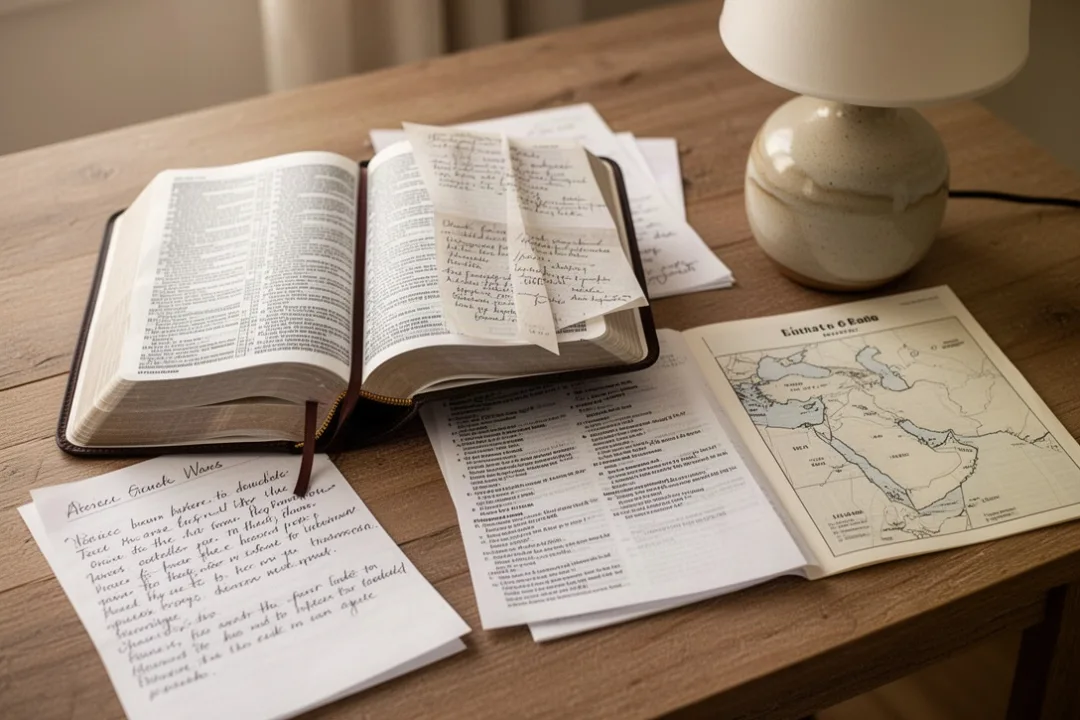
Keep a simple notebook with three questions: What does this passage say?What problem or hope does it address?What assumptions am I bringing to it? Those questions encourage observation before application and make it easier to distinguish the text’s message from your first reaction.
The Old Testament rewards patient reading because its books speak to one another across different periods and genres. Its stories expose both human faithfulness and failure; its laws connect worship with community life; its poems give language to joy and grief; and its prophets insist that genuine devotion cannot be separated from justice, mercy, and truth.
Frequently asked questions
Is the Old Testament the same as the Hebrew Bible?
They overlap extensively, but they are not identical in arrangement or religious context. The Hebrew Bible, or Tanakh, is organized as Torah, Prophets, and Writings and is read within Judaism. The Old Testament is the Christian name for the earlier section of the Bible, arranged differently and interpreted within Christian theology. Catholic and Orthodox Bibles may also include additional books.
How long does it take to read the Old Testament?
The time depends on your pace, translation, and whether you pause for notes. Reading straight through can take many weeks or several months for most people. A slower plan that covers a few chapters several days each week may provide better understanding. Short books such as Ruth, Jonah, and Malachi can be read in one sitting.
Which Old Testament book should I read first?
Genesis is usually the most natural starting point because it introduces creation, sin, covenant, and the ancestors of Israel. Exodus follows well because it explains Moses, liberation from Egypt, and Sinai. If you prefer poetry, begin with Psalms; if you want a short narrative, read Ruth; if you want practical sayings, start with Proverbs.
Why does the Old Testament contain so much violence?
Its books preserve accounts of warfare, conquest, political violence, abuse, and judgment, sometimes as commands, sometimes as accusations, and sometimes as tragic events. Each passage needs attention to genre, historical setting, translation, and literary purpose. Readers should neither ignore the difficulty nor assume every reported action is automatically approved by the text.







Leave a Reply