The word Pentateuch comes from Greek terms meaning “five books” or “five-volume work.” It refers to Genesis, Exodus, Leviticus, Numbers, and Deuteronomy, which appear at the beginning of the Christian Old Testament and form the Torah, or written teaching, in Judaism.
These books combine several kinds of writing. They include creation stories, ancestral narratives, laws, worship instructions, census records, speeches, poetry, and accounts of Israel’s journey from slavery toward the land promised to its ancestors. Read together, they provide a connected account of God, humanity, Israel, covenant, worship, and moral responsibility.
“Pentateuch” is the common Greek-based term in Christian settings. Jewish tradition more often uses Torah, a Hebrew word that can mean instruction, teaching, or guidance. Torah can refer specifically to these five books, but it can also describe the broader body of Jewish teaching in some contexts.
Central idea: The Pentateuch does not present only a collection of religious rules. It tells a story in which laws and worship practices arise within a relationship established between God and a people.
How the five books fit together
The Pentateuch has a clear broad movement. Genesis describes the origins of the world, humanity, and Israel’s ancestors. Exodus recounts liberation from Egypt and the establishment of Israel’s covenant relationship with God. Leviticus explains holiness and worship, Numbers follows the people through the wilderness, and Deuteronomy presents Moses’ final teaching before Israel enters the promised land.
Genesis: Creation, human rebellion, the flood, the ancestors of Israel, and the family of Jacob.
Exodus: Israel’s rescue from Egypt, the covenant at Mount Sinai, and the construction of the tabernacle.
Leviticus: Sacrifices, priests, ritual purity, sacred time, ethical conduct, and holiness.
Numbers: Wilderness travel, censuses, disputes, failures, judgments, and preparation for entry into Canaan.
Deuteronomy: Moses’ speeches, renewed covenant instruction, warnings, blessings, and his death before the land is entered.
The books are not five unrelated units. Promises made to the ancestors continue into the story of Moses and the nation. The liberation described in Exodus leads to covenant obligations, and those obligations shape the laws in Leviticus, Numbers, and Deuteronomy.
Genesis establishes the world and the ancestral family
Genesis begins with the creation of the heavens and earth, the formation of human beings, and the goodness of the created order. Its early chapters also describe human disobedience, violence, the flood, and the scattering of peoples. These stories explain the brokenness of human life while continuing to portray God as active in judgment, preservation, and promise.
The book then narrows its focus to one family. God calls Abraham and makes promises involving descendants, blessing, and land. Abraham’s story includes his wife Sarah, his son Isaac, and the difficult experiences through which the promise appears to be threatened and preserved.
Isaac’s son Jacob, later called Israel, becomes the father of twelve sons. Their family conflicts, especially their treatment of Joseph, lead to a move to Egypt. Genesis ends with Jacob’s descendants living there, setting the stage for the oppression and rescue described in Exodus.
Major themes in Genesis
Creation and human dignity: Human beings are presented as creatures made in God’s image, while also capable of serious wrongdoing.
Promise and blessing: God’s promises to Abraham create a continuing line that connects the ancestral stories to Israel’s later identity.
Family conflict and reconciliation: Rivalry appears repeatedly, but so do forgiveness, survival, and restored relationships.
Providence and human choices: The narrative holds together divine purpose and the consequences of human decisions.
Land and belonging: The promise of land becomes a major theme, although the ancestors often live as migrants or outsiders.
Genesis should not be reduced to a set of isolated stories. The creation accounts, flood narrative, and ancestral cycles contribute to a larger question: How can blessing and faithful relationship continue in a world marked by sin, violence, and uncertainty?
Exodus tells how Israel becomes a covenant people
Exodus opens with the descendants of Jacob suffering under forced labor in Egypt. Moses becomes the central human figure in the story. God calls him to confront Pharaoh, and a series of plagues leads to Israel’s departure from Egypt. The Passover story gives this liberation a lasting ritual form within Israelite worship.
The escape is followed by the crossing of the sea, the journey through the wilderness, and the arrival at Mount Sinai. There, God gives Israel covenant instruction. The Ten Commandments are part of this larger body of teaching, which addresses worship, justice, property, violence, slavery, family relationships, and community responsibilities.
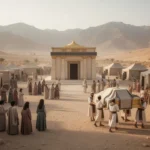
Exodus also describes the construction of the tabernacle, a portable sanctuary associated with God’s presence among the people. The golden calf episode interrupts the covenant story, showing how quickly the people violate their commitment. The covenant is nevertheless renewed, and the book ends with the completed tabernacle filled with the visible sign of divine presence.
The Exodus becomes the Pentateuch’s defining account of deliverance from oppression. Later biblical writers repeatedly refer back to it when discussing justice, worship, national identity, and God’s faithfulness. Israel’s laws are also connected to its memory of having been vulnerable in a foreign land.
That connection affects how the law treats strangers, the poor, workers, and the powerless. The people are not simply told to obey because rules exist; they are reminded of their own experience as an oppressed community. This gives the law a historical and ethical foundation.
Reading tip: Pay attention to the sequence in Exodus: rescue comes before the covenant laws. The narrative presents obedience as a response to an established relationship, not as a way to purchase liberation.
Leviticus explains holiness, sacrifice, and community life
Leviticus is often the most difficult book for modern readers because it focuses heavily on sacrifices, priestly duties, ritual purity, bodily conditions, food restrictions, and sacred festivals. Its material is closely connected to the tabernacle and to the question of how a holy God can dwell among an imperfect people.
The book describes several kinds of offerings, including sacrifices associated with worship, thanksgiving, purification, and repairing wrongdoing. It also outlines the responsibilities of Aaron and the priests, who oversee the sanctuary and its rituals. These practices are part of a system that distinguishes what is holy from what is ordinary and what is clean from what is unclean.
Ritual categories in Leviticus do not always correspond directly to modern ideas of moral goodness or personal hygiene. A person might become ritually unclean through circumstances that were not necessarily sinful, such as contact with death or certain bodily conditions. The rules describe how people could return to ordinary participation in community and worship.
The ethical center of Leviticus
Leviticus is not only about ritual. The Holiness Code, especially in chapters 17 through 26, connects holiness with social behavior. It addresses honesty, fair treatment of workers, care for the poor, protection of the vulnerable, sexual conduct, and respect for neighbors.
The command to love one’s neighbor appears in Leviticus 19. Its surrounding instructions connect neighbor-love with practical actions such as rejecting theft, refusing false testimony, paying workers properly, and leaving some harvest for people in need. The book therefore presents holiness as both worship before God and responsible treatment of other people.
Numbers follows Israel through the wilderness
Numbers receives its English name from the censuses recorded near the beginning and end of the book. Its Hebrew title, based on its opening words, emphasizes the wilderness. Both ideas are useful: the book organizes the people as a community while recounting their long and difficult movement away from Sinai.
The narrative includes camp arrangements, tribal organization, priestly responsibilities, travel stages, complaints, rebellions, military concerns, and laws for life in the land. The people repeatedly struggle with fear and distrust. Their refusal to enter the land after the scouts’ report leads to a judgment that the older generation will not make the journey’s final entry.
Numbers also includes significant figures such as Miriam, Aaron, Moses, Joshua, and Caleb. Miriam and Aaron challenge Moses’ authority, Korah leads another rebellion, and Moses himself later fails to honor God at Meribah. These episodes portray leadership as serious and accountable rather than flawless.
What Numbers contributes to the Pentateuch
Wilderness testing: The journey reveals whether the people trust the promises they have received.
Leadership under pressure: Moses and other leaders face complaint, conflict, and the burden of representing the community.
God’s patience and judgment: The narrative includes both severe consequences and continued guidance.
Preparation for a new generation: The people who will enter the land are organized and instructed for life ahead.
Promise despite delay: The failure of one generation does not erase the larger promise to Israel.
Deuteronomy presents Moses’ final teaching
Deuteronomy is structured largely as a series of speeches by Moses on the plains of Moab, east of the Jordan River. The people are about to enter the land, but Moses will not go with them. He reviews the past, restates the covenant, and calls the new generation to faithful obedience.
The book is not a simple repetition of Exodus, Leviticus, and Numbers. It retells earlier events with a particular emphasis on remembering, teaching, choosing, and loving God. Moses repeatedly urges parents to teach the commandments to their children so that covenant identity will continue across generations.
Deuteronomy also gives detailed attention to worship, economic life, courts, kingship, prophets, warfare, family responsibilities, and treatment of the poor. Its laws often stress that worship cannot be separated from justice. The book’s blessings and warnings present obedience as a matter affecting the whole community.
The final chapters describe Moses’ commissioning of Joshua, a song and blessing, Moses’ view of the land from Mount Nebo, and his death. The Pentateuch ends with Israel still facing the next stage of its story. The promise has moved forward, but the narrative does not depict its full completion within these five books.
Shared themes that connect all five books
Covenant creates a relationship with obligations
A covenant in the Pentateuch is a formal relationship involving commitments and promises. The covenant with Abraham focuses on descendants, blessing, and land. The Sinai covenant establishes Israel as a people bound to God through worship and a way of life. Deuteronomy renews that covenant for the generation preparing to enter the land.
The covenant is therefore more than a private spiritual agreement. It shapes national identity, family instruction, economic rules, worship, leadership, and treatment of outsiders. Its obligations apply to the whole community, although individual actions still carry serious consequences.
God’s presence requires holiness
The tabernacle in Exodus, the rituals in Leviticus, and the camp arrangements in Numbers all reflect a central concern: how can divine presence remain among a human community? Holiness marks what belongs especially to God, while ritual practices provide ordered ways for the community to approach worship.
Holiness also reaches beyond the sanctuary. The Pentateuch repeatedly connects faithfulness with honest business practices, fair courts, sexual integrity, care for the poor, and restraint in the use of power. The sacred and the social are closely related rather than separate spheres.
Land is both promise and responsibility
The land promised to Abraham’s descendants is one of the Pentateuch’s central subjects. Yet the ancestors often live as strangers, and the wilderness generation does not immediately possess what has been promised. Land is presented as a gift, but living in it requires obedience and justice.
Deuteronomy especially warns that possession of the land should not produce forgetfulness or arrogance. The people are told to remember their dependence on God and to protect those who lack security, including foreigners, orphans, and widows.
Memory preserves identity
The Pentateuch repeatedly tells its audience to remember creation, the ancestors, slavery in Egypt, the Exodus, the wilderness, and the covenant. Festivals and teaching practices turn memory into a regular part of communal life. Remembering is not merely recalling facts; it shapes how the people act in the present.
Who wrote the Pentateuch?
Jewish and Christian traditions have long associated the Pentateuch with Moses. Moses is the central prophet, lawgiver, and leader in much of Exodus through Deuteronomy, and the books themselves describe him writing or recording certain instructions. Traditional views differ on how to understand passages that describe events after Moses’ death, especially the account of his burial at the end of Deuteronomy.
Modern biblical scholarship commonly distinguishes between the Pentateuch’s traditional association with Moses and the question of how the final books reached their present form. Scholars study repeated stories, shifts in vocabulary, differing legal collections, changes in divine names, and variations in style. Many conclude that the Pentateuch developed through a long process involving oral traditions, written sources, editors, and communities that preserved and shaped the material.
There is no single modern scholarly explanation accepted by everyone. The classic documentary model proposed several major sources, while other scholars emphasize smaller layers, independent traditions, or the work of later editors. These discussions concern composition and transmission; they do not by themselves determine whether the text is religiously authoritative.
Keep two questions separate: “Who is traditionally associated with the Pentateuch?” and “How did the collection develop into its final form?” Jewish tradition, Christian tradition, and modern scholarship may answer those questions differently.
How Jewish and Christian readers approach the Pentateuch
In Judaism, the Torah is the first and most foundational part of the Hebrew Bible. It is read publicly in the synagogue according to an annual cycle, with sections known as parashot. Torah study includes attention to the Hebrew text, traditional interpretation, legal reasoning, ethical meaning, and the ways the commandments shape Jewish life.
Christian Bibles place the Pentateuch at the beginning of the Old Testament. Christians generally read it as Scripture that reveals God’s character, human sin, covenant, worship, and the history of Israel. Christian traditions differ in how they understand the continuing role of Old Testament laws, often interpreting them through later biblical writings and through the life and teachings of Jesus.
Both traditions recognize the Pentateuch as foundational, but they do not always assign the same role to every law or interpret every passage in the same way. A careful reader should avoid treating one tradition’s interpretation as representative of all Jewish or Christian communities.
A practical order for reading the Pentateuch
Reading all five books can be demanding, especially when long legal sections interrupt the narrative. A plan helps you see how the parts relate rather than treating difficult passages as obstacles.
Read Genesis first for the larger story. Track creation, human failure, Abraham’s family, and the move to Egypt.
Read Exodus in two movements. Follow the rescue from Egypt and Sinai, then connect the tabernacle instructions with the completed sanctuary.
Approach Leviticus by asking what problem each law addresses. Consider holiness, worship, community boundaries, restoration, and ethical conduct.
Read Numbers as a wilderness narrative and community record. Notice how rebellion, leadership, law, and preparation for the next generation interact.
Read Deuteronomy as a series of final speeches. Pay attention to memory, teaching children, social justice, loyalty, and the choice between faithfulness and disobedience.
For a shorter first reading, focus on Genesis 1–12, Genesis 12–50, Exodus 1–24, Exodus 32–40, selected sections of Leviticus 17–26, Numbers 13–14 and 20–24, and Deuteronomy 5–8 and 29–34. Then return to the remaining chapters with a better sense of the collection’s structure.
How to read difficult laws and unfamiliar customs
Some Pentateuchal laws concern sacrifices, slavery, warfare, bodily conditions, punishments, or social structures that require careful context. Reading a rule in isolation can make its purpose difficult to understand. Ask who is speaking, what situation the law addresses, how it relates to the covenant, and whether a later passage modifies or repeats it.
It also helps to distinguish several categories of law. Some rules concern ritual worship, some organize courts and property, some address community ethics, and some regulate the behavior of priests or leaders. These categories can overlap, but identifying the main concern prevents every command from being treated as if it served the same function.
Do not assume that an ancient text’s description of a practice is automatically an endorsement of every aspect of that practice. The Pentateuch sometimes records conflict, failure, or injustice within its narrative without presenting the behavior as a model. Read the surrounding story and observe how the text evaluates the action.
Why the Pentateuch still matters
The Pentateuch supplies vocabulary and themes used throughout the rest of the Bible: creation, covenant, sin, blessing, sacrifice, priesthood, holiness, Exodus, wilderness, promised land, and law. Later prophets, psalms, Jewish writings, and Christian texts repeatedly assume knowledge of these books.
Its influence also extends into ethics and public life. The Pentateuch asks how communities should remember suffering, limit power, protect vulnerable people, organize worship, settle disputes, and use land. Those questions remain recognizable even when readers disagree about how particular laws apply today.
For religious readers, the Pentateuch is sacred instruction and the beginning of God’s dealings with Israel. For literary and historical readers, it is a complex ancient collection that preserves laws, traditions, and stories of lasting importance. Either way, its five books are best understood as a connected whole: a story of origins, liberation, covenant, failure, instruction, and hope at the threshold of a promised future.
Frequently asked questions
Is the Torah the same as the Pentateuch?
In many contexts, yes. Both terms refer to the first five books: Genesis, Exodus, Leviticus, Numbers, and Deuteronomy. “Pentateuch” is a Greek-derived term commonly used in Christian and academic settings, while “Torah” is the traditional Hebrew term in Judaism. Torah can also refer more broadly to Jewish teaching, so its meaning depends on context.
Why does the Pentateuch end before Israel enters the promised land?
The ending keeps attention on Moses’ leadership, the covenant, and the responsibility of the next generation. Moses views the land but dies before entering it, and Joshua is prepared to lead the people forward. This creates a deliberate transition from the foundational period of the Pentateuch to the later history recorded in books such as Joshua.
Are all the laws in the Pentateuch still followed today?
Jewish communities differ in how they interpret and practice the commandments, and many laws depend on the ancient Temple, priesthood, or agricultural setting of Israel. Christians also differ widely, often interpreting Old Testament laws through later biblical teaching. No single answer represents every Jewish or Christian tradition, so a specific law requires attention to its religious context.
What is the difference between the Pentateuch and the Old Testament?
The Pentateuch is only the first five books of the Christian Old Testament. The Old Testament includes many additional writings, such as historical books, poetry, wisdom literature, and prophets. In the Hebrew Bible, the corresponding collection is part of the Tanakh, whose books are arranged and grouped differently from those in most Christian Bibles.








Leave a Reply