If you are trying to place Zipporah in the Bible, the short answer is that she was Moses’ wife and the daughter of a Midianite priest. Her story appears mainly in Exodus, where she helps reveal Moses’ life before leadership, his family ties outside Egypt, and the demanding nature of his calling.
Zipporah is not given a long speech or a separate book, yet she appears at several important moments. She meets Moses after he flees Egypt, marries him in Midian, bears his sons, and takes decisive action during a mysterious episode on the journey back to Egypt. She is also connected to the questions raised by Moses’ family about his marriage and authority.
At a glance: Zipporah was a Midianite woman, the daughter of Reuel or Jethro, Moses’ wife, and the mother of at least one of his sons. The biblical text presents her as active and perceptive, not merely as a background character.
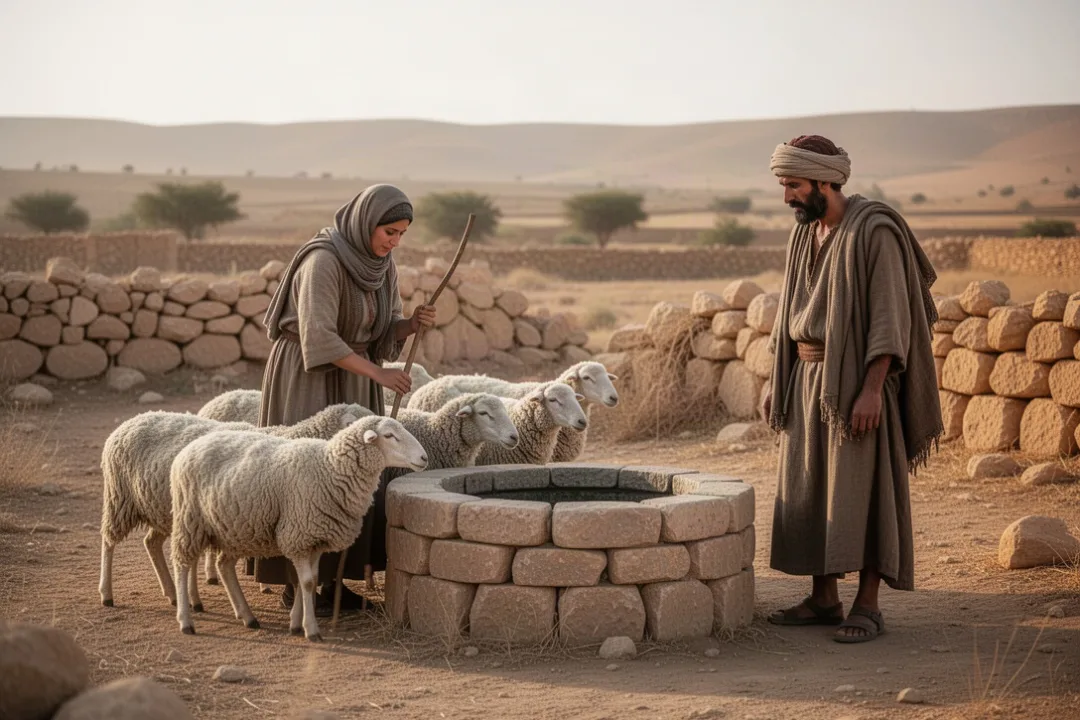
Zipporah first appears in Exodus 2:16-22. Moses has escaped from Egypt after defending a Hebrew man and killing an Egyptian overseer. He reaches Midian, where he sits near a well. A priest of Midian has seven daughters who come to draw water for their father’s flock, but shepherds drive them away. Moses intervenes and helps the women water the animals.
The women return home sooner than expected and explain what happened. Their father then sends for Moses, and Moses begins living with the family. Zipporah becomes his wife, and she gives birth to a son named Gershom. Moses explains the name by connecting it with his experience as a foreign resident in another land.
The passage does not describe a formal courtship or give Zipporah’s personal reaction in detail. It does, however, establish the practical setting of the marriage: Moses is a displaced Egyptian-raised Hebrew living among the Midianites, and Zipporah belongs to the household that receives him. Their relationship begins during Moses’ long period away from Egypt, before he becomes Israel’s leader.
What does Zipporah’s name mean?
The name Zipporah is commonly connected with the Hebrew word for bird. Transliteration varies, so you may see the name written as Zipporah, Tzipporah, or Tsipporah in different resources. The variations reflect differences in how Hebrew sounds are represented in English, not different biblical characters.
The Bible does not give a symbolic explanation of her name. The meaning may be interesting, but it should not be used to construct a personality or predict her role. Her actions and relationships provide stronger evidence about her character than the possible meaning of her name.
How Zipporah met and married Moses
Zipporah’s first scene is built around a conflict over water and work. She and her six sisters are attempting to care for their father’s flock, but other shepherds interfere. Moses steps into the situation, protects their access to the well, and waters the flock. His action shows courage and practical competence, qualities that also appear later in his public leadership.
Her father is called a priest of Midian. Exodus 2 names him Reuel, while later passages refer to Moses’ father-in-law as Jethro. Readers and scholars have suggested several ways to understand this variation, including the possibility of family names, titles, or different traditions within the larger account. The text clearly connects Zipporah with this Midianite household, even when discussions of the father’s name become complicated.
Zipporah’s marriage to Moses also places the biblical story across cultural boundaries. Moses is associated with the Hebrews but was raised in Pharaoh’s household. Zipporah is Midianite, and her family follows its own social and religious traditions. The marriage does not erase those differences, but it becomes part of Moses’ preparation for returning to Egypt and confronting Pharaoh.
When Moses names their first son Gershom, he identifies himself as a resident foreigner. That name reflects more than geography. Moses has lost his position in Egypt, found shelter in Midian, and built a family far from the people he will later lead. Zipporah’s household is therefore central to the years when Moses is living outside the main biblical spotlight.
Zipporah’s family and Moses’ sons
Exodus names at least two sons associated with Moses and Zipporah. The first is Gershom, mentioned in Exodus 2:22. The second is Eliezer, mentioned in Exodus 18:4. The name Eliezer is linked to Moses’ acknowledgment that God helped him against Pharaoh and rescued him from danger.
The narrative does not spend much time describing the boys’ childhoods. They matter because their names preserve Moses’ memories: Gershom reflects his foreign residence, while Eliezer recalls divine help. Zipporah’s role as their mother is stated through the family story, even though the text gives little domestic detail.
Exodus 4 introduces an important change in the family’s situation. God has called Moses to return to Egypt, and Moses begins the journey with his wife and sons. At some point after the troubling circumcision episode described in that chapter, Zipporah and the children are associated with a return to her father’s household. Later, in Exodus 18, Jethro brings Zipporah and the sons to Moses at the Israelite camp.
Because the narrative moves quickly, readers should avoid assuming more detail than the text provides. It does not give a full account of when the family separated, how long Zipporah stayed with her father, or exactly why the arrangement changed. It does show that the family remained connected and that Jethro later reunited them with Moses.
What happened when Zipporah circumcised her son?
The most difficult passage about Zipporah appears in Exodus 4:24-26. Moses is traveling toward Egypt after receiving his commission. At a lodging place, the Lord confronts him, and Moses faces a life-threatening danger. Zipporah then circumcises her son with a flint and touches Moses’ feet with the foreskin. She speaks of Moses as a “bridegroom of blood,” using a phrase whose exact meaning is debated.
The passage is brief and leaves several questions unanswered. It does not explicitly identify which son was circumcised. It also does not state whether Moses had neglected the rite, whether the son had not yet been circumcised for another reason, or how each detail should be interpreted. The text’s compact style has led to many explanations across Jewish and Christian interpretation.
Circumcision was the covenant sign given to Abraham’s male descendants in Genesis 17. It was to be performed on male children within the covenant community. In Exodus, the rite is therefore connected with belonging, obedience, and the identity of the people Moses is about to lead out of Egypt.
Zipporah’s action is significant because she responds when the crisis reaches its most urgent point. She takes the flint, performs the circumcision, and makes a ritual statement. Whatever precise translation or interpretation a reader adopts, the scene portrays her as decisive under pressure.
Why is the “bridegroom of blood” phrase difficult?
English Bibles translate Zipporah’s words in slightly different ways. The expression may refer to Moses, the circumcised son, or the relationship created through the blood of the rite. It may also preserve an ancient phrase whose cultural meaning is not fully clear to modern readers.
Some interpreters understand Zipporah as objecting to the bloody ritual or expressing distress over it. Others view her words as recognizing that the circumcision has removed the threat. Still others connect the phrase with a marriage-related ritual expression. None of these explanations resolves every detail, and the biblical passage does not provide a narrator’s explanation.
Read the passage carefully: Exodus 4 gives enough information to see that Zipporah acted at a critical moment, but not enough to settle every question about the son, Moses’ condition, or the phrase “bridegroom of blood.” A responsible explanation should distinguish the text from later interpretation.
What Zipporah’s action may show about her character
Zipporah is often remembered mainly because of the unusual circumcision account, but that scene fits several broader features of her story. She is connected with work at the well, care for animals, family decisions, and a dangerous journey. In each setting, she is more than a passive observer.
Her action in Exodus 4 may also show that she understood a covenant obligation affecting Moses’ household. The passage does not say exactly how she learned the requirement or what she believed about it. It does show her taking responsibility when the situation demands immediate action.
She also appears as a bridge between different communities. Her marriage joins Midianite and Israelite family networks, while Moses’ own identity connects Hebrew ancestry with Egyptian upbringing. Zipporah’s presence reminds readers that Moses’ life was shaped by relationships beyond the Israelite community in Egypt.
At the same time, it would be inaccurate to turn Zipporah into a flawless hero based on one brief event. The Bible offers too little information for a complete psychological portrait. The safest description is that she is resourceful, courageous, and significant to Moses’ family history, while many details about her motives remain unknown.
Did Zipporah return to her father’s household?
Exodus 18 says that Jethro came to Moses in the wilderness and brought with him Zipporah and her two sons. The wording indicates that they had been sent to, or were staying with, her father before this reunion. The text does not narrate the separation in detail, so interpreters differ about when it occurred and why.
One likely reading is that Moses’ family did not accompany him through every stage of the exodus in the same way. After the crisis in Exodus 4, Zipporah and the children were with her father, and Jethro later returned them to Moses. This arrangement may have offered the family safety or stability while Moses faced Pharaoh and the dangers of the wilderness, but the Bible does not state the reason directly.
When Jethro arrives, Moses greets him and tells him what God has done for Israel. Jethro responds with joy and worship. The meeting then shifts toward leadership advice: Jethro observes Moses judging the people alone and recommends a shared structure in which capable leaders handle smaller matters.
Zipporah does not speak in this chapter, but her return is still meaningful. The family that began in Midian is reunited with Moses at the point when his public responsibilities are expanding. The passage presents her and the sons as part of Moses’ household, even though Jethro receives most of the narrative attention.
Was Zipporah the Cushite woman in Numbers 12?
Numbers 12:1 says that Miriam and Aaron criticized Moses because of the Cushite woman he had married. The text then moves to a dispute about Moses’ unique prophetic authority. Because Zipporah is already known as Moses’ wife, many readers identify her with the Cushite woman.
That identification is possible, but it is not certain. Zipporah is explicitly called Midianite in Exodus, while “Cushite” often points to Cush, a region generally associated with areas south of Egypt. Some interpreters propose that Cushite is another description of Zipporah. Others believe Numbers refers to a different woman, although the passage does not give her name or explain the relationship.
The Bible does not resolve the geographical or marital question in a direct comment. It also does not explain whether Miriam and Aaron’s criticism focused on the woman’s ethnicity, on Moses’ marriage, or on a deeper challenge to Moses’ leadership. The immediate narrative emphasizes that God defends Moses’ unique role rather than providing a full biography of the woman.
For that reason, it is best to describe Zipporah’s connection with the Cushite woman as a debated interpretation, not as an established fact. Readers can mention the possibility while acknowledging that Exodus calls Zipporah Midianite and Numbers uses a different term.
Practical tips for reading Zipporah’s story accurately
Zipporah appears in only a few passages, and those passages are separated by major events in Moses’ life. A careful reading benefits from keeping direct statements, reasonable inferences, and later traditions separate.
Read the main passages together: consult Exodus 2:16-22, Exodus 4:18-26, Exodus 18:1-12, and Numbers 12:1-16.
Separate names from titles: Reuel and Jethro are both associated with Zipporah’s father or Moses’ father-in-law, but the text does not explain the relationship in modern genealogical terms.
Do not claim more sons than the text names: Gershom and Eliezer are associated with Moses, and Exodus 18 refers to two sons.
Keep the circumcision passage’s uncertainty: the text does not identify the son or explain every part of the ritual exchange.
Distinguish Zipporah from the Cushite woman carefully: some readers identify them, while others treat them as separate women.
Notice Zipporah’s actions: she protects her family’s obligations and acts decisively, even though the narrative gives her few spoken lines.
Avoid judging her only by silence: biblical narratives often summarize women’s roles through actions and family events rather than extended speeches.
Common mistakes about Zipporah
Several popular claims about Zipporah go beyond what Exodus and Numbers actually say. They may arise from sermons, fictional retellings, or later interpretations, but they should not be presented as direct biblical facts.
Calling her Egyptian: Exodus identifies her with Midian and the household of a Midianite priest.
Saying the Bible gives her a complete biography: her story is important, but the text covers only selected moments.
Assuming the circumcised child is definitely named: Exodus does not identify the son in that episode.
Claiming she divorced Moses: the Bible describes a period when she and the children were with her father, not a divorce.
Treating the Cushite identification as settled: it remains an interpretive question.
Describing her as opposed to Moses’ mission: the text does not clearly make that claim.
Using the meaning of her name as proof of character: a possible name meaning is not a biography.
Why Zipporah matters in the story of Moses
Zipporah helps readers see Moses before he becomes the central leader of Israel. His life is not only a sequence of miracles, confrontations, and public speeches. It also includes exile, marriage, fatherhood, work, cultural adjustment, and family decisions made under pressure.
Her presence also complicates simple ideas about identity. Moses is raised in Egypt, belongs by birth to the Hebrews, lives in Midian, and marries a Midianite woman. His preparation for leadership takes place across several communities rather than in one isolated setting.
Zipporah’s story further shows that the biblical narrative can give a woman substantial importance without giving her many words. At the well, she belongs to a group of daughters managing their father’s flock. At the lodging place, she acts in a crisis involving the covenant. In the family reunion of Exodus 18, her return marks the restoration of Moses’ household.
Her story raises questions that the text leaves open, but uncertainty does not make the character irrelevant. It invites careful reading. Zipporah remains a significant figure because her choices intersect with Moses’ identity, his family, and the obligations connected with Israel’s deliverance.
Where to read about Zipporah in the Bible
The clearest way to study Zipporah is to read the passages in their narrative order. Each one adds a different part of her story, and no single passage provides the whole picture.
Exodus 2:16-22: Moses meets the daughters of the Midianite priest, marries Zipporah, and becomes the father of Gershom.
Exodus 4:18-26: Zipporah travels with Moses toward Egypt and circumcises a son during a mysterious crisis.
Exodus 18:1-12: Jethro brings Zipporah and Moses’ two sons to the wilderness camp and reunites them with Moses.
Numbers 12:1-16: Miriam and Aaron criticize Moses in connection with a Cushite woman, creating a debated link to Zipporah.
Reading these chapters in context prevents the most common distortion: treating the circumcision episode as if it were Zipporah’s entire story. Her role begins with hospitality and family life, reaches a crisis on the road to Egypt, and continues through the restoration of Moses’ household in the wilderness.
What Zipporah teaches about overlooked biblical figures
Zipporah’s story illustrates why short biblical portraits deserve close attention. A character may appear in only a few verses yet still influence the interpretation of a major leader. Moses’ marriage, children, Midianite years, and return to Egypt cannot be understood without her.
Her example also cautions against equating narrative prominence with personal importance. Zipporah does not lead Israel publicly, receive a long genealogy, or deliver a famous speech. Still, when a crisis arises, her action becomes one of the most memorable moments in the early Moses narrative.
The most balanced reading holds two ideas together: Zipporah is important, and the Bible tells us relatively little about her. That combination calls for respect toward the text’s details and restraint about everything it does not say.
Frequently asked questions
Was Zipporah an Israelite?
No. Exodus presents Zipporah as a Midianite woman, the daughter of a Midianite priest. She married Moses, whose ancestry was Hebrew although he had been raised in Pharaoh’s household. Her marriage connected Moses’ family with Midian and shows that his life and preparation took place across more than one cultural setting.
How many children did Zipporah have with Moses?
The Bible associates Moses with two sons, Gershom and Eliezer, and Exodus 18 describes Zipporah arriving with both sons. The circumcision episode in Exodus 4 mentions a son but does not identify him by name, so the text does not allow readers to state with certainty which child was involved.
Why did Zipporah circumcise her son?
Exodus 4 connects her action with a sudden and dangerous encounter during Moses’ journey to Egypt. Circumcision was the covenant sign given to Abraham’s descendants, so the event concerns an important religious obligation. The passage does not explain every detail, including why the rite had not occurred earlier or exactly what Zipporah’s words meant.
Is Zipporah the Cushite woman in Numbers 12?
Some interpreters identify her with the Cushite woman because Zipporah is already known as Moses’ wife. Others distinguish the two women because Exodus calls Zipporah Midianite and Numbers uses the term Cushite. The biblical text does not settle the question explicitly, so the identification should be presented as possible rather than certain.








Leave a Reply