Abraham is the patriarch whose covenant with God became the foundation of Judaism, Christianity, and Islam. In the Bible, his story follows a man called from his homeland to trust a promise about land, descendants, and blessing. His life includes remarkable faith, painful waiting, serious failures, family conflict, and a willingness to obey God even when the outcome seemed impossible.
Abraham first appears in the book of Genesis as Abram, the son of Terah and a resident of Ur of the Chaldeans. He later travels with his household toward Canaan, stopping for a time in Haran. Genesis presents his life as a turning point: God begins a relationship with one family that will eventually affect many peoples.
Abraham is central to the Bible’s account of God’s covenant people. His son Isaac becomes the father of Jacob, whose name is changed to Israel. Jacob’s twelve sons become the ancestors of the tribes of Israel. Through this family line, the biblical story moves toward the nation of Israel and, in Christian interpretation, toward Jesus.
His importance extends beyond one religious tradition. Judaism, Christianity, and Islam all honor Abraham, although each tradition interprets parts of his life and legacy in distinctive ways. Jewish tradition emphasizes the covenant and the ancestors of Israel. Christianity often highlights Abraham’s trust in God and his connection to the promise fulfilled through Christ. Islam honors him as Ibrahim, a devoted monotheist and prophet associated with the rebuilding of the Kaaba alongside his son Ishmael.
Names to remember: Abram is the name used earlier in Genesis; Abraham is the name God gives him when the covenant is emphasized. His wife is first called Sarai and later Sarah.
The setting of Abraham’s story in Genesis
Most of Abraham’s biblical story appears in Genesis chapters 11 through 25. The account begins after the story of the Tower of Babel and the genealogy leading from Noah’s family to Terah’s household. This placement matters because Genesis shifts from the broad history of humanity to the specific family through which God’s purposes will unfold.
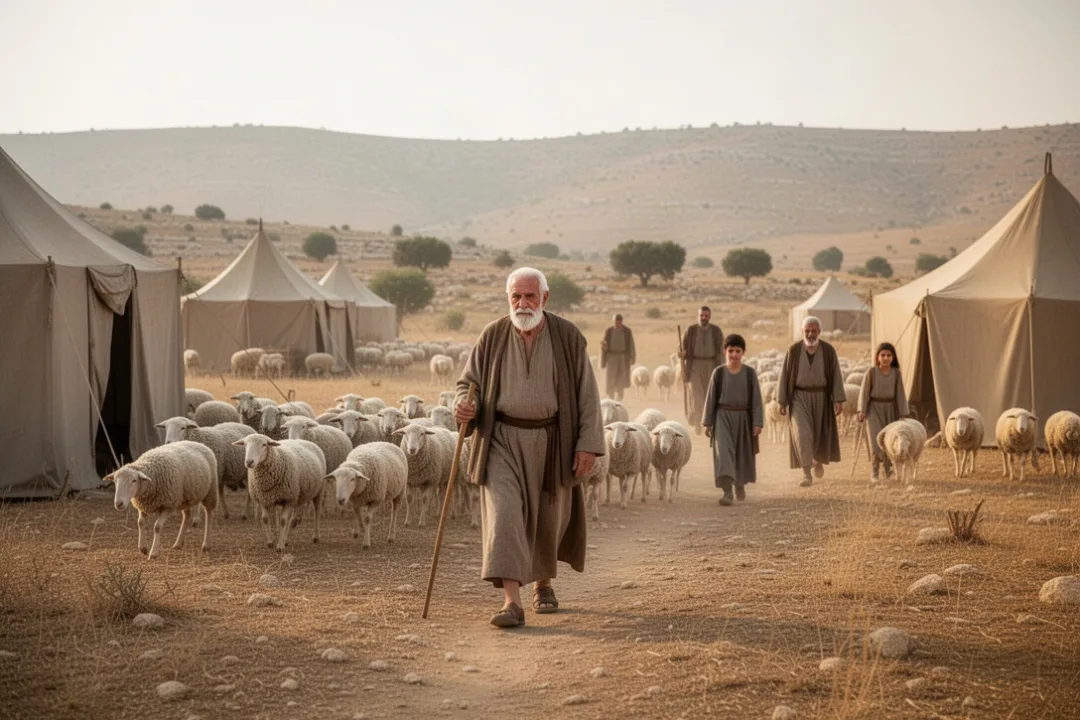
Abraham lives in a world of extended households, traveling herds, city-states, local rulers, and competing religious practices. His wealth is measured partly in livestock and servants, and his security depends on family relationships, land, alliances, and access to water. A decision to leave one region for another is therefore not a simple change of address; it places an entire household at risk.
The biblical narrative does not give a modern biography with a complete timeline. It focuses on selected encounters that reveal Abraham’s relationship with God and the consequences of his choices. Some episodes repeat similar situations, such as Abraham identifying Sarah as his sister in foreign territory. Rather than smoothing away these tensions, Genesis shows a complicated person whose faith grows amid fear and uncertainty.
Abraham’s story step by step
He leaves his homeland. God calls Abram to leave his country, relatives, and father’s household for a land that God will show him. The promise includes descendants, a great name, and blessing for other peoples through him (Genesis 12:1-3).
He travels through Canaan. Abram reaches Canaan and builds altars at significant locations, including Shechem and the area near Bethel. These acts mark the land as central to the promise and show his worship in a new place (Genesis 12:4-9).
He faces famine and fear. A famine sends Abram toward Egypt. Afraid that others will kill him because of Sarai’s beauty, he presents her as his sister. The plan creates danger for Sarai and exposes Abram’s fear (Genesis 12:10-20).
He separates from Lot. As Abram and his nephew Lot become wealthy, their herdsmen quarrel over grazing land. Abram offers Lot the first choice, and Lot selects the well-watered Jordan Valley. Abram remains in Canaan (Genesis 13).
He rescues Lot. After Lot is captured during a conflict among local kings, Abram gathers trained men from his household and rescues him. On his return, he meets Melchizedek, king of Salem, who blesses him (Genesis 14).
He receives the covenant promise. God promises Abram descendants as numerous as the stars and counts his trust as righteousness. A covenant ceremony then confirms the promise of land and future nationhood (Genesis 15).
He and Sarai try to solve the waiting. Because Sarai remains childless, she gives her Egyptian servant Hagar to Abram. Hagar bears Ishmael, but tension develops between Hagar and Sarai. The episode shows the human cost of trying to force a promised future through human planning (Genesis 16).
His name and covenant sign change. God changes Abram’s name to Abraham and Sarai’s to Sarah. Circumcision becomes the sign of the covenant for Abraham’s household and descendants (Genesis 17).
He intercedes for Sodom. Abraham speaks with God about the fate of Sodom and asks whether the city might be spared for the sake of righteous people living there. The scene presents him as both reverent and willing to plead for others (Genesis 18).
Isaac is born. Sarah gives birth to Isaac in her old age, fulfilling the promise of a son through whom the covenant line will continue. The name Isaac is connected with laughter, reflecting the earlier disbelief and later joy surrounding his birth (Genesis 21).
He is tested through Isaac. God commands Abraham to offer Isaac, but stops him before the sacrifice is completed. A ram is provided instead. The account is one of the Bible’s most difficult passages and is traditionally read as a test of Abraham’s trust and a rejection of human sacrifice within the story’s resolution (Genesis 22).
He secures a burial place. After Sarah dies, Abraham purchases the field and cave of Machpelah near Hebron as a permanent burial place. This is the first piece of the promised land that he legally acquires in the narrative (Genesis 23).
He arranges Isaac’s marriage and dies. Abraham sends a servant to find a wife for Isaac from his extended family. Abraham later dies at an advanced age and is buried by Isaac and Ishmael (Genesis 24-25).
What God promises Abraham
God’s promises to Abraham appear in several stages, rather than in one single statement. Together, they form the core of the Abrahamic covenant. The promises involve land, descendants, a lasting relationship with God, and blessing for the nations.
Land: Abraham’s descendants will receive the land of Canaan as their inheritance.
Descendants: Abraham will become the ancestor of a great nation, even though he and Sarah begin the story without a child.
A great name: Abraham’s identity and reputation will become significant beyond his own lifetime.
Divine protection: God promises to bless those who bless Abraham and to oppose those who treat him with contempt.
Blessing for others: Abraham’s calling is not presented as a private benefit. Through him, all families of the earth will be blessed.
These promises develop through Genesis 12, 15, 17, and 22. The covenant in Genesis 15 is especially important because Abraham trusts God’s promise despite having no visible heir. Genesis 17 adds circumcision as the covenant sign and expands the promise to include nations and kings arising from Abraham’s family.
The covenant also carries obligations. Abraham is called to walk faithfully before God, and his household is to maintain the covenant sign. The biblical account therefore combines gift and responsibility: God initiates the relationship, while Abraham and his family are expected to respond with loyalty and obedience.
Why Abraham’s faith is emphasized
Abraham’s faith is not shown as constant confidence or perfect behavior. He believes God’s promise, but he also becomes afraid, makes questionable decisions, and attempts to secure a future through Hagar. The biblical portrait is persuasive partly because it includes these weaknesses rather than presenting him as morally flawless.
Genesis 15 describes Abraham trusting God’s promise about descendants, and the text treats that trust as righteousness. The point is not that Abraham has already seen the promise fulfilled. He believes while still childless, without secure ownership of the land, and without knowing how the future will develop.
Later biblical writers build on this theme. Romans and Galatians use Abraham to discuss faith and God’s promise. Hebrews presents him as someone who obeyed by leaving his homeland and living as a foreigner in the land of promise. James also refers to Abraham, emphasizing that genuine faith becomes visible through action. These passages approach the same life from different angles, but none requires Abraham to have been sinless.
Abraham’s example is faith that acts while the promised outcome remains beyond immediate sight.
His faith also includes intercession. When Abraham asks about Sodom, he does not treat divine judgment casually, yet he appeals for mercy and justice. This episode shows that trust in God can include honest questions and respectful persistence, not merely silent acceptance.
Abraham and Sarah’s long wait for a child
The promise of descendants becomes especially difficult because Abraham and Sarah remain childless for many years. In the ancient world, having an heir affected inheritance, household stability, social standing, and the continuation of a family name. Their infertility is therefore both a personal grief and a direct challenge to God’s promise.
Sarah gives Hagar to Abraham, following a practice known in the ancient Near Eastern world in which a servant could bear a child on behalf of a wife. Ishmael is born, but the arrangement produces conflict. Hagar is mistreated and flees into the wilderness before returning after an encounter with God. The story gives Hagar a significant voice and shows that God sees her suffering.
Genesis later presents Isaac as the covenant son born to Sarah. This does not erase Ishmael’s place in the story. God hears Hagar and promises that Ishmael will also become the father of a great people. Abraham’s family therefore branches into more than one important line, and the narrative refuses to portray the consequences of the household conflict as insignificant.
Abraham’s relationship with Sarah also reveals the limits of viewing him as the sole central figure. Sarah makes decisions, responds to divine promises, experiences doubt and laughter, and becomes the mother of Isaac. The New Testament names Sarah with Abraham among figures associated with faith, while Jewish and Islamic traditions also preserve her importance in different ways.
The meaning of Abraham’s covenant sign
In Genesis 17, circumcision becomes the physical sign of God’s covenant with Abraham and his male descendants. It marks belonging to the covenant community and is to be practiced across generations. For Judaism, circumcision remains a central religious practice connected with the covenant of Abraham.
The covenant sign is not presented as a substitute for moral faithfulness. The surrounding commands call Abraham to live before God with integrity, and later biblical teaching repeatedly connects covenant identity with justice, mercy, and obedience. A physical sign has meaning within a relationship; it is not treated as a magic protection or an automatic guarantee of righteous behavior.
Christian interpretations differ over how the Abrahamic covenant relates to baptism, the church, and the law of Moses. Paul’s letters make Abraham a major example in discussions of faith, promise, and inclusion of Gentiles. Christian traditions do not all explain these connections in the same way, but they generally agree that Abraham’s story is essential for understanding biblical covenant language.
Why the binding of Isaac is difficult
The account often called the binding of Isaac appears in Genesis 22. God tests Abraham by commanding him to take Isaac to a mountain and offer him. Abraham prepares to obey, but an angel stops him, and a ram is offered instead.
This passage raises difficult moral and theological questions. A parent’s willingness to sacrifice a child is disturbing, and the story should not be used to justify violence, abuse, or the idea that every harmful command must be obeyed. The narrative itself ends with Isaac alive and the substitute animal provided.
Within the Bible, the episode tests whether Abraham trusts God when the command seems to threaten the very promise previously given. It also establishes a powerful pattern of substitution. Jewish interpretation has explored obedience, mercy, remembrance, and the merit associated with Isaac. Christian interpretation often connects the scene with sacrifice and redemption, while recognizing that the details are not identical to later Christian claims about Jesus.
Islamic tradition also remembers Abraham’s willingness to submit to God and connects the story with the sacrifice commemorated during Eid al-Adha. Islamic sources differ in identifying which son was involved, with many Muslim interpreters identifying him as Ishmael rather than Isaac. That difference is one example of how the three traditions share Abraham while reading his story through distinct theological frameworks.
A careful reading matters: Abraham’s obedience in Genesis 22 is a unique narrative test, not a general permission to harm children or follow private impulses that claim divine authority.
Abraham in Judaism, Christianity, and Islam
Abraham in Judaism
Judaism regards Abraham as the first patriarch and a foundational ancestor of the Jewish people. The covenant with Abraham is linked to the land, the descendants of Israel, and circumcision. Jewish readings often emphasize his hospitality, compassion, faithfulness, and willingness to respond to God’s call.
Abraham’s hospitality in Genesis 18 is especially prominent. He welcomes visitors, offers food and rest, and then hears a renewed promise about Sarah’s future child. Jewish tradition also preserves debates about his decisions, showing that honoring a biblical figure does not require ignoring moral complexity.
Abraham in Christianity
Christianity sees Abraham as an ancestor of Israel and an important example of faith. Matthew’s Gospel begins Jesus’ genealogy by connecting Jesus with Abraham, while Paul’s letters discuss Abraham in relation to justification, promise, and the inclusion of Gentiles. Hebrews presents him as a model of trust in God’s future fulfillment.
Christian communities differ in how they explain the relationship between Abraham’s covenant and the new covenant associated with Jesus. Still, Abraham remains important because Christian theology reads God’s promise to bless the nations as part of the wider biblical movement toward salvation for people beyond Abraham’s immediate family.
Abraham in Islam
In Islam, Abraham is known as Ibrahim and is honored as a prophet and a model of submission to God. The Quran presents him as rejecting idolatry and calling people to worship the one God. It also associates Ibrahim and his son with the foundations of the Kaaba in Mecca and with acts of pilgrimage and sacrifice.
Islamic tradition highlights Ibrahim’s devotion, his rejection of false gods, and his prayers for his descendants. Abraham is not treated as belonging exclusively to a later Jewish or Christian community. Instead, he is understood as a faithful monotheist whose submission to God precedes the later religious communities associated with Moses and Jesus.
Abraham’s most important relationships
Abraham’s life is shaped by relationships, and each one reveals a different aspect of his character and calling.
Sarah: His wife shares the pain of infertility and becomes the mother of Isaac. Their partnership includes trust, fear, conflict, laughter, and a long wait for fulfillment.
Lot: Abraham’s nephew benefits from their shared household but later separates from him. Abraham still risks his life to rescue Lot after a military defeat.
Hagar: Hagar is a servant whose pregnancy intensifies tension in Abraham’s household. God hears her distress and promises a future for Ishmael.
Ishmael: Ishmael is Abraham’s first son and remains part of the family story even though Isaac becomes the covenant son in Genesis.
Isaac: Isaac is the promised son whose birth confirms God’s promise to Abraham and Sarah. His near-sacrifice becomes one of the defining tests in Abraham’s life.
Melchizedek: This king and priest blesses Abraham after the rescue of Lot. Psalm 110 and Hebrews later give Melchizedek additional symbolic significance.
These relationships also show that Abraham’s calling never affects him alone. His choices influence spouses, children, servants, relatives, and neighboring communities. The biblical story repeatedly connects personal faith with responsibility toward other people.
Abraham’s failures and what they teach
Abraham is not a simple hero. His fear in Egypt places Sarah in a vulnerable position, and a similar pattern appears later with Abimelech in Genesis 20. His arrangement with Hagar contributes to household suffering. His treatment of Lot’s departure, his dealings with local rulers, and his response to family conflict all invite readers to examine both wisdom and weakness.
These failures do not cancel the covenant, but they do have consequences. Scripture often presents God as protecting the promise while still allowing human actions to produce pain. That distinction is useful: divine faithfulness does not mean every decision made by a biblical character is approved or free from harm.
Abraham’s story can therefore be read as a warning against waiting by manipulation. When a promise seems delayed, people may try to control the outcome through schemes, shortcuts, or pressure on others. Genesis shows that such attempts can create real suffering even when they arise from a desire to help God’s plan.
How to study Abraham’s story for yourself
Reading the passages in order makes the development of Abraham’s character easier to see. Pay attention to what God promises, what Abraham understands, how he responds, and what changes after each decision. The story’s repeated movement between promise and crisis is part of its design.
Read Genesis 11:27-32 for Abraham’s family background and the move toward Canaan.
Read Genesis 12-14 for the call, the journey, the separation from Lot, and the rescue of Lot.
Read Genesis 15-17 for the covenant promises, Hagar and Ishmael, the name changes, and circumcision.
Read Genesis 18-20 for hospitality, intercession for Sodom, Isaac’s promised birth, and Abraham’s repeated fear in foreign territory.
Read Genesis 21-23 for Isaac’s birth, the separation involving Hagar and Ishmael, the binding of Isaac, and Sarah’s burial.
Read Genesis 24-25 for Isaac’s marriage, Abraham’s later family, and his death.
Compare Romans 4, Galatians 3, Hebrews 11, and James 2 to see how early Christian writers interpret Abraham’s faith and actions.
Read Quranic passages about Ibrahim with a reliable translation and commentary to understand the Islamic presentation without assuming it is identical to Genesis.
As you read, ask several focused questions: Which promises are repeated? When does Abraham act from fear? How are Sarah, Hagar, Ishmael, and Isaac treated by the narrative? What does the story say about land, family, worship, justice, and blessing?
What Abraham’s legacy means today
Abraham’s legacy rests on more than being an ancestor. He represents a life shaped by a call that cannot be separated from uncertainty. He leaves familiar surroundings, lives for years without seeing the promised future, and learns that faith must coexist with responsible treatment of other people.
His story also provides a framework for thinking about trust, delayed hope, moral failure, family tension, and religious identity. Abraham is remembered because he believes, but Genesis also asks what belief produces in practice. He builds altars, welcomes strangers, rescues a relative, pleads for vulnerable people, and struggles with decisions that affect his household.
The promise that Abraham will be a blessing to other peoples remains especially significant. It prevents his calling from being reduced to private privilege. In the biblical vision, election carries a purpose: the blessing given to one family is intended to reach beyond that family.
For readers from different backgrounds, Abraham can be approached as a biblical patriarch, a model of monotheistic devotion, a figure of interfaith importance, or a complicated human being preserved in sacred tradition. A careful reading holds these dimensions together. His story is about God’s faithfulness, but it is also about the difficult, unfinished work of responding to a promise with courage, humility, and care for others.
Frequently asked questions
Was Abraham a real historical person?
The Bible presents Abraham as a historical ancestor, but modern historians cannot independently verify every event in Genesis. The text does not provide a complete chronology, and proposed dates remain debated. Abraham’s historical status is therefore approached differently by faith communities, biblical scholars, and historians. The strongest evidence for his significance is his enduring place in Jewish, Christian, and Islamic tradition.
What was Abraham’s original name?
His original biblical name was Abram, which is commonly understood as connected with an exalted or honored father. Genesis 17 records God changing his name to Abraham in connection with the covenant and the promise that he would become the ancestor of many nations. His wife’s name also changes in the same chapter, from Sarai to Sarah.
Did Abraham have more than one son?
Yes. Abraham’s sons include Ishmael, born to Hagar, and Isaac, born to Sarah. Genesis identifies Isaac as the son through whom the covenant promise continues, while Ishmael also receives a divine promise of becoming the ancestor of a great people. Abraham later has additional sons with Keturah, according to Genesis 25.
Why did Abraham leave his homeland?
According to Genesis, God called Abraham to leave his country, relatives, and father’s household and go to a land God would show him. The call included promises of descendants, blessing, and a significant future. Abraham’s departure is presented as an act of trust because he leaves before knowing the full destination or seeing how the promises will be fulfilled.







Leave a Reply