Noah is the man Genesis presents as righteous in a corrupt generation, chosen by God to preserve human and animal life through the flood.
His story appears mainly in Genesis 5–9, where Noah is introduced as a descendant of Seth and the father of Shem, Ham, and Japheth. The account combines judgment, rescue, family responsibility, creation imagery, and a lasting promise from God. Noah is not portrayed as flawless, but as a person who trusted God and acted on what he was told.
Noah enters the biblical story near the end of the genealogy from Adam to Noah. His father, Lamech, gave him the name Noah, connecting it with the hope that he would bring relief from the difficult labor associated with the ground after humanity’s fall. Genesis presents this naming as part of the story’s larger movement toward judgment and renewal.
Genesis describes Noah as a righteous man who was “blameless” among the people of his time and who walked with God. These descriptions do not mean that Noah never sinned. His later drunkenness shows that he remained morally vulnerable. Instead, they emphasize his distinctive loyalty to God in a society characterized by widespread violence and corruption.
Noah had three sons: Shem, Ham, and Japheth. Their names matter because the story of the flood is also the story of a family through whom human life continues. Later biblical genealogies trace many nations and peoples through these three sons, although the text does not provide a modern ethnic classification system.
The world Noah inhabited is described in severe terms. Genesis says that human wickedness had become pervasive and that the earth was filled with violence. The flood therefore functions in the narrative as divine judgment against a creation marked by destructive wrongdoing, not simply as a response to isolated personal mistakes.
Why God sent the flood in Genesis
The flood account begins with a description of humanity’s moral condition rather than with a technical explanation of weather or geography. God sees the extent of human evil, grieves over the corruption of creation, and announces judgment. The language is solemn because the flood is presented as a reversal of the ordered world God made in Genesis 1.
The story also repeats the idea that the earth had become corrupt. Violence is especially prominent. This emphasis helps explain why the flood is not merely an adventure involving a large boat; it is a story about sin, judgment, mercy, and the possibility of a new beginning.
At the same time, Genesis does not portray judgment as the final word. God chooses Noah, his household, and representatives of the animal world for preservation. The rescue of living creatures shows that the covenant after the flood concerns more than one individual. It reaches toward the continuation of life on earth.
Central idea: The flood narrative holds judgment and mercy together. God takes violence seriously, yet provides a means of preservation and promises not to destroy the earth by flood in the same way again.
Readers sometimes ask whether Noah was saved because he earned God’s favor. Genesis first says that Noah found favor in God’s sight, then describes his righteousness and obedience. The sequence supports a biblical pattern in which divine favor leads to faithful action. Noah’s obedience matters deeply, but the rescue begins with God’s grace and initiative.
How Noah received and followed God’s instructions
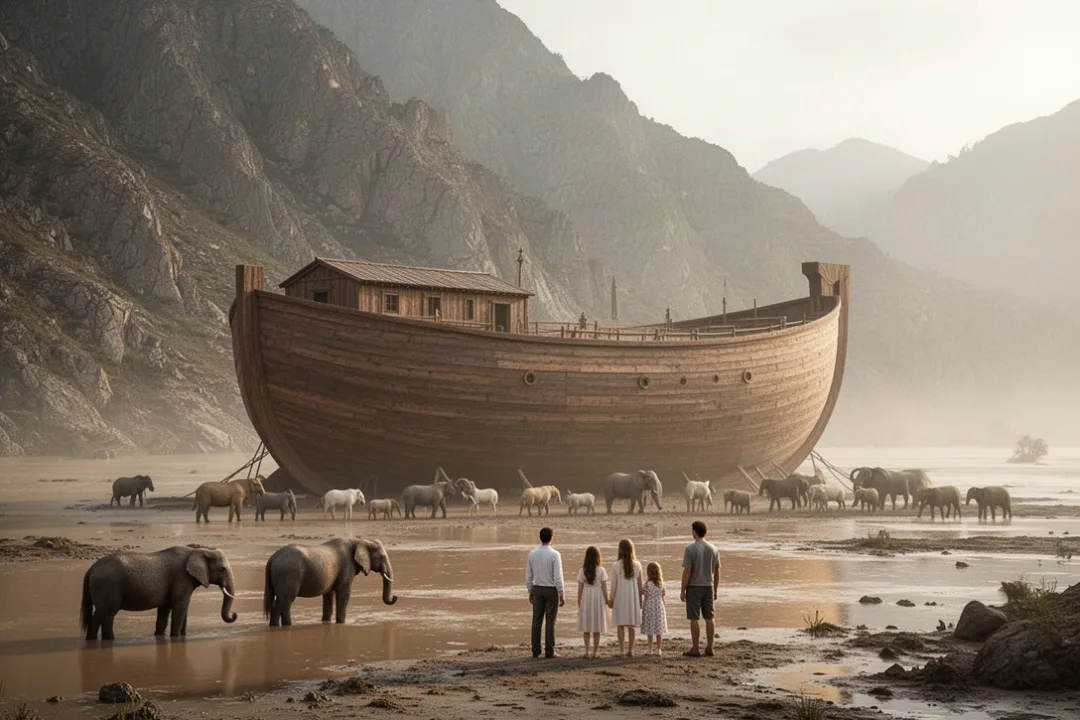
God tells Noah to build an ark because a flood is coming. Genesis gives the vessel specific proportions: 300 cubits long, 50 cubits wide, and 30 cubits high. The text also describes its compartments, covering, opening, and construction material. The measurements communicate a large, stable vessel, although the exact length of a cubit varied in the ancient world.
The ark was not designed like a modern ship for sailing from one destination to another. Its stated purpose was to float and preserve life. Genesis focuses on its capacity, structure, and occupants rather than on steering, navigation, or a planned landing route.
Noah receives instructions to bring his wife, his sons, and his sons’ wives into the ark. He is also told to bring animals, food, and provisions. The account uses different numerical descriptions for animals in different passages, including pairs and additional animals used for sacrifice. These details have produced various interpretations, but the main narrative point remains clear: Noah is to preserve representative living creatures.
The Bible repeatedly connects Noah’s actions with obedience. He builds the ark, gathers his family, brings in the animals, and follows God’s commands. Genesis does not describe Noah debating the instructions, recruiting a construction crew, or persuading the surrounding population. It simply presents him acting on God’s word.
God warns Noah about the coming judgment.
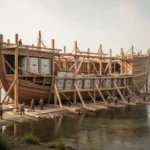
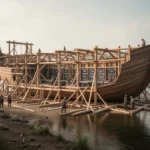
Noah builds the ark according to the instructions he receives.
Noah brings his household and the animals into the ark.
The flood covers the earth, while those inside are preserved.
Noah waits for God’s direction before leaving the ark.
The story says the ark rested on the mountains of Ararat. This identifies a mountainous region rather than giving enough information to verify a precise modern location. Many expeditions and traditions have claimed to find the ark, but the biblical text itself does not identify a surviving archaeological specimen.
What the flood story says about Noah’s faith
Noah’s faith is shown primarily through obedient endurance. He acts before the flood arrives and continues waiting after the rain stops. Genesis portrays several stages of waiting: the rising waters, the months during which the waters recede, the sending of birds to test the conditions, and the final command to leave the ark.
This waiting matters because Noah does not leave simply when the land begins to appear. He remains inside until God tells him to go out. The narrative therefore presents faith as more than believing a warning. It includes continuing to follow God when the timetable is uncertain.
The New Testament reflects on Noah in several ways. Hebrews 11 places him among people who acted by faith in response to God’s warning about events not yet visible. First Peter refers to Noah and the ark when discussing salvation, patience, and baptism. Second Peter uses Noah as an example of a person who remained faithful while surrounded by ungodliness.
Jesus also refers to the days of Noah in the Gospels of Matthew and Luke. His comparison centers on people carrying on with ordinary activities without recognizing the seriousness of what was coming. The point is not to encourage speculation about dates. It is a warning to remain spiritually alert rather than assuming that normal routines guarantee safety.
Hebrews 11:7 presents Noah as responding to God’s warning with reverent faith and preparing for what he could not yet see.
Noah’s example can be misunderstood if it is reduced to personal bravery. The account does not say that Noah designed his own rescue plan. His strength lies in responding to God’s direction, accepting an enormous responsibility, and persevering through an event he could not control.
What happened when Noah left the ark
When Noah comes out of the ark, one of his first recorded acts is to build an altar and offer burnt offerings to God. This response places worship before settlement, farming, or personal comfort. Noah recognizes preservation as an act of divine mercy and responds with thanksgiving.
God then makes a covenant with Noah, his descendants, and every living creature. A covenant is a binding relationship marked by a promise and obligations or signs. In this covenant, God promises that a flood will not again destroy all life on earth in the same way. The promise extends beyond Noah’s family to the earth and its creatures.
The sign of this covenant is the rainbow in the clouds. Genesis describes it as a reminder of God’s promise. The rainbow is not presented as a human achievement or a reward Noah creates. It is a visible sign associated with God’s commitment to preserve the created order.
The covenant also includes a renewed command to be fruitful and multiply. Human beings are again told to fill the earth, echoing the language of creation. God permits the eating of animals but prohibits consuming blood, because blood represents life. The chapter also establishes the seriousness of shedding human blood, grounding that seriousness in humanity’s creation in God’s image.
These instructions show that the post-flood world is not a return to Eden in every respect. Human sin remains possible, and the need for moral accountability continues. Yet God establishes a broad promise of created-world stability: seasons, planting and harvest, cold and heat, summer and winter, day and night will continue as long as the earth remains.
How Noah failed after the flood
Noah’s story does not end with the flood as a perfect hero. Genesis 9 says that he planted a vineyard, drank wine, and became drunk inside his tent. His son Ham saw his father’s nakedness and told his brothers, while Shem and Japheth responded by covering Noah without looking at him.
The passage raises difficult interpretive questions, especially about what Ham did and why Noah later pronounced a curse on Canaan, Ham’s son. The text does not clearly explain every detail. It does make clear that Noah’s drunkenness was shameful and that the family’s behavior afterward produced lasting consequences in the narrative.
Readers should avoid treating Noah as either completely virtuous or entirely corrupt. Genesis offers a more realistic portrait: a man who trusted God, obeyed a demanding command, worshiped after deliverance, and still committed serious personal failures. His righteousness did not make him incapable of sin.
The account also warns against using Noah’s curse as a justification for racism, slavery, or domination. The passage concerns a particular family relationship and does not say that any modern racial group is cursed. Later history shows how this text was misused to defend oppression, but that misuse cannot be derived responsibly from Genesis.
What Noah’s sons mean in the biblical story
Shem, Ham, and Japheth are important because they become the ancestors of the nations listed in Genesis 10, often called the Table of Nations. That chapter presents a broad map of peoples descended from Noah’s family after the flood. It is not intended to match modern political borders or provide a complete catalog of every people in human history.
Shem receives special attention in the biblical narrative. The genealogy from Shem leads toward Abram, later called Abraham, and therefore toward the covenant story of Israel. This does not make Shem more valuable as a human being than his brothers. It shows how Genesis narrows its focus from all humanity to a particular family through which God’s promises will continue.
Ham’s descendants include peoples associated in Genesis with regions such as Egypt, Canaan, and parts of Africa and the ancient Near East. Japheth’s descendants are associated with other surrounding peoples. The ancient geographical references can be difficult to identify precisely, and responsible interpretation should distinguish the text’s theological purpose from uncertain modern mapping.
The family division after the flood also prepares for the story of Babel in Genesis 11. Humanity spreads across the earth, develops different languages, and forms distinct communities. The biblical narrative continues to show both the unity of the human family and the fragmentation created by pride, violence, and disobedience.
How Noah compares with other biblical figures
Noah resembles Adam in several ways. Both appear in a world connected with the ground, both receive commands concerning life, and both experience failure in a garden-like setting after a major beginning. Yet Noah’s story does not erase the problem introduced in Genesis 3. Sin remains present even after the flood.
Noah also resembles later covenant figures such as Abraham. God calls each man to trust a promise and respond through obedience. Noah’s covenant has a universal scope involving all living creatures, while God’s covenant with Abraham focuses more specifically on a family that will become a blessing to the nations.
The ark has often been compared with Moses’ basket, which protects him from a deadly royal decree and carries him through the waters. The Hebrew terms used for the ark and Moses’ basket are related, suggesting a literary connection. In both accounts, God uses a vessel to preserve a chosen person for a larger purpose.
The New Testament develops another comparison between Noah’s flood and Christian baptism in First Peter 3. The passage does not simply say that water itself saves people. It points toward an appeal to God through the resurrection of Jesus Christ. Christian traditions explain the connection differently, but the emphasis is on salvation, conscience, and God’s action rather than on the ark as a magical object.
Common mistakes when reading Noah’s story
Noah’s account has inspired art, sermons, children’s books, archaeological claims, and scientific debates. Those discussions can be useful, but they can also distract from what Genesis actually emphasizes. Keep these common mistakes in mind:
Assuming the ark was a small boat. Genesis gives substantial proportions and describes multiple compartments. Children’s illustrations often make it look like a simple rowboat, which does not match the text.
Calling Noah morally perfect. Genesis calls him righteous and blameless in his generation, but his later drunkenness shows that he was not sinless.
Reducing the story to animals. Animals are central to the preservation theme, but the flood is also about human violence, divine judgment, covenant, and renewed creation.
Claiming the Bible gives an exact modern location for the ark. Ararat identifies a mountainous region. The text does not provide evidence for a verified archaeological site.
Using the flood to predict a specific date. Jesus’ reference to Noah emphasizes readiness and accountability, not a timetable for calculating the end.
Treating the rainbow as only a symbol of personal optimism. In Genesis, it signifies God’s covenant promise concerning the earth and all living creatures.
Applying the curse of Canaan to modern peoples. That interpretation has been used to support racism and slavery and has no legitimate basis as a claim about contemporary racial groups.
Ignoring the differences among biblical passages. Genesis contains repeated descriptions of animals, timing, and the flood’s progression. Careful readers should acknowledge those features rather than forcing every detail into a simplified retelling.
Reading tip: Start with Genesis 5–9, then compare the later references in Hebrews 11, First Peter 3, Second Peter 2, and the Gospel passages about the days of Noah. Let each passage make its own emphasis clear.
How to study Noah in the Bible carefully
A useful study begins by separating the main narrative from later interpretation. Read Genesis 5–9 in one sitting if possible, paying attention to repeated words such as corrupt, violence, covenant, remember, and obey. Repetition often signals the themes the writer wants readers to notice.
Next, observe the movement of the story. It begins with a world filled with violence, moves through warning and judgment, reaches preservation inside the ark, and then turns toward worship, covenant, and renewed life. This structure is more important than trying to answer every modern question about the mechanics of the flood from details the text does not explain.
It can also help to compare several translations without treating one wording as the only possible interpretation. Terms such as “blameless,” “clean,” “gopher wood,” and “the windows of heaven” involve translation choices and ancient cultural references. Comparing wording can reveal where the Hebrew text is clear and where interpreters must exercise caution.
Read the immediate context: Begin with Genesis rather than starting with a later sermon or popular retelling.
Mark what God commands: Notice how Noah responds to each instruction.
Track the covenant: Identify who receives it, what it promises, and what sign accompanies it.
Notice Noah’s weaknesses: A complete reading includes the post-flood vineyard episode.
Compare later references: Ask what Jesus, Hebrews, and Peter emphasize about Noah.
Separate interpretation from certainty: Label proposed locations, timelines, and scientific models as interpretations rather than biblical statements.
The flood story can be approached through several kinds of questions. A theological reading asks what Genesis teaches about sin, judgment, mercy, and covenant. A literary reading examines repetition, structure, and connections with creation. A historical or scientific reading asks about ancient flood traditions, geography, and possible natural events, while recognizing that these disciplines use different methods and do not answer every theological question.
What Noah’s story means for readers today
Noah’s story challenges the idea that moral majorities determine what is right. The surrounding society is described as violent and corrupt, yet Noah is called to live differently. His example does not require isolation from all other people; it does require refusing to treat widespread wrongdoing as normal or harmless.
The story also gives obedience a practical shape. Noah does not merely express agreement with God. He builds, gathers, waits, worships, and accepts responsibility for the lives entrusted to him. Faith in this account is visible in sustained action, especially when the promised outcome is not yet visible.
At the same time, Noah warns against placing ultimate confidence in a human leader. He is faithful but flawed. The covenant rests on God’s promise, not on Noah’s permanent moral success. That distinction keeps the story from becoming a simple lesson about finding a perfect person to imitate.
The covenant with Noah has a broad ecological dimension. God’s promise includes every living creature and the continuing rhythms of the earth. The story therefore supports serious concern for human life, animal life, and the conditions that sustain creation, even though Genesis does not present a modern environmental program.
For Christian readers, Noah also points toward later biblical themes of rescue, judgment, and new creation. Interpretations differ about exactly how the ark and flood relate to salvation through Christ, but the New Testament clearly treats Noah as a figure whose story calls people to faith, alertness, and trust in God’s saving action.
For Jewish readers, Noah’s covenant is foundational to the biblical understanding of God’s relationship with all humanity and the created world. The story contributes to reflection on justice, human responsibility, violence, repentance, and the obligations shared by people beyond the boundaries of Israel.
Read as a whole, Noah’s story refuses a shallow message. It does not say that faithful people will avoid every disaster, that obedience eliminates human weakness, or that judgment can be predicted by ordinary observation. It presents a serious account of a broken world, a God who judges violence, a person who responds in faith, and a covenant promise that preserves the future of creation.
Frequently asked questions
Was Noah the only righteous person in the world?
Genesis singles Noah out as righteous and blameless in his generation, but it does not provide a complete moral census of every person alive. His household is preserved with him, yet the text does not describe each family member’s personal faith in detail. The emphasis is on Noah’s distinctive relationship with God and his role in preserving his family and living creatures.
How long did Noah stay in the ark?
Genesis gives several time markers, including the beginning of the flood, the period of rain, the recession of the waters, and the eventual drying of the ground. These details indicate that Noah remained in the ark for many months, not merely during a short storm. The exact total depends on how the calendar references are interpreted.
Did Noah take two of every animal?
Genesis describes pairs of animals, while other verses mention additional numbers for animals considered clean and for birds. Interpreters explain the relationship among these passages in different ways. The central point is that Noah preserved representative animals, with distinctions made between clean and unclean creatures and with food provided for those inside the ark.
Where is Noah’s ark today?
Genesis says that the ark came to rest on the mountains of Ararat, a regional description rather than a confirmed modern address. Various claims have identified possible remains, but none has received broad archaeological verification as Noah’s ark. The Bible’s message does not depend on locating a surviving vessel.






Leave a Reply