The phrase gopher wood appears in only one biblical passage: Genesis 6:14. In that verse, God tells Noah to make an ark from gopher wood, construct rooms inside it, and cover it with pitch on the inside and outside. The instruction comes as part of the larger account of the coming flood and Noah’s preservation of his family and the animals.
Because the term appears only once, readers cannot compare it with other passages that might clarify its meaning. Biblical scholars call a rare word of this kind a hapax legomenon, meaning a word recorded only one time in a particular body of writing. That rarity is the central reason the identity of the wood remains uncertain.
The Hebrew text uses a word commonly transliterated as gofer or gopher. The English spelling can create confusion because it resembles the name of a burrowing animal. In Genesis, however, gopher wood has no connection to gophers; it refers to a type of timber, though the precise species or category cannot be established with confidence.
The passage gives a few details about the ark’s construction:
It was made from gopher wood.
It contained internal compartments or rooms.
It was coated with pitch to make it resistant to water.
It had a door, a window, and multiple levels.
It was designed to preserve life during the flood rather than function as an ordinary sailing vessel.
These details show that the Bible identifies the wood as a practical building material within the story, not as an object of worship or a substance with magical properties. The text emphasizes God’s instructions, Noah’s obedience, and the ark’s role as a means of preservation. It does not explain where the wood came from, how Noah processed it, or which modern tree produced it.
Why the exact identity of gopher wood is uncertain
The main difficulty is linguistic. The Hebrew word behind “gopher” is obscure, and its meaning cannot be securely derived from a clear Hebrew root. Since the word occurs only in Genesis 6:14, there is no second biblical example that shows how it functions in another sentence.
Ancient translations offer clues, but they do not settle the question. Translators working in different periods sometimes treated the word as the name of a particular kind of wood, while others understood it more generally as prepared timber or smoothed wood. Their choices reflect interpretation as well as translation.
Several explanations have been proposed over the centuries:
Cypress: Some English translations render the term as cypress wood, partly because cypress was valued in the ancient Near East for construction and its resistance to decay.
Resinous wood: Other translations use wording such as resinous or pitch-bearing wood, connecting the material with the ark’s waterproof coating.
Coniferous timber: Some interpreters suggest a broader group of evergreen trees, such as fir, pine, or related species.
Processed or squared wood: Ancient translation traditions sometimes appear to describe the form or preparation of the timber rather than identify a tree species.
An unknown local term: The word may have referred to a type of wood known to the original audience but no longer identifiable from surviving language evidence.
Each proposal has a reasonable feature, but none has enough evidence to be treated as certain. A tree that grows in one region may have been available in another through trade, and ancient words for plants often changed meaning over time. The biblical text also does not specify Noah’s location in a way that would allow modern readers to identify a local tree with confidence.
Best answer: Gopher wood is the Bible’s name for the ark’s construction material, but Scripture does not tell us which modern tree or wood species that name represents.
The uncertainty should not be confused with a translation mistake. A translator must decide how to represent an unfamiliar ancient word. Leaving it as “gopher wood” preserves the original uncertainty, while translating it as “cypress” or another term offers readers a more familiar possibility. Each approach has advantages, but a specific modern identification goes beyond what Genesis explicitly says.
What different translations mean by gopher wood
English Bibles do not all handle Genesis 6:14 in the same way. Some retain gopher wood as a transliteration, allowing readers to see that the original term is unclear. Others substitute a proposed identification, most commonly cypress, while some use more descriptive phrases such as resinous wood.
A transliteration transfers the sound of a word into another alphabet without claiming to know its definition. In this case, “gopher” signals that the Hebrew term is being carried into English rather than confidently translated. This can be the most transparent choice when the available evidence does not support a firm botanical answer.
A translation such as “cypress wood” takes a different approach. It presents one interpretation as the wording readers encounter in the verse. Cypress is a plausible candidate because it was a useful ancient building material and is associated with durable timber in parts of the Mediterranean and Near Eastern world. Still, plausible does not mean proven.
Other versions may use wording that highlights the wood’s qualities. A phrase such as resinous wood can suggest material suitable for waterproof construction, especially since the same verse mentions coating the ark with pitch. Yet the word for gopher wood and the word for pitch are separate elements in the Hebrew passage. The wood’s exact identity cannot be established simply from the instruction to apply pitch.
Older translation traditions also show that interpreters struggled with the same question. Some ancient renderings seem to focus on timber that was cut, shaped, or smoothed. This may indicate that the translators did not know the name of a tree and instead supplied a description of usable lumber.
When comparing Bible translations, readers can ask three practical questions:
Does the version preserve the unusual term? If it says “gopher wood,” it is acknowledging that the original word is difficult to identify.
Does it select a proposed species? If it says “cypress,” it is following one interpretation rather than reporting a universally established fact.
Does it describe the material? Phrases involving resin, smoothness, or prepared timber may reflect an ancient translator’s understanding of the word.
Study Bibles and translation notes often explain these differences. Consulting more than one translation can help you distinguish what the verse clearly states from what translators have inferred. The stable point across the versions is that Noah was instructed to build with a particular kind of timber; the disputed point is the identity of that timber.
How gopher wood relates to Noah’s ark
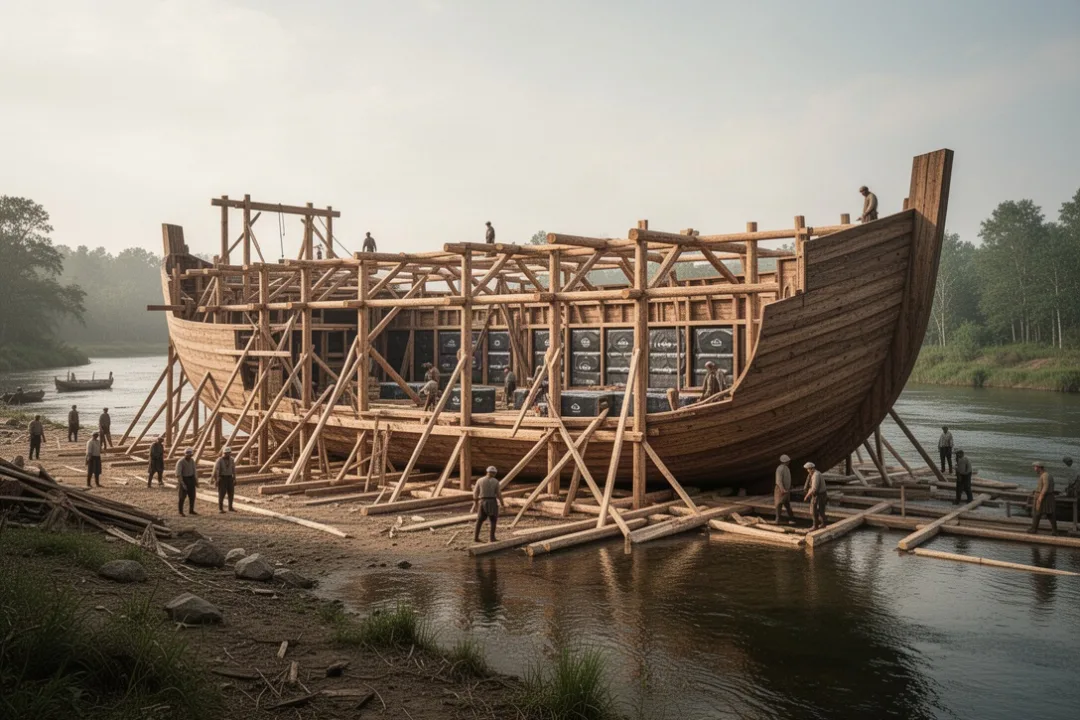
Genesis presents the ark as a large, enclosed structure built for survival during a catastrophic flood. The description includes rooms, a coating of pitch, a door, a window, and three levels. These features suggest that the ark’s construction required substantial planning and a material capable of supporting a large wooden structure.
The biblical dimensions are given in cubits in Genesis 6:15. Because the exact length of an ancient cubit can vary, modern estimates differ, but the proportions describe a long, boxlike vessel rather than a conventional ship designed for speed or navigation. Its purpose was to remain afloat and protect its occupants, not to travel to a destination under human control.
Gopher wood therefore matters in the story because it is part of the ark’s physical provision. The passage does not describe the wood as miraculous or indestructible. Instead, it places a material instruction alongside measurements, internal divisions, and waterproofing. The ark’s survival depends on the complete construction plan, not on a special power attributed to the wood itself.
The mention of pitch is also significant. Pitch was used in the ancient world as a sealant or waterproofing substance. Genesis says the ark was covered inside and outside, indicating attention to the structure’s ability to withstand water. The text does not say that gopher wood alone made the ark watertight.
Several practical conclusions follow from the construction details:
Wood selection mattered because the ark needed structural strength and workable lumber.
Waterproofing was essential because the wooden structure was exposed to prolonged water.
Internal compartments served a purpose by organizing people, animals, supplies, or other provisions.
The ark was a planned structure, not an improvised raft assembled without measurements.
The text gives no construction blueprint detailed enough to identify the exact species from engineering requirements alone.
Modern experiments or proposed ark replicas can show how different woods perform, but they cannot prove what the biblical term means. A particular timber may seem suitable because it is strong, light, rot-resistant, or easy to seal. Those qualities can support a theory, but they do not turn that theory into a translation of the Hebrew word.
What gopher wood may symbolize in biblical interpretation
The Bible does not directly assign a symbolic meaning to gopher wood. Its immediate function is practical: it is the material God commands Noah to use. Symbolic interpretations can be meaningful within a religious tradition, but they should be distinguished from the word’s original lexical meaning.
Many readers connect the ark’s timber with obedience and careful preparation. Noah receives detailed instructions and acts on them before the flood arrives. In that reading, gopher wood represents the concrete work required to respond faithfully: measuring, building, sealing, organizing, and completing the task.
Others emphasize protection and preservation. The wood forms the structure that shelters Noah, his family, and the animals from the flood. This does not mean the material itself saves them independently. Rather, the ark as a whole represents the provision made through God’s command and Noah’s compliance.
Some Christian interpretations also compare the ark with later biblical images of refuge or salvation. Those connections belong to theological reflection, especially when readers interpret the flood account alongside other passages. They should not be presented as the definition of the Hebrew word “gopher.” The word’s direct meaning remains the name of the ark’s required timber.
Jewish and Christian readers may approach the passage with different interpretive traditions, but both can recognize the text’s restraint. Genesis does not pause to praise the tree, describe its rarity, or teach that one species is spiritually superior to another. The focus remains on the command, the construction of the ark, the flood, and the preservation of life.
A careful reading can hold two ideas together:
Historically and linguistically, the exact wood species is unknown.
Theologically, the material can still contribute to the story’s themes of provision, obedience, judgment, and refuge.
This distinction prevents two common errors. One error is claiming that a symbolic interpretation proves the word’s dictionary meaning. The other is assuming that uncertainty about the tree makes the passage meaningless. The text can communicate its narrative and religious themes even when one ancient construction term cannot be identified with modern certainty.
Common misconceptions about gopher wood
One misconception is that gopher wood must be a rare supernatural substance. Genesis does not say this. It gives Noah a building instruction, but it never describes the wood as heavenly, indestructible, or impossible for ordinary people to obtain.
Another misconception is that “gopher wood” means wood from the animal called a gopher. That association comes from modern English spelling, not from the biblical context. The term is a transliteration of an ancient Hebrew word and refers to timber used in construction.
A third misconception is that all Bible translations identify the same tree. They do not. “Gopher,” “cypress,” and descriptive alternatives represent different decisions about how to handle a word whose original meaning is uncertain. Reading one translation as if it were the only possible rendering can hide the underlying linguistic issue.
It is also inaccurate to claim that the mention of pitch proves gopher wood was naturally full of resin. The verse separately commands the use of wood and the application of pitch. A resinous species might have been useful, but the text does not establish that connection.
Finally, the lack of a definite modern identification does not undermine the central account. Ancient texts sometimes preserve names for plants, materials, and places whose meanings later become obscure. The responsible approach is to state what the text says clearly and mark the rest as possibility.
When studying the term: Treat “cypress,” “fir,” “pine,” and “resinous wood” as proposed interpretations, not settled facts. “Gopher wood” is the most cautious English wording because it preserves the uncertainty.
The most reliable answer is therefore concise: gopher wood was the timber specified for Noah’s ark in Genesis 6:14, but the Bible does not identify its modern tree species. Translation history provides possible clues, and the ark’s design shows why durable, workable, sealable wood would have been needed. Neither evidence is strong enough to remove the uncertainty.
Frequently asked questions
Is gopher wood a real type of wood?
The biblical term refers to real timber used to build Noah’s ark, but its exact identity is unknown. “Gopher” is a transliteration of an obscure Hebrew word that appears only in Genesis 6:14. Some translations identify it as cypress, while others use terms such as resinous wood. No modern species can be confirmed as the definitive answer.
Does the Bible say gopher wood was cypress?
Not all Bible translations do, and the Hebrew text itself does not clearly identify cypress. “Cypress” is a proposed translation based on linguistic and historical considerations, including the tree’s usefulness as building material. Versions that say “gopher wood” avoid choosing a specific species and preserve the uncertainty surrounding the original word.
Why did Noah need pitch if gopher wood was suitable for the ark?
Genesis 6:14 presents the wood and pitch as separate parts of the construction instructions. Even durable timber would need sealing against water, especially in a large vessel exposed to prolonged flooding. The passage says the ark was coated inside and outside, showing that waterproofing was part of the overall design rather than a quality supplied by the wood alone.
Does gopher wood have a special spiritual meaning?
Scripture does not assign a symbolic meaning to the wood itself. Readers may connect it with obedience, protection, preparation, or refuge because it formed the ark’s structure. Those are theological reflections on the story, not definitions of the Hebrew word. The direct biblical claim is that God instructed Noah to use it for construction.










Leave a Reply