Have you ever wondered how someone can speak words that come from God and still make deeply wrong choices? Balaam in the Bible raises that difficult question. He is best known for the donkey that spoke, but the larger story concerns greed, spiritual discernment, obedience, and God’s protection of Israel.
Balaam was a non-Israelite seer or diviner whom King Balak of Moab hired to curse the Israelites. Instead, God compelled Balaam to bless them. Balaam’s story appears mainly in Numbers 22–24, while later passages interpret his actions as a warning about corrupt motives and leading others into sin.
Balaam is identified as the son of Beor. Balak sent messengers to summon him from Pethor, a place associated with the Euphrates region, because Balaam had a reputation for blessing or cursing people effectively. Balak believed that Balaam’s words could change the outcome of a military conflict with Israel.
The main account is found in Numbers 22–24. These chapters describe Balak’s request, Balaam’s journey, the angel and donkey, and four messages in which Balaam blesses Israel rather than cursing them. Other passages help explain how later biblical writers viewed him.
Deuteronomy 23:4–5: recalls that Balak hired Balaam to curse Israel, but God turned the intended curse into a blessing.
Joshua 13:22: describes Balaam as a diviner who was killed during Israel’s conflict with Midian.
Nehemiah 13:2: remembers the same episode as an example of God changing a curse into a blessing.
Numbers 31:8, 16: connects Balaam with the later temptation that drew Israel into unfaithfulness.
Micah 6:5: points back to Balak and Balaam when urging Israel to remember God’s faithfulness.
2 Peter 2:15–16, Jude 11, and Revelation 2:14: use Balaam as a symbol of greed, rebellion, and corrupt spiritual influence.
These references create a fuller picture. Balaam was not simply a cartoon villain, and the Bible does not present him as a faithful prophet in the same way it presents Moses. He recognized that God had authority over his speech, yet his desire for reward and his willingness to help Balak remained central problems.
What happened when Balak hired Balaam
Israel had reached the plains of Moab after victories over several enemy kings. Balak feared that the Israelites would threaten his kingdom, so he sent elders with payment for divination to ask Balaam to curse them. His request was political and military, but he treated spiritual power as something that could be purchased.
Balaam asked the messengers to stay overnight while he sought God’s direction. God told him not to go with them and not to curse Israel, because Israel had been blessed. Balaam therefore refused the first request and sent the officials back.
Balak did not give up. He sent more distinguished representatives and offered Balaam greater honor and financial reward. Balaam said that even a house filled with silver and gold would not allow him to go beyond what God commanded, but he still invited the visitors to stay overnight so he could ask again.
God then told Balaam to go with the men, while warning him to do only what God instructed. Balaam set out the next morning. The narrative then says that God’s anger was kindled because Balaam went, and an angel stood in the road against him.
A difficult detail: God first told Balaam not to go, later permitted him to go, and then opposed him on the road. The story presents permission as different from approval. Balaam’s outward compliance did not erase the selfish motive revealed by his eagerness to pursue Balak’s offer.
Why the donkey saw the angel before Balaam did
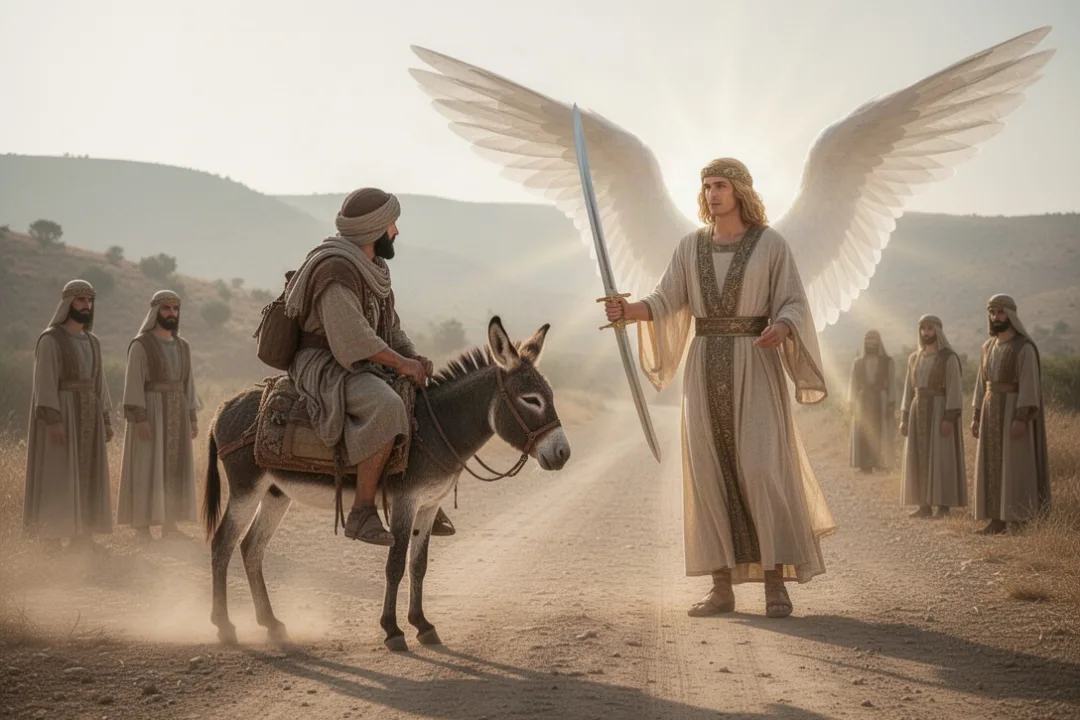
Balaam rode his donkey toward Moab, accompanied by two servants. Three times the donkey saw the angel of the Lord standing in the road with a drawn sword. Balaam did not see the angel, so the donkey turned aside, pressed against a wall, and finally lay down.
Each time, Balaam struck the animal. The donkey’s actions looked disobedient to him, but they were actually preserving his life. God then enabled the donkey to speak, and it challenged Balaam about the repeated beatings. Balaam answered as if the conversation were ordinary, apparently focused more on his frustration than on the strange event before him.
Afterward, God opened Balaam’s eyes, and he saw the angel. The angel explained that the road was dangerous and that the donkey had saved Balaam from death. Balaam admitted that he had acted wrongly and offered to turn back, but the angel told him to continue and repeat only the words God gave him.
The scene is not merely a children’s story about an unusual animal. It exposes Balaam’s spiritual blindness. The animal recognized danger before the professional seer did. The man who claimed special insight could not perceive what a donkey saw clearly.
How Balaam’s four messages changed curses into blessings
When Balaam arrived, Balak took him to several high places overlooking the Israelite camp. At each location, Balak built altars and offered sacrifices, expecting Balaam to pronounce a curse. Balaam instead received messages from God and spoke blessings over Israel.
The first oracle: Balaam declared that he could not curse a people whom God had not cursed. He described Israel as distinct and numerous, emphasizing that their identity and future were not controlled by Balak’s wishes.
The second oracle: Balaam affirmed that God was not fickle or deceptive and would fulfill what he had determined. Israel’s strength and future were grounded in God’s purpose, not in Balaam’s personal power.
The third oracle: From another vantage point, Balaam described Israel’s prosperity and order. He compared the people to well-watered gardens and trees, images of life, fruitfulness, and stability.
The fourth oracle: Balaam spoke of a future ruler arising from Israel. The message included judgment against Israel’s enemies and presented Israel’s destiny as part of God’s larger plan.
Balak became increasingly angry. He had paid Balaam to curse Israel, but Balaam repeatedly stated that he could speak only what God placed in his mouth. The king moved Balaam from one location to another, apparently assuming that a different viewpoint might produce a different spiritual result.
That strategy failed. The story emphasizes that God’s blessing cannot be canceled by a hired curse. Israel’s safety did not depend on Balaam’s goodness; it depended on God’s commitment to his people. At the same time, Balaam’s later conduct shows that being used to deliver a true message did not make his character trustworthy.
What Balaam’s prophecies say about Israel
Balaam’s messages contain several themes that matter beyond the immediate conflict with Moab. They portray Israel as a people separated for a particular purpose, protected by God, and destined for growth. They also describe God as dependable rather than changeable or manipulative.
One significant theme is God’s control over blessing. Balak thought Balaam could manage spiritual outcomes through rituals and payment. The oracles reject that assumption. Balaam is not the source of the blessing; he is only the messenger who must say what God has determined.
Another theme is the future rule associated with Israel. The fourth oracle points toward a ruler who will exercise power over Israel’s enemies. Christians have often read this passage in connection with the Messiah, although the immediate setting concerns Israel’s future strength and victory.
The prophecies also show that God’s purposes are not easily redirected by human hostility. Balak used wealth, political status, repeated sacrifices, and strategic locations, but none of these could force God to agree with him.
Balaam could not turn God’s blessing into a curse simply because Balak offered a reward.
Still, the narrative should not be read as proof that Balaam was spiritually reliable. He spoke accurate words under divine restraint, but later Scripture focuses on his willingness to pursue profit and influence Israel toward wrongdoing.
What Balaam did after the blessings
Numbers 22–24 ends without describing Balaam’s full response to the failed curses. The next relevant passage appears in Numbers 31. After Israel’s battle with Midian, Moses identifies Balaam as connected with the event that led Israelite men to participate in sexual immorality and worship connected with Baal of Peor.
Numbers 25 describes the sin at Peor, where Israel was drawn into sexual and religious unfaithfulness. Numbers 31:16 later says that this happened through Balaam’s advice. The text therefore presents a contrast: Balaam could not curse Israel directly, so he appears to have helped create a situation in which Israel would bring judgment upon itself through disobedience.
The precise mechanics of Balaam’s counsel are not fully narrated in the earlier chapters. Scripture does not provide a long speech in which he lays out a detailed plan. The connection is nevertheless clear in Numbers 31:16 and is echoed in Revelation 2:14, where Balaam is remembered as one who taught Balak to put a stumbling block before Israel.
This explains why Balaam’s story does not end with the impressive oracles. Correct words do not compensate for corrupt counsel. A person may say something true about God while still using spiritual knowledge for personal gain or helping others turn away from God.
Why later biblical writers criticize Balaam
Later biblical writers use Balaam’s name as a warning because his life combines spiritual awareness with moral compromise. He knew that God opposed Balak’s plan, yet he remained attracted to the reward connected with it.
2 Peter 2:15–16 describes people who abandon the right path because they love the reward associated with wrongdoing. Balaam’s irrational conduct is exposed when a speechless animal restrains him.
Jude 11 places Balaam alongside other examples of people who turn religious or spiritual matters toward personal corruption.
Revelation 2:14 refers to Balaam’s role in leading Israel toward idolatry and sexual immorality. The emphasis is on teaching others to compromise, not only on private temptation.
These passages distinguish between receiving a message and living faithfully. Balaam’s words over Israel were true because God controlled the outcome, not because Balaam’s motives were pure. The later warnings focus on his love of money, his willingness to exploit spiritual influence, and the damage caused by his advice.
That distinction remains useful when evaluating religious leaders or teachers. Impressive speech, unusual experiences, or accurate observations do not automatically establish a person’s integrity. Character, motives, and the effect of a person’s teaching matter as well.
Was Balaam a prophet, a sorcerer, or a diviner?
The Bible uses language that presents Balaam as someone who practiced divination or operated as a professional seer. Joshua 13:22 calls him a diviner, while the Numbers account shows him receiving messages from the true God. These descriptions can seem contradictory only if they are treated as modern job titles with fixed boundaries.
Balaam was not an Israelite prophet within Israel’s covenant community. He was a foreign religious specialist whom God confronted and used for a particular purpose. The story does not endorse his entire religious practice. Instead, it shows that God can communicate through an unexpected person without approving that person’s motives or methods.
His story also makes clear that Balaam did not control God. He could build altars and seek an oracle, but he could not force God to produce the message he wanted. The repeated phrase that Balaam could speak only what God gave him undercuts the idea that he possessed independent power over blessing and cursing.
Helpful distinction: Balaam was a messenger of true words in specific moments, but he was not an example of faithful character. The Bible’s later warnings depend on holding both facts together.
What the talking donkey teaches about spiritual blindness
The donkey episode is memorable because it is unusual, but its deeper purpose is moral and spiritual. Balaam considered himself qualified to perceive spiritual realities, yet he missed the angel directly in his path. The animal’s resistance revealed that Balaam’s judgment was impaired by his determination to continue.
The narrative also shows that God may use an unexpected means to stop harmful behavior. Balaam expected the donkey to obey him, but the animal became the instrument that protected him and exposed his blindness. The reversal humbles Balaam: the supposed expert needs correction from the creature he is beating.
His response is also revealing. Balaam admits wrongdoing after the angel becomes visible, but the text does not show a lasting transformation in his motives. He proceeds to meet Balak and deliver the required blessings, yet later Scripture still identifies him with greed and destructive counsel.
Readers should therefore avoid reducing repentance to a moment of embarrassment or fear. Balaam recognized danger, but recognition alone did not produce faithfulness. The broader story asks whether a person will submit to God’s will when obedience conflicts with wealth, prestige, or opportunity.
What Balaam’s story teaches about greed and compromise
Balak offered Balaam money and honor in exchange for spiritual services. Balaam repeatedly acknowledged that he could not disobey God, but he continued entertaining the offer. His problem was not ignorance of the command. It was the willingness to remain close to a profitable opportunity even when its purpose was plainly opposed to God.
That pattern is why the New Testament connects Balaam with greed. Greed does not always begin with openly rejecting God. It can begin with asking whether there is a way to preserve religious language while still obtaining the desired reward.
Balaam’s example also shows how compromise can affect other people. The danger was not limited to his own private decisions. According to Numbers 31:16 and Revelation 2:14, his influence helped put Israel in a position of temptation and disobedience.
Recognize the difference between God’s permission and God’s approval.
Examine whether financial reward or status is shaping a supposedly spiritual decision.
Do not assume that accurate speech proves faithful character.
Take seriously the effect your advice may have on other people.
Pay attention when circumstances expose a motive you would rather ignore.
The warning is especially relevant for anyone with influence. A teacher, counselor, leader, or friend may cause harm not only by saying something false, but also by using true ideas to justify selfish aims. Balaam’s story treats that kind of influence as a serious responsibility.
How Balaam’s story differs from the story of Balak
Balak and Balaam are often mentioned together, but they represent different forms of opposition. Balak is the king who fears Israel and attempts to use a religious specialist against them. Balaam is the specialist who understands that God cannot be manipulated but still remains attracted to the king’s reward.
Balak’s error is direct hostility. He wants a curse because he wants Israel weakened or destroyed. Balaam’s error is more subtle: he knows the curse will not work, yet he keeps seeking a way to benefit from the request. One is driven by fear and political control; the other is compromised by profit and influence.
Their partnership also demonstrates that spiritual manipulation cannot overturn God’s purpose. The king changes locations and increases pressure, but the desired curse never comes. The final damage associated with Balaam occurs not through a successful curse, but through temptation and compromise.
How to read Balaam’s story responsibly
A responsible reading keeps the whole biblical record together. If you focus only on the donkey, Balaam becomes a strange character in an entertaining miracle story. If you focus only on the blessings, he may appear to be a faithful prophet. If you focus only on the later warnings, you may overlook the important truth that God protected Israel from Balak’s plan.
Read the account in stages. First, observe Balak’s attempt to purchase a curse. Next, notice Balaam’s repeated inability to say anything except what God gives him. Then examine the donkey episode as a revelation of Balaam’s blindness. Finally, read Numbers 31 and the later New Testament references to see why his conduct remains a warning.
The central lesson is not that Balaam possessed a magical ability to bless or curse. It is that God remains sovereign even when people seek to manipulate spiritual matters. At the same time, people remain accountable for motives, choices, and influence. Balaam could not defeat God’s blessing, but he could still participate in leading others toward sin.
What Balaam in the Bible means for readers today
Balaam’s story speaks to anyone who faces a conflict between conviction and personal advantage. You may know what is right while still looking for an exception, a profitable compromise, or a way to keep the reward attached to a harmful decision.
It also challenges the assumption that visible spiritual ability equals mature character. Balaam received divine messages, witnessed a supernatural warning, and spoke remarkable blessings, yet his motives remained vulnerable to greed. Scripture therefore directs attention beyond giftedness to integrity, obedience, and the consequences of influence.
The story offers reassurance as well as warning. Balak’s hostility could not cancel God’s purpose for Israel. The blessings did not depend on Balaam’s virtue or Balak’s cooperation. God protected his people even through a reluctant and compromised messenger.
Balaam is remembered, then, for two sharply different reasons. His oracles testify that God’s blessing cannot be overturned by human schemes. His later reputation warns that a person can speak truth, recognize divine power, and still damage others by loving reward more than obedience.
Frequently asked questions
Was Balaam an Israelite?
No. Balaam was a foreigner from the region near the Euphrates, identified as the son of Beor. Balak, king of Moab, summoned him because he was known as a religious specialist whose words were believed to bring blessing or cursing. Although God gave Balaam messages concerning Israel, Balaam was not an Israelite prophet serving within Israel’s covenant community.
Did Balaam actually curse Israel?
No. Balak repeatedly asked Balaam to curse Israel, but God prevented him from doing so. Balaam delivered several oracles that blessed Israel instead. His later association with Israel’s sin at Peor involved advice or influence that led the people toward idolatry and sexual immorality, not a successful spoken curse.
Why did God let Balaam go and then oppose him?
The narrative distinguishes between permission and approval. God eventually allowed Balaam to travel with Balak’s representatives but warned him to speak only God’s words. Balaam’s eagerness to pursue the opportunity and its rewards exposed a bad motive, so God confronted him on the road through the angel and the donkey.
What is the main warning from Balaam’s story?
Balaam warns that spiritual knowledge and accurate speech do not automatically prove faithful character. He recognized God’s authority and spoke true blessings over Israel, yet later Scripture connects him with greed and destructive counsel. The story urges readers to examine motives, resist profitable compromise, and consider how their advice affects other people.











Leave a Reply