In Scripture, dust most often points to human frailty, mortality, humility, and God’s power to restore.
The Bible uses dust in ordinary and symbolic ways. It is the loose earth beneath a person’s feet, the material associated with the human body, the setting for mourning, and an image of weakness before God. At the same time, dust is not only a symbol of death or disgrace. Scripture also connects it with creation, descendants, restoration, and resurrection hope.
That range matters when you read a verse about dust. The meaning depends on the scene: a person may be sitting in dust because of grief, shaking dust from their feet as a sign of rejected witness, or being compared to dust to emphasize dependence on the Creator. Reading the surrounding passage keeps the image from being reduced to one simple definition.
Dust commonly represents the limits of human life. People are formed from the earth, return to it at death, and remain dependent on God for every breath. This imagery does not mean that the human body has no value. Instead, it places human life within the larger truth that God is the giver of life and that people are not self-sustaining.
Dust can also represent a humbled condition. A person who sits in dust may be grieving, repenting, or experiencing public disgrace. In other passages, dust suggests the vast number of descendants God promises to a family. The same physical substance can therefore carry different meanings according to the context.
Creation: God forms the human being from the dust of the ground.
Mortality: Human bodies return to the earth after death.
Humility: Dust reminds people that they are creatures, not God.
Mourning and repentance: Sitting in dust or ashes expresses deep sorrow.
Judgment: Dust may portray defeat, humiliation, or the seriousness of rejection.
Promise: Dust can describe an abundant future family or a restored people.
Reading tip: Do not treat every mention of dust as a symbol of sin. In many passages, dust emphasizes creaturely dependence, grief, or the contrast between human weakness and God’s strength.
Dust and the creation of human beings
Genesis 2:7 describes God forming the man from the dust of the ground and breathing life into him. The verse presents two truths together: human beings have an earthly origin, and human life comes from God’s personal action. The body is connected to the ground, while life is received from the Creator.
This passage gives dust a foundational meaning in Scripture. People are neither divine nor self-created. Their dignity comes from being made by God and animated by God, not from being independent of God. Dust therefore communicates humility without denying human worth.
The Hebrew word translated as “dust” in many Old Testament passages can refer to fine earth, dry soil, or loose particles. The physical image is familiar: dust is easily scattered, cannot hold itself together, and can be moved by wind or footsteps. In the creation account, however, God takes this lowly material and forms a living person from it.
Genesis 3:19 connects dust with the consequences of human disobedience. After the fall, the human being is told that returning to the ground is part of the condition of mortal life. The wording links the beginning and end of earthly existence: formed from the ground, a person eventually returns to the ground.
That connection appears again in passages such as Psalm 103:14, which says that God remembers human frailty and knows that people are dust. The point is not that God despises people. The psalm presents God as compassionate because he understands how limited and fragile human beings are.
Dust as a picture of mortality and human limits
Several biblical writers use dust to remind readers that life is temporary. Ecclesiastes 3:20 describes all people as going to one place and returning to dust. The statement places human beings within the natural order of earthly life, regardless of status, wealth, or achievement.
Job also uses dust imagery while wrestling with suffering and mortality. In Job 10:9, he reflects on being made from clay and returning to dust. Job 34:15 similarly emphasizes that if God withdrew life-giving breath, humanity would perish and return to the earth.
These references are not invitations to despair. They challenge the illusion that human power is permanent. A person may possess authority, knowledge, or possessions, but none of those things removes the limits of created life. Dust levels human pride by placing every person under the same basic condition.
Psalm 90 makes a related point by contrasting God’s eternity with the shortness of human life. Its reflection on returning to dust is part of a prayer for wisdom. Remembering mortality should lead to a wise use of time, honest dependence on God, and attention to what lasts beyond temporary accomplishments.
Daniel 12:2 uses the phrase “dust of the earth” in a different but crucial way. The passage speaks of people awakening from the dust, some to everlasting life and others to shame. Here dust is associated with death, but it is not the final word. The image opens toward resurrection and future judgment.
Dust as a sign of grief, repentance, and humility
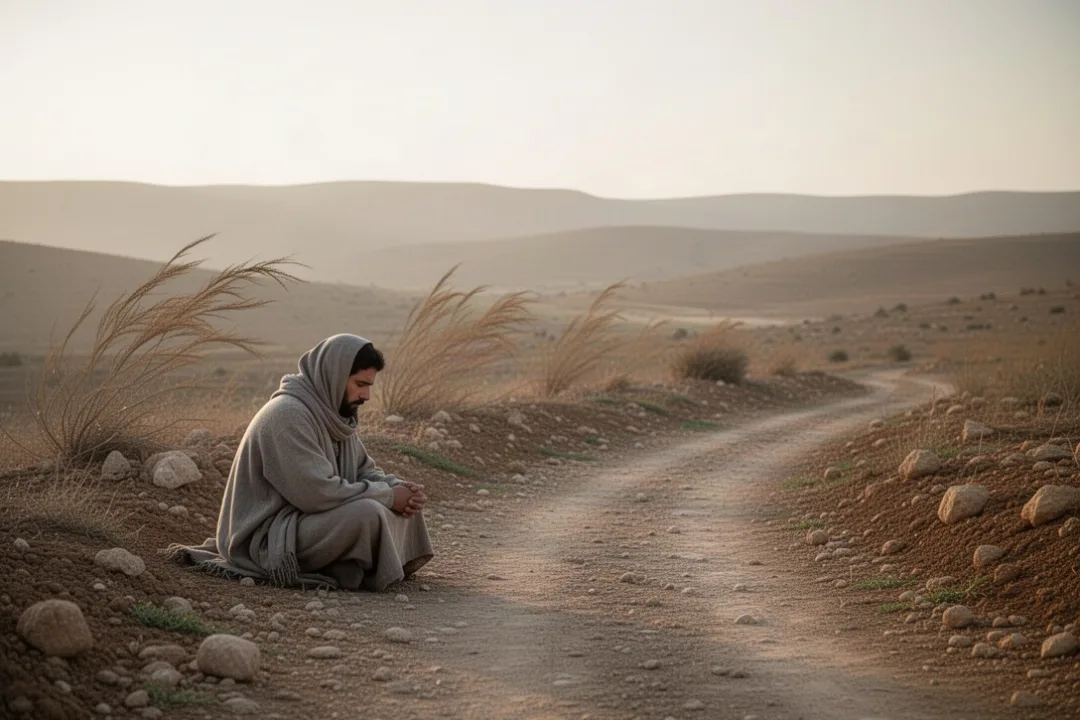
In the ancient biblical world, sitting in dust or placing dust on the head could express intense grief. After hearing devastating news, a person might tear clothing, wear sackcloth, sit on the ground, or cover the head with dust. These actions made inward sorrow visible to other people.
Job 2:8 describes Job sitting among the ashes while suffering. In Job 42:6, his response to God includes language of repentance in dust and ashes. The scene does not suggest that dust itself earns forgiveness. Rather, the physical posture reflects humility before God and recognition of personal limitation.
In Joshua 7:6, Joshua and the elders fall facedown before the ark and put dust on their heads after Israel’s defeat at Ai. The action expresses distress and a search for understanding. The surrounding story connects the defeat with hidden wrongdoing in the community, so the dust is part of a larger posture of lament, confession, and dependence.
Jonah 3:5-6 gives another example. When the people of Nineveh hear Jonah’s warning, they respond with fasting, sackcloth, and other outward signs of repentance. The king descends from his throne and sits in ashes. The physical act communicates a reversal of pride: those who possess power acknowledge that they are accountable to God.
Dust and ashes should not be mistaken for a mechanical religious formula. Scripture does not teach that sitting in dirt automatically produces repentance. The outward sign has meaning when it expresses a genuine inward response. Without changed conduct and sincere turning, visible mourning can become only a performance.
Dust, ashes, and public mourning in the Old Testament
Dust often appears beside ashes, sackcloth, torn clothing, and lying on the ground. Together, these images describe the seriousness of loss. They occur in stories involving death, national disaster, threatened judgment, personal suffering, and communal confession.
Esther 4:1 describes Mordecai tearing his clothes, putting on sackcloth and ashes, and crying out after learning of the threat against the Jewish people. In Esther 4:3, Jewish communities in the provinces respond with fasting, lament, and similar signs of distress. Dust-related mourning is therefore not limited to private sadness; it can express a people’s shared crisis.
Lamentations portrays Jerusalem’s devastation with images of people sitting on the ground and putting dust on their heads. The book does not minimize the destruction or rush past sorrow. Its language allows grief to be spoken honestly while continuing to address God.
Isaiah also uses dust imagery in passages about Jerusalem’s humiliation and future restoration. Isaiah 47:1 portrays Babylon brought low, while Isaiah 52:2 calls Jerusalem to shake off the dust and rise from a degraded state. In the latter passage, dust is not the final identity of the city. God’s promise moves the image from disgrace toward renewal.
Dust as an image of descendants and God’s promise
Dust can symbolize abundance when God speaks about descendants. In Genesis 13:16, God compares Abram’s future offspring with the dust of the earth. Genesis 28:14 uses a similar image in the promise to Jacob, connecting his descendants with an immense number spread across the land.
These promises use dust differently from passages about mortality. The image emphasizes an uncountable multitude, not the weakness of individual people. A handful of dust cannot be counted particle by particle, so it becomes a fitting comparison for a family or nation that will grow beyond easy measurement.
Numbers 23:10 contains related language when Balaam speaks of Jacob’s descendants as dust. The passage belongs to a series of blessings that God does not permit Balaam to replace with a curse. The image reinforces the idea that God’s purpose for his people cannot be overturned by human manipulation.
At the same time, these promises should be read in their covenant setting rather than used as generic guarantees of personal success. The dust comparison concerns God’s historical promise to a people and their descendants. It points to divine faithfulness, not a promise that every individual will receive unlimited wealth or influence.
In biblical poetry and prophecy, enemies may be described as licking dust or being brought down to the dust. These images communicate defeat, submission, and the collapse of arrogant power. They often contrast human pride with God’s authority over nations and rulers.
Psalm 72:9 describes hostile groups bowing before the king and licking dust. Isaiah 49:23 uses similar imagery for rulers bowing before God’s people. These statements should be understood as poetic pictures of submission, not instructions for people to degrade one another.
Micah 7:17 says that nations will come trembling from their strongholds and turn toward the Lord in fear. Its language includes dust imagery associated with submission. The larger prophetic message is that God’s justice will expose false security and bring the nations to acknowledge his rule.
Dust can also appear in descriptions of a city’s destruction. When a place is reduced to rubble and dust, the image communicates the loss of stability and glory. Prophetic poetry often uses such language to warn against violence, idolatry, injustice, and pride.
What shaking dust from the feet means
Jesus instructs his disciples to shake the dust from their feet when a town refuses to receive them or listen to their message. This instruction appears in Matthew 10:14, Mark 6:11, and Luke 9:5. Paul and Barnabas perform a similar action in Acts 13:51 after opposition in Antioch of Pisidia.
The gesture has an established symbolic force. A traveler might shake off the dust of a place as a visible sign that the person was leaving and was no longer accepting responsibility for that community’s response. In the ministry passages, it marks the seriousness of rejecting the message while allowing the messengers to move on.
It is not a command to retaliate, insult people, or treat difficult neighbors as spiritually worthless. The disciples first proclaim the message and give people an opportunity to respond. Shaking off the dust comes after persistent refusal, and it functions as a sober witness rather than an angry performance.
Speak clearly and faithfully. The disciples were sent to announce God’s message, not to win arguments through pressure.
Recognize rejection. You are not responsible for forcing another person to believe or listen.
Leave without revenge. The gesture marks a boundary and a warning, not permission to nurture hatred.
Continue the mission. The disciples moved to other places instead of remaining trapped in one unresponsive setting.
Dust in Jesus’ teaching and the New Testament
The New Testament continues Old Testament dust imagery while placing it within Jesus’ mission. The instructions to the disciples show that the kingdom message demands a response. Hospitality and rejection are not treated as morally neutral, yet the disciples are told to leave judgment in God’s hands.
Luke 10:10-11 records a similar instruction for disciples who enter a town and are not welcomed. They are to announce that even the town’s dust is being shaken off. The action communicates that the message was offered and refused. It also prevents the messengers from confusing faithfulness with control over results.
Acts 13:51 applies the same symbolic action in the early church. Paul and Barnabas do not remain in a hostile setting indefinitely. They leave and continue preaching elsewhere, while the account also mentions the disciples’ joy and the work of the Holy Spirit.
Another New Testament use appears in the description of Jesus healing a man born blind in John 9. The narrative refers to making mud with saliva and applying it to the man’s eyes. Because the passage is about Jesus’ authority and the man’s restored sight, the dust or earth material should not be treated as a magical substance. The healing comes through Jesus’ action.
Practical ways to interpret dust scriptures accurately
Dust passages can be misunderstood when a reader isolates one image from its setting. A careful approach asks who is speaking, what has happened, and whether the verse belongs to poetry, prophecy, narrative, wisdom writing, or a direct instruction.
Read the whole paragraph. The verses before and after the dust reference usually clarify whether the subject is grief, judgment, promise, or mortality.
Identify the speaker. God, a prophet, a grieving individual, a king, and a disciple may use the same image for different purposes.
Separate symbol from command. A poetic description of dust is not necessarily an instruction for modern practice.
Check the emotional setting. Dust in Job expresses suffering, while dust in Genesis may describe creation or descendants.
Look for the biblical movement. Some passages move from dust to restoration, death to resurrection, or humiliation to renewed dignity.
Compare related passages. Genesis, Psalms, Job, the Prophets, the Gospels, and Acts together provide a fuller picture than one isolated verse.
Avoid forced symbolism. Not every mention of earth or dust carries a hidden spiritual code; sometimes the text describes a physical action.
Common mistake: Using “dust” as proof that people are worthless misses the Bible’s larger message. Scripture joins human frailty with God’s compassion, creative purpose, moral accountability, and ability to bring life from death.
How dust connects humility with human dignity
The Bible’s dust imagery holds humility and dignity together. Human beings are made from the ground and return to it, but they are also made by God, given life, addressed by God, and held accountable for their choices. Dust limits human pride without erasing human significance.
This balance corrects two opposite errors. One error is arrogance: assuming that intelligence, strength, wealth, or status makes a person independent of God. The other is contempt: deciding that human weakness makes a person disposable. Scripture rejects both ideas by presenting people as fragile creatures who nevertheless matter deeply to their Creator.
Psalm 103 illustrates this balance especially well. The psalm recognizes that people are like grass and that their lives pass quickly, yet it also emphasizes God’s steadfast mercy toward those who honor him. Human frailty becomes a reason to seek compassion, not an excuse for despair.
Dust can therefore encourage a grounded view of life. It reminds you to receive each day as a gift, confess limits honestly, treat other people with patience, and resist the demand to appear invulnerable. Biblical humility is not self-hatred. It is truthful awareness of who you are before God.
Dust, death, and the hope of restoration
Although dust often signals death, Scripture does not leave the image there. Daniel 12:2 speaks of people awakening from the dust, and the New Testament’s resurrection message gives that hope its fullest expression. The earth may receive the body, but God’s power is not defeated by death.
Isaiah’s calls for Jerusalem to rise from the dust also show how the image can move from humiliation to restoration. The city’s condition is not presented as permanent when God acts to redeem and renew. The biblical pattern is not a promise that suffering will always disappear quickly, but it does affirm that disgrace, death, and ruin do not have ultimate authority over God’s purposes.
For Christian readers, dust ultimately points toward the resurrection of Jesus and the promised resurrection of the dead. The body’s return to earth is real, but it is not beyond God’s reach. The God who formed humanity from dust can also restore life.
That hope does not cancel grief. Biblical people mourn, lament, repent, and acknowledge death honestly. It gives those experiences a larger horizon: the Creator who knows human frailty is also the God who judges evil, keeps his promises, and brings restoration.
Dust scriptures to read by theme
When you want to study the subject, group the references by their main emphasis rather than reading them as one undifferentiated collection. The following passages offer a useful starting point.
Rejected witness: Matthew 10:14; Mark 6:11; Luke 9:5; Luke 10:10-11; Acts 13:51.
As you read these passages, notice the direction of each image. Dust may describe where life begins, where the body returns, where grief is expressed, where pride is humbled, or where God’s people are called to rise. Its meaning becomes clear through the action surrounding it.
The central message is consistent: human beings are dependent, temporary, and accountable, but they are not forgotten. The God who forms from dust remembers human weakness, hears the lament of the humble, keeps covenant promises, and has power to restore what appears lost.
Frequently asked questions
Does dust always symbolize death in the Bible?
No. Dust can symbolize death and mortality, especially in Genesis 3:19 and Ecclesiastes 3:20, but it also represents creation, humility, grief, repentance, numerous descendants, humiliation, and restoration. The surrounding passage determines the meaning. Genesis 13:16 uses dust to describe the abundance of Abram’s descendants, while Matthew 10:14 uses it in a warning about rejected witness.
What does it mean to shake the dust from your feet?
In the Gospel accounts, shaking dust from the feet is a symbolic response when a town refuses the disciples’ message. It shows that the witness was given and the messengers are moving on. The gesture is not permission to retaliate or despise people. It represents a sober boundary and leaves judgment with God.
Why did people sit in dust or ashes?
Sitting in dust or ashes was an outward expression of deep grief, repentance, humiliation, or communal crisis. Examples include Job, Joshua, Mordecai, and the king of Nineveh. The action had no automatic power to produce forgiveness. Its significance came from the humility, sorrow, or repentance it expressed before God.
What is the connection between dust and resurrection?
Dust is associated with the body’s return to the earth, but Daniel 12:2 uses the dust of the earth in a promise that the dead will awaken. This imagery shows that death is not beyond God’s authority. In Christian teaching, resurrection hope rests on God’s power to give renewed life, not on the material itself.









Leave a Reply