Jesus cross: meaning, history, and Christian symbolism
Jesus cross: meaning, history, and Christian symbolism
The Jesus cross is the central symbol of Christianity, representing the crucifixion of Jesus Christ and the Christian belief that his death opened the way to reconciliation with God. For many Christians, the cross also points beyond suffering to forgiveness, resurrection, and hope.
Its meaning is both historical and spiritual. Historically, the cross was a Roman method of execution. In Christian faith, it became a sign of Christ’s self-giving love, victory over sin and death, and promise of new life.
The cross brings several connected Christian ideas together. It recalls the public death of Jesus, but it is not understood merely as an instrument of punishment. Christians see the crucifixion as part of God’s work of salvation and as a visible expression of love directed toward humanity.
The cross can represent atonement, meaning the restoration of a broken relationship between God and people. Different Christian traditions explain the mechanics of that restoration in different ways, but they commonly affirm that Jesus’ death has decisive spiritual significance.
It also represents the cost of discipleship. Jesus’ teachings connect following him with humility, endurance, service, and a willingness to surrender self-centered priorities. In this sense, the cross is not only something Christians look at; it is also a call to live with compassion and faithfulness.
Core meaning: The Jesus cross points to Christ’s sacrificial death, God’s mercy, and the Christian hope that death does not have the final word.
How the cross became a Christian symbol
Crucifixion was a feared form of execution in the Roman world. It was designed to cause intense suffering and public humiliation, often along roads or in other visible places. The Gospel accounts describe Jesus being crucified under the authority of the Roman governor Pontius Pilate, with the event taking place outside Jerusalem.
Because of that background, the cross was not originally a comforting image. It represented shame, violence, and death. The early Christian message transformed its meaning by proclaiming that Jesus, though executed, was raised from the dead. The cross therefore became inseparable from the resurrection.
The New Testament presents the crucifixion as central to Christian preaching. The Gospel narratives describe Jesus’ arrest, trial, beating, execution, burial, and resurrection. Other New Testament writings reflect on the meaning of the cross in relation to sin, grace, reconciliation, wisdom, and the identity of Jesus as the Messiah.
Christians did not all use the cross in exactly the same way during the earliest centuries. Some communities relied more on symbolic images such as a fish, a shepherd, or an anchor. Over time, the cross became increasingly prominent in Christian art, worship spaces, burial places, jewelry, manuscripts, and public ceremonies.
How to understand the Jesus cross step by step
A helpful way to read the symbol is to move from the historical event to its spiritual meaning. The following points show how the different layers fit together.
Start with the crucifixion. The cross first refers to Jesus’ actual execution in Jerusalem. Christian belief is rooted in a claimed historical event, not only in an abstract idea about suffering.
Consider Jesus’ willing self-giving. The Gospels portray Jesus continuing toward Jerusalem despite knowing that opposition and death awaited him. Christians understand this as an act of obedience and love.
Connect the cross with human sin. Christian teaching describes sin as alienation from God and failure to love God and neighbor. The cross is interpreted as God addressing that brokenness rather than ignoring it.
Recognize God’s mercy. The cross communicates that forgiveness is offered through divine grace. It is not a claim that wrongdoing is harmless, but that reconciliation remains possible.
Read the cross together with the resurrection. The cross by itself could signify only death. In Christian faith, the resurrection declares that Jesus has been vindicated and that death and evil are not ultimate.
Apply the symbol to daily life. The cross calls believers toward humility, costly love, endurance, forgiveness, and service to others rather than power for its own sake.
This sequence prevents two common misunderstandings. The cross is not simply a decoration with no connection to Jesus’ death, and it is not meant to glorify suffering for its own sake. Its meaning depends on the relationship between Christ’s death, God’s saving purpose, and the resurrection.
What the Bible says about Jesus and the cross
The four Gospels—Matthew, Mark, Luke, and John—describe Jesus’ crucifixion with different emphases. Together, they present him as condemned, mocked, wounded, and executed, while also showing his compassion, faithfulness, and trust in God.
Jesus’ death is linked to the Passover setting in the Gospel accounts, and Christian readers often see connections with themes of sacrifice, deliverance, covenant, and liberation found in the Hebrew Scriptures. The exact interpretations vary among churches, but the shared focus is that Jesus’ death has meaning beyond the immediate political circumstances.
Several New Testament passages explain the cross in distinct ways. Romans discusses justification and reconciliation; 1 Corinthians emphasizes the contrast between worldly expectations and God’s wisdom; Philippians connects Jesus’ humility with his exaltation; and Hebrews describes his priestly self-offering. These passages should be read as complementary theological reflections rather than as a single formula.
Jesus’ own teaching also matters. In the Gospel accounts, he tells his followers to take up their cross and follow him. This phrase does not mean that every hardship is automatically a sacred mission. It refers to the willingness to remain faithful, accept the cost of discipleship, and place love and obedience above personal status.
The cross is understood by Christians not as the defeat of love, but as love remaining faithful in the face of violence and rejection.
Why Christians connect the cross with forgiveness
Christian views of the cross often begin with the conviction that people need reconciliation with God. Sin is understood not only as individual mistakes but also as patterns of pride, injustice, cruelty, dishonesty, and indifference that damage relationships and communities.
The cross shows the seriousness of that damage while also proclaiming that God responds with mercy. In Christian teaching, forgiveness is not earned by performing enough good actions. It is received as grace, although genuine forgiveness is expected to produce repentance and a changed way of living.
Different traditions use different terms to explain this. Some emphasize Jesus bearing the consequences of sin on behalf of humanity. Others focus on Christ defeating the powers of sin, death, and evil, or on the cross revealing God’s love so clearly that human hearts are transformed. Many churches draw on more than one of these ideas.
These explanations should not be reduced to the claim that God enjoys punishment or that human suffering is automatically redemptive. The Christian message is that God acts through Christ to heal separation and bring people into restored relationship. The cross is therefore a sign of mercy joined with moral seriousness.
Why the cross is often shown with Jesus on it
A plain cross is called a Latin cross in its most familiar form. A cross that includes a representation of Jesus’ body is called a crucifix. Both are used widely, although churches differ in which image they prefer.
A plain cross can emphasize the resurrection and the continuing life of Christ. It may also invite the viewer to think about the cross as a symbol of discipleship. A crucifix keeps the suffering and physical reality of the crucifixion in view, reminding worshipers that Christian salvation is connected to Jesus’ embodied life and death.
Neither form automatically communicates the entire Christian message by itself. A crucifix without resurrection hope can appear to end at suffering, while an empty cross without attention to the crucifixion can make the cost of Jesus’ death easy to overlook. Many Christians value both perspectives.
Some crucifixes include additional details, such as a small sign above Jesus’ head, a crown of thorns, or particular positions of the arms and body. These details may reflect artistic tradition, biblical references, or the customs of a denomination. Their meaning should be considered within the worship tradition where the image is used.
Common types of Christian crosses
Christian art includes many cross designs. Their names can differ across languages and traditions, and not every church assigns the same meaning to every shape.
Latin cross: The lower section is longer than the other three arms. It is the most familiar cross shape in Western Christianity.
Crucifix: A cross bearing an image of Jesus’ body. It is especially common in Catholic, Anglican, Lutheran, and some other traditions.
Greek cross: The four arms are generally equal in length. It appears in Eastern Christian art and in many decorative designs.
Cross with a circle: Often associated with Celtic Christian art, particularly when decorated with interlacing patterns and carved details.
Orthodox cross: Often includes additional horizontal bars, with the lower bar sometimes angled. Its form reflects Eastern Christian artistic and liturgical tradition.
Jerusalem cross: A large central cross surrounded by four smaller crosses. It has associations with the historic Christian presence in Jerusalem.
Chi-Rho: A monogram formed from Greek letters associated with the name of Christ. It is not shaped like a traditional cross, but it is an important early Christian symbol.
The visual form matters less than the meaning a community gives it. A cross may be carved in stone, painted on wood, woven into fabric, cast in metal, or drawn with simple lines. The material can change the artistic effect, but it does not change the central reference to Jesus.
What the cross means in Catholic, Orthodox, and Protestant traditions
Most Christian traditions treat the cross as essential, but worship practices differ. In Catholic churches, crucifixes are common in sanctuaries, homes, classrooms, and personal devotion. The sign of the cross is also used in prayer, and the Stations of the Cross guide meditation on events associated with Jesus’ passion.
Eastern Orthodox churches place the cross within a strong visual and liturgical setting that includes icons, hymns, processions, and services connected with Holy Week and Pascha. The Orthodox tradition often emphasizes that the crucified Christ is also the victorious Christ, so suffering and triumph are held together.
Many Protestant churches display an empty cross, highlighting the resurrection and the living Christ. This is not universal; some Protestant denominations use crucifixes or alternate between the two forms. Protestant worship commonly centers on preaching, Scripture, prayer, baptism, and communion, with the cross interpreted through those practices.
These differences do not mean that one symbol has a single universally accepted design. They show how Christian communities emphasize different aspects of the same central confession: Jesus was crucified and, Christians believe, raised from the dead.
How Christians use a Jesus cross in worship and prayer
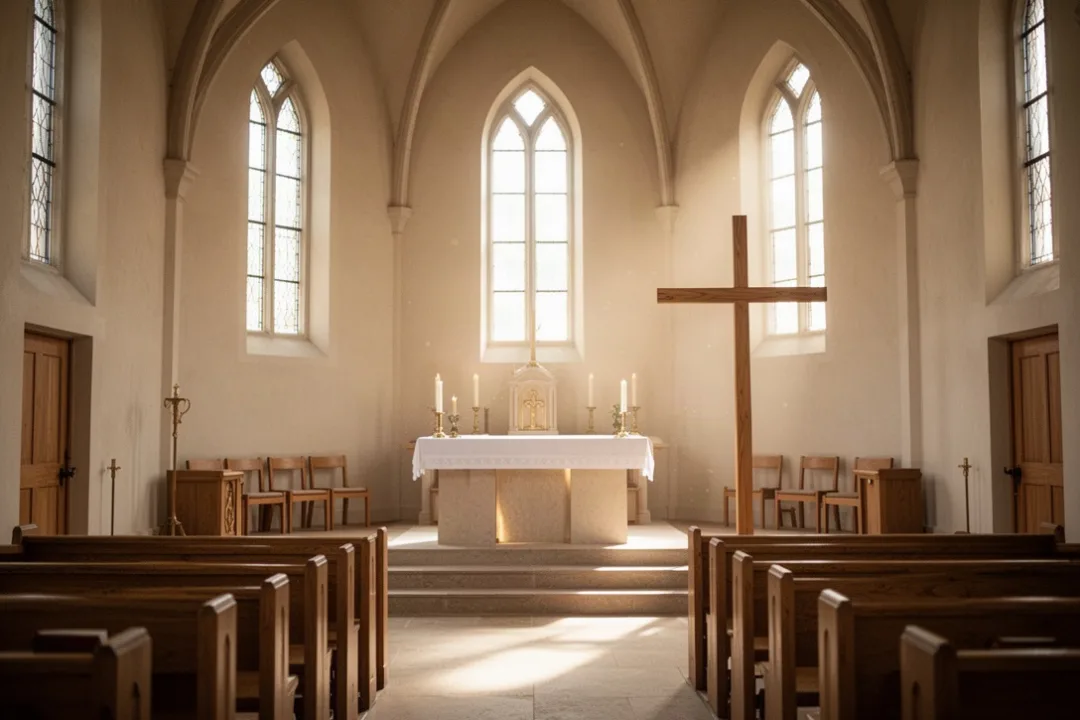
A cross may be placed above an altar, at the front of a sanctuary, on a church steeple, or near a baptismal font. Its location can direct attention toward Christ during prayer and worship. In some churches, people bow toward the cross, make the sign of the cross, or carry it during a procession.
Individuals may wear a cross necklace, keep a cross in their home, or hold one during private prayer. These practices can serve as reminders of faith, repentance, hope, and the call to love others. The object itself is not generally treated as a magical charm in mainstream Christian teaching.
Some people kiss or touch a cross as an act of reverence. That gesture is intended to honor the person and event the cross represents, not to worship wood, metal, or stone. Christians who do not use physical images may still meditate on the cross through Scripture, hymns, sermons, and prayer.
If you are choosing a cross for personal use, consider what it means to you and whether its design comes from a tradition you understand. A respectful choice does not require expensive materials. A simple wooden cross can communicate the same central message as an ornate object.
Practical distinction: In Christian worship, the cross is a sign that points beyond itself to Jesus. Its value is symbolic and devotional, not magical or dependent on the material from which it is made.
What Jesus’ cross means for suffering and hope
The cross gives Christians a way to speak about suffering without pretending that suffering is good. Jesus’ crucifixion acknowledges betrayal, injustice, physical pain, political abuse, and grief. It can therefore be especially meaningful to people who feel abandoned or harmed.
At the same time, the cross should not be used to pressure someone to remain in an abusive situation or to accept preventable harm without seeking help. Christian teaching about endurance must not become an excuse for cruelty. Protecting vulnerable people and pursuing justice are consistent with the cross’s call to love one’s neighbor.
For Christians, hope enters through the resurrection. The cross does not erase the reality of death, but it declares that suffering and death are not the final measure of Jesus’ life. This hope shapes Christian mourning, worship, and expectations about the future.
The cross can also encourage solidarity. Rather than treating suffering people as failures, Christians are called to draw near, provide practical care, oppose injustice, and bear one another’s burdens. The symbol has ethical consequences when it is taken seriously.
How to explain the Jesus cross to a child
A child-friendly explanation should be truthful without giving unnecessary graphic detail. You might say that the cross was a painful way Jesus was put to death, that Christians believe he accepted this out of love, and that God raised him to new life.
It helps to explain the cross alongside Jesus’ teachings about kindness, forgiveness, prayer, courage, and care for people who are overlooked. Children often understand symbols through concrete actions, so connect the cross with helping someone, telling the truth, making peace, and trusting God during sadness.
Questions about fairness are natural. A child may ask why Jesus had to die or why God allowed it. Christian traditions answer these questions differently, so parents and teachers can acknowledge that the subject is deep while offering an age-appropriate explanation consistent with their church’s teaching.
A useful approach includes these ideas:
The cross was real: Jesus suffered and died under Roman authority.
Jesus showed love: Christians believe he did not abandon his mission of mercy.
God brings life: The resurrection is why the cross is a symbol of hope rather than only sadness.
Followers respond: Christians are called to love, forgive, serve, and seek justice.
How to wear or display a Jesus cross respectfully
Wearing a cross can be a personal expression of Christian faith, a family tradition, or a reminder of someone’s beliefs. It can also be worn as cultural jewelry without a strong religious commitment. In either case, respect is helped by understanding that many Christians regard the symbol as sacred rather than merely decorative.
If you display a cross in a home or public setting, consider its surroundings and purpose. A cross placed in a prayer area may invite reflection, while one displayed in a church communicates the community’s focus on Christ. Avoid treating the symbol as protection that guarantees safety or success.
People from different Christian backgrounds may respond differently to a cross or crucifix. Asking about its significance with genuine respect is better than assuming that everyone interprets the same design in exactly the same way. The symbol is widespread, but personal and denominational meanings can still vary.
Why the Jesus cross remains central to Christian identity
The cross remains central because it gathers the Christian story into one recognizable sign. It recalls Jesus’ life of service, his confrontation with religious and political power, his suffering and death, the promise of forgiveness, and the hope of resurrection.
Its message is not limited to private comfort. The cross challenges Christians to reject pride, respond to suffering with compassion, forgive without excusing injustice, and practice love when doing so requires sacrifice. It also asks communities to examine whether their behavior reflects the mercy they proclaim.
Across centuries and cultures, the shape of the cross has appeared in worship, art, architecture, music, and personal devotion. Its meaning is deepest when the symbol remains connected to Jesus’ teachings and to the resurrection faith that followed his crucifixion.
For Christians, looking at the cross means remembering both what happened to Jesus and what they believe God accomplished through him. The cross is therefore a sign of sacrificial love, reconciliation, and hope stronger than death.
Frequently asked questions
What is the difference between a cross and a crucifix?
A cross is the basic Christian symbol with intersecting beams, while a crucifix includes a representation of Jesus’ body. Churches that use crucifixes often emphasize the physical reality of Jesus’ suffering and death. Churches that prefer an empty cross may place stronger visual emphasis on the resurrection. Both forms can point to the same Christian belief about Jesus’ death and resurrection.
Why do some Christians wear a cross?
Christians may wear a cross as a public expression of faith, a reminder of Jesus’ sacrifice, or a personal prompt toward humility and service. For others, it carries family or cultural meaning. Wearing one does not automatically indicate the same denomination or identical beliefs, so its significance depends on the person and tradition.
Is the cross mentioned in the Bible?
Yes. The New Testament repeatedly refers to Jesus’ crucifixion and reflects on the meaning of the cross. The Gospel accounts describe the event, while letters such as Romans, 1 Corinthians, Philippians, and Hebrews discuss themes including reconciliation, humility, salvation, and victory over death. Wording and interpretation differ among Bible translations and Christian traditions.
Why is the cross a symbol of hope if it shows an execution?
The cross is joined to the Christian belief in Jesus’ resurrection. Without that connection, it would primarily represent suffering and death. Christians see the resurrection as God’s affirmation of Jesus and as a promise that evil, death, and despair are not ultimate. That is why the cross can represent grief and hope at the same time.











Leave a Reply