Plowshares: Meaning, history, and biblical symbolism
Plowshares: Meaning, history, and biblical symbolism
Plowshares are the cutting blades or shares attached to a plow, used to break and turn soil for planting. In the Bible, the word appears in the famous image of people beating their swords into plowshares, meaning that weapons are transformed into tools that sustain life.
The term therefore has both a practical agricultural meaning and a powerful symbolic one. Understanding the physical tool helps clarify the biblical picture: a society that no longer prepares for war can redirect its metal, labor, wealth, and skill toward growing food and preserving peace.
A plowshare is the part of a plow that first enters the ground. Traditionally, it was a sharpened wedge or blade made from wood, stone, bronze, or iron. As the plow moved forward, the share cut through the soil and helped loosen it so seeds could be planted.
The word can refer specifically to the cutting share, although people sometimes use it more broadly for the working blade or lower portion of a plow. On a modern moldboard plow, the share works with other parts, including the moldboard, which lifts and turns the soil after the share has opened a furrow.
Its main jobs are straightforward:
Cutting into the soil at the bottom of the furrow.
Breaking compacted earth so roots can grow more easily.
Separating and lifting soil as the plow moves across a field.
Creating furrows that guide planting and help organize a cultivated field.
A plowshare must be strong enough to resist stones and packed earth but shaped carefully enough to move through the ground without wasting excessive force. In older agricultural communities, repairing or replacing an iron share was a practical concern because a damaged blade could reduce a farmer’s ability to prepare fields at the right time.
Plain meaning: A plowshare is not the entire plow. It is the soil-cutting part, traditionally a strong blade or wedge positioned at the front or bottom of the implement.
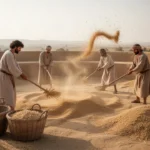
Ancient farmers used different kinds of plows depending on local soil, animals, materials, and farming traditions. Some were light wooden tools that scratched a shallow line, while heavier designs used metal parts to penetrate more resistant ground. The exact shape varied, but the essential function remained the same: open the earth for cultivation.
Why plowshares matter in the Bible
The best-known biblical reference appears in Isaiah 2:4, with a closely related passage in Micah 4:3. Both passages describe a future in which nations stop training for war and turn weapons into agricultural tools. The image reverses the normal direction of military preparation: metal once made for conflict becomes equipment for producing food.
These passages are not merely describing a change in machinery. They present a vision of changed relationships among nations. Hostility, fear, and military competition give way to a society in which people no longer need to organize their lives around defense and conquest.
The biblical image includes several connected ideas:
Weapons are disarmed rather than preserved for the next conflict.
Resources are redirected from warfare to agriculture and community life.
Nations learn peace instead of preparing for battle.
People can cultivate their land without the constant threat of invasion.
Isaiah and Micah use agricultural language because farming was central to everyday survival. A plowshare represented more than a tool. It suggested fields, food, settled work, household stability, and the ability to plan for the future. Turning a sword into one meant converting destructive power into something that could support ordinary life.
The passages also connect peace with justice and security, not simply with the absence of fighting. In Micah’s vision, people sit under their own vines and fig trees without fear. That picture communicates safety, dignity, and the freedom to benefit from one’s own labor.
Isaiah 2:4 and Micah 4:3 portray weapons being reshaped into tools for cultivation, expressing a future in which nations no longer prepare for war.
The Bible contains other references to plows and plowshares in more ordinary settings. Farming tools appear in accounts involving agriculture, labor, and the organization of a rural society. These passages help readers see that the famous phrase is grounded in a familiar object rather than an abstract symbol invented apart from daily experience.
What “swords into plowshares” means
The phrase “swords into plowshares” has become a widely recognized expression for transforming instruments of violence into tools that benefit people. It can describe literal weapons being melted down or repurposed, but it is also commonly used in discussions of diplomacy, disarmament, public spending, and reconciliation.
At its heart, the phrase describes a change in purpose. A sword is designed to threaten, wound, or kill. A plowshare is designed to prepare soil for food production. The contrast is deliberately sharp: destruction becomes nourishment, and conflict gives way to productive work.
The expression can be understood at several levels:
Material transformation
At the most literal level, metal used for weapons can be melted, reshaped, or recycled into agricultural equipment. This does not always mean that an actual sword is physically turned into an actual share. The concrete image communicates a broader decision to stop producing weapons and use industrial capacity for civilian needs.
Economic transformation
Military production consumes materials, labor, research, transportation capacity, and public money. The plowshare image asks what could happen if those resources were redirected toward food, housing, infrastructure, health, or education. It presents peace as an active allocation of resources rather than merely a pause between wars.
Social transformation
A culture shaped by conflict may teach people to distrust neighbors, glorify conquest, or expect violence. “Swords into plowshares” can therefore signify a change in habits and institutions. Communities choose cooperation, repair relationships, and build systems that make peaceful work possible.
Spiritual transformation
In its biblical setting, the image points toward a future shaped by divine judgment and instruction. The nations are not portrayed as reaching peace only through clever negotiation; they are pictured as learning a different way of living. The result is not just fewer weapons but a different understanding of human flourishing.
The phrase should not be reduced to a promise that all conflict can be solved by changing equipment. The prophetic passages address injustice, fear, and relations between nations as well as weapons. A plowshare is meaningful because it represents a larger social order in which people can safely work, own the fruits of their labor, and raise families without preparing for violence.
Plowshares were especially meaningful in the ancient Near East because agricultural land was the foundation of political and household life. When armies invaded, they could destroy crops, seize livestock, damage irrigation systems, and prevent farmers from planting. Peace was therefore tied directly to the ability to work the land through an entire growing season.
In that setting, military tools and farm tools could be linked by their materials and by the labor needed to produce them. A society with blacksmiths, furnaces, and metal supplies could use those capabilities for weapons or agricultural implements. The biblical contrast draws attention to that choice: the same human skill can serve warfare or cultivation.
The metaphor also reflects the vulnerability of farming communities. A farmer does not benefit from a plowshare if armies repeatedly cross the fields, confiscate harvests, or force workers away from their land. The prophetic vision assumes that durable peace must protect the conditions that allow agriculture and ordinary work to continue.
Later writers, religious leaders, activists, and political movements adopted the phrase because it is both visual and practical. It does not describe peace as a vague feeling. It asks what happens to the physical systems of war when a society chooses another future.
Modern references may use the phrase in several ways:
A government may discuss converting defense manufacturing to civilian production.
A peace organization may use it to advocate disarmament or arms reduction.
A church or community group may connect it with reconciliation and service.
An environmental campaign may apply it to redirecting industrial capacity toward sustainable production.
A writer may use it more generally for turning harmful power toward constructive purposes.
These modern uses preserve the original contrast while extending it to new circumstances. The central question remains recognizable: What would people build if they no longer had to devote so much effort to destroying one another?
Plowshares, peace, and the limits of the metaphor
The image is powerful, but it should be used carefully. A physical reduction in weapons does not automatically create justice. If oppression, hunger, corruption, or fear remain, simply melting down military equipment will not produce the peaceful society envisioned by Isaiah and Micah.
The metaphor works best when it includes both disarmament and constructive responsibility. A community must not only stop investing in violence; it must also create conditions in which people can live securely. That may require fair laws, trustworthy institutions, access to land or employment, protection for vulnerable people, and ways to resolve disputes without force.
The image also raises questions about timing and security. Some people may support the ideal of disarmament while arguing that weapons cannot be abandoned unilaterally in a dangerous situation. Others may believe that continued accumulation of weapons makes genuine peace less likely. The biblical passages present a prophetic vision rather than a technical policy manual, so applying them to modern situations requires moral and political judgment.
Helpful distinction: “Swords into plowshares” describes the direction of a society’s purpose. It does not claim that changing tools alone can repair every cause of conflict.
The phrase can also be misunderstood as a call to value farming over every other form of work. Its force comes from the contrast between harmful production and life-giving production, not from the idea that every weapon must literally become agricultural equipment. In a modern context, the equivalent might be technology, engineering, or manufacturing redirected toward civilian needs.
Another limit is that peace involves more than the absence of armed conflict. People can suffer from exploitation, domestic violence, discrimination, or deprivation even when nations are not at war. A responsible use of the metaphor therefore asks whether the redirected resources actually improve safety and dignity for ordinary people.
How to explain the phrase clearly
If you need to explain plowshares in a lesson, sermon, essay, or conversation, begin with the literal object. Say that a plowshare is the blade that cuts into the soil. Then connect it to the biblical contrast between a tool for cultivation and a weapon made for combat.
A clear explanation can follow this sequence:
Define the object: explain that the share is the cutting part of a plow.
Identify the biblical references: point to Isaiah 2:4 and Micah 4:3.
Describe the contrast: a sword harms, while a plowshare prepares land for food.
Explain the wider meaning: resources once devoted to war are redirected toward peace and human well-being.
Acknowledge the context: the vision includes justice, security, and changed relationships between nations.
It is also useful to distinguish “plowshare” from “plow.” A plow is the full implement, while the share is the blade or wedge that enters the ground. In ordinary speech, people may use the terms loosely, but the distinction helps when discussing ancient tools, biblical imagery, or agricultural history.
When paraphrasing the biblical passages, describe their meaning rather than presenting an unverified quotation. Translations differ in wording, and the central idea is more important than memorizing one English version: nations cease training for war, weapons are remade as farming tools, and people live without the fear of military conflict.
The enduring power of plowshares comes from their ordinariness. A plowshare is not a symbol of luxury or conquest. It is a working tool associated with soil, food, patience, and shared dependence on the land. Set against the sword, it represents the choice to make human strength serve life rather than destruction.
Frequently asked questions
Is a plowshare the same as a plow?
No. A plow is the complete farming implement, while the plowshare is the blade or wedge that cuts into the soil. Other parts may lift, turn, or stabilize the earth after the share creates the furrow. In casual speech, “plowshare” can sometimes refer broadly to the working end of a plow, but the technical distinction remains useful.
Where does the phrase “swords into plowshares” come from?
The phrase comes from prophetic passages in Isaiah 2:4 and Micah 4:3. Both describe nations abandoning military preparation and transforming weapons into agricultural tools. The wording differs among Bible translations, but the central picture is consistent: resources once devoted to war are redirected toward cultivation, security, and peaceful work.
What does the plowshare symbolize in Christianity?
In Christian interpretation, the plowshare commonly symbolizes peace, disarmament, reconciliation, and the redirection of human resources toward life-giving purposes. Its meaning is broader than simply destroying weapons. The image points toward a world where justice and safety allow people to labor, enjoy the fruits of their work, and live without fear of war.
Are plowshares still used in modern farming?
Yes, although modern plows may use more specialized parts and configurations than traditional designs. A contemporary plowshare is still the component that cuts into the soil, often working with a moldboard or other equipment. Many farms also use conservation practices that reduce soil disturbance, so not every field is prepared with conventional plowing.









Leave a Reply