The Ascension of Jesus: Meaning, Scripture, and Hope
The Ascension of Jesus: Meaning, Scripture, and Hope
The Ascension is the Christian teaching that Jesus Christ, after his resurrection, was taken into heaven and entered the presence of God the Father. It marks the end of Jesus’ visible earthly ministry and the beginning of the church’s witness in the power of the Holy Spirit.
According to the New Testament, Jesus spent a period of time appearing to his disciples after rising from the dead. He then blessed them, commissioned them to be his witnesses, and was lifted from their sight. The Ascension is not presented as Jesus simply disappearing; it signifies his exaltation, continuing reign, and return to the Father.
The clearest account appears in Acts 1:1–11. Luke describes Jesus meeting with his apostles after the resurrection and teaching them about God’s kingdom. He tells them that they will receive power when the Holy Spirit comes upon them and that they will bear witness from Jerusalem outward to the ends of the earth.
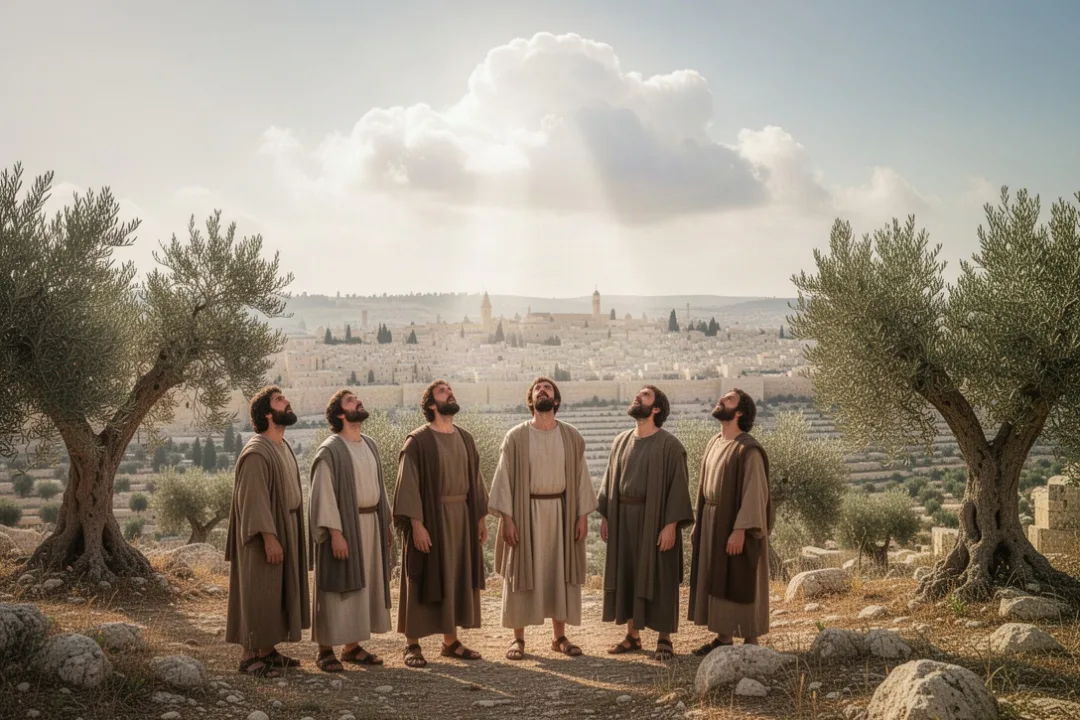
After giving this commission, Jesus is lifted up while the disciples watch. A cloud takes him from their sight, and two men in white clothing tell them that Jesus will return in a way connected with his departure. The passage links three realities: Jesus has gone to the Father, the disciples have a mission, and Christ’s return remains part of Christian hope.
The Gospel of Luke also ends with the disciples returning to Jerusalem with joy after Jesus is taken up, as described in Luke 24:50–53. Luke’s two-volume account therefore begins and ends with the work of Jesus in view, while Acts continues the story through the apostles and the Holy Spirit.
Several other New Testament passages refer to the Ascension without narrating the event in the same detail. Mark 16:19 describes Jesus as being taken up into heaven and seated at God’s right hand. Because the longer ending of Mark has a complex manuscript history, readers often consider the passage alongside the fuller accounts in Luke and Acts.
The Gospel of John emphasizes Jesus’ return to the Father through repeated statements about his departure. In John 20:17, Jesus speaks of ascending to his Father and the disciples’ Father, to his God and their God. John presents the Ascension as part of Jesus’ movement from the Father, through his earthly mission, and back to the Father.
The letters of Paul and other New Testament writers also assume that the risen Christ is exalted in heaven. Ephesians 1:20–23 describes Christ as raised and seated at God’s right hand above every power and authority. Philippians 2:9–11 connects Jesus’ humiliation, obedience, exaltation, and universal acknowledgment of his lordship.
Read the accounts together: Acts gives the most visible description of Jesus’ departure, while Luke, John, Paul, and Hebrews explain what the Ascension means for Christ’s authority, priestly work, and relationship with believers.
Why the Ascension matters in Christian belief
The Ascension means that Jesus’ resurrection was not the end of his mission. It was the transition to a new form of presence and ministry. Jesus is no longer physically visible to the disciples in the ordinary way, yet Christians confess that he remains alive, reigning, and active.
Jesus is exalted as Lord
In the New Testament, being seated at the right hand of God represents honor, authority, and participation in divine rule. The image does not suggest that heaven is merely a location with a physical chair. It communicates that the crucified and risen Jesus has been publicly vindicated by God and given supreme authority.
This is significant because the Ascension is inseparable from the cross and resurrection. Jesus who ascends is the same Jesus who served, suffered, died, and rose. His exaltation does not erase his humanity or distance him from human weakness; it declares that the one who entered human life and endured suffering now reigns as the risen Lord.
Christian teaching traditionally connects the Ascension with the continuing humanity of Jesus. He does not discard his human nature when he enters heavenly glory. The Ascended Christ is understood as the God-man, still bearing the identity of the one who shared human life.
That belief gives the Ascension a personal dimension. Christians do not pray to an abstract spiritual force or to a distant idea. They trust in the risen Jesus, who knows human grief, temptation, rejection, physical suffering, and death. Hebrews 4:14–16 presents him as the great high priest who can sympathize with human weakness and invites believers to approach God with confidence.
Jesus reigns over every power
The Ascension also answers the question of who truly rules. Early Christians lived among competing political, religious, and cultural claims to authority. By proclaiming Jesus as Lord, they were saying that no earthly ruler, empire, ideology, or spiritual power has the final word.
This does not mean Christians should ignore earthly responsibilities or treat government and society as irrelevant. It means every human authority is limited and accountable. Christ’s reign gives believers a framework for practicing loyalty, justice, humility, and courage without giving ultimate allegiance to any temporary power.
How the Ascension changes the disciples’ mission
The disciples do not receive the Ascension as permission to remain focused on the sky. In Acts 1, the heavenly messengers redirect them toward their calling. They are to return to Jerusalem, wait for the Holy Spirit, and become witnesses to Jesus’ life, death, and resurrection.
The Ascension therefore creates a pattern for Christian mission: Jesus has completed his earthly work, the Spirit empowers the church, and believers are sent to serve and testify. The church does not continue Jesus’ work by its own strength or cleverness. It depends on God’s presence and guidance.
The geographical movement described in Acts begins in Jerusalem and extends outward. This shows that the message about Jesus is not intended for one ethnic group, region, or social class alone. The disciples’ witness crosses boundaries and gradually reaches people from many nations and backgrounds.
The Ascension also changes how the disciples understand absence. They had followed Jesus physically and relied on his direct presence. After he leaves their sight, they must learn to trust his promise, receive the Spirit, practice community, and make decisions in faithfulness to his teaching.
They wait: Christian mission begins with dependence on God rather than frantic activity.
They receive power: The Holy Spirit equips ordinary people to bear witness.
They speak publicly: The disciples explain what God has done through Jesus.
They form a community: Worship, prayer, teaching, generosity, and shared life become part of their witness.
They cross boundaries: The gospel moves beyond its original setting toward all peoples.
The Ascension also prevents two opposite mistakes. One mistake is to act as if Jesus’ physical absence means he is uninvolved. The other is to claim that the church can simply replace Jesus. Christian faith holds both truths together: Christ reigns from heaven, and the church serves under his authority.
What the Ascension means for the Holy Spirit and the church
Jesus’ departure is closely connected with the coming of the Holy Spirit. In the Gospel of John, Jesus teaches that his departure is related to the Spirit’s coming. In Acts, the disciples are told to wait for power from above, and Pentecost follows as the Spirit equips them for witness.
This relationship can seem surprising. If Jesus is leaving, why would his departure be good for his followers? The New Testament answer is that Jesus’ visible presence with a limited group of disciples gives way to the Spirit’s presence with the whole people of God. Through the Spirit, believers in many places can be united to Christ and equipped for service.
The Spirit does not draw attention away from Jesus. The Spirit makes Jesus known, helps believers remember his teaching, creates unity, gives gifts for ministry, and strengthens people to live faithfully. The church’s life is therefore not an attempt to recreate the first-century setting. It is life under the continuing work of the risen and ascended Christ.
The Ascension also shapes the church’s worship. Christians gather because Jesus is Lord, not because a particular leader or building creates God’s presence. The church listens to Scripture, prays, celebrates baptism and the Lord’s Supper according to its tradition, cares for the vulnerable, and announces the gospel as a community belonging to the ascended King.
Different Christian traditions explain Christ’s presence in worship in different ways, especially in relation to Communion. They share the conviction that the Ascension does not mean Christ is absent in a total or inactive sense. The risen Lord remains present to his people through the Holy Spirit and is encountered according to the promises and practices of Christian faith.
A practical distinction: The Ascension does not teach that Jesus abandoned the world. It teaches that his rule is heavenly and universal, while his presence and work continue through the Spirit and the community of believers.
How Christians live in light of the Ascension
The Ascension gives Christian life a forward-looking shape. Believers live between Christ’s completed resurrection victory and the fulfillment still to come. They worship a reigning Lord, serve neighbors in the present, and wait for the renewal associated with Christ’s return.
Prayer with confidence
Because the Ascended Christ is described as an advocate and high priest, Christians are encouraged to pray with honesty and confidence. Prayer does not depend on presenting a perfect record or finding exactly the right words. It rests on access to God through Jesus and on the Spirit’s help in human weakness.
This confidence should not become arrogance. The presence of an advocate does not make sin or suffering trivial. Instead, it allows believers to bring guilt, fear, grief, confusion, and need to God while trusting that Jesus represents them faithfully.
Hope in suffering
The Ascension offers hope without denying present pain. Jesus’ path to glory passed through rejection, crucifixion, and death. His exaltation therefore promises that suffering and apparent defeat do not determine the final meaning of a life surrendered to God.
That hope is not a guarantee that every problem will quickly disappear. It is confidence that Christ is alive, that evil is judged by his authority, and that God’s purposes extend beyond what can be seen. For people facing illness, persecution, grief, or injustice, the Ascension points to a Lord who has entered suffering and now reigns beyond it.
Responsible service
Since Jesus has entrusted witness to his followers, Christians are called to serve rather than speculate endlessly about heavenly matters. Their responsibility includes telling the truth about Jesus, practicing mercy, seeking justice, caring for creation, and treating every person as someone made in God’s image.
Service can take many forms, depending on a person’s gifts and circumstances. It may involve parenting, teaching, medical care, honest work, hospitality, advocacy, local church ministry, or quiet support for someone in distress. The Ascension gives these actions a larger purpose: they are offered under the authority of Christ and in dependence on the Spirit.
Waiting for Christ’s return
The message in Acts about Jesus’ return connects the Ascension with Christian expectation. The church is not simply preserving memories of someone who lived long ago. It awaits the completion of God’s purposes and the public fulfillment of Christ’s reign.
Healthy expectation produces faithfulness rather than panic. Jesus’ return is not given as a timetable for date-setting. It is a promise that history is moving toward God’s judgment, restoration, and justice. Christians are therefore called to remain awake, love their neighbors, resist evil, and continue their work without pretending to control the timing of future events.
Remember Christ’s authority: Let his lordship shape your values and loyalties.
Depend on the Spirit: Pray for wisdom, courage, and love rather than relying only on personal ability.
Practice faithful witness: Speak about Jesus with truthfulness, humility, and respect.
Serve where you are: Treat ordinary responsibilities as opportunities to reflect Christ’s character.
Keep hope: Face uncertainty with confidence that Christ’s reign will be fully revealed.
Common questions about the Ascension in Scripture
Readers sometimes ask whether the Ascension should be understood as a physical event, a symbolic statement, or both. The biblical accounts use concrete imagery: Jesus is with the disciples, is lifted up, and disappears from their sight. At the same time, the meaning of the event goes beyond movement through the atmosphere. It announces Jesus’ entrance into heavenly glory and his enthronement as Lord.
The word “heaven” can also cause confusion. In Christian Scripture, heaven is not merely the visible sky or outer space. It refers to God’s transcendent dwelling and rule. The Ascension does not require a modern scientific model of Jesus traveling to a particular point in the universe. It uses the language of exaltation to describe a reality beyond ordinary human observation.
The timing of the Ascension is presented differently in the New Testament’s emphases, but the central claim remains consistent: Jesus rose from the dead, appeared to his followers, commissioned them, and was exalted to the Father. The accounts should be read for their theological witness rather than forced into details they do not all spell out in the same way.
The Ascension is celebrated in the Christian calendar on Ascension Day, traditionally observed forty days after Easter. This count follows Acts 1:3, which describes Jesus appearing to the apostles over a period of forty days. In many churches, the celebration is associated with worship, readings from Acts and the Gospels, prayer for the church’s mission, and expectation of Pentecost.
At its heart, the Ascension answers several questions at once. Where is Jesus now? Christians confess that he is with the Father in glory. Does he still act for his people? Christians answer yes, through his reign, intercession, and the Holy Spirit. What should his followers do? They should worship, witness, serve, and wait in hope.
Frequently asked questions
Is the Ascension the same event as the resurrection?
No. The resurrection is Jesus’ rising from the dead on Easter. The Ascension occurs afterward, when Jesus is taken up into heaven and exalted to the Father. The two events are closely connected: the resurrection establishes that Jesus has conquered death, while the Ascension marks his transition from visible post-resurrection appearances to heavenly reign.
Where is the story of the Ascension found in the Bible?
The fullest narrative is in Acts 1:1–11, with a shorter account in Luke 24:50–53. Mark 16:19 also refers to Jesus being taken up and seated at God’s right hand. John and several New Testament letters discuss the meaning of Jesus’ return to the Father and his exalted authority without providing the same scene-by-scene description.
Why did Jesus need to ascend if he had already risen?
The Ascension completes a distinct part of Jesus’ mission. It signifies his return to the Father, public exaltation, and continuing reign. It also prepares the disciples for the coming of the Holy Spirit and their worldwide witness. Christian belief therefore sees the Ascension not as Jesus abandoning his followers, but as the beginning of his heavenly ministry and the church’s empowered mission.
What can Christians learn from the Ascension today?
Christians can find encouragement to trust Christ’s authority, pray confidently, rely on the Holy Spirit, and serve faithfully. The event also gives hope during suffering because Jesus, who shared human weakness and death, now reigns in glory. Its promise of Christ’s return calls believers to remain watchful and faithful without trying to predict a date.











Leave a Reply