Lazarus in the Bible: His story, meaning, and lessons
Lazarus in the Bible: His story, meaning, and lessons
Have you ever wondered why the Bible contains two different figures named Lazarus? One is the man Jesus raised from the dead in Bethany, while the other appears as a poor man in Jesus’ parable about a rich man and the afterlife. The name connects them, but their stories, settings, and purposes are different.
The best-known Lazarus is Lazarus of Bethany, the brother of Mary and Martha and a close friend of Jesus. His story appears in John 11, where Jesus calls him out of a tomb after Lazarus has been dead for four days. The event becomes one of Jesus’ most significant signs and leads directly toward the final conflict that ends in his crucifixion.
A second Lazarus appears in Luke 16:19–31. He is a poor, sick man who lies at the gate of a wealthy man’s home. After both men die, their circumstances are dramatically reversed. This Lazarus is part of a parable, not the account of the Bethany miracle.
Quick distinction: Lazarus of Bethany is a historical person in the Gospel narrative who was raised by Jesus. The Lazarus in Luke 16 is the named poor man in a teaching story about wealth, mercy, judgment, and listening to God.
Lazarus lived in Bethany, a village near Jerusalem, with his sisters Mary and Martha. John presents the three siblings as people Jesus loved. Their home appears to have been a place where Jesus and his disciples were welcomed, and the family had a personal relationship with him rather than merely knowing him as a traveling teacher.
John identifies Lazarus as “the one whom Jesus loved,” using a description similar to the language later used for the disciple associated with the Gospel. This phrase does not mean Jesus cared about Lazarus to the exclusion of everyone else. It emphasizes the closeness of their relationship and helps explain the emotional force of the narrative.
The family sent word to Jesus when Lazarus became seriously ill. Their message was brief: the person Jesus loved was sick. They seem to have expected Jesus to come quickly, yet he remained where he was for two more days. That delay is central to the story because the miracle is not presented simply as a healing from a distance. Jesus allows the illness to reach its apparent end before going to Bethany.
What happens when Jesus raises Lazarus?
John 11 begins with Lazarus sick and ends with him alive again, but the passage contains much more than a miracle report. It explores grief, delayed answers, human limitation, faith, and Jesus’ identity. The narrative moves from a family’s urgent request to a public sign that changes the course of Jesus’ ministry.
When Jesus tells the disciples that Lazarus has died, he describes the event as an opportunity for God’s glory and for the disciples’ faith to grow. The disciples are concerned about returning to Judea because Jesus has already faced opposition there. Thomas, one of the disciples, expresses a willingness to go with Jesus even though the journey may bring danger, showing both courage and a limited understanding of what lies ahead.
By the time Jesus arrives, Lazarus has been in the tomb for four days. Martha goes out to meet him and says that Lazarus would not have died if Jesus had been there. Her words combine disappointment with confidence: she still believes God can answer Jesus’ request. Jesus responds by speaking about resurrection and life, then draws Martha toward faith in him rather than only faith in a future event.
Mary later comes to Jesus and expresses the same pain. When Jesus sees her weeping, along with the mourners who came with her, he is deeply moved. John then records the shortest verse in many English Bibles: John 11:35. Rather than reproducing the wording of a particular translation, the verse can be understood as saying that Jesus wept.
Jesus’ tears matter because he is not emotionally detached from human suffering. He knows what he is about to do, yet he still enters the grief of the family and the crowd. The story holds together two truths that people sometimes separate: Jesus has power over death, and Jesus is present with people who mourn.
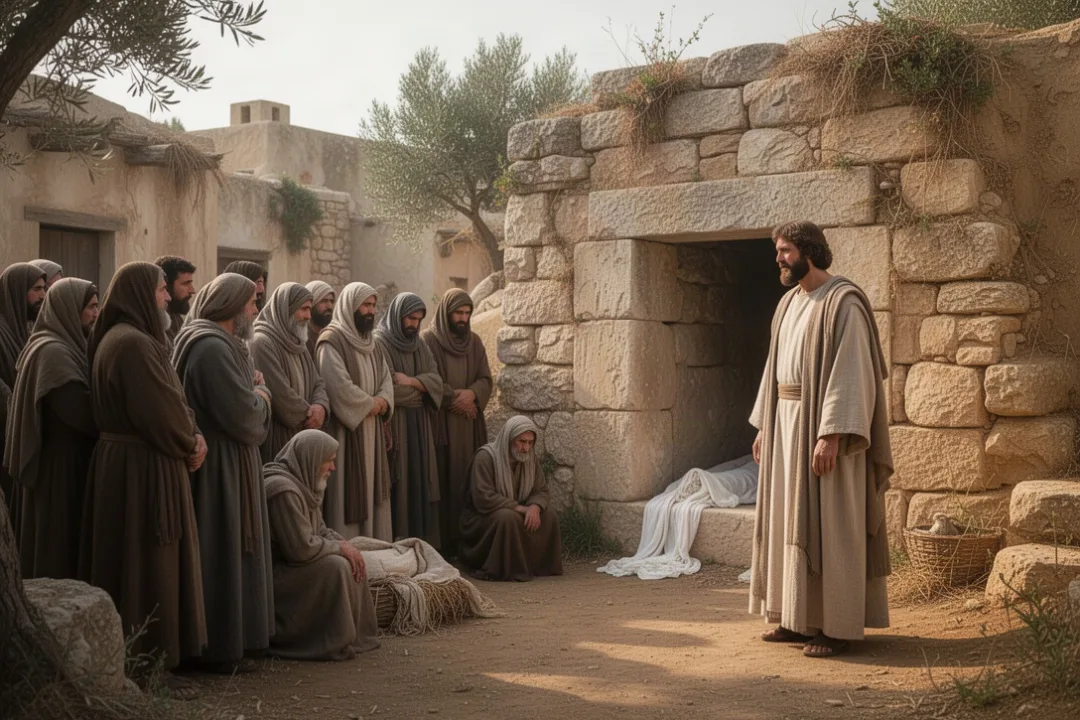
At the tomb, Jesus tells the people to remove the stone. Martha objects that there will be an odor because Lazarus has been dead for several days. After praying aloud, Jesus calls Lazarus by name and commands him to come out. Lazarus emerges still wrapped in burial cloths, and Jesus tells the people to release him from them.
The scene is deliberately physical. The stone, the tomb, the smell, the grave cloths, and the people standing nearby all underline that Lazarus was genuinely dead, not merely unconscious. His return is not described as an abstract spiritual awakening. It is a visible act of restoration that witnesses can see.
Why is the raising of Lazarus important in John?
The raising of Lazarus is the seventh and final major sign recorded in the main body of John’s Gospel. John uses signs not merely to display power but to point toward Jesus’ identity and mission. The miracle shows that Jesus is not only a healer who can postpone death; he is presented as the one through whom resurrection and life are revealed.
The event also points beyond Lazarus himself. Lazarus eventually dies again, because his restored life is not the same as the permanent resurrection hope taught in the New Testament. His return from the tomb is a sign of Jesus’ authority, while Jesus’ own resurrection is portrayed as the decisive victory over death.
Jesus’ statement to Martha in John 11:25–26 is one of the passage’s central teachings. He connects resurrection and life with his own person and asks Martha whether she believes. The emphasis is not simply that a resurrection will happen at some distant time. It is that life with God is connected to trust in Jesus.
The miracle creates different responses. Many people who witness what Jesus does believe in him, but others report the event to the religious authorities. The authorities become increasingly concerned about Jesus’ influence and decide that he must die. In John’s account, the raising of Lazarus therefore becomes a turning point: it reveals Jesus’ glory while also intensifying the opposition that leads to the cross.
John 12 adds another detail. Lazarus is present at a meal in Bethany, and many people come to see both him and Jesus. The religious leaders discuss killing Lazarus as well because his restored life is drawing people toward belief in Jesus. This detail highlights the public impact of the miracle and the danger faced by those associated with Jesus.
What do Mary and Martha teach us about faith?
Mary and Martha respond differently, but neither sister is presented as faithless. Martha goes to meet Jesus and speaks directly about her disappointment. Mary remains at home until Jesus calls for her, then approaches him with the same sense of grief. Their responses show that faith can include honest sorrow and difficult questions.
Martha’s conversation with Jesus moves through several stages. She remembers what Jesus could have done, affirms that God may still answer him, acknowledges a future resurrection, and then responds to Jesus’ question about believing in him. Her understanding develops during the conversation rather than appearing fully formed from the beginning.
Mary’s actions also communicate more than words. She falls at Jesus’ feet, and her grief affects everyone present. The sisters do not hide the seriousness of Lazarus’s death or pretend that their pain is insignificant. Their example gives readers permission to bring confusion, disappointment, and sorrow into prayer without treating those emotions as proof that faith has failed.
The family’s story should not be used to promise that every illness will end in a visible miracle. John 11 describes a particular sign at a particular moment in Jesus’ ministry. Its broader promise concerns Jesus’ authority over death and his presence with those who suffer, not a guarantee that every requested healing will happen in the way people hope.
For grieving readers: The Lazarus story does not require you to minimize loss or force certainty before you are ready. Martha and Mary speak honestly, and Jesus meets them in their grief before the tomb is opened.
Who is Lazarus in the parable of the rich man?
The second Lazarus appears in Luke 16:19–31, in a teaching story about a wealthy man and a poor man named Lazarus. The rich man dresses in luxury and feasts regularly. Lazarus lies at his gate, covered with sores, longing for food from the rich man’s table. Dogs come near him, adding to the picture of severe neglect and social humiliation.
Unlike the rich man, Lazarus is named. The rich man remains anonymous even though he has status, wealth, and public visibility. This reversal may be deliberate: the person ignored at the gate is known to God, while the powerful man is not given a personal name in the story.
Both men die. Lazarus is carried to Abraham’s side, a phrase that represents comfort and honor in the story. The rich man experiences anguish and sees Lazarus at a distance. He asks for relief and then asks that someone warn his brothers so they will not share his fate.
Abraham explains that the brothers already have Moses and the Prophets, meaning the Scriptures that should have taught them how to live. When the rich man suggests that a person returning from the dead would persuade them, Abraham answers that those who refuse to listen to Scripture will not necessarily be convinced by a resurrection.
The parable is not primarily a map of the afterlife. It is a serious warning about hard-hearted wealth, ignored suffering, moral accountability, and resistance to God’s revealed instruction. The rich man’s problem is not stated as wealth alone. The story emphasizes his indifference to a suffering person directly outside his home.
Are the two biblical Lazaruses connected?
There is no biblical statement that Lazarus of Bethany and the Lazarus in Luke 16 are the same person. They belong to different literary settings and serve different purposes. The Bethany Lazarus appears in John’s narrative as a brother, friend, and recipient of a miracle. The other Lazarus appears in a parable told by Jesus in Luke.
The shared name can be confusing because the name Lazarus is familiar to modern readers mainly through John 11. Yet names can be reused, and the Gospel writers do not identify the two figures. The safest reading is to treat them as separate unless a passage gives a reason to connect them.
The stories may still be compared because both deal with death and reversal. In John, a dead man is restored to ordinary earthly life. In Luke, a poor man’s condition is reversed after death while a privileged man faces judgment. The comparison can be useful, but it should not erase the distinction between a miracle narrative and a parable.
What does Lazarus mean as a name?
Lazarus is the Greek form of a Hebrew or Aramaic name related to Eleazar. The name is commonly understood to mean “God has helped.” That meaning fits the role of Lazarus of Bethany, whose life is restored through Jesus’ action, and it also creates an ironic contrast in the parable, where the neglected poor man is ultimately received into comfort.
Name meanings can enrich biblical study, but they should not be treated as the main explanation of a character. The Gospel writers communicate meaning through events, dialogue, setting, and theological themes. Lazarus’s significance comes primarily from what happens to him and what his story reveals about Jesus and human responsibility.
What does the Lazarus story teach about death and hope?
The story of Lazarus does not present death as unreal or painless. The family mourns, the crowd weeps, and the tomb carries the physical signs of death. Hope in the passage does not depend on denying grief. Instead, it is grounded in the claim that death does not have the final authority over those who belong to God.
At the same time, Lazarus’s restoration is temporary in an earthly sense. The Bible does not say that he became immortal or would never die again. His story points to a larger promise rather than completing it. The miracle directs attention to Jesus’ identity and to the future resurrection hope that Christian teaching associates with him.
The passage also shows that God’s timing may not match human expectations. Mary and Martha believe Jesus could have prevented Lazarus’s death, and their words make that belief clear. Jesus does not answer their pain with a simple explanation. He acts in a way that reveals more than the family initially expected, though the delay remains painful.
That does not mean every delay should be interpreted as a hidden miracle waiting to happen. A careful reading avoids turning the story into a formula. Its central assurance is that Jesus is present, compassionate, and powerful even when circumstances have passed beyond human control.
Common mistakes when reading Lazarus in the Bible
Combining the two Lazaruses: John 11 and Luke 16 describe different figures. Read each passage in its own setting before comparing them.
Calling the Luke account a straightforward biography: Luke presents the rich man and Lazarus within a parable, so its images should be interpreted as part of Jesus’ teaching.
Assuming Lazarus became permanently immortal: John describes his return to life, not the final resurrection state promised in Christian hope.
Reducing John 11 to a miracle only: The chapter also addresses Jesus’ identity, grief, belief, opposition, and the movement toward the cross.
Using the story to guarantee healing: The passage reveals Jesus’ authority but does not promise that every illness will end in the same visible way.
Ignoring the role of the sisters: Mary and Martha are central witnesses whose honest responses help shape the meaning of the event.
Making wealth itself the only issue in Luke 16: The parable focuses on the rich man’s refusal to respond to the suffering person at his gate.
How to study the Lazarus passages carefully
Reading the passages in context helps prevent the most common misunderstandings. Instead of isolating a single sentence, pay attention to who is speaking, what the surrounding characters know, and how the story develops.
Read John 11:1–44: Notice the illness, Jesus’ delay, the conversations with Martha and Mary, the public grief, and the command at the tomb.
Read John 11:45–57: Observe how the miracle produces belief in some people and stronger opposition in others.
Read John 12:1–11: Consider Lazarus’s presence at the meal and the way his restored life attracts attention.
Read Luke 16:19–31: Identify the contrasts between the rich man and Lazarus, then examine Abraham’s explanation about Scripture and repentance.
Ask what each passage emphasizes: John highlights Jesus as resurrection and life, while Luke warns against ignoring suffering and refusing God’s instruction.
It can also help to compare several responsible Bible translations without treating one English wording as the only possible expression. For study, mark repeated ideas such as love, belief, death, glory, hearing, seeing, and remembering. These repeated themes often show what the passage wants readers to notice.
How Lazarus connects with the larger message of the Bible
Lazarus’s story fits a broad biblical pattern in which God brings life where humans see only finality. Earlier biblical narratives include people restored from death through prophets, while the New Testament presents Jesus healing, raising, and ultimately overcoming death. These accounts are related, but the Lazarus sign has a special place because of its direct connection to Jesus’ final week.
The story also connects personal resurrection hope with public witness. Lazarus is not raised in isolation. His sisters, the disciples, mourners, and other visitors are present, and the event becomes known beyond the household. The miracle therefore affects a community and creates consequences that reach the authorities in Jerusalem.
In Luke’s parable, the larger biblical message appears through the call to hear Scripture and care for vulnerable people. The suffering person at the gate is not invisible to God, even though the rich man behaves as if Lazarus does not matter. The story challenges readers to examine what they overlook when comfort and abundance make another person’s pain easy to ignore.
Together, the passages present two complementary responsibilities: trust Jesus in the face of death and respond to suffering while you have the opportunity. One story directs attention toward resurrection life; the other exposes the danger of a life closed to mercy.
Questions Lazarus raises for everyday life
The Bethany narrative invites you to ask how you respond when prayer seems delayed. Martha and Mary do not receive a quick explanation, but they do receive Jesus’ presence. Their example suggests that honest prayer can include both confidence and lament rather than requiring a polished answer.
The story also asks what you do with the evidence of another person’s suffering. The rich man in Luke 16 does not need a distant report to know that Lazarus is in need. Lazarus is at his gate. Applying the parable today involves paying attention to the people and needs placed directly within your responsibility instead of waiting for a dramatic sign.
Finally, Lazarus reminds readers that restored life should produce witness and changed priorities. John 12 shows that Lazarus’s presence points people toward Jesus, while Luke 16 shows that religious knowledge without compassion is inadequate. The two passages together call for faith that sees clearly, grieves honestly, and acts mercifully.
Frequently asked questions
Is Lazarus of Bethany the same person as the Lazarus in Luke 16?
No. The Bible presents them in different settings and with different purposes. Lazarus of Bethany is the brother of Mary and Martha whom Jesus raises in John 11. The Lazarus in Luke 16 is the poor man in Jesus’ parable about a rich man and the afterlife. Scripture does not identify them as the same person.
How long was Lazarus dead before Jesus raised him?
John 11 says Lazarus had been in the tomb for four days when Jesus arrived. This detail emphasizes that the event was a genuine raising from death, not an ordinary recovery from illness. It also heightens the contrast between human hopelessness and Jesus’ authority in the narrative.
What happened to Lazarus after Jesus raised him?
The Bible does not provide a complete later biography of Lazarus. John 12 places him at a meal with Jesus in Bethany, where many people came to see him. The text does not say that Lazarus became immortal or never died again. His restoration functions as a sign pointing to Jesus’ power over death.
What is the main lesson of the rich man and Lazarus?
The parable warns against ignoring suffering and relying on privilege while refusing to listen to God’s instruction. The rich man sees Lazarus at his gate but does not show mercy. Jesus frames the story around accountability, the seriousness of present choices, and the need to heed Scripture rather than demand extraordinary proof.











Leave a Reply