Zacchaeus: His story, meaning, and lessons from Luke 19
Zacchaeus: His story, meaning, and lessons from Luke 19
Zacchaeus was a wealthy chief tax collector in Jericho who climbed a sycamore-fig tree because he wanted to see Jesus. When Jesus called him down and chose to stay at his house, Zacchaeus responded by promising generous gifts to the poor and full repayment to anyone he had cheated. His story appears in Luke 19:1–10 and presents him as an example of repentance that changes both the heart and a person’s treatment of others.
The account is brief, but it addresses questions about wealth, social rejection, forgiveness, restitution, and salvation. Zacchaeus is not remembered merely because he was short or because he climbed a tree. He is remembered because an encounter with Jesus moved him from wanting only to see Jesus to accepting a transformed way of life.
Zacchaeus lived in Jericho, a prosperous city in the Jordan Valley. Luke identifies him not simply as a tax collector but as a chief tax collector, and he adds that Zacchaeus was wealthy. Those details establish his position, resources, and the reason many people would have viewed him with suspicion.
Tax collection in the Roman world was closely connected with the occupying government. Local collectors gathered payments from their own communities and could benefit financially from the system. The Gospel does not give a detailed account of Zacchaeus’s specific business practices, but his later reference to people he had defrauded shows that his wealth had been connected, at least in part, with wrongdoing.
His occupation also created a serious social and religious barrier. Many Jews regarded tax collectors as collaborators with Rome and as morally compromised people. A chief collector would likely have been especially prominent within that system, which helps explain why the crowd reacted negatively when Jesus showed Zacchaeus personal attention.
Luke introduces Zacchaeus with a physical limitation: he was unable to see Jesus because he was short and the crowd blocked his view. Rather than give up, he ran ahead and climbed a sycamore-fig tree along Jesus’ route. The detail makes the scene vivid, but it also shows that Zacchaeus possessed determination and curiosity before he understood what meeting Jesus would require.
The story does not tell us exactly why Zacchaeus wanted to see Jesus. He may have been curious because Jesus was famous, or he may have sensed a personal need that he could not yet name. Luke leaves that motive open. What the passage does show is that his initial interest became a life-changing encounter.
The setting matters: Zacchaeus was not an anonymous bystander. He was a wealthy and unpopular public figure whose occupation had damaged his relationship with the community. Jesus addressed him personally rather than treating him as permanently defined by his reputation.
What happened when Zacchaeus met Jesus
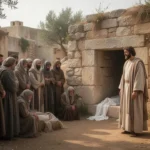
As Jesus passed through Jericho, he stopped beneath the tree and called Zacchaeus by name. Jesus then told him to come down because he intended to stay at Zacchaeus’s house that day. The invitation was direct, public, and personal: Jesus did not wait for Zacchaeus to prove himself before offering him attention.
Zacchaeus came down quickly and welcomed Jesus with joy. Luke then describes the crowd’s complaint. They objected that Jesus had gone to stay with someone regarded as a sinner. Their reaction reveals the social meaning of the encounter: Jesus was not merely speaking to Zacchaeus in passing. He was extending fellowship and acceptance to a person the crowd believed should remain outside.
Jesus’ willingness to enter Zacchaeus’s home should not be confused with approval of exploitation. The narrative places acceptance before Zacchaeus’s public response, but it does not ignore the harm connected with his conduct. Instead, grace creates the setting in which truth, repentance, and repair can take place.
Zacchaeus then announced that he would give half of his possessions to the poor. He also said that if he had defrauded anyone, he would repay that person four times the amount. These promises are the visible evidence of his changed priorities. He did not offer only an emotional reaction or a private religious feeling; he addressed money, victims, and social responsibility.
Jesus responded by declaring that salvation had come to Zacchaeus’s house and by identifying him as a son of Abraham. In the context of the story, this means that Zacchaeus belongs within the people of God despite the crowd’s judgment. Jesus closes the account by explaining that the Son of Man came to seek and save the lost.
The narrative therefore follows a clear movement:
Zacchaeus seeks to see Jesus, overcoming the crowd and his physical disadvantage.
Jesus seeks Zacchaeus, calling him by name and entering his home.
The crowd rejects Zacchaeus, treating his past as the whole truth about him.
Zacchaeus responds with repentance, generosity, and restitution.
Jesus confirms his restoration, describing salvation as reaching his household.
Why Zacchaeus’s restitution is central to the story
The most distinctive part of Zacchaeus’s response is his treatment of money. He promises to give half of his possessions to the poor and to repay those he defrauded four times over. These actions show that biblical repentance is not limited to saying that one feels sorry. It includes a changed relationship with wealth, power, and people who have been harmed.
Scholars and readers sometimes discuss the grammar of Zacchaeus’s statement. The wording can be understood as a present practice—“I give” and “I repay”—or as a declaration of what he is now committing himself to do. Either way, the narrative presents his words as a meaningful response to Jesus. The story emphasizes the outcome rather than providing a technical accounting of his previous transactions.
The reference to fourfold repayment is especially striking. Jewish law included requirements for restoring stolen property, with the amount varying according to the circumstances. Zacchaeus’s promise goes beyond a minimal correction and communicates serious accountability. He is prepared to absorb a substantial personal cost in order to address the damage associated with his actions.
His gift to the poor also matters. Restitution deals directly with people who were wronged, while generosity addresses the wider community. By giving half of his possessions, Zacchaeus demonstrates that wealth is no longer the measure governing his life. His resources become a means of service rather than a source of status and control.
That does not mean every person must imitate Zacchaeus’s exact percentage or repayment formula in every situation. The story does not establish a universal financial rule for all wrongdoing. Instead, it gives a principle: genuine repentance takes practical responsibility, and the appropriate form of repair should seriously consider the harm done.
Identify the people or groups affected by the wrongdoing.
Tell the truth about what happened instead of minimizing it.
Return money or property when that is possible and appropriate.
Accept a cost rather than expecting the injured person to carry it.
Change the habits, systems, or relationships that allowed the harm to occur.
Restitution also has limits. A person who has caused harm should not use an apology, gift, or request for forgiveness to pressure victims into immediate reconciliation. Zacchaeus’s story celebrates responsibility, but it does not authorize unsafe contact or erase the need for wise boundaries. In modern situations involving abuse, fraud, or criminal conduct, accountability may include professional, legal, or community processes.
Repentance has direction: Zacchaeus turns toward God by turning toward the people affected by his conduct. His generosity does not purchase salvation; it reveals that his priorities have changed.
What Jesus’s response means for salvation and belonging
Jesus says that salvation has come to Zacchaeus’s house. The statement is not presented as a reward for earning God’s favor through charitable giving. Zacchaeus does not buy his way into acceptance. His generosity follows the encounter with Jesus and functions as evidence that the encounter has reached his conscience, possessions, and relationships.
The phrase “to his house” may refer to Zacchaeus’s household as well as to the place where the encounter occurred. Luke does not provide a separate account of every family member’s response, so the text should not be pressed beyond what it says. The central point is that salvation is not a hidden idea confined to Zacchaeus’s thoughts; it enters the setting of his ordinary life.
Jesus also calls Zacchaeus a son of Abraham. That designation answers the crowd’s implied question about whether someone with Zacchaeus’s occupation could still belong. His identity has not been erased by his past, and his exclusion is not permanent. Jesus restores him to a place of human and covenant belonging.
This is one reason the story carries such force. Zacchaeus has wealth, but wealth has not protected him from loneliness or rejection. He has a position, but his position has not made him respected. He is known by the public as a tax collector, while Jesus sees the person who can still answer God’s call.
The story also challenges two opposite errors. One error says that a person’s past disqualifies him or her from change. The other says that forgiveness makes changed behavior unnecessary. Luke presents a different pattern: Jesus offers mercy to a compromised person, and that mercy produces a concrete response.
Jesus’ final explanation—that the Son of Man came to seek and save the lost—places Zacchaeus inside a larger purpose. “Lost” does not mean that Zacchaeus has no value. It means that he is separated from the life and relationship he was made to have. Jesus seeks people who are morally compromised, socially excluded, spiritually confused, or all three.
How Zacchaeus differs from other tax collectors in the New Testament
Zacchaeus is sometimes confused with other tax collectors in the Gospels, but the accounts involve different people and circumstances. Matthew, also called Levi, is a tax collector whom Jesus calls to follow him in the Synoptic Gospels. Zacchaeus appears only in Luke 19, where the focus is on his encounter in Jericho and his response involving restitution.
Both stories show Jesus calling people whom respectable society might avoid. However, their details are not interchangeable. Matthew’s story emphasizes his call to discipleship and the meal associated with it, while Zacchaeus’s story emphasizes his desire to see Jesus, Jesus’ visit to his house, and his financial response.
Zacchaeus should also not be reduced to a simple stereotype of every tax collector. The text tells us that he was wealthy, a chief collector, and connected with claims of defrauding. It does not provide a complete biography or explain every part of his career. Responsible reading keeps the clear details distinct from speculation.
The account is also different from the prayer of the tax collector in Jesus’ parable about two men praying in the temple. That parable contrasts a self-righteous Pharisee with a tax collector who asks for mercy. Zacchaeus is a named individual in a historical narrative within Luke’s presentation, not the unnamed tax collector in that teaching story.
Keeping these accounts separate helps preserve the particular message of Zacchaeus’s story. He is not merely a symbol for “bad people.” He is a specific man whose social position, economic behavior, curiosity, encounter with Jesus, and response all contribute to the meaning of the passage.
Lessons from Zacchaeus for faith and daily life
Zacchaeus’s story continues to speak to people who feel defined by their reputation. The crowd sees a tax collector; Jesus sees someone capable of responding. This does not mean reputation is irrelevant. It means a person’s worst actions do not have to become the final word about that person.
The account also gives practical guidance to people who have benefited from unfairness. Religious language should not become a way to avoid financial and relational responsibility. If someone has gained through deception, coercion, or exploitation, a sincere response should ask what can be returned, repaired, disclosed, or changed.
At the same time, the passage encourages communities to examine how they respond to people who are seeking change. The crowd’s criticism may have been based on real concerns about Zacchaeus’s conduct. Yet the crowd treated his past as proof that no new future was possible. Jesus did not ignore wrongdoing, but he made room for transformation.
Several practical questions can help apply the passage without turning it into a slogan:
What controls my sense of security? Zacchaeus had substantial wealth, but his possessions did not settle the deeper questions in his life.
Whom have my choices affected? Repentance looks beyond private intentions to the people who carry the consequences.
Am I willing to accept a cost? Repair often involves time, money, humility, or the loss of an advantage.
Do I allow people to change? Wise trust may develop gradually, but permanent condemnation leaves no room for redemption.
Does my faith affect ordinary decisions? Zacchaeus’s response reached his home, finances, reputation, and relationships.
The account offers guidance to leaders and churches as well. Welcoming a person does not require overlooking harm, and accountability does not require denying the possibility of grace. Healthy communities can hold both truths together by protecting those who were harmed, requiring honest change, and refusing to treat anyone as beyond the reach of restoration.
For readers who identify with Zacchaeus, the first step is not to manufacture a public performance. It is to respond honestly to what Jesus reveals. That response may include confession, a concrete plan for restitution, generosity toward people in need, and a willingness to accept the consequences of past actions.
For readers who identify more with the crowd, the challenge is different. It is possible to recognize wrongdoing without assuming that change is impossible. Zacchaeus’s encounter shows that mercy is not denial and that accountability is not the opposite of compassion.
Luke’s short account ends with Jesus’ mission, not with a detailed report of Zacchaeus’s later life. We are not told what happened to him afterward. That restraint keeps attention on the central message: Jesus seeks the lost, welcomes a person whom others reject, and brings salvation that becomes visible through changed priorities and repaired relationships.
Frequently asked questions
Was Zacchaeus really a short man?
Luke 19:3 says Zacchaeus was short and could not see Jesus over the crowd. The text does not give his exact height. His effort to climb a sycamore-fig tree is included to explain how he overcame the crowd’s obstruction and gained a view of Jesus.
Did Zacchaeus give away all his money?
No. Zacchaeus said he would give half of his possessions to the poor and repay four times what he had taken from anyone through fraud. The passage does not say that he gave away everything, and it presents these actions as evidence of repentance rather than a formula for earning salvation.
Why did people dislike Zacchaeus?
Zacchaeus was a chief tax collector working within a system connected to Roman rule, and tax collectors were widely viewed as collaborators. His wealth and his statement about defrauding people also suggest that the community had reasons to distrust him. These factors explain the crowd’s objection when Jesus visited his home.
What does the Zacchaeus story teach about repentance?
It teaches that repentance involves more than regret or religious words. Zacchaeus responded by changing how he used his wealth, helping the poor, and offering substantial restitution to people he had harmed. The story connects inward change with outward responsibility while showing that acceptance comes through Jesus, not through financial performance.









Leave a Reply