Bartimaeus appears in Mark 10:46–52, as Jesus leaves Jericho with his disciples and a large crowd. Mark identifies him as “the son of Timaeus,” explains that he is blind, and says that he is sitting beside the road asking for help. The name Bartimaeus comes from the Aramaic expression meaning “son of Timaeus.”
The account is brief, but each detail carries weight. Bartimaeus is physically disabled, economically vulnerable, and dependent on the generosity of travelers. He occupies a position at the edge of public life, yet he recognizes something about Jesus that many people in the crowd do not express so directly: Jesus is the Son of David, a title connected with the promised royal deliverer of Israel.
When Bartimaeus hears that Jesus is passing by, he begins shouting for mercy. Some people tell him to be quiet, but he calls out even more forcefully. Jesus stops, asks that Bartimaeus be brought to him, restores his sight, and then Bartimaeus follows Jesus along the road.
The central movement of the story: Bartimaeus hears that Jesus is near, calls for mercy, responds when Jesus summons him, receives sight, and follows Jesus on the way.
The setting near Jericho
Jericho was an important city in the Jordan Valley, positioned along routes used by travelers moving toward Jerusalem. Jesus is traveling toward Jerusalem at this point in Mark’s Gospel, and the journey has a clear narrative direction: he is approaching the events of his arrest, crucifixion, and resurrection.
For a blind beggar, a busy road could provide an opportunity to receive alms from pilgrims and other travelers. People heading toward Jerusalem might pass through or near Jericho, making the roadside a practical place to ask for assistance. Bartimaeus is therefore not presented in a private setting but in a crowded, public one.
The location also creates a sharp contrast between the road and the way of discipleship. Bartimaeus begins beside the road, dependent on passing travelers. After Jesus heals him, he joins Jesus on the road. Mark’s wording connects his physical restoration with a new direction for his life.
What happens to Bartimaeus step by step
Mark’s account can be followed through a series of simple actions. Each action reveals something about Bartimaeus, Jesus, or the crowd around them.
Bartimaeus hears that Jesus is passing. His blindness does not prevent him from receiving information or responding to what he hears.
He calls Jesus “Son of David.” This is a public appeal that recognizes Jesus as the expected Davidic king or deliverer.
He asks for mercy. Bartimaeus does not present a detailed argument or claim personal merit; he appeals to Jesus’ compassion.
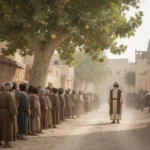
The crowd rebukes him. The people around Jesus treat his shouting as an interruption and try to silence him.
He calls out more insistently. Opposition does not make him withdraw. He repeats his appeal with greater urgency.
Jesus stops. The movement of the crowd pauses because Jesus gives attention to the person others want to quiet.
Bartimaeus throws aside his cloak. He gets up quickly and comes to Jesus, leaving behind an item that may have been useful for collecting or protecting the money he received.
Jesus asks what he wants. Bartimaeus answers plainly that he wants to see again.
Jesus restores his sight. Mark describes the healing as connected with Bartimaeus’s faith.
Bartimaeus follows Jesus. He does not simply return to his former routine; he becomes a follower on the road.
This sequence gives the story its rhythm. Bartimaeus hears, calls, persists, comes, asks, receives, and follows. The repeated movement from hearing to action makes him an example of a person who responds decisively when an opportunity for encounter appears.
Why Bartimaeus called Jesus “Son of David”
“Son of David” is more than a respectful form of address. In the Jewish Scriptures and later Jewish expectation, David represented Israel’s ideal king and the royal line associated with God’s promises. Calling Jesus the Son of David suggests that Bartimaeus sees him as the promised ruler who can bring God’s saving work.
Mark has already shown Jesus teaching, healing, forgiving sins, and exercising authority over illness and spiritual powers. Bartimaeus’s title gathers these themes into a public confession. He does not merely call out to a traveling teacher; he appeals to someone he believes has a distinctive role in God’s purposes.
The title is especially striking because Bartimaeus is blind. In the story’s literary design, a man who cannot see physically appears to perceive Jesus’ identity more clearly than many sighted people around him. His body lacks sight, but his response shows recognition, trust, and expectation.
His use of the title also explains why the crowd may have objected. Publicly identifying Jesus as a royal or messianic figure could attract attention and create tension. Bartimaeus’s cry is not a quiet private prayer; it is a visible announcement made in a public crowd.
Bartimaeus’s request for mercy is both specific and open. He asks Jesus to act compassionately, but he does not initially spell out every detail of his need. The phrase recognizes that help depends on Jesus’ willingness and ability to respond.
When Jesus later asks what Bartimaeus wants, he gives a direct answer: he wants to see again. The exchange shows that a cry for mercy is not vague or evasive. Bartimaeus trusts Jesus enough to make his need known clearly when invited to do so.
His request also differs from a demand. He does not attempt to control Jesus or tell him how the healing must happen. Instead, he places his need before Jesus and remains persistent when the crowd attempts to silence him.
For readers, the scene presents prayer as a combination of honesty and persistence. Bartimaeus does not hide his condition, minimize it, or wait for a more socially acceptable moment. He brings his need into the open because he believes Jesus is worth calling.
Why the crowd tried to silence him
Mark does not give the crowd’s exact reasoning, so readers should avoid assigning motives that the text does not state. They may have viewed Bartimaeus as a nuisance, assumed Jesus had more important concerns, or simply wanted to keep the procession moving. Whatever their reason, their response places them between Bartimaeus and Jesus.
The crowd’s behavior reflects a recurring Gospel theme: people who appear insignificant are often pushed aside by those who think they understand access to Jesus. Children, the poor, the sick, and outsiders repeatedly challenge assumptions about who deserves attention.
Bartimaeus does not allow the crowd to define the limits of his hope. His second cry is louder or more urgent than the first. The story does not praise volume for its own sake; it highlights his refusal to abandon the appeal when others discourage him.
Jesus’ response corrects the crowd without a long speech. He stops, calls for Bartimaeus, and makes room for him to approach. The same people who tried to silence Bartimaeus then tell him to take courage because Jesus is calling him. Their change of attitude shows how quickly a crowd can follow the direction established by Jesus.
The significance of Bartimaeus throwing off his cloak
Mark specifically mentions that Bartimaeus throws aside his cloak before coming to Jesus. That small detail suggests urgency and readiness. A cloak could provide warmth, protection, and a surface for collecting coins, so leaving it behind involves practical risk.
The action may also symbolize a break with his former situation. Bartimaeus does not slowly prepare while Jesus waits. He rises and moves toward the opportunity in front of him. His response is physical, immediate, and wholehearted.
The text does not require readers to treat the cloak as a permanent vow of poverty or as proof that Bartimaeus abandoned all possessions. It is safer to see it as a narrative detail showing that he does not let his roadside circumstances delay him when Jesus calls.
His movement can be outlined in three stages:
From sitting to standing: he changes posture in response to Jesus’ call.
From the roadside to Jesus: he crosses the distance separating him from the person he trusts.
From dependence to following: after healing, he joins the traveling community on the way.
Why Jesus asked Bartimaeus what he wanted
Jesus already knows that Bartimaeus is blind, yet he asks him to state his desire. The question gives Bartimaeus a voice in a setting where others have tried to silence him. Instead of allowing the crowd to speak for him, Jesus places the conversation directly between them.
The question also preserves Bartimaeus’s dignity. He is not treated as an object of pity or as a problem to be solved quickly. He is addressed as a person capable of answering for himself. His response is concise: he wants his sight restored.
Jesus’ question can also distinguish genuine desire from the assumptions of observers. The crowd may have had opinions about what Bartimaeus needed, but Bartimaeus himself names the request. The story therefore emphasizes personal agency within an act of divine compassion.
In the Gospel accounts, Jesus sometimes heals through touch, spoken commands, or other actions. Here, Mark focuses on the conversation and on Bartimaeus’s faith. The healing is not presented as a technique that can be reproduced mechanically; it is an encounter between Jesus and a person who calls on him.
How the healing relates to faith
Jesus tells Bartimaeus that his faith has made him well. The statement connects the healing with Bartimaeus’s trust, but it should not be turned into a simplistic formula suggesting that every illness results from insufficient faith. The passage does not give permission to blame sick or disabled people for their conditions.
In this scene, faith is visible in Bartimaeus’s response to Jesus. He hears who is passing, identifies Jesus as the Son of David, continues calling despite opposition, comes when summoned, and asks confidently for sight. His faith is not merely an idea held privately; it becomes action.
The wording also carries the broader sense of being saved or made whole. Mark’s story includes a physical restoration, yet the final image shows more than improved eyesight. Bartimaeus follows Jesus, placing his restored life within the larger path of discipleship.
Read the healing carefully: Bartimaeus’s faith explains his trusting response to Jesus, not a universal rule that makes illness a person’s moral or spiritual failure.
What it means that Bartimaeus followed Jesus
The last line of Mark’s account is essential. Bartimaeus receives sight and then follows Jesus on the way. The healing does not end with personal relief; it leads to a new relationship and direction.
In Mark, “the way” can describe the physical road Jesus is traveling, but it also carries discipleship significance. Jesus has been teaching his followers what it means to follow him toward suffering and service. Bartimaeus joins that movement immediately after receiving sight.
This ending separates the story from a simple miracle report. A miracle story might focus only on the problem, the act of healing, and the result. Mark adds the response of a former beggar who becomes a follower. The restored man is not returned merely to ordinary life; he is shown walking with Jesus.
His discipleship is also notable because the Twelve frequently struggle to understand Jesus’ identity and mission. Bartimaeus, who begins as a marginalized person beside the road, responds with remarkable clarity. Mark does not tell readers everything about his later life, but he gives him a meaningful final posture: following Jesus.
How Mark’s account differs from Matthew and Luke
Matthew 20:29–34 records a healing near Jericho involving two blind men. Like Bartimaeus in Mark, they call Jesus the Son of David, ask for mercy, and receive healing. Matthew does not name either man.
Luke 18:35–43 describes one unnamed blind man near Jericho. He also calls out to Jesus, asks for mercy, receives his sight, and praises God. Luke says that he follows Jesus and that the people who witness the event praise God.
These differences should be acknowledged rather than forced into a single detail-by-detail account. Mark names one man, Bartimaeus; Matthew mentions two unnamed men; Luke mentions one unnamed man. The Gospel writers may be selecting different aspects of an event, preserving related traditions, or arranging details for their own narrative purposes.
For the specific question “Who was Bartimaeus?” Mark is the direct source. Matthew and Luke support the broader picture of blind people calling on Jesus near Jericho, but neither provides additional biographical information about Bartimaeus himself.
What the story teaches about dignity and attention
Bartimaeus is introduced through his condition and social position: he is blind and begging by the road. Yet the story quickly gives him a name, a voice, a theological insight, and a decisive response. He is not treated as a background figure once Jesus notices him.
Jesus does not hurry past him because the crowd is large or because the journey is urgent. He gives Bartimaeus direct attention. That response has ethical force: people who are often reduced to their needs remain capable of faith, judgment, speech, and meaningful participation.
The account also challenges the way communities can manage access to religious leaders or public figures. The crowd assumes that silence is appropriate, but Jesus rejects that assumption by calling Bartimaeus forward. The person considered disruptive becomes the person the crowd must help approach.
Readers can apply this dimension without romanticizing poverty or disability. Bartimaeus’s faith does not make his hardship acceptable, and the story does not excuse social neglect. His healing highlights Jesus’ compassion while also exposing how easily vulnerable people can be ignored.
How to read Bartimaeus’s story responsibly today
The passage invites spiritual reflection, but responsible interpretation keeps its historical and literary details in view. Bartimaeus is not a symbol detached from a real social setting; he is a person living with blindness and poverty in a public place.
Do not equate disability with spiritual deficiency. The story presents Bartimaeus as a person of faith, not as someone being punished.
Do not promise automatic healing. The Gospel reports a particular act of Jesus and does not guarantee that every prayer will produce the same physical result.
Notice his agency. Bartimaeus calls, answers, rises, and follows; he is not passive within the narrative.
Pay attention to the crowd. The people around Jesus can either obstruct access or help someone respond to his call.
Keep discipleship in view. The story ends with Bartimaeus following Jesus, not simply with the restoration of sight.
A careful reading can therefore hold together several truths: Jesus shows compassion, Bartimaeus exercises faith, the crowd initially fails him, and the healing leads to a changed direction. None of these themes needs to erase the others.
Where to read about Bartimaeus
The fullest account is Mark 10:46–52. Read the surrounding chapters as well, since the episode comes near the end of Jesus’ journey toward Jerusalem and follows repeated teaching about discipleship, service, suffering, and the kingdom of God.
For comparison, read Matthew 20:29–34 and Luke 18:35–43. Comparing the passages helps you see which details are shared and which are distinctive. Mark supplies the name Bartimaeus and the detail about the cloak; Matthew records two blind men; Luke emphasizes the man’s praise of God after receiving sight.
Questions that can guide your reading include:
What does Bartimaeus recognize about Jesus before he receives healing?
How does the crowd respond to him, and how does Jesus respond differently?
Why might Mark include the detail that Bartimaeus leaves his cloak?
What changes between Bartimaeus’s position at the beginning and his position at the end?
How does following Jesus shape the meaning of the healing?
Bartimaeus remains memorable because his story joins persistent prayer, clear recognition, and active discipleship. He begins by the road calling for mercy and ends on the road following Jesus, with the crowd no longer able to define his importance.
Frequently asked questions
Is Bartimaeus the same person as the blind man in Matthew and Luke?
The Gospel accounts describe similar healings near Jericho, but they present the details differently. Mark names Bartimaeus and mentions one blind man. Matthew refers to two blind men without naming them, while Luke refers to one unnamed blind man. Readers may compare the accounts, but the texts do not explicitly identify every figure in exactly the same way.
What does the name Bartimaeus mean?
Bartimaeus is commonly understood as an Aramaic-based name meaning “son of Timaeus.” Mark effectively explains the name for readers. The word “bar” means “son of” in Aramaic usage, while “Timaeus” is connected with the man’s father or family designation. The name helps distinguish him from other people in the Gospel narratives.
Was Bartimaeus a disciple of Jesus?
Mark says that Bartimaeus followed Jesus after receiving his sight. This clearly presents him as responding in discipleship, at least from that point in the story. The Gospel does not provide a longer biography, explain how long he followed Jesus, or identify him with a named member of the Twelve.
Why is Bartimaeus important in Christian teaching?
Bartimaeus illustrates persistent faith, honest dependence on Jesus, and a willingness to follow after receiving help. His story also highlights the dignity of a person whom the crowd tries to silence. Christians often study the passage because it connects physical healing with spiritual recognition and a changed direction of life, while cautioning against blaming people for illness or disability.









Leave a Reply