Barrabas or Barabbas? The biblical figure explained
Barrabas or Barabbas? The biblical figure explained
Barrabas is usually a misspelling of Barabbas, the prisoner whom Pontius Pilate released while Jesus was condemned to crucifixion.
Barabbas appears in all four New Testament Gospels, but the accounts describe him with slightly different details. He was connected with violent resistance, rebellion, and murder, not merely a minor offense. His release forms one of the most striking contrasts in the Passion narratives: a guilty prisoner goes free, while Jesus is handed over to execution.
The form Barabbas is the standard English spelling used in most modern Bible translations and reference works. “Barrabas” commonly appears as a spelling variation, typing error, or transliteration difference, but it normally refers to the same biblical figure.
The name comes through Greek from an Aramaic expression. It is often explained as bar abba, meaning “son of the father” or “son of a father.” The exact linguistic details are discussed by scholars, because ancient names could pass through several languages and spelling systems before reaching English.
The meaning creates an important literary contrast in the Gospel story. Jesus is repeatedly presented as the Son of God, while Barabbas’s name can be understood as “son of the father.” The text does not stop to explain this wordplay, and readers should not treat it as the only meaning of the scene. Still, it helps explain why later Christian interpretation has found the name especially memorable.
Spelling tip: If you are searching for the biblical prisoner, use Barabbas. “Barrabas” generally points to the same person but is not the usual English form of his name.
What the Gospels say Barabbas had done
The four Gospel accounts agree that Barabbas was imprisoned and that Pilate released him instead of Jesus. They do not describe his offense in exactly the same way, so it is best to read the accounts together rather than reduce him to a single label.
Matthew 27:15–26 describes him as a notorious prisoner.
Mark 15:6–15 identifies him with people involved in a rebellion and says that he had committed murder during the uprising.
Luke 23:18–25 connects him with an insurrection in the city and a killing.
John 18:38–40 refers to him as a bandit or violent criminal, depending on how the Greek term is translated.
These descriptions show that Barabbas was not simply accused of a vague political disagreement. He was associated with public disorder and bloodshed. Mark and Luke place his crime in the setting of an uprising, while John’s wording can carry the sense of a robber, bandit, or armed rebel.
The differences do not necessarily mean that the Gospels present unrelated stories. Ancient writers often emphasized different features of the same event. One account may highlight Barabbas’s reputation, another his participation in rebellion, and another the violent character of his actions.
How Barabbas became the prisoner released instead of Jesus
During Jesus’s trial, the Roman governor Pontius Pilate is portrayed as questioning him and finding no clear basis for the death sentence. At the same time, the Gospel narratives describe pressure from the gathered crowd and religious leaders to have Jesus executed.
The Gospels say that Pilate had a practice of releasing a prisoner around the Passover season. He presented the crowd with a choice between Jesus and Barabbas. The crowd called for Barabbas to be released and Jesus to be crucified.
Matthew, Mark, Luke, and John place the decision in the final period before Jesus’s crucifixion, but they frame Pilate’s role somewhat differently. Matthew emphasizes Pilate’s attempt to distance himself from responsibility. Mark presents the governor as acting to satisfy the crowd. Luke records a series of judgments in which Pilate says he finds no grounds for execution. John presents an extended exchange about kingship, authority, and truth.
The central contrast remains the same: Barabbas, a prisoner associated with violence, receives freedom, while Jesus, whom the Gospel narratives portray as innocent, receives the death sentence. This reversal is the scene’s main dramatic and theological force.
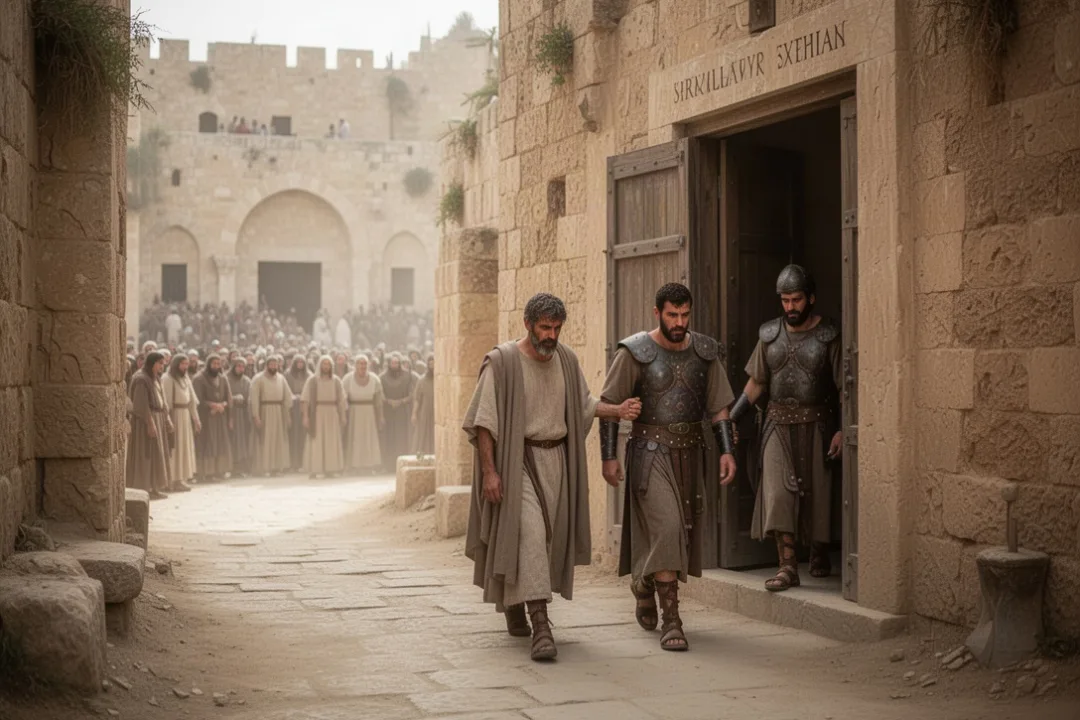
The Gospel accounts place the guilty prisoner’s release beside Jesus’s condemnation, creating a deliberate contrast between freedom and sacrifice.
What the Barabbas episode means in the Gospel story
Barabbas’s release is not a minor detail in the Passion narratives. It helps readers see how the Gospels understand Jesus’s death and the human decisions surrounding it.
An innocent man is condemned while a guilty man goes free
The story presents a stark legal and moral reversal. Barabbas is connected with serious wrongdoing, while Pilate repeatedly struggles to identify a legitimate reason to execute Jesus. The prisoner who appears to deserve punishment leaves the scene alive, and the person portrayed as innocent is condemned.
Christian readers have often understood this as a picture of substitution: Jesus takes the place of another. The Gospel text does not say that Barabbas personally understood the exchange or became a disciple. Instead, the event functions symbolically within the larger claim that Jesus dies on behalf of sinners.
That interpretation should not erase the historical people involved. Barabbas is presented as a real prisoner in the narrative, the crowd makes a real demand, and Pilate makes a real political decision. The theological meaning grows out of those concrete actions rather than replacing them.
The scene exposes political pressure and public violence
The episode also shows how Roman authority, local leadership, and crowd pressure interact. Pilate has the power to approve an execution, but the narratives portray him as concerned about the public reaction. His decision reflects the danger of unrest during a major festival in Jerusalem.
Barabbas represents one possible response to Roman rule: armed resistance. Jesus represents a different kind of kingdom, one that the Gospel of John especially describes as not founded on ordinary political power. The crowd’s choice between these two figures sharpens the contrast between violent revolt and Jesus’s mission as the Gospels understand it.
The release anticipates Christian teaching about redemption
Later Christian theology developed the Barabbas scene as a vivid illustration of redemption. The guilty person is released, while Jesus suffers. This does not mean that every Christian tradition explains the cross in exactly the same way, but the episode fits naturally with teachings about Jesus bearing sin, giving his life for others, and bringing reconciliation with God.
Paul’s letters and other New Testament writings explain these ideas in several forms. The Gospels do not provide a formal theory in the Barabbas passage itself. They show the exchange through narrative: one prisoner leaves, and Jesus is led away.
Was Barabbas a revolutionary, a robber, or a murderer?
The safest answer is that the Gospel accounts associate Barabbas with an uprising and a killing, while John uses a term that can be translated in more than one way. Calling him only a “robber” may understate the political and violent setting suggested by Mark and Luke. Calling him a fully organized revolutionary may add details the text does not provide.
The Greek word in John can refer to a bandit or violent outlaw. In the Roman world, banditry could overlap with rebellion, because armed groups might attack travelers, officials, or property while also resisting the government. The word therefore does not settle the question by itself.
Mark and Luke provide the clearest link to an insurrection. They mention an uprising and a murder, suggesting that Barabbas was involved in a serious disturbance rather than an isolated theft. The Gospels do not name the victim, identify Barabbas’s political organization, or describe the full event.
Descriptions such as violent rebel, insurrectionist, or bandit involved in a revolt can all capture part of the evidence. A precise explanation should also acknowledge what remains unknown.
Did Barabbas actually exist?
Barabbas is known primarily through the four New Testament Gospels. There is no widely accepted independent ancient record that provides a separate biography of him. That absence is not surprising for a local prisoner who appears briefly in the account of Jesus’s trial.
The Gospel writers place his release within the Roman administration of Judea and the tense setting of Passover in Jerusalem. The scene is historically plausible in its broad setting, but scholars debate some specific elements, especially the custom of releasing a prisoner at the festival.
The Gospel accounts are the direct sources for what Christians know about Barabbas. They do not tell us what happened to him after his release. There is no reliable biblical information about his later life, conversion, death, or relationship with Jesus’s followers.
What remains unknown: The Bible does not tell us what Barabbas did after leaving prison. Claims that he later became a Christian, returned to crime, or died in a particular way belong to later imagination or tradition, not to the Gospel text.
Did Pilate really offer a choice between Jesus and Barabbas?
All four Gospels include the choice involving Barabbas, which makes it a significant part of the New Testament presentation of Jesus’s trial. Matthew, Mark, and Luke describe the release custom more directly, while John focuses on the exchange between Pilate, Jesus, and the crowd.
Some historians question whether the Roman governor regularly released a prisoner at Passover. The evidence outside the Gospels is limited, and ancient sources do not give a complete description of such a practice in Jerusalem. Other scholars argue that a local or temporary custom could have existed without leaving a clear record elsewhere.
The question should be separated from the meaning of the narrative. The Gospels clearly use Barabbas to create a comparison between Jesus and a notorious prisoner. Even when readers discuss the historical background, the story’s literary structure remains unmistakable.
It is also useful to avoid assuming that the crowd represents every Jewish person in Jerusalem. The narratives describe a particular gathering in a charged political and religious situation. Blaming an entire people for Jesus’s death is historically inaccurate and contradicts responsible Christian and scholarly interpretation.
What the name Barabbas may suggest about the story
The name’s possible meaning, “son of the father,” has attracted attention because Jesus is described throughout the New Testament in relation to God the Father. Some ancient manuscript evidence for Matthew includes the name Jesus Barabbas in the choice presented by Pilate, although the wording is not identical across all manuscripts and translations.
This textual issue is important but should be handled carefully. It does not mean that the released prisoner was normally known as Jesus, nor does it change the basic Gospel account. It shows that some early copies may have preserved a longer form of the name in Matthew’s version of the scene.
If the longer reading is considered, the contrast becomes even more pointed: the crowd chooses between two people named Jesus, one identified as Jesus Barabbas and the other as Jesus called the Messiah. However, because manuscript evidence differs, readers should check the notes in a reliable Bible translation rather than treat this detail as certain in every text.
The name should support careful reading, not speculation. The Gospel writers’ main emphasis is not a hidden code in the name but the visible exchange between a guilty prisoner and the condemned Jesus.
Common mistakes when explaining Barabbas
Using “Barrabas” as the standard spelling: It is usually better to write Barabbas, while recognizing that Barrabas is a common variant in searches and informal writing.
Calling him only a thief: Mark and Luke connect him with rebellion and murder, so “thief” alone can make his role seem less serious.
Inventing his later biography: The New Testament does not say what happened to him after his release.
Claiming the Gospels give identical details: They agree on the central event but describe his crimes and Pilate’s decision with different emphases.
Presenting the prisoner custom as historically certain: The practice is reported by the Gospels, but its wider historical documentation is limited.
Blaming all Jewish people for the decision: The story concerns particular leaders, a crowd, and Roman authority in a specific setting.
Turning the name into a complete explanation: The possible meaning of Barabbas adds interpretive interest but does not replace the narrative itself.
Quoting a Bible translation as if every version uses the same wording: Differences in translation and manuscript evidence can affect terms such as “bandit,” “robber,” and the longer form of the name.
How to read the four Barabbas passages together
A careful reading begins with the shared facts. Barabbas is imprisoned, he is associated with serious violence, Pilate presents a choice, the crowd asks for his release, and Jesus is crucified. Those points provide the stable framework for comparing the accounts.
Next, notice each Gospel’s emphasis. Matthew highlights the governor’s public gesture and the crowd’s response. Mark gives a concise account centered on the prisoner involved in rebellion. Luke stresses the legal tension surrounding Jesus’s innocence. John develops the political and theological questions raised by Jesus’s identity as king.
Read Matthew 27:15–26 for the crowd’s choice and Pilate’s public handling of the decision.
Read Mark 15:6–15 for Barabbas’s connection with rebellion and murder.
Read Luke 23:18–25 for the repeated claim that Jesus has not committed a capital offense.
Read John 18:38–40 for the contrast between Jesus and the violent prisoner called Barabbas.
Compare the details without forcing them into identical wording, allowing each account to make its own point.
This approach prevents two common errors: treating small differences as proof that the stories cannot be related, or flattening the four accounts into one version that ignores their distinctive emphases.
Why Barabbas still matters to Christian readers
Barabbas matters because his brief appearance gathers several major themes into one scene: guilt, innocence, political fear, public pressure, violence, and substitution. He is not developed as a fully rounded character, but his role is memorable precisely because the narrative places him at the center of a decisive exchange.
For Christian readers, the scene raises a personal question about the meaning of grace. Barabbas does not appear to earn his freedom or make a moral argument for it. He receives release while another person takes the path toward execution. The Gospel story uses that unexpected outcome to illustrate the claim that Jesus acts for the sake of others.
For historical readers, the scene provides a window into the unstable conditions surrounding Roman rule, public executions, and festival crowds. For literary readers, it presents a carefully shaped contrast between two prisoners and two ideas of deliverance: armed revolt on one side and Jesus’s kingdom on the other.
The Bible does not tell readers to admire Barabbas or to treat his crimes as unimportant. His significance comes from the fact that he is the guilty person who walks free. His name remains attached to one of the clearest narrative pictures of the Christian claim that Jesus takes the place of sinners.
What happened to Barabbas after his release?
No biblical passage answers this question. The Gospels end their attention to Barabbas once he has been released, and the rest of the New Testament does not provide a trustworthy account of his later life.
Some later stories and artistic works imagine that Barabbas was changed by witnessing Jesus’s death. Others portray him as troubled, grateful, or morally unchanged. These versions can explore the story’s themes, but they are creative interpretations, not established facts.
The lack of information is part of the narrative’s effect. Readers are left with the image of a man who receives an undeserved escape while Jesus is taken away. The text does not explain whether Barabbas understood the significance of what happened, leaving the theological contrast to stand on its own.
Frequently asked questions
Is Barrabas the same person as Barabbas?
Yes. “Barrabas” is generally a spelling variant or misspelling of “Barabbas,” the prisoner released instead of Jesus. Barabbas is the standard form in English Bibles and biblical reference works. The underlying name comes through ancient languages, so spelling differences can appear across languages, translations, older publications, and informal writing.
What crime did Barabbas commit?
The Gospels associate Barabbas with a rebellion and a killing. John uses a term that may mean bandit, robber, or violent rebel. The accounts do not provide the victim’s name, explain the full uprising, or identify a political group. Calling him a violent prisoner involved in insurrection is more accurate than describing him simply as a thief.
Why was Barabbas released instead of Jesus?
According to the Gospels, Pilate presented the crowd with a choice between Jesus and Barabbas during the Passover period. The crowd demanded Barabbas’s release and Jesus’s crucifixion. The narratives connect the decision with public pressure, political anxiety, and the desire to prevent unrest. The scene also illustrates the Christian theme of an innocent person taking the place of the guilty.
Does the Bible say Barabbas later followed Jesus?
No. Scripture gives no reliable information about Barabbas after his release. It does not say that he became a disciple, returned to violence, or met Jesus again. Later novels, films, sermons, and legends may imagine his response, but those portrayals should not be presented as biblical history.











Leave a Reply