Malchia: meaning, Bible references, and name variants
Malchia: meaning, Bible references, and name variants
Malchia is a biblical Hebrew name usually understood to mean “my king is Yahweh” or “Yahweh is king.” It is related to the better-known forms Malchiah, Malchijah, and Malkijah, which appear in different Bible translations.
The name does not identify only one person in Scripture. Several men are called Malchiah or a closely related form, especially in passages about Jerusalem’s priests, families, officials, and builders after the exile. The exact spelling, pronunciation, and meaning can vary slightly depending on the Hebrew form and English translation.
Malchia comes from a Hebrew name built from two meaningful parts. The first is connected with melech, the Hebrew word for “king.” The second is a shortened form associated with Yahweh, the personal name of Israel’s God.
For that reason, Malchia is commonly explained in either of two closely related ways: “my king is Yahweh” or “Yahweh is king.” These translations express the same central idea: loyalty to God as the true king.
The difference between the two English explanations comes from how scholars and translators analyze the name’s Hebrew grammar. Personal names can be compressed forms of longer phrases, so a name may carry a theological meaning without functioning as a complete sentence in ordinary Hebrew.
Meaning in brief: Malchia points to God’s kingship. If you are choosing the name, “my king is Yahweh” is the most commonly given personal-name explanation.
The name’s meaning is religious rather than occupational. It does not mean that the person named Malchia was a king, descended from a king, or held a royal position. Instead, it expresses a belief about who rules and whom the name-bearer or family recognizes as sovereign.
Why Malchia has several different spellings
Readers may encounter Malchia in one source and Malchiah or Malchijah in another. This happens because biblical names pass through several stages: the original Hebrew writing, ancient translations, transliteration into the Roman alphabet, and the spelling conventions chosen by a particular English Bible.
The Hebrew consonants are often represented in English as m-l-k-y-h or with a similar arrangement. The final element may be rendered as “-iah,” “-jah,” or “-yah,” depending on the translation system. The inserted “i” in Malchijah also reflects a common way of representing the Hebrew sounds.
Common related forms include:
Malchia: a shorter or alternate English spelling.
Malchiah: a form found in several English Bible translations.
Malchijah: a traditional spelling used in the King James tradition and other older translations.
Malkijah: a spelling that stays closer to a scholarly transliteration of the Hebrew.
Malkiah: another modernized form used in some names and reference works.
These forms are closely connected, but they are not always interchangeable in every passage. One translation may use Malchiah for a particular person while another uses Malchijah. A careful reader should check the reference and surrounding context rather than assuming every spelling points to the same individual.
Spelling differences do not usually change the name’s basic meaning. They mainly show how translators chose to represent Hebrew sounds in English. The form Malchia can therefore be understood as part of a broader family of biblical names rather than as an entirely separate name with an unrelated origin.
How to pronounce Malchia
There is no single universally accepted English pronunciation because Malchia is an uncommon spelling and different communities follow different traditions. A natural English pronunciation is mal-KY-uh. Some speakers may say mal-kee-AH, especially when treating the final “iah” as a distinct syllable.
The related form Malchijah is often pronounced mal-KY-jah or mal-kee-JAH. Malkijah may be pronounced mal-kee-YAH, reflecting a more deliberate rendering of the Hebrew ending.
If you are using Malchia as a given name, you can choose the pronunciation that feels clearest to your family. The most useful approach is to introduce it once—“We pronounce it mal-KY-uh”—and use that pronunciation consistently.
Where Malchia appears in the Bible
The Bible refers to multiple men named Malchiah or Malchijah. Most references occur in the Old Testament, particularly in passages connected with the exile, the restoration of Jerusalem, and the organization of Israel’s religious life.
Some references identify a person through his father, family, profession, or responsibility. Others mention a name in a list of priests, officials, or people who had taken part in a religious or community action. Because several individuals share the name, each reference needs to be read in its own setting.
Malchia in Jeremiah 38
Jeremiah 38 names Malchiah in the account of the prophet Jeremiah’s imprisonment. The passage describes a cistern belonging to Malchiah and records how Jeremiah was lowered into it after officials opposed his message.
This Malchiah is not presented as the same person as every Malchiah in Ezra or Nehemiah. The passage’s main focus is Jeremiah’s treatment during a political and spiritual crisis, not the personal history of Malchiah. The name matters because it helps identify the location and ownership associated with the event.
Readers should also be aware that English translations differ in how they handle the description connected with this Malchiah. Some wording can make the relationship or title appear slightly different. Comparing the verse in more than one translation can clarify that the spelling variation is a translation issue, not necessarily evidence of different events.
Malchia in Ezra
Ezra includes names related to families and individuals who returned from exile or were involved in the community’s effort to restore covenant faithfulness. Malchiah appears among these records in passages dealing with marriages outside the community and the response led by Ezra.
These lists can feel difficult to read, but they serve a practical historical purpose. They identify the families and individuals involved in a major communal decision. A name such as Malchiah is therefore part of a record of responsibility, ancestry, and public accountability, not merely a decorative detail.
Different editions may spell the name Malchiah, Malchijah, or another close form. When studying Ezra, use the chapter and verse along with the person’s family designation. The name alone is not enough to determine which individual is meant.
Malchia in Nehemiah
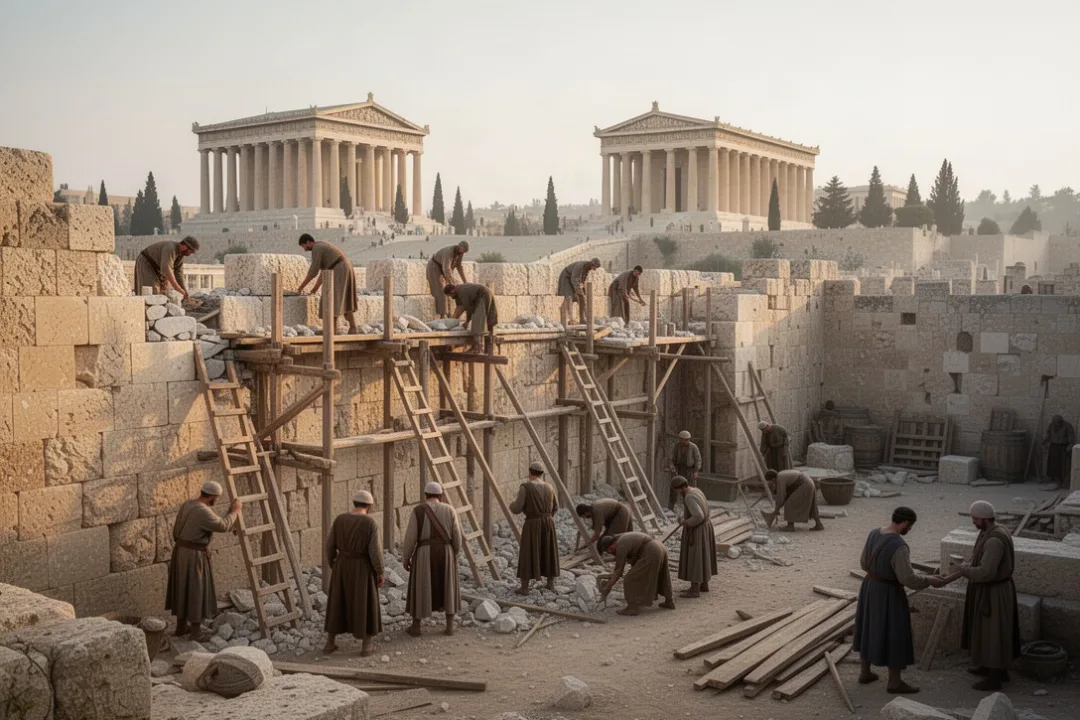
Nehemiah mentions more than one person with a name translated as Malchiah or Malchijah. The book describes the rebuilding of Jerusalem’s walls and gates, the organization of priests and Levites, and reforms intended to strengthen the restored community.
One Malchiah is associated with work on the city wall, while other men with the same or a similar name appear in lists of priests, families, or officials. These references show why it is misleading to speak of “the biblical Malchia” as if Scripture described one clearly identifiable man from beginning to end.
The context in Nehemiah is especially helpful for understanding the name’s wider setting. Malchia belongs to a naming tradition used among people who were rebuilding religious and civic life after Jerusalem’s destruction. The name’s reference to God as king fits the book’s larger concern with worship, covenant, leadership, and the ordering of community life.
Malchia in priestly and genealogical lists
Some forms of the name appear in lists connected with priestly divisions and religious service. In these passages, a name may identify a family line, a priestly group, or a person who held a recognized role in worship.
Genealogical lists are not always easy to align across translations because names can be spelled differently and because several people may share the same name. A Malchiah listed in a priestly context should not automatically be identified with the Malchiah connected with Jeremiah’s cistern or with a wall builder in Nehemiah.
The safest reading method is to ask three questions:
Is Malchia identified by a father, family, occupation, or office?
Does the passage describe a person, a household, or a larger group?
What Malchia reveals about biblical naming customs
Malchia belongs to a large group of Hebrew names that include a reference to God. Names ending in forms such as -iah or -yah often preserve an abbreviated form of Yahweh. These names can express praise, trust, gratitude, or a declaration about divine authority.
Examples of similar naming patterns include names commonly rendered as Isaiah, Jeremiah, Zechariah, and Elijah. Their exact meanings differ, but they share the practice of incorporating a divine name or divine title into a person’s name.
In the ancient Israelite setting, a name could communicate the family’s faith and hopes. It might remind the bearer and the community that God was dependable, powerful, merciful, or king. Malchia’s emphasis is especially direct: human authority is not ultimate.
That meaning does not prove what every individual named Malchia personally believed. Biblical names often continue through families and communities, and a name by itself cannot establish a person’s character. It does, however, show the religious vocabulary available to the people and families who used it.
Malchia compared with similar biblical names
Malchia is sometimes confused with other names that begin with the Hebrew element associated with “king.” Similar-looking names may share part of their structure while having different second elements and different meanings.
Malchus: a different name, often associated with the Greek form of a Semitic name meaning “king” or “royal.” It is connected with the servant mentioned in the Gospel account of Jesus’ arrest, but it is not simply another spelling of Malchia.
Melchizedek: a separate biblical name commonly explained as “king of righteousness.” Its structure and meaning differ from Malchia.
Adonijah: a name commonly understood as referring to the Lord or master, with a different first element from Malchia.
Malchiel: a related-looking name whose ending changes the meaning and should not automatically be treated as Malchia.
The shared “malch” sound reflects a connection with the idea of kingship, but similar sounds do not make names identical. Checking the original spelling or a reliable Bible dictionary is useful when a study note claims that two names are the same.
What Malchia means as a modern baby name
As a modern given name, Malchia offers a distinctive biblical option with a clear spiritual meaning. Parents may choose it because they want a name that expresses faith, divine authority, and devotion without using one of the most familiar biblical names.
The name may require occasional explanation because it is uncommon in English-speaking communities. People may ask how to spell or pronounce it, and official records may use Malchiah, Malchijah, or Malkiah instead. Deciding on one spelling before completing legal documents can prevent inconsistencies later.
Families should also consider whether they want the name to follow a particular Bible translation. Someone drawn to the King James tradition may prefer Malchijah, while someone seeking a shorter contemporary spelling may prefer Malchia or Malkiah.
Possible considerations include:
Meaning: Choose it if “my king is Yahweh” expresses the message you want the name to carry.
Pronunciation: Decide whether you prefer mal-KY-uh or a pronunciation closer to mal-kee-YAH.
Spelling: Select one form and use it consistently across records and announcements.
Middle-name pairing: A shorter middle name may balance Malchia’s unusual sound and length.
Cultural context: Consider how the name will be understood in your family, church, or community.
Practical tip: If you choose Malchia for a child, write down the preferred spelling and pronunciation with the name’s meaning. That gives teachers, relatives, and caregivers a simple reference.
Common mistakes when researching Malchia
Researching a rare biblical name can lead to confident but inaccurate conclusions. The most common problem is treating every occurrence of Malchia as a reference to one individual. Scripture uses the name for more than one person, and the surrounding verses determine the identity.
Another mistake is assuming that one English spelling is the original form. English Bibles are translations and transliterations, so Malchia may appear differently across editions. Even when two forms look unrelated, they may represent the same Hebrew name.
Read the complete passage. Do not base an identification on the name alone.
Check the verse reference. A Malchiah in Jeremiah may not be the Malchijah in Nehemiah.
Compare translations carefully. Differences in spelling and titles can affect how a passage is understood.
Separate meaning from biography. The name’s meaning does not prove the personality or faith of every person who carried it.
Use reputable reference works. Bible dictionaries and concordances can distinguish similar Hebrew names.
Avoid overconfident pronunciation claims. English pronunciation varies, especially for uncommon transliterations.
It is also easy to confuse a name meaning with a devotional application. Saying that Malchia means “my king is Yahweh” explains the name’s linguistic background. It does not mean that every biblical passage featuring a person named Malchia is directly teaching that phrase.
How to study a Malchia reference in context
Start by recording the exact spelling used in your Bible and the full citation. Then read several verses before and after the reference. Look for family relationships, locations, occupations, and actions that distinguish one Malchia from another.
Next, compare at least two reputable translations. Pay attention to whether the difference concerns only spelling or whether the translation handles a title, genealogy, or relationship differently. A study Bible may also identify alternate spellings in a footnote.
Finally, consult a concordance or Bible dictionary that lists the Hebrew form. This can show whether two English spellings represent the same name and can prevent a mistaken connection between names that merely sound alike.
A useful study sequence is:
Write down the exact biblical reference.
Read the entire paragraph or narrative scene.
Identify the person’s family and role.
Compare spelling across translations.
Check a Hebrew-name reference for related forms.
State only what the passage actually supports.
This method is especially valuable in Ezra and Nehemiah, where long lists contain repeated names and closely related spellings. It respects both the historical detail of the text and the limitations of translating ancient names into modern English.
Why the name remains meaningful
Malchia combines a distinctive sound with a concise statement of faith. Its central message is that God is recognized as king, not merely as a distant religious figure. For readers studying Scripture, that meaning provides a useful window into the beliefs reflected in Hebrew personal names.
The biblical references also show how names function within historical records. Malchia appears among prisoners, families, priests, officials, and builders—not as a single symbolic character, but as a name carried by real people in different circumstances.
Understanding that distinction makes the name more useful. You can appreciate its meaning while still reading each biblical reference with care. Malchia is best understood as a family of closely related spellings and biblical usages centered on the declaration that Yahweh is king.
Frequently asked questions
Is Malchia a biblical name?
Yes. Malchia is a biblical Hebrew name represented by forms such as Malchiah, Malchijah, and Malkijah. Several people with one of these forms appear in the Old Testament, especially in Jeremiah, Ezra, and Nehemiah. Because the name was used by more than one person, the exact identity depends on the chapter and surrounding description.
What is the difference between Malchia and Malchijah?
They are generally alternate English spellings of closely related Hebrew forms. Malchijah is a traditional transliteration, while Malchia is shorter and visually simpler. Different Bible translations use different conventions, so spelling alone does not always indicate a different person. The verse reference and family details are needed to identify the individual.
Is Malchia a boy’s name or a girl’s name?
In its biblical usage, Malchia refers to male individuals. As a modern given name, families may use names in ways that do not follow ancient conventions, but Malchia is most commonly understood as a masculine name because of its scriptural history and meaning. Pronunciation and spelling preferences can vary by family.
What is the most accurate meaning of Malchia?
The most common explanations are “my king is Yahweh” and “Yahweh is king.” Both connect the name with the Hebrew word for king and a shortened form of God’s name, Yahweh. The precise grammatical analysis may vary among scholars, but the central idea of divine kingship remains consistent.











Leave a Reply