Israel meaning: Name, history, and biblical significance
Israel meaning: Name, history, and biblical significance
Israel has several related meanings. In the Bible, Israel is the name given to Jacob after his nighttime struggle with a mysterious divine figure, and it later refers to Jacob’s descendants, the ancient kingdom, and the people associated with that covenant. In modern usage, Israel most often means the State of Israel, established in 1948, although the word can also describe the Jewish people or the historic land.
The name comes from the Hebrew Yisrael (יִשְׂרָאֵל). Its exact grammatical derivation is debated, but it is commonly connected with ideas such as striving with God, contending with God, or God prevailing in a struggle. The surrounding passage in Genesis gives the name its central biblical meaning: Jacob is portrayed as someone who wrestles, persists, and receives a new identity.
The Hebrew name Yisrael is traditionally explained through the verb associated with struggling or contending and the word El, a Hebrew term for God. Many English references therefore translate Israel as “one who struggles with God” or “one who strives with God.” These renderings capture the biblical story, though they should not be treated as a single universally settled word-for-word translation.
Some scholars have proposed a slightly different sense, such as “God strives” or “God rules,” based on how the name may be formed linguistically. The precise etymology remains uncertain because biblical Hebrew names can preserve older word forms and meanings that are not completely transparent centuries later.
For religious readers, the meaning of Israel is therefore more than a dictionary definition. It suggests a relationship marked by struggle, persistence, accountability, and blessing. The name does not describe effortless faith. It reflects a person and a people who continue to engage with God through fear, questioning, repentance, obedience, and hope.
Plain-language meaning: In the biblical story, Israel is best understood as a name linked to Jacob’s struggle with God and as a lasting designation for Jacob’s descendants.
How Jacob received the name Israel
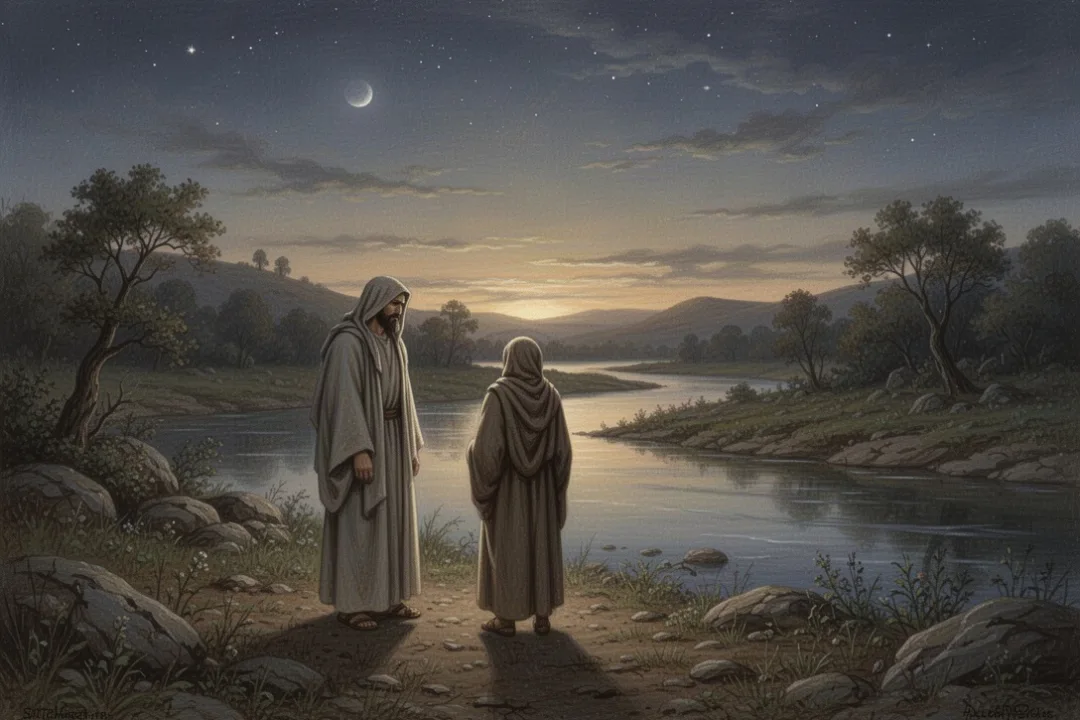
The name first becomes prominent in Genesis 32. Jacob is returning to the land of Canaan after years away and expects to meet his brother Esau, whom he had previously deceived. During the night, Jacob wrestles with a mysterious figure until daybreak. The account presents the struggle as a turning point in Jacob’s life.
After the encounter, Jacob receives the name Israel because he has struggled with God and with human beings and has endured. The passage does not reduce the experience to a simple victory. Jacob is wounded, blessed, and changed. His new name represents a transformed identity rather than merely a personal nickname.
The story also connects the name with Jacob’s persistence. Earlier in Genesis, Jacob is associated with conflict within his family, difficult choices, and a long period of uncertainty. In Genesis 32, that conflict becomes a direct encounter with the divine. The name Israel holds together both sides of the experience: human struggle and divine encounter.
The next chapter continues to call him Jacob as well as Israel. This matters because the biblical text does not necessarily present “Jacob” and “Israel” as two completely separate identities. The names can emphasize different aspects of the same person: Jacob recalls his family history and personal story, while Israel highlights his covenant identity and the future of his descendants.
Why Jacob’s descendants became known as Israel
Jacob had twelve sons, who became the ancestors of the twelve tribes of Israel. As the biblical narrative develops, “Israel” moves from an individual name to a collective name. It refers to the extended family descended from Jacob and eventually to the people formed from those tribes.
In this sense, Israel is similar to other biblical names that become names for a community. The individual and the people remain connected: Jacob is Israel, and his descendants are the people of Israel. This relationship explains why biblical passages may use “Israel” for a patriarch, a nation, a kingdom, or a covenant community depending on the period being described.
The twelve tribes are traditionally associated with Jacob’s sons, although the biblical genealogies and later tribal arrangements are complex. The tribes are often listed in different ways, and the tribe of Levi has a special priestly role. Joseph’s descendants are also represented through Ephraim and Manasseh in some lists.
As a collective name, Israel carries a strong connection to the covenant with God. In the Hebrew Bible, the people are called to worship God, practice justice, care for vulnerable people, and live according to the covenant given through Moses. Their identity is religious, familial, historical, and communal at the same time.
Israel in the Hebrew Bible and the Old Testament
In Jewish tradition, the Hebrew Bible is known as the Tanakh. In Christian traditions, much of the same collection is called the Old Testament, though the ordering and interpretation can differ. In both contexts, Israel is one of the central subjects of the biblical story.
The word can refer to several related realities:
Jacob personally: Israel is the name Jacob receives after his struggle.
Jacob’s descendants: The family that grows into the twelve tribes is called Israel.
The united kingdom: After the period of the judges, Saul, David, and Solomon rule over a united Israelite kingdom.
The northern kingdom: After the kingdom divides, “Israel” commonly identifies the northern kingdom, while “Judah” identifies the southern kingdom.
The covenant people: Prophetic and poetic passages use Israel for the people in their relationship with God.
The land and political community: In some passages, Israel can describe the territory or society associated with the people.
These meanings overlap, but they are not interchangeable in every verse. A reference to “the kingdom of Israel” may concern a particular historical government, while “the people of Israel” may refer to a broader ethnic and religious community. The surrounding passage and historical period determine the intended sense.
How the kingdom of Israel divided into two kingdoms
According to the biblical historical books, the tribes were eventually united under a monarchy. After the reign of Solomon, the kingdom divided into a northern kingdom called Israel and a southern kingdom called Judah. Jerusalem was the capital of Judah, while the northern kingdom had several important centers over time.
This division explains why “Israel” can mean either all the descendants of Jacob or specifically the northern kingdom. The northern kingdom continued for centuries before falling to the Assyrian Empire. Judah survived longer and later experienced conquest by Babylon, the destruction of Jerusalem, and exile.
The division had lasting religious and political consequences. Prophets addressed Israel and Judah separately at times, criticizing injustice, idolatry, exploitation, and political dependence on foreign powers. At other times, biblical writers looked forward to healing the division and restoring the people as one community.
The term Israelite generally refers to a member of the ancient people of Israel. It is a historical term and should not automatically be used as a synonym for every modern person who identifies as Jewish or every resident of the modern State of Israel.
What Israel means in Jewish tradition
In Jewish tradition, Israel can refer to the people of Israel, often expressed in Hebrew as Am Yisrael. This identity includes shared ancestry, religious practice, memory, law, language, history, and community. It is not limited to a single modern political definition.
Jewish prayer and religious writing frequently use Israel as a collective name. Phrases such as “the people of Israel” can refer to Jews across different countries and historical periods. The term may emphasize a people bound together by covenant and tradition rather than citizens of one particular state.
Jewish thought contains diverse views about the relationship between the people of Israel, the land of Israel, and the modern State of Israel. Religious movements and individual Jews may differ on questions of theology, sovereignty, exile, return, and the role of a Jewish state. No single statement represents every Jewish interpretation.
The expression Land of Israel, or Eretz Yisrael, has a religious and historical meaning in Jewish tradition. It refers to the land connected with the biblical narratives and Jewish history. The boundaries described in biblical texts are not always identical, and interpretations vary across texts and traditions.
What Israel means in Christianity
Christian interpretations of Israel vary among denominations and theologians. Christians generally recognize Israel’s central role in the Bible and regard the Hebrew scriptures as foundational to Christian faith. The New Testament continues to refer to Israel, Jewish people, Jerusalem, and the land in several different contexts.
Some Christian traditions distinguish sharply between the biblical people of Israel and the Christian church. Others emphasize continuity between Israel and the church, sometimes using theological language about a “new” or “spiritual” Israel. These positions are debated, and they should not be treated as interchangeable.
Christian discussions can also use “Israel” in at least three ways: the biblical nation, the Jewish people, and the modern state. Confusing these categories can lead to inaccurate claims about history or theology. A responsible interpretation identifies which meaning is intended before drawing conclusions.
Christians who discuss Israel and the Bible should also take care with supersessionism, the belief that the church has replaced Israel in God’s plan. This idea has appeared in some Christian traditions and has also been criticized for its theological, historical, and social consequences. Christian views today range widely.
How Israel differs from Judah, Hebrews, Israelites, and Jews
Several words connected with Israel are often used as though they mean exactly the same thing. They are related, but each carries its own historical emphasis.
Hebrew: A term used in the Bible for the ancestors of the Israelites and, in some contexts, for the Israelite people. It may emphasize an ancestral or outsider perspective.
Israelite: A member of the ancient people descended from Jacob, whose name was Israel.
Israel: The name of Jacob, his descendants, the ancient people, the northern kingdom, the historic land, or the modern state, depending on context.
Judah: The name of one tribe, the southern kingdom, and the region associated with it. The word is related to the later term “Jew.”
Jew: A person belonging to the Jewish people or religion. The term developed historically from Judah and came to have a broader meaning after the biblical kingdoms and exiles.
Israeli: A citizen or resident of the modern State of Israel. Israelis include Jews, Muslims, Christians, Druze, and people from other backgrounds.
These distinctions are particularly useful when reading historical or political writing. For example, Israelite king normally refers to an ancient ruler, while Israeli citizen refers to a person connected with the modern state. “Jewish” describes a people and religion, while “Israeli” is primarily a modern civic identity.
What the modern State of Israel means
The modern State of Israel was established in 1948 and took its name from the ancient biblical and historical term. In political and news contexts, “Israel” usually refers to this state and its government, institutions, territory, citizens, or military, depending on the sentence.
The state’s name reflects the long historical connection between the Jewish people and the land, as well as modern Zionism’s goal of creating a Jewish national home. The choice of the name also connected the new state to biblical history and the Hebrew language.
The modern state is not identical to every biblical description of Israel. Ancient kingdoms, biblical territories, modern borders, and political claims belong to different historical contexts. Treating them as though they are exactly the same can obscure important differences in geography, government, law, and population.
Modern Israel is a state with a diverse population. Its citizens include Jews from many ethnic and cultural backgrounds, Arab citizens, Muslims, Christians, Druze, and others. The terms Israeli government, Israeli society, Jewish people, and biblical Israel should be used carefully because each refers to a different category.
Context check: When you see the word Israel, ask whether the writer means Jacob, the ancient Israelites, the Jewish people, the historic land, or the modern State of Israel. The surrounding sentence usually supplies the answer.
How to identify the intended meaning of Israel
The easiest way to understand “Israel” is to examine the words around it and the time period being discussed. A biblical genealogy, a prayer, a history textbook, and a news report may all use the same word differently.
Check the time period. References to Jacob, Moses, David, or the prophets usually concern ancient Israel. References to citizenship, elections, or current borders concern the modern state.
Look for descriptive words. “The people of Israel” usually points to a community, while “the kingdom of Israel” points to an ancient political entity.
Separate religion from citizenship. A Jewish person may live outside Israel, and an Israeli citizen may not be Jewish.
Check the source’s purpose. A prayer may use Israel devotionally, a historian may use it politically, and a journalist may use it as shorthand for a government.
Read the wider paragraph. Nearby references to Jacob, the tribes, Judah, Jerusalem, Palestinians, parliament, or modern borders can clarify the intended meaning.
Common mistakes when explaining the meaning of Israel
Most confusion comes from treating a broad historical word as though it has only one definition. These mistakes are especially common when biblical language is applied directly to modern politics or when modern civic terms are projected backward into ancient history.
Assuming Israel always means the modern state: In the Bible, it usually does not.
Assuming Israel always means Jewish people: The word can also name Jacob, an ancient kingdom, or a geographic and political entity.
Using Israeli and Jewish as synonyms: One is mainly a modern civic identity; the other refers to a people and religious tradition.
Ignoring the split kingdom: “Israel” sometimes means the northern kingdom, in contrast to Judah in the south.
Treating a theological interpretation as a dictionary fact: Religious traditions disagree about how Israel relates to the church and the modern state.
Assuming the name’s etymology is completely certain: “Struggles with God” is the best-known explanation, but the linguistic details are debated.
Clear writing can avoid these problems by adding a short qualifier. Phrases such as biblical Israel, ancient Israel, the people of Israel, the Land of Israel, and the modern State of Israel make the intended meaning much easier to follow.
Why Israel remains a powerful name
Israel has lasted as a meaningful name because it connects personal experience with collective identity. It begins with Jacob’s encounter and becomes the name of a people, a religious tradition, ancient kingdoms, a historic land, and a modern state.
The name also preserves a distinctive view of faith. Jacob is not portrayed as someone who avoids conflict or receives a new identity without pain. He struggles, survives, receives a blessing, and carries the consequences of the encounter. For many Jewish and Christian readers, that pattern gives Israel a lasting spiritual meaning.
At the same time, the word carries real historical and political weight. Its meaning cannot be separated from the long history of the Jewish people, the biblical kingdoms, exile and return, Zionism, the establishment of the modern state, and the continuing Israeli-Palestinian conflict. Using the term precisely respects both its religious depth and its modern complexity.
Frequently asked questions
Does Israel mean “wrestles with God”?
That is the most familiar explanation of the Hebrew name Yisrael, based on Jacob’s struggle in Genesis 32. It is also commonly rendered as “strives with God” or “contends with God.” Scholars debate the exact linguistic derivation, so the phrase captures the biblical interpretation more confidently than it provides a universally agreed literal translation.
Is Israel the same as the Jewish people?
Sometimes, especially in religious or biblical language, Israel refers to the Jewish people as a covenant community. In other contexts, Israel means the ancient northern kingdom, the land, or the modern State of Israel. The Jewish people include communities worldwide, while Israeli commonly means a citizen or resident of the modern state.
Why was the modern country named Israel?
The state established in 1948 adopted Israel as its name because of the Jewish people’s ancient historical and religious connection with the biblical name, land, and people of Israel. The modern country is a contemporary political state, however, and should not automatically be treated as identical to every biblical use of Israel.
What is the difference between Israel and Judah in the Bible?
Israel can refer to all twelve tribes or the united kingdom, but after the kingdom divided, Israel usually meant the northern kingdom. Judah referred to the southern kingdom, centered on Jerusalem. The term Jew developed from Judah and later became a broader name for the Jewish people and religious tradition.











Leave a Reply