The tribe of Judah: History, meaning, and biblical legacy
The tribe of Judah: History, meaning, and biblical legacy
When you see the name Judah in the Bible, you may wonder whether it means a person, a tribe, a kingdom, or the Jewish people as a whole. The answer depends on the passage. Judah began as one of the twelve tribes of Israel, descended from Judah, the fourth son of Jacob and Leah. Over time, the name also came to describe the southern kingdom, its territory, and eventually a people associated with the Hebrew term Yehudi, or Jew.
The tribe of Judah became prominent because it was connected with Jerusalem, the Davidic royal line, the temple, and the promised Messiah in Christian interpretation. Its story includes family conflict, political strength, exile, survival, and lasting religious symbolism. Understanding those different uses of “Judah” helps prevent several common misunderstandings about biblical history.
Judah was the fourth son born to Jacob and Leah, according to Genesis 29. Jacob was later given the name Israel, and his twelve sons became the traditional ancestors of the twelve tribes of Israel. Judah’s full brother was Issachar, Zebulun, Reuben, Simeon, Levi, Dan, Naphtali, Gad, Asher, Joseph, and Benjamin made up the remaining tribal family lines, with some later adjustments in how Joseph’s descendants were counted.
The name Judah is commonly associated with praise. In Genesis 29, Leah gives the reason for the name after Judah’s birth, expressing gratitude to God. The biblical account does not present Judah as the firstborn or the obvious family leader. Reuben held the position of firstborn, but the story later assigns Judah a special place in leadership and royal promise.
Judah’s early reputation is mixed. In Genesis 37, he participates in the brothers’ plan concerning Joseph, but he is also the brother who proposes selling Joseph rather than killing him. Later, in Genesis 44, Judah offers himself in place of Benjamin before Joseph, showing a significant change in character. That willingness to protect his younger brother becomes one of the clearest examples of Judah’s moral growth.
Helpful distinction: Judah was a person, a tribal ancestor, a territory, a kingdom, and a name connected with the Jewish people. The surrounding passage usually reveals which meaning is intended.
What Jacob’s blessing says about Judah’s future
Before Jacob dies, he gathers his sons and speaks about their future in Genesis 49. His words about Judah give the tribe a stronger position than its birth order would suggest. Jacob describes Judah with images of a lion, strength, authority, and leadership among the other tribes.
The passage also refers to a ruler’s scepter and staff associated with Judah. Its wording has been interpreted in different ways within Jewish and Christian traditions, but the central theme is clear: Judah is linked with kingship. Christian readers commonly connect this promise with the line of David and ultimately with Jesus. Jewish interpretation may approach the royal language through Israel’s monarchy, messianic hope, or other traditional readings.
Jacob’s blessing does not mean that every individual from Judah ruled Israel. Rather, it describes the tribe’s developing place in the nation’s story. The later biblical record supports this broad pattern: David comes from Judah, the royal house is established in Judah’s territory, and Jerusalem becomes the political and religious center of the southern kingdom.
Another important text appears in Deuteronomy 33, where Moses blesses the tribes before his death. The blessing of Judah asks God to hear and help the tribe, reflecting both its importance and its dependence on divine protection. These passages should be read as tribal poetry and covenant history, not as simple predictions about every event in Judah’s later experience.
Where the tribe of Judah settled in the promised land
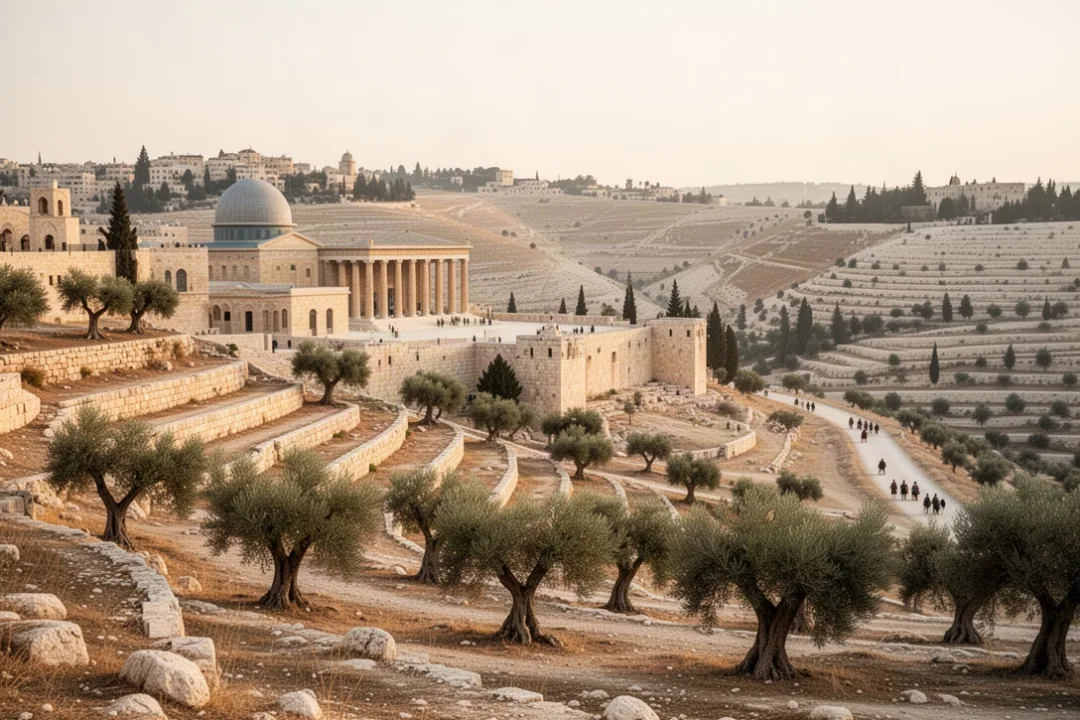
After Israel entered Canaan, the land was distributed among the tribes. Joshua 15 describes Judah’s allotment in considerable detail. It occupied a large area in the southern part of Canaan, extending from the wilderness in the south toward the hill country and including important settlements.
Judah’s territory included the hill country around Hebron, the Negev, and western areas near the Philistine plain. The exact boundaries and place identifications can be difficult to reconstruct because ancient geography, place names, and textual lists do not always correspond neatly with modern maps. Even so, Judah’s territory was substantial and strategically important.
Several well-known biblical locations stood in or near Judah’s territory:
Hebron, associated with Abraham, David, and the patriarchal burial place.
Bethlehem, the town connected with David’s family and, in the New Testament, Jesus’ birth.
Jerusalem, captured by David and developed as Israel’s capital.
Tekoa, associated with the prophet Amos.
Lachish, a fortified city that played a major role in conflicts with Assyria.
Judah’s landscape included highlands, dry southern regions, valleys, and areas near major travel routes. Its geography influenced its history. The hill country offered defensive advantages, while access toward the coast and the desert created both opportunities and military risks.
Jerusalem was located near the boundary between Judah and Benjamin, and its early political history involved both tribal areas. David, who came from Judah, captured the city and made it his capital. That decision gave Judah a lasting connection with the central seat of Israelite government.
David’s son Solomon built the first temple in Jerusalem, making the city the principal center of Israelite worship. The temple was not merely a local shrine for Judah. It served the united kingdom, yet after the political division of Israel, Jerusalem and the temple remained in the southern kingdom of Judah.
This is why biblical references to Judah and Jerusalem often appear together. Judah represented the southern realm, while Jerusalem represented its capital and sanctuary. The relationship became especially important after the northern kingdom developed its own political and religious centers.
Judah’s association with Jerusalem also shaped later Jewish identity. Even after the temple was destroyed and the people were exiled, memories of Jerusalem, the temple, David’s line, and the land of Judah remained central to biblical prayer, prophecy, and hope.
How Judah differed from the northern kingdom of Israel
After Solomon’s death, the united monarchy split. The northern tribes formed a kingdom commonly called Israel, while the southern kingdom centered on Judah. Benjamin was closely connected with Judah, and priests and Levites also lived throughout the land, so the southern kingdom was not made up of Judah’s descendants alone.
The division is described in 1 Kings 12. Political tension, heavy labor demands, taxation, and leadership disputes contributed to the break. Jeroboam led the northern tribes, while Rehoboam continued to rule the southern kingdom from Jerusalem. From that point, “Israel” can mean the whole covenant people or specifically the northern kingdom, depending on context.
The two kingdoms had different experiences. The northern kingdom existed for roughly two centuries before Assyria conquered it in the late eighth century BCE. Its population was deported in stages, and later biblical and historical traditions describe the northern tribes as dispersed among other peoples.
Judah lasted longer. Babylon conquered Jerusalem in the early sixth century BCE, destroyed the temple, and deported many people. The exile was devastating, but the community later returned under Persian rule and rebuilt the temple. Because Judah preserved a continuing religious and communal identity through exile and restoration, its name had an influence far beyond the original tribe.
How the word “Jew” relates to Judah
The English word Jew is related through Greek and Latin forms to the Hebrew term Yehudi, meaning a person associated with Judah. At first, that term could refer specifically to someone from the kingdom or region of Judah. Over time, its use broadened to identify members of the Jewish people, including people descended from different Israelite tribes and converts to Judaism.
This development explains why it is inaccurate to say that every Jewish person today must be genealogically descended only from the tribe of Judah. Biblical Israel included many tribes, and the history of exile, migration, intermarriage, religious conversion, and community continuity is complex. The name “Jew” became a broader religious and communal designation than the original tribal label.
The books of Ezra and Nehemiah describe the post-exilic community in and around Jerusalem. They emphasize Judah, Benjamin, priests, Levites, and families returning from exile, but they do not provide a complete modern genealogical record of every Israelite descendant. Tribal identity remained meaningful, yet not every later person could establish a documented tribal lineage.
Judah’s role in Israel’s kings and prophets
The most influential royal family in the Hebrew Bible came from Judah. David was the son of Jesse from Bethlehem, and 1 Samuel presents his anointing by Samuel as God’s choice to replace Saul. David’s reign united the tribes for a time and established Jerusalem as the capital.
The covenant with David in 2 Samuel 7 promises a continuing royal dynasty. The passage has both an immediate historical dimension, involving David’s descendants and Solomon, and a larger theological dimension. Later biblical writers use David’s line as a foundation for hope that God will restore righteous leadership.
Several kings of Judah receive favorable attention, including Hezekiah and Josiah, although the biblical accounts also describe serious failures among Judah’s rulers. Prophets such as Isaiah, Micah, Jeremiah, Zephaniah, and Habakkuk addressed the people of Judah. Their messages confronted idolatry, exploitation, corrupt leadership, empty worship, and misplaced trust in political power.
Micah connects Bethlehem in Judah with future leadership, while Isaiah develops themes of a Davidic ruler and a restored people. Jeremiah speaks to Judah before and during the Babylonian crisis. These prophetic books should not be reduced to predictions alone; they also address concrete social and political problems in the communities of their own time.
What happened to Judah during the Babylonian exile
Babylon’s conquest of Jerusalem was a turning point. The first temple was destroyed, the monarchy ended in practice, and many residents of Judah were taken into exile. The experience forced the community to confront difficult questions about covenant, judgment, land, worship, and God’s presence outside Jerusalem.
Books such as 2 Kings, 2 Chronicles, Jeremiah, Ezekiel, and Lamentations preserve different perspectives on this crisis. They describe Jerusalem’s destruction, the suffering of the population, and the theological interpretation of the disaster. Ezekiel ministered among exiles, while Jeremiah addressed those connected with Judah and Jerusalem.
The exile did not erase Judah’s identity. Families maintained traditions, remembered the land, and continued forms of worship and community life. When the Persian Empire conquered Babylon, Cyrus permitted exiled peoples, including Judeans, to return and rebuild. Ezra 1 records the Persian authorization in biblical form, while the broader historical setting includes Persian imperial policy toward displaced populations.
The restored community was not identical to the pre-exilic kingdom. It lived under imperial authority rather than under a Davidic king, and the temple was rebuilt on a smaller scale. Still, the people of Judah continued to develop religious practices, texts, and institutions that shaped later Judaism.
How Judah is portrayed in the New Testament
The New Testament continues the connection between Jesus and Judah in several ways. Matthew 1 traces Jesus’ legal or royal genealogy through David, while Luke 3 gives a genealogy with a different structure and purpose. Both passages connect Jesus with the wider history of Israel and with David’s line, although interpreters differ over how the two genealogies relate to one another.
Jesus was associated with Bethlehem in Judea through the birth narratives in Matthew and Luke, and he spent much of his ministry in Galilee. The Gospels describe Jerusalem as the place of his final arrival, crucifixion, and resurrection proclamation. In Christian theology, these events are understood in relation to Israel’s Scriptures and the promises connected with David and Judah.
Hebrews 7 discusses Jesus in relation to Judah and the royal figure Melchizedek. The passage also explains why Jesus’ priestly role is not based on descent from the tribe of Levi. This distinction matters: Jesus is presented as coming from Judah, while the traditional Israelite priesthood was associated with Levi and Aaron.
Revelation 5 uses the title “Lion of the tribe of Judah” for Christ. Rather than reproducing the verse, its imagery can be understood as presenting Jesus as the victorious Davidic ruler who fulfills Judah’s royal symbolism. The same passage also uses the image of a slain lamb, placing power and sacrificial suffering together.
What “the Lion of the tribe of Judah” means
The lion image comes from Judah’s blessing in Genesis 49. Lions suggest strength, authority, and royal status. In Revelation, the title points to Jesus’ connection with Judah, David, and the expected ruler of God’s people.
The title should not be treated as a claim that Judah’s tribal descendants were naturally superior to everyone else. Biblical texts frequently balance Judah’s prominence with warnings about injustice and unfaithfulness. Royal status creates responsibility, not permission for domination.
For Christians, the phrase combines several themes:
Royal lineage: Jesus is connected with David and the promises surrounding his house.
Victory: the lion represents triumph over hostile powers and the completion of God’s purpose.
Sacrifice: Revelation places the lion’s authority alongside the lamb’s suffering.
Messianic hope: Judah’s royal imagery is interpreted as pointing toward Christ’s saving work.
Jewish and Christian readers do not always interpret the relevant passages in the same way. A careful explanation should identify the tradition being used rather than present one theological interpretation as the only possible meaning of every Hebrew Bible text.
Judah’s story crosses several biblical periods, so it is easy to combine distinct meanings. The following habits help keep the history and theology clear:
Do not equate Judah with all Israel in every passage. Judah can mean one tribe, the southern kingdom, or the wider Jewish people depending on context.
Do not assume the southern kingdom contained only Judah’s descendants. Benjamin, Levi, priests, and other families were also present.
Do not call the northern tribes simply “lost” without qualification. Their later history is complex, and biblical texts, Jewish traditions, and modern theories do not provide one universally accepted account.
Do not treat the tribal allotment as a modern political map. Biblical boundaries and place names can be difficult to identify with precision.
Do not quote Jacob’s blessing as though it were a complete biography of every Judean. Genesis 49 uses poetic language about tribal destiny.
Do not assume modern people can prove tribal descent from surnames alone. Reliable genealogical evidence for ancient tribal affiliation is limited.
Do not separate Judah’s privileges from its failures. The prophets repeatedly criticize Judah’s kings, worship, and social injustice.
Do not assume “Jew” always means a person from the single tribe of Judah. The term became a broader religious and communal identity.
Reading tip: When you encounter “Judah,” first ask what kind of passage you are reading: genealogy, land description, royal history, prophecy, exile narrative, or New Testament theology. The genre and setting often determine the meaning.
How Judah’s story shaped Jewish and Christian identity
Judah’s importance is not limited to one period of ancient history. The tribe’s association with Jerusalem and the temple influenced Jewish worship, memory, and hope after the exile. The name also remained attached to the region known in later periods as Judea.
In Christian interpretation, Judah links Israel’s early history with the story of Jesus. The sequence is often presented through Judah, David, Jerusalem, and the Messiah. This does not erase the importance of the other tribes. Instead, it reflects the biblical pattern in which God’s purposes are worked through a particular family and royal line for the benefit of the wider people.
Judah also provides a warning about confusing religious status with faithful conduct. Its kings received major promises, but prophets still condemned oppression, idolatry, dishonest leadership, and neglect of the poor. The tribe’s biblical legacy therefore includes both honor and accountability.
For readers studying Scripture, Judah is a useful example of how names develop across time. A family name becomes a tribal name; the tribal name becomes a territorial and political term; the political term contributes to a broader communal identity; and later religious texts use the name symbolically in discussions of kingship and redemption.
Questions to ask when reading a passage about Judah
A few practical questions can make difficult passages easier to understand. Start by identifying whether the text is describing a person, a family line, a land area, a political kingdom, or a theological symbol.
Who is speaking? A genealogist, prophet, historian, psalmist, or New Testament writer may use the name differently.
What time period is involved? The answer changes if the passage concerns the patriarchs, the united monarchy, the divided kingdom, the exile, or the Second Temple period.
Is Judah being praised, judged, or symbolized? Royal poetry and prophetic criticism have different purposes.
Which neighboring groups appear in the passage? References to Benjamin, Israel, Jerusalem, Levi, Babylon, or Assyria can clarify the setting.
Is the interpretation historical or theological? A passage may describe an ancient event while also carrying meaning for a later community.
Useful passages to read together include Genesis 29 and 49, Joshua 15, 2 Samuel 7, 1 Kings 12, 2 Kings 24–25, Ezra 1, Micah 5, Matthew 1, Hebrews 7, and Revelation 5. Reading several books prevents one verse or symbol from carrying more meaning than its context supports.
The tribe of Judah began as one branch of Jacob’s family, but its influence became much larger. It was tied to a strategic territory, the capital at Jerusalem, the Davidic dynasty, the southern kingdom, post-exilic Jewish identity, and Christian claims about Jesus. Its story is best understood through these connected but distinct meanings, with careful attention to historical setting and religious tradition.
Frequently asked questions
Was Judah the largest tribe of Israel?
Judah was one of the most prominent and influential tribes, and Joshua 15 describes a large territorial allotment. However, biblical texts do not provide a simple, consistent population ranking that settles whether it was always the largest. Judah’s importance came especially from its territory, military role, connection with Jerusalem, and Davidic royal line rather than from population size alone.
Are Jews today all descendants of the tribe of Judah?
No. “Jew” developed from a term associated with Judah, but it became a broader religious and communal identity. Jewish communities include descendants of multiple ancient Israelite groups, along with people who joined the Jewish people through conversion. In most cases, modern individuals cannot document descent from one specific biblical tribe through an unbroken genealogy.
Why is Jesus called the Lion of the tribe of Judah?
Revelation 5 uses this title to connect Jesus with Judah’s royal imagery, Jacob’s blessing, and the line of David. In Christian interpretation, it identifies Jesus as the promised ruler who brings victory and fulfills messianic hope. The same passage also presents lamb imagery, emphasizing that this victory is associated with sacrifice and suffering.
What happened to the tribe of Judah after the Babylonian exile?
Many Judeans were deported to Babylon, but the community was not permanently erased. Under Persian rule, some returned to Jerusalem and rebuilt the temple and communal life. Others remained outside the land. Over time, “Judah” became associated with the broader Jewish people rather than functioning as a separate, fully documented tribe with a known genealogy for every descendant.









Leave a Reply