Hezekiah in the Bible: His life, reforms, and legacy
Hezekiah in the Bible: His life, reforms, and legacy
Hezekiah was a king of Judah who ruled Jerusalem for 29 years and is remembered for religious reform, courage during an Assyrian invasion, and serious trust in God. His story appears mainly in 2 Kings 18–20, 2 Chronicles 29–32, and Isaiah 36–39.
Hezekiah’s reign was not flawless. He removed idols and restored worship at the temple, but later displayed his wealth to Babylonian visitors and received a troubling prophecy about Judah’s future. The Bible presents him as one of Judah’s strongest kings while also showing how even a faithful ruler could be vulnerable to pride.
Hezekiah was the son of King Ahaz, a ruler remembered for rejecting the Lord’s ways and encouraging practices that harmed Judah’s spiritual life. Hezekiah’s mother was Abi, also called Abijah in Chronicles, and she was associated with the family of Zechariah. He became king of Judah after Ahaz and ruled from Jerusalem.
The biblical record gives Hezekiah a reign of 29 years. The accounts in 2 Kings and 2 Chronicles describe him as a king who did what was right in the sight of the Lord, using David’s faithfulness as a standard. That praise is especially striking because Hezekiah inherited a kingdom shaped by his father’s religious failures.
Hezekiah ruled the southern kingdom of Judah, while the northern kingdom of Israel still existed for part of his reign. During his sixth year as king, Samaria fell to the Assyrian Empire, and the northern kingdom was conquered. This event created a powerful warning for Judah: Assyria was not a distant threat but an expanding empire that had already destroyed Israel.
The Bible does not describe Hezekiah as a passive religious figure. He took direct action against the practices he believed had corrupted Judah’s worship. His reign combined spiritual reform, military preparation, political pressure, and public appeals for trust in God.
Where to read about him: Start with 2 Kings 18–20 for the main narrative, then read 2 Chronicles 29–32 for additional details about temple worship, the Passover, defenses, and Hezekiah’s water projects. Isaiah 36–39 gives a closely related account.
How Hezekiah restored worship in Judah
Hezekiah’s first major work was religious reform. The biblical writers say he reopened and repaired the doors of the temple, which had been neglected under Ahaz, and called priests and Levites back to their responsibilities. The temple was not treated merely as a building; its condition represented the spiritual condition of the nation.
According to 2 Chronicles 29, the priests and Levites purified the temple and removed objects connected with impurity. The work took place in stages, with the inner areas receiving attention first and the temple courts afterward. Once the cleansing was completed, the nation offered sacrifices and worshiped with singing and instruments.
Hezekiah also removed the high places, broke sacred pillars, cut down the Asherah pole, and destroyed other objects associated with idolatrous worship. These actions challenged long-established local practices. Reform required more than adding religious activity; it required removing competing forms of worship.
One unusual object Hezekiah destroyed was the bronze serpent called Nehushtan. According to 2 Kings 18, the Israelites had preserved it from the time of Moses, but by Hezekiah’s day people were burning incense to it. The object had become a religious substitute, so Hezekiah treated it as an idol rather than as a sacred relic.
This episode provides an important distinction between remembering a past act of God and worshiping an object connected with that act. Something that once served a legitimate purpose can become spiritually harmful when people give it a place that belongs to God alone.
Hezekiah also organized a national Passover celebration. The invitation went beyond the people of Judah and reached some Israelites from the former northern kingdom. The response was mixed: some people mocked the invitation, while others humbled themselves and came to Jerusalem.
The Passover gathering emphasized repentance, shared worship, and national identity. It also showed Hezekiah’s desire to reunite people who had been divided politically. The Chronicles account says that the Lord heard Hezekiah’s prayer for those who participated, even when some were not ceremonially prepared in every detail.
The biblical account does not portray the reform as instant or universally popular. Hezekiah had to confront habits that had been established over many years. His example suggests that meaningful reform involves both public leadership and patient correction of practices that people have come to regard as normal.
He repaired the temple and restored its regular worship.
He removed idols and unauthorized worship sites throughout Judah.
He destroyed Nehushtan when it had become an object of worship.
He restored Passover observance and invited people from beyond Judah.
He supported the priests and Levites so temple service could continue.
How Hezekiah responded to Assyria’s invasion
Hezekiah’s most famous crisis came when Sennacherib, king of Assyria, invaded Judah. The invasion took place after Assyria had already conquered many fortified cities. Jerusalem was threatened, and Hezekiah faced an empire with a record of military dominance.
At first, Hezekiah tried to manage the crisis through tribute. The account in 2 Kings says he sent silver and gold to Sennacherib and even stripped precious materials from the temple and royal palace. This decision shows that Hezekiah’s response was not a simple display of fearlessness. He made a political concession under pressure, yet the Assyrian army continued its advance.
Sennacherib sent senior officials to Jerusalem, including the field commander often called the Rabshakeh. He delivered a public speech intended to weaken the confidence of Jerusalem’s defenders. He questioned Hezekiah’s military strategy, suggested that Judah’s God could not rescue the city, and urged the people not to trust their king.
The Rabshakeh spoke in a way designed for maximum psychological impact. He addressed people near the city wall, used the language of the Judeans, and appealed directly to ordinary residents rather than only to officials. His argument was that surrender would bring security, while resistance would bring destruction.
Hezekiah responded by tearing his clothes, wearing sackcloth, and going to the temple. He sent officials to the prophet Isaiah, asking for prayer and guidance. The king’s first response to the crisis was not a triumphant speech but grief, humility, and a request for divine help.
Isaiah told Hezekiah not to fear the Assyrian message and announced that Sennacherib would hear a report that would cause him to withdraw. Later, when the Assyrian king sent another threatening message, Hezekiah spread it before the Lord in the temple and prayed for God to act.
Hezekiah’s prayer is one of the clearest windows into his faith. He did not deny Assyria’s power. He acknowledged that Assyria had devastated other nations, but he argued that the living God was not like the idols of those nations. His request was not merely for personal survival; he wanted the nations to know that the Lord alone is God.
The biblical accounts say that the Lord delivered Jerusalem from the Assyrian threat. The exact descriptions differ in their presentation, but both 2 Kings and Isaiah attribute the deliverance to God rather than to a military victory achieved by Hezekiah’s forces. The Assyrian king withdrew, and Jerusalem was spared from capture.
Second Chronicles adds that Hezekiah had prepared Jerusalem before the invasion. He organized military commanders, strengthened the city’s defenses, made weapons and shields, and encouraged the people with the message that the Lord was greater than the forces confronting them.
Hezekiah’s leadership included practical preparation and spiritual dependence. He did not treat prayer as an excuse to neglect defense. He strengthened the city while reminding the people that human resources were not the ultimate source of security.
A balanced lesson from the invasion: Hezekiah prepared responsibly, sought counsel, and prayed honestly. The biblical story joins practical action with trust in God rather than treating them as opposites.
After the Assyrian crisis, Hezekiah became seriously ill. Isaiah came to him with a message that he should put his affairs in order because he would die. Hezekiah turned his face toward the wall and prayed, recalling his devotion and asking God to remember him.
The account says that God heard Hezekiah’s prayer and gave him additional years of life. Isaiah instructed that a cake of figs be applied to the affected area, and Hezekiah asked for a sign that he would recover. The sign involved the shadow moving backward on the steps or stairway associated with the king’s house.
The passage is significant because it shows Hezekiah as emotionally vulnerable. He was not only a reforming king facing international danger; he was also a sick person confronting mortality. His prayer is personal and intense, and the narrative does not criticize him simply for wanting to live.
At the same time, the story raises questions about prayer, divine purpose, and human weakness. The Bible presents God as responding to Hezekiah’s prayer, but it does not turn the event into a formula guaranteeing that every illness will end in recovery. Hezekiah’s experience belongs to his particular calling and historical setting.
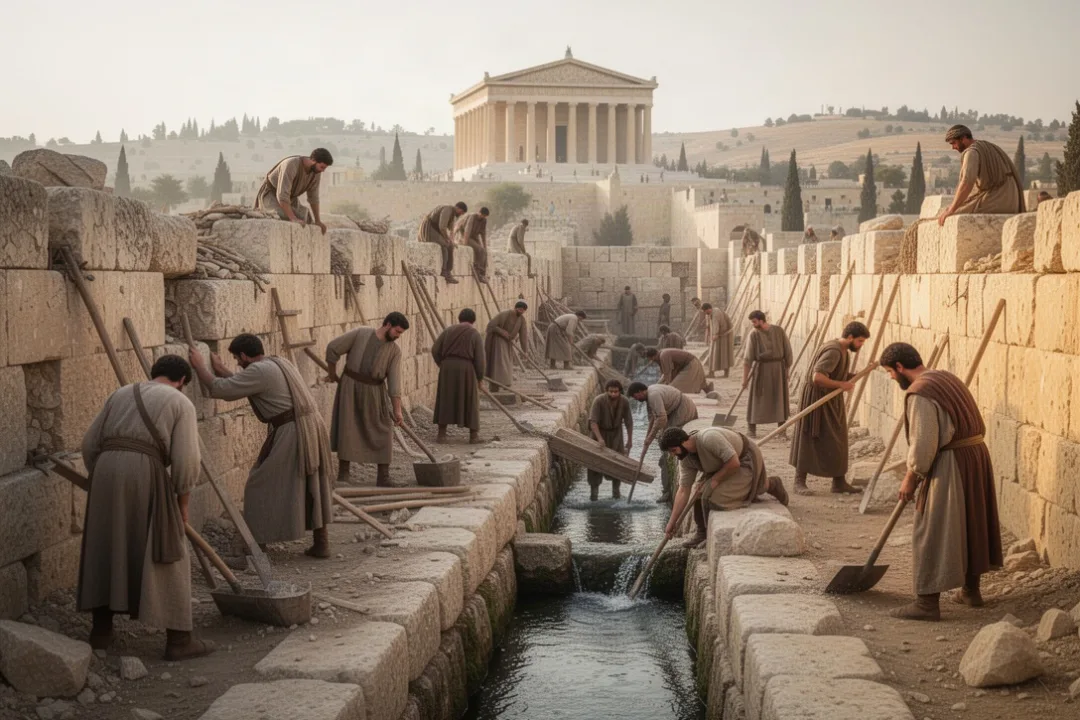
Second Kings connects Hezekiah with the construction of a water tunnel that brought water into Jerusalem. Second Chronicles also describes his work to secure the city’s water supply during the Assyrian threat. The tunnel is commonly associated with the waterworks that carry the Gihon Spring’s water toward the Pool of Siloam.
This project illustrates the practical side of Hezekiah’s rule. A city under siege needed access to water inside its defenses. The king’s preparations included engineering, organization, and protection of vital resources, not only religious ceremony and military speeches.
Hezekiah’s recovery also led to a moment of testing. Visitors from Babylon came after hearing that he had been ill. Hezekiah showed them his treasures, armory, storehouses, and other possessions. The biblical account says he held nothing back from them.
Isaiah then confronted him and announced that a future generation would see Judah’s wealth and royal descendants carried away to Babylon. The prophecy looked beyond Hezekiah’s own lifetime toward the later Babylonian conquest and exile.
Hezekiah’s response is troubling. He accepted the word from Isaiah and seemed relieved that the disaster would not occur during his own days. The account in 2 Chronicles explains that his heart became proud after his prosperity, though he eventually humbled himself.
This episode prevents a one-sided portrait of Hezekiah. His earlier trust during Assyria’s invasion did not make him immune to pride, self-display, or short-term thinking. A person can rely on God in one crisis and still fail when success brings admiration and a sense of security.
What the Bible says about Hezekiah’s character
Hezekiah receives unusually strong praise in the biblical record. Second Kings says he trusted in the Lord and remained devoted to him. It presents him as unlike the kings who ruled before and after him, especially because he held firmly to the Lord rather than turning away.
His faith was expressed through decisions that carried political and personal risk. Removing local shrines and destroying the bronze serpent could provoke resistance. Refusing to surrender Jerusalem to Assyria could bring military disaster. Restoring national worship required him to challenge both religious habits and public fear.
Yet the Bible does not call him perfect. His payment to Assyria, his display of wealth to Babylonian envoys, and his pride after prosperity all reveal limitations. The Chronicles account says that Hezekiah’s heart was lifted up, but that he and the people of Jerusalem humbled themselves, preventing the full expression of divine anger during his lifetime.
Hezekiah’s story therefore holds together two truths:
Faithfulness can involve bold action. Hezekiah did not merely express private belief; he changed worship, prepared Jerusalem, and sought God publicly.
Faithfulness does not remove the need for humility. Past obedience cannot justify pride, careless self-display, or confidence in possessions.
Good leadership requires both conviction and discernment. Hezekiah recognized the danger of idolatry and Assyria, but he misjudged the significance of displaying Judah’s resources.
Prayer can be honest. Hezekiah brought fear, illness, and national danger directly before God rather than hiding his distress.
Success can become a spiritual test. The later part of his story asks how a faithful person responds when pressure gives way to prosperity.
Hezekiah’s legacy continued after his death. His son Manasseh succeeded him, and the biblical record presents Manasseh as a deeply damaging ruler whose reign reversed much of the reforming direction associated with Hezekiah. This contrast also shows that one generation’s faithfulness cannot automatically be passed to the next.
Second Chronicles says Hezekiah was buried among the descendants of David and that people honored him at his death. The statement reflects the broad judgment of his reign: despite his failures, he was remembered as a king who strengthened Judah and sought the Lord during a decisive period.
How to study Hezekiah’s story in the Bible
Reading the parallel accounts helps you see both the shared events and the different emphases. Second Kings focuses strongly on the royal history of Judah, Assyria’s threat, Hezekiah’s illness, and the Babylonian visitors. Isaiah presents the same major crisis within a prophetic framework. Second Chronicles gives more space to temple worship, the Passover, national preparation, and Hezekiah’s organizational work.
A useful reading sequence is:
Read 2 Kings 18. Notice the evaluation of Hezekiah, his reforms, the fall of Samaria, and the beginning of the Assyrian invasion.
Read 2 Kings 19. Focus on Hezekiah’s prayer, Isaiah’s response, and Jerusalem’s deliverance.
Read 2 Kings 20. Consider the illness, recovery, sign, water project, Babylonian visitors, and prophecy of exile.
Read 2 Chronicles 29–32. Pay attention to the temple cleansing, Passover, priests and Levites, city defenses, and the account of pride.
Read Isaiah 36–39. Compare Isaiah’s prophetic presentation with the historical accounts in Kings and Chronicles.
As you read, ask what each scene reveals about trust, reform, leadership, prayer, and pride. Hezekiah’s life is not simply a story about a good king defeating a bad empire. It is a study of how faith responds to inherited corruption, public threats, illness, prosperity, and the consequences that extend beyond one person’s lifetime.
For Christian readers, Hezekiah is often remembered as an example of dependence on God in crisis. For any careful reader, his story also offers a warning: spiritual seriousness must continue after the emergency passes. The same king who prayed sincerely under siege later needed correction when admiration and wealth became more visible than humility.
The central message of the Hezekiah Bible accounts is therefore both encouraging and searching. Trust God when power appears overwhelming, remove practices that compete with faithful worship, prepare wisely for real dangers, and remain humble when success arrives.
Frequently asked questions
Was Hezekiah a good king in the Bible?
Yes. The biblical writers consistently rank Hezekiah among Judah’s most faithful kings. He removed idols, restored the temple, celebrated Passover, and trusted God during Assyria’s attack. However, he was not portrayed as sinless. His decision to display Judah’s treasures to Babylonian visitors revealed pride and led to a prophecy about the future loss of those possessions.
What was Hezekiah’s most important prayer?
His prayer during the Assyrian threat is usually regarded as his most significant public prayer. After receiving a threatening message, Hezekiah brought it to the temple and asked God to act so that the nations would know the Lord is God. The prayer shows both honest recognition of danger and confidence that Assyria was not beyond God’s authority.
Why did Hezekiah destroy the bronze serpent?
The bronze serpent had originally been connected with an event in Israel’s wilderness history, but people in Hezekiah’s time had begun burning incense to it. Because it had become an object of worship, Hezekiah destroyed it and called it Nehushtan. The episode shows why a religious object can become wrongfully revered even when it has a legitimate historical origin.
How long did Hezekiah live after becoming sick?
The account in 2 Kings says that God added 15 years to Hezekiah’s life after his prayer for healing. The same passage describes a sign involving the movement of a shadow and records Isaiah’s instructions involving a cake of figs. The narrative presents the extension of his life as a specific answer to his prayer.








Leave a Reply