Rehoboam was the son of Solomon whose first major decision split the united kingdom of Israel. His story appears mainly in 1 Kings 11–14 and 2 Chronicles 9–12, where it becomes a study in leadership, pride, political pressure, and the consequences of refusing wise advice.
Rehoboam succeeded Solomon after Solomon’s death. He was the only son of Solomon named in the biblical account, and his mother was Naamah, an Ammonite woman (1 Kings 14:21). Rehoboam was 41 years old when he began to reign, according to 1 Kings 14:21, and he ruled from Jerusalem for 17 years.
His accession came at a tense moment. Solomon had built the temple, expanded royal projects, strengthened Jerusalem, and established a powerful administration. Yet those achievements required heavy taxation and forced labor. The people’s dissatisfaction had already contributed to the rise of Jeroboam son of Nebat, who had challenged Solomon before fleeing to Egypt.
Rehoboam inherited the throne, but he did not inherit an easy political situation. The kingdom was united in name, while many of its tribes resented the burdens created by the royal court. His first public decision determined whether those tensions would be reduced or become an open revolt.
Why the people gathered at Shechem
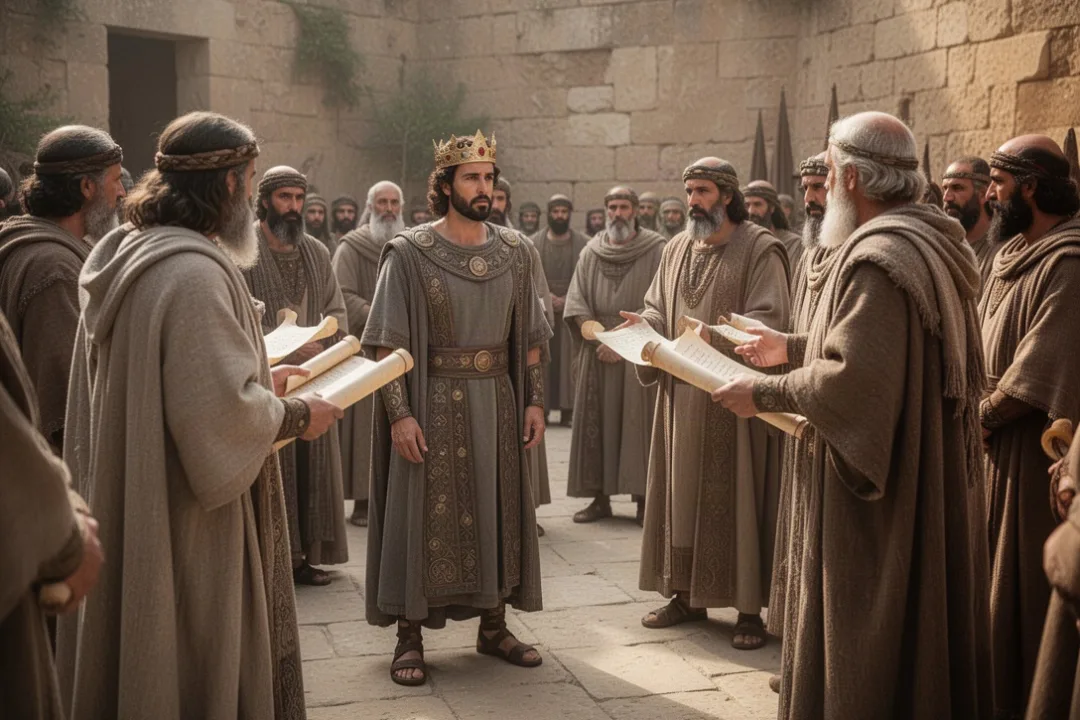
Rehoboam went to Shechem to be recognized as king. Shechem stood in the hill country of Ephraim and had deep historical importance. It was associated with the patriarchs, Joshua’s covenant gathering, and the political life of the northern tribes. Holding the royal assembly there allowed the northern Israelites to participate in the succession rather than simply accepting a coronation in Jerusalem.
Jeroboam returned from Egypt when the northern tribes summoned him. The people approached Rehoboam with a practical request: they wanted him to reduce the severe labor demands and heavy yoke associated with Solomon’s reign. Their request did not necessarily reject the monarchy itself. They were asking for a less burdensome form of royal rule.
The request exposed the central problem Rehoboam faced. He could preserve unity by acknowledging legitimate grievances, or he could defend royal authority by promising to maintain—and perhaps increase—the pressure. The account in 1 Kings 12 presents his response as a decisive test of character and judgment.
The central issue was not simply taxation. The people were asking what kind of king Rehoboam would be: a ruler who listened and served, or one who expected obedience without considering the cost imposed on those he governed.
How Rehoboam handled the decision at Shechem
Rehoboam followed a process that initially looked sensible. The biblical narrative describes several stages in his response:
He asked the people to return after three days. This gave him time to consider the request instead of answering immediately.
He consulted the elders who had served Solomon. These experienced advisers told him to speak kindly, serve the people, and answer their request favorably. They believed that patient leadership could secure the people’s loyalty.
He rejected the elders’ advice. Rehoboam turned to the younger men who had grown up with him and now served in his court.
He asked the younger advisers what answer to give. Their recommendation was not merely to preserve Solomon’s policy but to intensify it.
He delivered a harsh response. Rehoboam told the people that his rule would be more demanding than his father’s and used an image of increased physical punishment to communicate the point.
He refused to reconsider when the people rebelled. The tribes of Israel withdrew their support and made Jeroboam king over the northern kingdom.
The contrast between the two groups of advisers is one of the most memorable features of the story. The elders understood that authority depends partly on willing loyalty. Rehoboam’s peers viewed strength as the ability to impose greater demands. Their advice appealed to pride and the appearance of toughness, but it ignored the political reality that the kingdom was already strained.
What Rehoboam’s answer revealed about his leadership
Rehoboam’s response suggested that he understood kingship primarily as control. Rather than treating the people’s complaint as information about a serious problem, he treated it as a challenge to his status. His answer communicated that he intended to prove himself by being stricter than Solomon.
That approach confused harshness with strength. A strong ruler can listen to criticism without surrendering authority. Rehoboam instead believed that flexibility would make him appear weak, so he chose language that made compromise nearly impossible.
The narrative also highlights the danger of relying on people who confirm what a leader already wants to believe. Rehoboam asked for advice, but he did not genuinely submit his preference to careful judgment. After hearing the elders’ counsel, he sought out advisers who would endorse a more aggressive policy.
According to 1 Kings 12:15, the Lord’s hand was involved in the outcome, fulfilling the word given through the prophet Ahijah concerning the division of the kingdom. The biblical account therefore presents two truths together: Rehoboam made a real moral and political choice, and the division also formed part of God’s judgment on the house of David after Solomon’s unfaithfulness and the people’s wider history.
How the united kingdom split into Israel and Judah
After Rehoboam announced his policy, the northern tribes rejected the Davidic king. They declared that they had no meaningful share in David’s dynasty and returned to their own territories. Only the people of Judah and Benjamin remained aligned with Rehoboam at first, although the territory and population connected with the southern kingdom later included others who moved south.
The division created two kingdoms:
The northern kingdom of Israel: Jeroboam ruled from the northern territories, with changing capitals over time.
The southern kingdom of Judah: Rehoboam ruled from Jerusalem, preserving the Davidic royal line.
The split was not a minor administrative adjustment. It changed the political, religious, and military history of the region for centuries. The northern kingdom became known as Israel, while the southern kingdom was generally called Judah. Biblical writers sometimes use “Israel” for the whole covenant people and sometimes for the northern kingdom, so the meaning depends on the context.
Rehoboam tried to recover the territory by mobilizing an army. He gathered 180,000 chosen warriors from Judah and Benjamin to fight against the northern tribes. Before the campaign began, however, the prophet Shemaiah delivered a message telling the people not to fight their fellow Israelites. Rehoboam and the people obeyed by turning back, at least in that moment (1 Kings 12:21–24; 2 Chronicles 11:1–4).
Rehoboam lost most of the kingdom through one decision, but he was not permitted to repair the loss through civil war. The account shows that political failure can create consequences that cannot be reversed simply by force.
What happened to worship during Rehoboam’s reign
The division affected worship as well as government. Jeroboam established alternative centers of worship in the northern kingdom, fearing that regular pilgrimages to Jerusalem would restore the people’s loyalty to Rehoboam. The northern king placed golden calves at Bethel and Dan and appointed priests outside the Levitical system described in the Torah.
These actions created a separate religious structure for Israel. The biblical writers consistently treat Jeroboam’s religious policy as a major sin because it led the northern kingdom away from worship centered on Jerusalem and the temple. This became a recurring standard by which later northern kings were judged.
Rehoboam’s kingdom also experienced religious failure. Judah built high places and permitted practices associated with foreign worship, including forms of ritual that the biblical text condemns. Second Chronicles gives additional detail, stating that priests and Levites from across Israel moved into Judah because Jeroboam and his sons excluded them from serving in the Lord’s priestly system.
These religious migrants strengthened the southern kingdom for a time. People from the northern tribes who remained committed to worshiping the God of Israel also came to Jerusalem. The resulting population was more complex than a simple division between two completely separate peoples.
How Rehoboam strengthened Judah before Egypt attacked
Second Chronicles 11 describes several measures Rehoboam took after the kingdom divided. He fortified cities in Judah and Benjamin, supplied them with weapons and food, and placed commanders in them. The list of fortified towns reflects an effort to protect the southern kingdom from both northern conflict and outside invasion.
Rehoboam also had a large family, with multiple wives and concubines, sons, and daughters. He distributed his sons among the fortified cities and provided them with provisions. The account presents this as part of his effort to secure the succession and strengthen his position, though it also reflects the royal household practices associated with the period.
For the first three years, Rehoboam and the people of Judah are described as walking in the way of David and Solomon. Second Chronicles then connects the presence of priests, Levites, and faithful worshipers with the relative strength of Judah during that period. The kingdom had suffered a political loss, but it still possessed Jerusalem, the temple, the Davidic dynasty, and a significant religious center.
The biblical account does not portray Rehoboam as entirely passive or incapable. He could organize defenses, manage a royal household, and respond to prophetic instruction. His greatest failure came from the way he exercised authority at the moment when humility and restraint mattered most.
What Shishak’s invasion meant for Rehoboam
In the fifth year of Rehoboam’s reign, Shishak king of Egypt attacked Jerusalem. The biblical account identifies the invasion as a judgment connected with Judah’s unfaithfulness. Shishak captured fortified cities and reached Jerusalem, where he took the treasures of the temple and the royal palace, including the gold shields Solomon had made.
Second Chronicles describes a prophetic confrontation before the invasion’s outcome was settled. Shemaiah told Rehoboam and Judah’s leaders that they had abandoned the Lord and were therefore being left vulnerable to Shishak. The leaders humbled themselves and acknowledged that the Lord was righteous.
Because they humbled themselves, complete destruction was withheld. However, the people were still handed over to Shishak for a time so that they would learn the difference between serving the Lord and serving foreign powers. The text presents mercy without removing every consequence.
Rehoboam replaced Solomon’s gold shields with bronze shields. The substitution is more than a detail about military equipment. It visibly represented the loss of royal wealth and glory. Whenever the king entered the temple guardroom, the guards carried the bronze shields; afterward they returned them there. The public display preserved some appearance of ceremony, but the kingdom no longer possessed the splendor it had inherited.
What Rehoboam’s reign teaches about advice and authority
Rehoboam’s story offers several practical lessons about leadership. The first concerns the quality of listening. He did consult advisers, but consultation alone is not wisdom. A leader can ask for counsel while remaining committed to a preferred answer.
Listen to people who understand consequences. The elders knew that the people’s loyalty could not be assumed.
Distinguish honest counsel from approval. Advice is valuable when it tests your assumptions rather than simply reinforcing them.
Do not treat a request as an insult automatically. The people’s complaint contained information about real administrative pressure.
Consider the long-term cost of proving authority. A severe answer may win a moment of control while destroying trust.
Recognize when force cannot restore what pride has lost. Rehoboam’s proposed military response could have turned political division into a bloodier disaster.
The story also warns against confusing age or social closeness with wisdom. Rehoboam’s younger advisers were not necessarily foolish because they were young, but their advice was shaped by the palace environment and by the desire to project strength. The elders’ advice was better because it addressed the needs of the governed, not because every older person is automatically wise.
Another lesson concerns the difference between servant leadership and coercive leadership. The elders told Rehoboam that serving the people would produce lasting loyalty. That principle appears throughout the biblical wisdom tradition: rulers are accountable for how they treat those under their authority, and power used without justice eventually becomes unstable.
How Rehoboam is portrayed in Kings and Chronicles
The books of Kings and Chronicles tell the same broad story but emphasize different features. First Kings focuses strongly on the political division, Jeroboam’s rise, the loss of the northern tribes, and the religious consequences of the split. It places Rehoboam’s decision within the larger story of Israel’s departure from faithful worship.
Second Chronicles concentrates more on Judah, the temple, the Levites, military fortifications, and Rehoboam’s response to prophetic correction. It gives a fuller account of the migration of priests and faithful worshipers into Judah, the strengthening of the southern kingdom, and the invasion by Shishak.
The differences are complementary rather than contradictory. Kings explains how the united monarchy broke apart and traces the consequences for both kingdoms. Chronicles asks what happened to the Davidic kingdom and the temple after the division. Reading both accounts gives a fuller picture of Rehoboam’s reign.
Both books agree that Rehoboam’s central error occurred at Shechem. They also agree that his reign included later failures in worship and that Egypt’s invasion exposed Judah’s vulnerability. The narrative does not reduce him to one moment, but his first decision remains the event that defines his place in Israel’s history.
Was Rehoboam responsible for the division?
The biblical text presents Rehoboam as responsible for his conduct, but it does not say that he alone created every condition behind the division. Solomon’s policies had already generated resentment, and the northern tribes had their own political interests. Jeroboam’s leadership and the prophetic word concerning the kingdom’s division also formed part of the background.
At the same time, Rehoboam’s choice was not meaningless because other factors were present. His answer converted existing dissatisfaction into rebellion. A more compassionate response might not have erased every regional tension, but it could have changed the shape or timing of the crisis. His responsibility lies in choosing an answer that intensified the problem.
This balance matters when reading the story. Biblical providence does not turn Rehoboam into a puppet, and human responsibility does not make God’s purposes irrelevant. The narrative holds together divine judgment, political conditions, personal pride, and the concrete consequences of a ruler’s words.
How Rehoboam’s reign ended
Rehoboam continued to reign in Jerusalem after the division and the Egyptian invasion. The two kingdoms remained in conflict during his reign, according to 1 Kings 14:30. He died and was buried in Jerusalem, and his son Abijah succeeded him as king of Judah.
His reign lasted 17 years, but its lasting significance is measured by more than its length. Rehoboam inherited a united kingdom and passed on a divided one. He preserved the Davidic line in Judah, yet he also presided over the loss of most of Israel and witnessed the reduction of Jerusalem’s royal wealth.
Rehoboam’s story is therefore not only about a bad decision at a public meeting. It is about the way a ruler responds when people under his authority ask to be heard. His failure began with pride, deepened through poor counsel, spread through political division, and was followed by religious and military consequences. His later humility before prophetic correction shows that change was possible, but it did not erase the damage already done.
Frequently asked questions
What does the name Rehoboam mean?
Rehoboam’s name is commonly understood as relating to the enlargement or expansion of the people, though explanations of Hebrew names can vary. In the biblical story, the irony is striking: instead of preserving a broad united kingdom, Rehoboam’s reign saw the kingdom divided. The meaning of his name should not be treated as a prediction, but it adds resonance to the account of his rule.
Was Rehoboam the only king of Judah at the time?
Rehoboam was the first king of the southern kingdom of Judah after the united monarchy divided. At the same time, Jeroboam ruled the northern kingdom of Israel. Rehoboam’s descendants continued the Davidic line in Jerusalem, while the northern kingdom passed through several dynasties and royal families before its later destruction.
Why did Rehoboam reject the elders’ advice?
The biblical account does not give a private explanation for his motives, but his response suggests that pride and a desire to appear strong influenced him. He accepted advice from younger associates who recommended greater severity. Their counsel matched the image of authority he wanted to project, even though it ignored the people’s grievances and the danger of rebellion.
Did Rehoboam repent after the kingdom divided?
Rehoboam did not reverse the division, but he did respond to prophetic correction at important points. When the prophet Shemaiah warned Judah not to fight the northern tribes, Rehoboam and his leaders withdrew. Later, when confronted about Judah’s unfaithfulness before Shishak’s invasion, Rehoboam and the leaders humbled themselves. These responses showed some willingness to submit, though they did not remove the consequences of his earlier failure.







Leave a Reply