When you see the word Shunammite in the Bible, you may wonder whether it is a personal name, a family title, or the name of a people. The answer is straightforward: a Shunammite was a woman from Shunem, an ancient town in the northern part of Israel. The Bible uses the term for more than one woman, and the two best-known Shunammite figures appear in different stories.
The most prominent is the Shunammite woman in 2 Kings 4, who welcomes the prophet Elisha and later faces the death and restoration of her son. Another is Abishag the Shunammite, a young woman connected with King David’s final days in 1 Kings 1–2. Their stories are separate, so identifying which Shunammite a passage describes is essential.
Shunammite is a geographical designation. It means “a woman from Shunem,” much as someone might be identified by the town where she was born or lived. The masculine form is generally rendered Shunamite, although English Bible translations may vary in spelling and transliteration.
The word does not itself describe a person’s occupation, ethnic group, social rank, or religious office. It tells you where she came from. In the biblical narratives, the woman’s personal name is not given, so her hometown becomes the main label by which readers know her.
Shunem was located in the territory associated with Issachar, in the northern kingdom of Israel. It stood near the Jezreel Valley and was connected with important routes through the region. The town’s location helps explain why travelers, including Elisha, could pass through it during journeys between communities.
Quick definition: Shunammite means “a woman from Shunem.” The term is a place-based identifier, not the woman’s personal name.
The two biblical women called Shunammite
The Bible’s references to Shunammite women are easiest to understand when separated into two narratives. Both women are associated with the royal or prophetic history of Israel, but their circumstances and roles are very different.
The Shunammite woman of 2 Kings 4: A married woman of means who recognizes Elisha as a holy man, provides hospitality for him, receives a promised son, and later seeks help when that son dies.
Abishag the Shunammite of 1 Kings 1–2: A young woman brought to care for the aging King David. After David’s death, her association with the royal household becomes part of a succession dispute.
Some readers assume that every reference to a Shunammite describes the woman in Elisha’s story. That assumption causes confusion. The passages in 1 Kings 1–2 concern Abishag, while the longer prophetic narrative appears in 2 Kings 4 and returns to the same woman in 2 Kings 8.
What happens to the Shunammite woman in 2 Kings 4
The story of the unnamed Shunammite woman is one of the most detailed accounts involving Elisha. It presents her as observant, decisive, hospitable, and persistent. Her actions matter at every stage of the narrative rather than serving merely as background for the prophet’s miracle.
1. She recognizes Elisha as a man of God
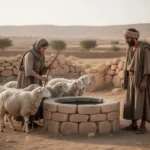
Elisha regularly traveled through the area near Shunem. The woman noticed that he was a holy man of God and persuaded him to stop at her home for meals. Her hospitality was not presented as a single polite invitation. She made room for repeated visits and treated the prophet as someone whose work deserved practical support.
Her husband agreed to build a small room for Elisha on the roof or upper part of the house. The room included basic furnishings: a bed, a table, a chair, and a lamp. These details show that her hospitality was deliberate and ongoing. She did not simply offer a meal; she created a dependable place where Elisha could rest.
This part of the account highlights a form of service that can be easy to overlook. The woman used what she had—her home, resources, and influence—to support a person she believed was carrying out God’s work. The narrative does not portray her as seeking attention or payment.
2. Elisha asks how he can repay her
Elisha wanted to respond to the woman’s generosity. Through his servant Gehazi, he asked whether she needed an introduction to a government official or military commander. Her answer, in the sense of the passage, was that she was settled among her own people and did not require political assistance.
Her response gives readers a glimpse of her independence. She was not trying to use hospitality to gain influence. She did not ask for wealth, protection, or social advancement. Yet Gehazi observed that she had no son and that her husband was old, a detail that becomes central to the next part of the story.
Elisha then announced that she would have a son within the appointed time. The woman reacted cautiously, asking him not to mislead her. Her response suggests that the promise touched a deep and possibly painful longing. The text does not explain why she had no child, but it presents the promise as emotionally serious rather than casually welcomed.
3. She gives birth to the promised son
The child was born as Elisha had said. For a period, the story seems to move from hospitality and barrenness to family joy. The woman’s earlier restraint is followed by the fulfillment of a promise, and the child grows old enough to accompany his father to the fields.
The narrative then changes suddenly. The boy complains of severe pain, is carried to his mother, and dies on her lap. The account does not soften the shock of the event. The son she received after a specific promise is taken away, creating the central crisis of the story.
4. She seeks Elisha instead of accepting the loss
The Shunammite woman lays her son on Elisha’s bed and closes the door. She then asks her husband for a servant and a donkey so she can go quickly to the prophet. When he asks why she needs to go, she gives a brief response often translated as “It is well” or “All is well,” though the passage itself shows that the situation is anything but normal.
Her words are not best understood as a denial that her son has died. They show controlled urgency. She does not explain the crisis to everyone along the way; she directs her attention toward the person she believes can address it. Her movement toward Elisha gives the story its sense of determination.
When she reaches the prophet, she takes hold of his feet. Gehazi tries to move her away, but Elisha recognizes her distress. She reminds him that she had not asked for a son and had warned him not to raise a false hope. Her complaint is direct: the promise and the present tragedy appear impossible to reconcile.
5. Elisha prays and the child is restored
Elisha sends Gehazi ahead with his staff, but the staff does not resolve the crisis. Elisha then enters the room, prays, and physically attends to the child. The boy gradually revives, sneezes repeatedly, and opens his eyes. Elisha calls the mother and gives her son back to her.
The account attributes the restoration to God’s power working through the prophet. It does not teach that every bereaved parent will receive the same earthly outcome. Instead, it presents a specific prophetic sign within the history of Elisha’s ministry and shows the woman’s persistent appeal in the face of devastating loss.
Reading the story carefully: The Shunammite woman’s faith is not portrayed as pretending that everything is fine. She acknowledges the crisis by going to Elisha, voicing her grievance, and refusing to let the matter be dismissed.
Why the Shunammite woman matters in 2 Kings 4
The story gives the woman unusual narrative weight. She is not named, but she initiates or influences nearly every major movement: she identifies Elisha, provides a room, responds to the promise, protects the child’s body, travels to Mount Carmel, confronts the prophet, and receives her son back.
Her character is shown through actions rather than a formal description. She is perceptive because she recognizes Elisha’s spiritual role; generous because she prepares a room; clear-headed because she responds quickly during the crisis; and persistent because she continues seeking help after the first response does not solve the problem.
The story also gives attention to the woman’s household and social setting. She is described as a prominent or well-to-do woman in many translations, and her husband participates in decisions about the home. Her wealth is not treated as proof that she has no needs. Material security does not protect her from grief, uncertainty, or dependence on others.
Her relationship with Elisha also differs from a simple patron-and-prophet arrangement. She does provide material support, but she does not attempt to purchase a blessing. When the promised child dies, she does not quietly accept a religious explanation. She brings her pain back to the prophet who had spoken the promise.
The Shunammite woman’s later story in 2 Kings 8
The woman from 2 Kings 4 appears again in 2 Kings 8:1–6. Elisha warns her that a seven-year famine is coming and tells her to leave the land with her household. She follows the warning and lives in the land of the Philistines for seven years.
When she returns, she appeals to the king for the restoration of her house and land. Her timing is striking: Gehazi is speaking to the king about the great things Elisha has done, including the restoration of the Shunammite woman’s son, when she arrives to present her own case. The king verifies her identity and orders that her property and the income connected with it be returned.
This later episode expands the picture of her life. She is not remembered only as the mother whose son was restored. She is also a displaced landowner who must protect her household’s rights after a long absence. Her earlier relationship with Elisha becomes relevant to a practical legal and economic need.
The famine passage also shows that divine care in the biblical narrative can involve warning, migration, legal recognition, and restoration of property. The woman still has to leave, endure separation from her homeland, return, and make a formal appeal. Protection does not remove every difficult step.
Abishag is the other prominent Shunammite woman. Her story begins in 1 Kings 1, near the end of King David’s life. David is elderly and unable to keep warm, so his servants seek a young woman from throughout Israel to care for him. They find Abishag from Shunem and bring her into the royal household.
The passage describes Abishag’s care for David and says that the king did not have sexual relations with her. That statement is significant because it distinguishes her caregiving role from a marital or sexual relationship. She is connected to the king’s household, but the text does not present her as David’s wife.
After David dies, Adonijah approaches Bathsheba and asks her to request Abishag as a wife for him from Solomon. Adonijah had previously tried to claim the throne, and Solomon interprets the request as politically threatening. He orders Adonijah’s death, and the request becomes part of the larger struggle over royal succession in 1 Kings 2.
Abishag does not speak in the recorded exchange and is not portrayed as responsible for the political maneuvering around her. Her identity as a Shunammite marks her origin, while her place in the royal household gives her symbolic importance in the succession dispute.
How Abishag differs from the woman in Elisha’s story
These two figures are often confused because both are called Shunammite. The Bible, however, gives no reason to identify them as the same person. Abishag is specifically named, while the woman in 2 Kings 4 remains unnamed. Their stories occur in different narrative settings and serve different purposes.
Name: Abishag is named; the woman in 2 Kings 4 is not.
Connection to a major figure: Abishag serves the elderly King David; the other woman supports the prophet Elisha.
Main setting: Abishag’s story centers on the royal court; the other woman’s story centers on her household, Elisha’s ministry, famine, and property.
Major conflict: Abishag becomes involved in a succession dispute; the other woman faces childlessness, bereavement, displacement, and restoration.
Reference locations: Abishag appears mainly in 1 Kings 1–2, while the unnamed Shunammite woman appears in 2 Kings 4 and 2 Kings 8.
Keeping these distinctions in mind prevents a common reading mistake: treating the term Shunammite as if it referred to one famous woman throughout the Bible. It functions like a place-based label used for different individuals.
Where Shunem was located
Shunem was an ancient settlement in northern Israel, associated with the territory of Issachar. It was near the Jezreel Valley and not far from places connected with the stories of Jezebel, Ahab, Saul, and the prophet Elisha. Its position along a traveled route helps explain why Elisha could pass through the area and why a household there might receive travelers.
The exact identification of ancient sites can involve archaeological and geographical discussion, but the biblical setting is clear enough for the narrative: Shunem was a real town in the northern part of the land, rather than an abstract religious term. Calling someone a Shunammite connects her to that community.
The location also adds context to the woman’s response when Elisha asks whether she needs an introduction to an official. She says, in effect, that she is living securely among her own people. Her answer reflects local belonging, not isolation. Later, when famine forces her to leave, her return to claim her property shows how deeply her household is tied to the land.
What readers can learn from the Shunammite narratives
Hospitality can be practical and intentional
The woman’s hospitality is not vague friendliness. She notices a need, offers meals, consults her husband, and creates a room with useful furnishings. Her example presents hospitality as a form of organized care that uses time, space, and resources.
The account does not require every reader to build a guest room or host a traveling prophet. Its practical principle is broader: meaningful welcome often involves noticing what another person needs and preparing to meet that need consistently.
Faith can include honest protest
The woman’s response to her son’s death is neither detached calm nor a polished religious speech. She moves quickly, seeks Elisha, and reminds him of the pain caused by the promise of a child. Her words show that trust and complaint can exist together.
That feature makes the narrative emotionally credible. She does not hide her confusion from the prophet or pretend that grief has no force. She brings the contradiction directly into the relationship through which the promise came.
Women can drive the action of biblical narratives
Although the stories are set in societies where men often held formal public authority, the Shunammite woman is the principal decision-maker in the scenes that concern her family. She identifies the prophet, arranges his accommodation, chooses the response to the child’s crisis, and later advocates for her property.
Abishag’s story shows a different reality: she is present at the center of royal power, yet the recorded political decisions are made by men around her. Reading both accounts together helps you distinguish between a woman’s narrative importance and the amount of speech or formal authority assigned to her.
Prosperity does not eliminate vulnerability
The woman in 2 Kings 4 appears to have social standing and material resources. Even so, she experiences childlessness, the death of her son, famine, displacement, and the possible loss of her property. Her story resists the assumption that wealth creates complete security.
At the same time, her resources enable her to offer hospitality and travel quickly when a crisis arises. The narrative treats possessions as tools that can be used for service, but it does not confuse possessions with control over life’s outcomes.
How to find the Shunammite passages in the Bible
If you are studying the term, read the passages in a sequence that keeps the characters separate. Begin with the short royal narrative about Abishag, then turn to Elisha’s longer account and its later continuation.
Read 1 Kings 1:1–4 for Abishag’s introduction and her role in caring for David.
Read 1 Kings 2:13–25 for the political significance of Adonijah’s request involving Abishag.
Read 2 Kings 4:8–37 for the unnamed Shunammite woman’s hospitality, promised son, grief, and the child’s restoration.
Read 2 Kings 4:38–44 for the broader context of Elisha’s ministry, including another act of provision.
Read 2 Kings 8:1–6 for the Shunammite woman’s famine, return, property claim, and recognition by the king.
As you read, mark whether the passage mentions David, Abishag, Elisha, the son, famine, or land. Those details quickly reveal which Shunammite narrative is in view.
Common misunderstandings about the Shunammite
One misunderstanding is that Shunammite is the woman’s name. It is not. In the Elisha story, the woman’s personal name is never supplied, and the geographical term becomes her identifying title.
A second misunderstanding is that the woman’s statement that all is well means she felt no fear or sorrow. The surrounding events show that she was in distress. Her brief reply may reflect urgency, restraint, or confidence that the crisis had to be brought to Elisha rather than explained to everyone she passed.
A third misunderstanding is that the restoration of the child should be treated as a universal promise about bereavement. The passage records a particular miracle in Elisha’s prophetic ministry. It can speak to hope and prayer, but it should not be used to blame grieving people whose loved ones are not restored to life.
A fourth misunderstanding is that Abishag and the unnamed woman must be the same person because both came from Shunem. The label identifies a place, not a single individual. The biblical texts present separate women in separate accounts.
Why the term still matters when studying the Bible
Place names often carry more meaning in biblical narratives than modern readers first expect. The word Shunammite anchors a woman’s identity in a particular town, region, and community. It also helps readers trace a character through the text when her personal name is not given.
The term brings together themes of home and displacement, because the Shunammite woman’s household is first a place of welcome and later a property she must leave and reclaim. It also connects ordinary domestic decisions with national history: a room prepared for a prophet, a child restored, a famine endured, and a royal official deciding whether land will be returned.
When you encounter Shunammite in a Bible passage, begin with the simple definition—“woman from Shunem”—then examine the surrounding names and events. That small step makes the stories clearer and reveals how geography, family life, prophetic ministry, and royal politics overlap in the biblical record.
Frequently asked questions
Is Shunammite a name or a title?
Shunammite is a geographical title, not a personal name. It means “a woman from Shunem.” The woman who helps Elisha in 2 Kings 4 is never given a personal name in the biblical text. Abishag, however, is named and is also called a Shunammite because she comes from the same town or region.
Are Abishag and the Shunammite woman the same person?
The Bible does not identify them as the same woman. Abishag appears in 1 Kings as a caregiver in King David’s household, while the unnamed Shunammite woman appears in Elisha’s stories in 2 Kings. Their different narratives and descriptions support treating them as separate individuals.
What did the Shunammite woman do for Elisha?
She regularly offered Elisha meals and persuaded her husband to prepare a furnished room where he could stay during his travels. Her hospitality created a reliable place of rest for the prophet. Later, she sought Elisha when her son died and appealed to him with remarkable persistence.
Where was Shunem located?
Shunem was an ancient town in northern Israel, associated with the territory of Issachar and situated near the Jezreel Valley. Its position along a regional travel route helps explain why Elisha passed through the area and why the town appears in stories connected with both prophetic ministry and Israel’s royal history.









Leave a Reply