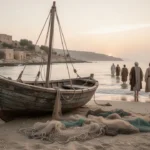
Magdala stood along the western shore of the Sea of Galilee, in the region known in the New Testament as Galilee. Its location placed it near fertile farmland, major travel routes, and the lake’s productive fishing grounds. The town was close to Capernaum, where Jesus spent much of his Galilean ministry, and to other communities mentioned in the Gospels.
The name is connected with the Aramaic word Magdala or Migdal, commonly understood to mean “tower”. Another form of the name, Magdala Nunayya, is associated with “tower of the fish,” reflecting the settlement’s relationship with the lake and its fishing economy. Greek and Roman writers also used the name Taricheae, a term linked with fish processing.
Magdala was more than a small rural village. Archaeological evidence points to a settled Jewish community with public, domestic, commercial, and religious spaces. Its position on the lake helped connect local fishing families with wider markets, making it a useful place for understanding the economic life of first-century Galilee.
The central connection: Mary Magdalene is called “Magdalene” because she was associated with Magdala. The name identifies her place of origin or connection; it does not describe a profession or a moral history.
Magdala in the New Testament setting
The Gospels do not provide a long description of Magdala itself. Instead, the town is known primarily through Mary Magdalene, one of Jesus’ followers. Luke 8 identifies Mary as a woman from whom seven demons had gone out and names her among the women who supported Jesus and the disciples from their own resources.
Mary Magdalene appears in the Gospel accounts of Jesus’ crucifixion, burial, and resurrection. The Gospel narratives place her among the women who witnessed the crucifixion from a distance, observed where Jesus was buried, and went to the tomb after the Sabbath. In John 20, Mary has a direct encounter with the risen Jesus and reports the news to the disciples.
These references give Magdala an important place in Christian memory, even though the town itself is not described at length. The designation “Magdalene” remains attached to Mary throughout Christian tradition because it preserves her connection to this Galilean community.
The New Testament does not say that Jesus visited Magdala by name. Some Gospel passages refer to the region of Magadan or Dalmanutha after the feeding of the four thousand, but scholars have discussed how, or whether, those names relate to Magdala. The locations are not identical by clear agreement, so it is better to avoid treating every similar place-name as certain evidence of a visit.
How to understand Magdala step by step
Several details help establish what Magdala was and why it remains significant:
Locate the town: Magdala was on the western side of the Sea of Galilee, in the heart of first-century Galilee.
Read the name carefully: “Magdalene” connects Mary with Magdala; it is a geographical identifier.
Consider the economy: Fishing, fish preparation, farming, trade, and transport likely shaped daily life in the community.
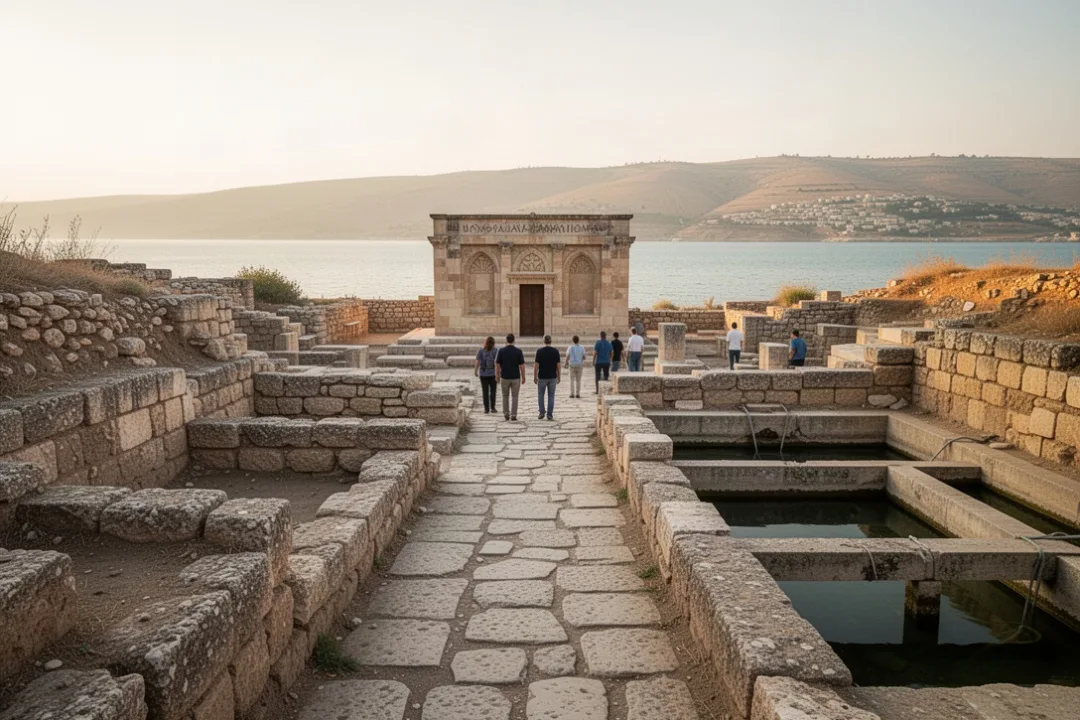
Recognize its Jewish setting: Excavations reveal Jewish ritual and communal practices, including a synagogue and ritual baths.
Separate history from tradition: Mary’s Gospel role is clear, while later ideas about her identity require careful distinction.
Read the archaeology alongside the texts: Buildings, tools, coins, stone vessels, and mosaics help place the Gospel stories within a real first-century landscape.
What daily life in Magdala may have looked like
Magdala’s position beside the lake shaped the rhythm of work. Fishermen used boats and nets on the Sea of Galilee, while other residents repaired equipment, prepared catches, transported goods, sold food, or worked in agriculture. Fish could be consumed locally, preserved, or moved to markets beyond the immediate shoreline.
The town’s waterfront setting also meant that Magdala was connected to people from different places. Travelers, traders, officials, and religious visitors could arrive by road or water. That movement would have made the town more commercially active than an isolated farming settlement.
Archaeological remains suggest that residents lived in stone-built houses arranged around courtyards and narrow streets. Excavated spaces include domestic rooms, storage areas, and installations associated with food preparation and other household work. The surviving structures do not tell us the name or story of every resident, but they show a community with organized homes and a developed urban layout.
Jewish religious practice was also part of community life. Archaeologists have found mikva’ot, or ritual baths, at the site. These baths indicate attention to ritual purification and help confirm the town’s Jewish character during the period associated with the New Testament.
That evidence matters because it places Mary Magdalene within an ordinary Jewish community rather than an abstract biblical backdrop. She would have belonged to a society with family networks, work responsibilities, local religious customs, and economic pressures. The archaeological setting gives greater texture to the brief Gospel references to her.
Modern excavations at Magdala have uncovered a substantial portion of the ancient settlement. Researchers have found residential buildings, paved streets, water installations, ritual baths, and a synagogue. Together, these remains show that Magdala was an established town with communal institutions and access to resources.
The synagogue is one of the site’s most important discoveries. It is generally dated to the first century, the period in which Jesus and Mary Magdalene lived. Its presence demonstrates that Jewish communal worship took place in Magdala during the same broad era as the Gospel events.
The building includes a decorated stone often called the Magdala Stone. Its carvings feature Jewish symbols and architectural imagery. Among the most recognizable elements is a menorah, the seven-branched lampstand associated with the Jerusalem Temple. Other designs have been interpreted in relation to the Temple, sacred space, and Jewish visual traditions.
The exact meaning of every carving remains a subject of scholarly discussion. The stone should not be treated as a simple diagram with one universally agreed explanation. Even so, it provides rare evidence of the artistic and religious world of first-century Galilean Jews.
The synagogue also changes the way people imagine local religious life. A community such as Magdala was not merely a collection of fishing households. It had a place where people could gather, hear Scripture, discuss religious matters, and participate in communal life. The building offers a physical setting for understanding the synagogue-centered culture reflected in the Gospels.
Why the Magdala Stone is significant
The Magdala Stone is significant because it is an early Jewish artifact connected with a synagogue and decorated with imagery associated with the Jerusalem Temple. Its design suggests that Temple symbolism mattered deeply to Jewish communities outside Jerusalem.
Before its discovery, scholars had fewer examples of how first-century Jewish communities represented sacred ideas in public or communal spaces. The stone does not prove every detail of ancient worship, but it adds evidence to the broader picture of Jewish identity in Galilee.
The artifact may have served a practical architectural function, such as a support, bench, or decorated feature within the synagogue. Its original use is not entirely certain. What is clear is that the stone was carefully made and displayed in a building used by the local community.
Its imagery also reminds visitors that first-century Judaism was visually and materially expressive. Jewish communities differed in how they used decoration, but they were not culturally bare or disconnected from artistic traditions. Magdala’s synagogue presents a complex picture of a community that honored Jewish tradition while living in a region influenced by broader Roman-era culture.
Mary Magdalene’s connection to Magdala
Mary Magdalene is one of the most important women in the Gospel accounts. Her identity is geographically clear: she was associated with Magdala. The Gospels also present her as a committed follower of Jesus and a witness to events at the center of Christian faith.
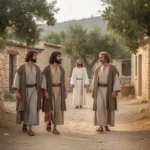
Luke 8 names Mary among the women who traveled with Jesus and the disciples and helped support their ministry. This description shows her as an active participant rather than a nameless member of a crowd. Her resources, presence, and loyalty contributed to the movement surrounding Jesus.
Mary’s role becomes especially prominent in the Passion narratives. The Gospels place her near the crucifixion and burial, when many followers had withdrawn or were absent. Her continued presence links her to the public death of Jesus as well as to the discovery of the empty tomb.
The resurrection accounts differ in some details, but they consistently give Mary Magdalene an important place. In John 20, she encounters the risen Jesus and carries the news to the disciples. This is why Christian writers have often described her as an early witness or messenger of the resurrection.
A common correction: The Bible does not identify Mary Magdalene as a prostitute. That association developed through later interpretation and the blending of several different women in Christian tradition.
Why Mary Magdalene is sometimes confused with other women
Mary Magdalene is mentioned alongside several other women named Mary in the New Testament. The Gospels also tell stories about an unnamed “sinful woman,” Mary of Bethany, and other female followers. Over time, some Western Christian traditions connected these figures, although the biblical texts do not clearly present them as the same person.
The confusion became especially influential in art, preaching, and popular culture. Images of a repentant woman with long hair or a jar were sometimes labeled as Mary Magdalene even when the Gospel passage did not name her. That artistic tradition helped create a familiar but historically uncertain portrait.
A careful reading keeps the identities separate unless the text itself connects them. Mary Magdalene’s own Gospel profile is already substantial: she was healed, supported Jesus’ ministry, remained present at his death and burial, and proclaimed the resurrection message to the disciples.
Her designation as “Magdalene” is also valuable because it preserves a link to a specific town. Many ancient women in the biblical texts are identified through family relationships or marital status. Mary’s place-name points to her association with Magdala and gives readers a glimpse of her regional background.
Magdala during the first century
Magdala existed within the political world of Roman-controlled Galilee. Local rulers governed the region under Rome’s broader imperial system, while towns and villages maintained their own economic, social, and religious patterns. This combination created opportunities for trade but also placed pressure on communities through taxation and administration.
Galilee was not culturally cut off from Jerusalem or the wider Mediterranean world. People moved between towns, goods traveled along roads and waterways, and political decisions affected local life. At the same time, Jewish religious practice remained central to the identity of communities such as Magdala.
Josephus, the first-century Jewish historian, refers to Taricheae in his account of the region and the Jewish revolt against Rome. Scholars have often associated Taricheae with Magdala, partly because of the town’s lakeside location and fishing economy. The identification is widely discussed, but details about the site’s role in particular military events should be presented with care.
The Jewish revolt against Rome in the first century brought violence and disruption to Galilee. Magdala’s location near the lake and its economic importance made it relevant to the conflict described by Josephus. The town’s later history, however, should not eclipse the earlier community reflected in the synagogue and domestic remains.
How archaeology complements the Gospel accounts
Archaeology cannot prove every event described in a biblical narrative, and it does not identify individual homes belonging to Mary Magdalene. Its contribution is different: it reconstructs the social, religious, and physical environment in which the stories took place.
The synagogue confirms that first-century Jews in Magdala gathered in a communal religious building. The ritual baths show that practices involving purification were part of local life. The streets, houses, and fishing-related evidence help portray a settled lakeside town rather than a vague or symbolic location.
This context can clarify terms and customs in the New Testament. References to synagogues, ritual purity, fishing, boats, food, travel, and public teaching become easier to picture when visitors can see the kinds of spaces available in a town like Magdala.
Archaeology also introduces necessary limits. Excavated ruins are incomplete, and interpretations can change as new evidence is examined. A responsible account distinguishes between what the remains directly show, what scholars reasonably infer, and what later tradition imagines.
Direct evidence: buildings, streets, objects, coins, stonework, and installations found at the site.
Reasonable interpretation: fishing and trade were important because of the town’s location and material remains.
Historical association: Mary Magdalene was connected to Magdala according to the Gospel designation.
Later tradition: ideas about Mary’s profession or personal history that are not stated in the New Testament.
What visitors can see at Magdala today
The archaeological site allows visitors to view remains of the ancient town and to consider how its public and private spaces fit together. Depending on current access and preservation work, visitors may see excavated portions of the first-century synagogue, the Magdala Stone, streets, domestic structures, and ritual baths.
A modern pilgrimage and visitor complex near the site also presents Magdala as a place connected with Christian reflection. Its facilities may include a church, gathering spaces, exhibits, and views toward the Sea of Galilee. Exact opening hours, admission arrangements, and access to individual areas can change, so travelers should check current information before making a special trip.
The setting beside the lake is part of the experience. Looking across the water helps connect the archaeological remains with the fishing economy, travel routes, and landscapes that shaped Galilean life. The shoreline is not simply a scenic background; it explains why the town developed where it did.
Visitors should allow time to look closely at construction details rather than treating the site as a quick stop. Stone walls, drainage features, courtyards, and the synagogue’s decorated elements can reveal how public and domestic life were organized.
Practical ways to visit the site thoughtfully
A visit is more meaningful when you combine the physical remains with a basic understanding of the ancient setting. You do not need specialized training, but a few preparations can help you notice details that might otherwise be missed.
Read the Gospel references first: Look at Luke 8 and the resurrection passages that mention Mary Magdalene.
Bring water and sun protection: The lakeside climate can be hot, and much of an archaeological visit may take place outdoors.
Wear practical shoes: Uneven ground and stone surfaces can make walking difficult in sandals or smooth-soled shoes.
Check current visitor information: Hours, guided tours, worship services, and access rules may vary.
Respect active religious spaces: Keep noise low and follow instructions if visiting a church or place of prayer.
Use the site’s labels carefully: Treat explanations as evidence-based interpretations, not as proof of every later tradition.
If you are visiting several locations around the Sea of Galilee, Magdala can be paired geographically with sites such as Capernaum and Tabgha. Planning the route in advance helps you avoid rushing and makes it easier to compare different kinds of evidence: archaeological remains at one location, landscape traditions at another, and Gospel associations across the region.
What Magdala teaches about women in the early Christian movement
Mary Magdalene’s association with Magdala offers more than a place-name. Her story shows that women were visible participants in the circle surrounding Jesus. The Gospel accounts describe women traveling with the group, providing support, witnessing the crucifixion, observing the burial, and communicating the resurrection message.
That evidence should not be minimized because the surviving texts are brief. Ancient sources often preserve only fragments of a person’s life. In Mary’s case, the fragments consistently place her near decisive moments and identify her as a trusted witness.
Her connection with a working Galilean town also challenges portraits of biblical characters detached from ordinary society. Mary was not presented as a legendary figure from an unknown setting. She was linked to a real community with economic activity, religious institutions, and social networks.
Magdala therefore helps connect biblical interpretation with historical geography. A reader can consider Mary’s role not only as a theological figure but also as a woman from a particular lakeside town who joined a traveling movement and remained present during its most dangerous and significant moments.
Questions to keep in mind when studying Magdala
Some questions about Magdala have clear answers, while others remain open. The town’s location, Jewish character, archaeological remains, and connection with Mary Magdalene are well established at a broad level. More specific claims require greater caution.
Was Magdala a fishing town? Its location and archaeological evidence strongly connect it with fishing and fish processing, although residents also had other occupations.
Was Mary Magdalene born there? The name indicates her association with Magdala, but the Gospel texts do not explain whether she was born there, lived there, or was otherwise identified with it.
Did Jesus visit Magdala? The Gospels do not clearly state this by name, and similar place-names in some passages are debated.
Does the synagogue prove a specific Gospel event? It confirms the type of Jewish communal setting present in Galilee, but it cannot identify which individuals used the building.
Does archaeology replace faith or interpretation? No. It supplies historical context and material evidence while leaving theological interpretation to religious traditions and readers.
These distinctions make the story of Magdala stronger, not weaker. The town does not need exaggerated claims to be significant. Its archaeological remains, its place in the Galilean landscape, and its connection with Mary Magdalene provide substantial evidence for understanding the world of the New Testament.
Why Magdala remains significant
Magdala brings together several parts of biblical history: the life of a first-century Jewish town, the economy of the Sea of Galilee, the religious world of local synagogues, and the testimony of one of Christianity’s most prominent women. Its importance comes from the way these strands meet in one physical place.
For Christian readers, Magdala is inseparable from Mary Magdalene’s witness to Jesus’ death and resurrection. For historians and archaeologists, it offers evidence about urban life, Jewish practice, fishing, trade, and material culture in Roman-period Galilee. For travelers, it provides a site where landscape and ancient remains can be considered together.
The most responsible way to approach Magdala is to hold these perspectives together. Read the Gospel texts closely, examine the archaeological evidence, distinguish early sources from later traditions, and allow the surviving remains to show both what can be known and what remains uncertain.
Frequently asked questions
Is Magdala the same place as Migdal in Israel?
Magdala and Migdal are closely related names for the ancient site associated with Mary Magdalene on the western shore of the Sea of Galilee. “Migdal” is commonly used for the modern locality nearby, while “Magdala” is familiar from the New Testament and Christian tradition. Naming conventions can vary among archaeological, biblical, and modern travel sources.
Was Mary Magdalene from Magdala?
Yes, the title “Magdalene” identifies Mary with Magdala. The Gospels do not explain whether she was born there, lived there permanently, or was known by the town because of another connection. They do clearly distinguish her from other women named Mary and present her as a follower and witness of Jesus.
Can you visit the ancient Magdala site?
Visitors can generally explore archaeological remains associated with ancient Magdala, including a first-century synagogue, the Magdala Stone, streets, houses, and ritual baths. Access, hours, tours, and religious facilities can change, so check current information before traveling. Sun protection, water, and sturdy footwear are useful for an outdoor archaeological visit.
What is the Magdala Stone?
The Magdala Stone is a decorated first-century Jewish stone found in the site’s synagogue. It includes a menorah and other carved imagery connected with Jewish sacred traditions. Scholars continue to discuss its exact function and the meaning of every design, but it provides valuable evidence about religious art and synagogue life in Galilee.






Leave a Reply