If you are planning a trip around the Sea of Galilee and wondering which biblical sites are worth your time, Capernaum Israel deserves a place near the top of your list. The ancient village sits on the lake’s northwestern shore, where archaeological remains, Christian tradition, and a peaceful landscape come together in one compact site.
Capernaum is best known as a major setting in the Gospels. Jesus is described as teaching there, healing people, and making the village a base during much of his Galilean ministry. You can walk among the remains of homes, see the foundations associated with an early Christian gathering place, and visit the striking white stone synagogue built over an older structure.
Plan for meaning as well as sightseeing: Capernaum is an archaeological and religious site, not a reconstructed theme park. The most valuable visit combines the visible ruins with the Gospel passages and historical context connected to them.
Capernaum lies beside the Sea of Galilee in northern Israel, in the region traditionally called Galilee. The site is a short drive from other important lakeside destinations, including Tabgha, the Mount of Beatitudes, and the Church of the Multiplication. Tiberias, on the western side of the lake, is a common base for visitors exploring the area.
The village occupied a narrow strip between the lake and the hills farther inland. Its position made sense for an ancient fishing community: residents could work on the water, trade along regional routes, and use the lake as a dependable source of food. The shoreline has changed over time, but the setting still makes clear why Capernaum developed where it did.
Modern visitors generally enter through the Capernaum National Park area, where paths lead through the archaeological remains. The site is also known as Kfar Nahum, a Hebrew name often understood as “village of Nahum.” Signs and guidebooks may use both names.
Why Capernaum matters in the New Testament
Capernaum appears repeatedly in the New Testament and is closely connected with Jesus’ ministry in Galilee. The Gospels describe him teaching in the village synagogue and healing people in and around the settlement. These accounts make Capernaum one of the clearest physical locations for understanding the geographical setting of Jesus’ public work.
According to the Gospel narratives, Jesus called several fishermen who worked near the Sea of Galilee, including Simon Peter and his brother Andrew. James and John are also associated with this lakeside setting. The Gospel of Matthew describes Capernaum as a place where Jesus lived or made his home during part of his ministry, and Mark frequently returns to the village as a center of activity.
Several familiar episodes are associated with Capernaum:
The healing of Peter’s mother-in-law, described in Matthew 8, Mark 1, and Luke 4.
The healing of a paralyzed man, whose friends lower him through a roof in Mark 2 and Luke 5.
The healing of the centurion’s servant, told in Matthew 8 and Luke 7.
Teaching in the synagogue, especially in Mark 1 and John 6.
The conversation about the bread of life, recorded in John 6 and traditionally linked with the synagogue area.
These references do not mean that every modern structure at the site dates from the first century. The most visible synagogue standing today is later, and the church above the house traditionally linked with Peter also belongs to a later phase. The value of Capernaum comes from the relationship between the Gospel setting, the archaeological evidence, and the long history of Christian memory at the site.
How to visit Capernaum step by step
A thoughtful visit usually takes about an hour, although people interested in archaeology, photography, or prayer may want longer. The following sequence helps you see the main features without rushing from one monument to the next.
Arrive with practical basics ready. Bring water, sun protection, and comfortable shoes. The site includes uneven stone surfaces, and summer temperatures can be intense.
Begin by orienting yourself. Look toward the lake and imagine the ancient settlement as a working fishing village rather than an isolated religious monument.
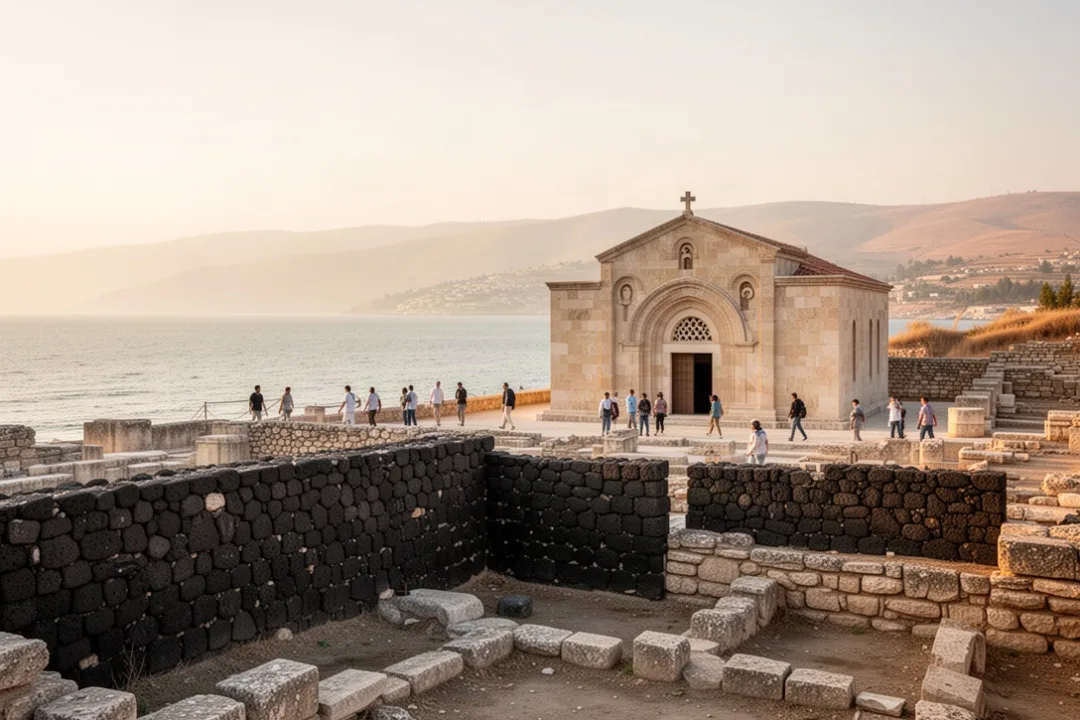
Walk through the residential area. Examine the dark basalt walls and the arrangement of domestic spaces to understand how people lived.
Visit the house associated with Peter. Look at the archaeological remains below the modern protective church and consider the layers of use represented there.
Spend time at the synagogue. Study the decorated limestone columns, carved details, and the lower remains associated with an earlier building.
Read the relevant Gospel passages afterward. The physical setting often becomes easier to picture once you have seen the village, synagogue area, and shoreline together.
Continue to nearby sites if time allows. Tabgha, the Mount of Beatitudes, and the north shore of the lake can be combined with Capernaum in one outing.
What the ancient synagogue at Capernaum shows
The synagogue is the site’s most recognizable monument. Its pale limestone stands out against the darker basalt used in many of the village’s homes. Decorative elements include carved columns, geometric details, and ornamental pieces that reflect the skill and resources available to the community that built it.
The visible synagogue is generally dated to the late Roman or Byzantine period, several centuries after the time of Jesus. Scholars and archaeologists have long examined the relationship between this structure and the earlier synagogue mentioned in the Gospels. Beneath and around the white limestone building are remains associated with an earlier phase, including darker stonework.
That distinction matters when you visit. Saying that Jesus taught in “the synagogue at Capernaum” does not necessarily mean he stood inside the white building visible today. The Gospel accounts refer to the village synagogue in the first century, while the surviving monument represents a later rebuilding or major development of the site.
Rather than reducing the synagogue’s importance, the layered history makes the location more interesting. It shows that Capernaum remained significant after the period described in the New Testament and that later Jewish communities invested in a substantial place of worship.
Look closely at the surviving architectural details, but avoid treating every carved feature as a confirmed symbol with a single meaning. Interpretations of particular designs can differ. A local guide or museum information panel can help explain which conclusions are well established and which remain debated.
What is beneath the modern church over Peter’s house
Near the synagogue is a modern church built above an archaeological area traditionally identified as the house of the apostle Peter. The church’s elevated design allows visitors to look down through a central opening at the excavated remains below. Its shape is distinctive and intentionally separates the modern worship space from the ancient structures.
Archaeological work at the location revealed a domestic building that appears to have received special treatment in the early Christian period. Researchers found evidence that one room was adapted for Christian use, including changes to the walls and inscriptions or markings interpreted as signs of devotion. Later, a larger church was constructed over the area.
The identification with Peter’s house rests on a combination of tradition, archaeology, and textual evidence, not on an inscription that names him in a way that settles every question. The Gospels place Peter’s home in Capernaum, and the building’s early Christian significance supports the longstanding association. Still, responsible interpretation distinguishes between what the excavation demonstrates and what Christian tradition identifies.
Inside the modern church, the open center provides a visual connection between present-day worship and the ancient remains. The building also offers shade, which can make it a useful pause during a hot visit. Visitors should be aware that it remains a functioning religious space, so quiet behavior and appropriate clothing are expected.
How the homes reveal daily life in ancient Capernaum
The residential ruins help correct a common impression of biblical sites: ancient villages were not made up only of grand religious buildings. Most people lived in practical homes constructed largely from local black basalt, a volcanic stone common in the region. Walls, doorways, courtyards, and connected rooms reveal a dense community shaped by family life and work.
Many houses appear to have shared walls or clustered around open spaces. Such arrangements could support extended families and neighborhood cooperation. Domestic buildings may have included areas for food preparation, storage, tools, and animals, although the exact use of individual rooms is not always certain.
The lake influenced nearly every aspect of village life. Fishing was a major occupation, and residents processed, stored, or traded fish. Agriculture in the surrounding area also contributed to the local economy. Capernaum’s population would have included people with different occupations, social positions, and religious responsibilities, not only the fishermen mentioned in the Gospels.
Walking through the homes can make the Gospel stories feel more grounded. A roof in the first-century region could be a usable platform reached by an outside stairway or ladder, which helps explain the account of friends lowering a paralyzed man through a roof. The story still involves faith and healing, but the architecture makes the practical details less abstract.
What happened to Capernaum after the Gospel period
Capernaum did not disappear immediately after the first century. The village continued through later Roman and Byzantine periods, and the substantial synagogue visible today reflects its continuing importance. Christian interest also grew, especially as pilgrims connected the archaeological remains with events in Jesus’ life.
Over time, the settlement declined and was eventually abandoned as a permanent village. The reasons are not represented by one simple event in the visitor experience. Changes in regional settlement patterns, economic life, political conditions, and natural circumstances all formed part of the broader history of the area.
For centuries, the site remained a place remembered through religious tradition and visited by travelers. Archaeological investigation later exposed the village layout and helped distinguish different construction phases. Modern preservation allows visitors to see the relationship between the homes, synagogue, church, and lake more clearly than would be possible from written sources alone.
The site therefore represents several historical periods at once:
The first-century Jewish village associated with Jesus and his disciples.
The later synagogue complex built in a period when the settlement remained active.
The early Christian house-church tradition connected with Peter’s home.
The modern archaeological and pilgrimage site preserved for visitors and worshipers.
What to see near Capernaum on the Sea of Galilee
Capernaum works well as part of a north-shore itinerary. Nearby locations add geographical context because several Gospel traditions are concentrated around the same part of the lake. Allowing extra time also prevents the visit from becoming a quick stop between unrelated attractions.
Tabgha and the Church of the Multiplication
Tabgha lies near Capernaum and is associated with the Gospel story of Jesus feeding a large crowd. The Church of the Multiplication is known for its early Christian mosaics, especially the image of a basket and fish near the altar. As with Capernaum, the modern church should be understood as a place of tradition and worship built amid a long sequence of historical remains.
The Mount of Beatitudes
The Mount of Beatitudes overlooks the Sea of Galilee and is traditionally connected with Jesus’ teaching, including the material known as the Beatitudes in Matthew 5–7. The exact location of the Sermon on the Mount is not established by a modern boundary marker, but the hillside provides a strong sense of the Galilean landscape described in the Gospels.
The Sea of Galilee shoreline
A short time beside the water can add more to your understanding than another rushed monument. From the shore, you can see how close the village was to fishing grounds and how the surrounding hills frame the lake. Water levels and shoreline access can vary, so follow signs and local guidance rather than assuming every area is open for swimming or boating.
Magdala and other Galilee sites
Magdala, farther along the western shore, offers another important archaeological setting from the period of the Second Temple. Its remains include a synagogue and evidence of a busy Jewish town. Depending on your route, it can be combined with Capernaum, although seeing both carefully may require a full day rather than a hurried half-day excursion.
When to visit Capernaum and what to bring
The best time of day often depends more on heat and crowd levels than on the season. Early morning usually provides cooler temperatures, softer light, and a quieter atmosphere. Late afternoon can also be pleasant, but confirm the site’s current closing time before relying on a sunset visit.
Weather around the lake can change quickly between seasons. Summer is often hot and bright, while winter and spring can bring cooler conditions and occasional rain. Check the official opening information shortly before your trip because hours, admission arrangements, and access policies may change.
Useful items include:
Water in a reusable bottle.
A hat, sunscreen, and sunglasses for exposed paths.
Sturdy walking shoes with good grip.
Light, respectful clothing suitable for religious buildings.
A phone or camera, used without disturbing worshipers or blocking pathways.
A Bible or digital reference containing Matthew, Mark, Luke, and John for historical context.
Some parts of the site may be difficult for visitors with limited mobility because ancient paving is uneven. Ask at the entrance about the most accessible route. The modern church may provide a smoother viewing experience than the residential ruins, but conditions can vary throughout the archaeological park.
Respect the site’s dual purpose: Capernaum is both an archaeological park and a place of Christian pilgrimage. Keep voices low inside religious buildings, follow photography rules, and do not climb on ancient walls or carved stones.
How to understand tradition and archaeology together
Visitors sometimes feel they must choose between a religious reading of Capernaum and a scholarly one. The site is better understood when both are kept in view. Archaeology can identify building phases, materials, layouts, and patterns of use; tradition explains why particular places have remained meaningful to generations of believers.
At the same time, the two types of evidence should not be confused. A tradition may be ancient and deeply important without proving every detail of an identification. A later building may stand over an earlier location without being the original structure mentioned in a Gospel account.
A useful approach is to ask three questions at each major feature:
What can be seen? Describe the surviving stones, walls, columns, foundations, or inscriptions.
What period does it represent? Consider whether the feature belongs to the first century, a later Roman or Byzantine phase, or modern preservation.
Why is it remembered? Connect the location with the Gospel narrative or Christian tradition while recognizing the limits of the evidence.
This approach makes the visit more rewarding for religious pilgrims, history enthusiasts, and travelers who are simply curious about the region. Capernaum is not valuable because every question has an uncomplicated answer. Its value lies in how clearly several layers of Jewish, Roman, Christian, and modern history remain visible in one lakeside settlement.
Why Capernaum remains one of Galilee’s essential stops
Capernaum brings together a rare combination of biblical association, archaeological clarity, and natural setting. The ancient homes show the scale of ordinary life. The synagogue reveals the importance of Jewish worship in the village. The church over Peter’s house preserves a long-standing Christian connection, while the lake explains the work and movement of the people who lived there.
A visit becomes especially meaningful when you resist the temptation to see only the most famous monument. Spend time looking at the basalt walls, imagining the sound of a working shore, and noticing how close the synagogue and homes were to one another. Then consider how the Gospel stories describe this same place as a center of teaching, healing, and conflict.
Capernaum is small enough to visit without exhausting yourself, yet layered enough to reward careful attention. With practical preparation, respectful behavior, and a willingness to distinguish ancient evidence from later tradition, you can experience the site as more than a stop on a sightseeing route: it becomes a tangible window into life around the Sea of Galilee.
Frequently asked questions
Is Capernaum the same place as Kfar Nahum?
Yes. Kfar Nahum is the Hebrew name commonly used for the ancient settlement known in English as Capernaum. Modern signs, maps, and travel resources may use either name. The site is located on the northwestern shore of the Sea of Galilee and is preserved as an archaeological and religious destination.
Can you visit Capernaum without a tour guide?
Yes, independent visits are possible. Paths and information signs explain the major areas, including the synagogue and church over the site traditionally identified as Peter’s house. A guide can add historical and biblical context, but check current entrance hours and visitor rules before arriving.
How far is Capernaum from Tiberias?
Capernaum is across the lake’s western and northern area from Tiberias, and the driving distance depends on the route and starting point. Many travelers visit from Tiberias as part of a broader Sea of Galilee itinerary that includes Tabgha and the Mount of Beatitudes.
Is the synagogue at Capernaum from the time of Jesus?
The white limestone synagogue standing today is generally dated to a later Roman or Byzantine period. Archaeological remains beneath or around it are associated with an earlier synagogue, which is the structure more closely connected with the first-century Gospel setting. The exact construction history continues to be studied.






Leave a Reply