Mount Nebo is the Jordanian ridge traditionally identified as the place where Moses saw the Promised Land before his death. Today, it is both a significant biblical site and an archaeological destination, with a hilltop church, finely preserved mosaics, stone ruins, and broad views across the Jordan Valley and Dead Sea.
The site stands near Madaba, southwest of Amman, in west-central Jordan. It attracts religious pilgrims, history travelers, photographers, and visitors who want to understand the landscape behind the biblical account. You can see the main remains in a relatively short visit, but the setting rewards a slower look at the terrain, church architecture, and changing layers of history.
Mount Nebo appears in the Book of Deuteronomy, especially in chapter 34. The account describes Moses climbing the mountain, where God shows him the land promised to the Israelites. Moses sees the region from a distance but does not enter it, and the text says he dies there.
The biblical passage also says that Moses’ burial place was not known. That detail has shaped the site’s importance: Mount Nebo is associated with Moses’ final view and death, but it is not presented as a confirmed tomb. Visitors should therefore distinguish between the traditional location and archaeological certainty.
The mountain’s significance comes from the relationship between the text and the landscape. From the ridge, the land stretches toward the Jordan Valley, the Dead Sea, and the hills beyond. On a clear day, the view helps explain why the mountain has been connected with the biblical description for centuries.
Important distinction: Mount Nebo is traditionally associated with Moses’ final view, not with a verified burial chamber or tomb. Its meaning rests on biblical tradition, religious memory, and the physical landscape.
Where Mount Nebo is located in Jordan
Mount Nebo is in the Madaba Governorate, a short drive from the city of Madaba. The mountain forms part of a high plateau east of the Jordan River and the Dead Sea. Its position makes it easy to combine with other attractions in the area, including Madaba’s churches, the Baptism Site, and the Dead Sea.
The name can refer to the broader mountain ridge as well as the principal archaeological area often called Nebo or Siyagha. The summit area is not a single dramatic alpine peak. Instead, it is a broad, elevated landscape with rocky ground, open slopes, and a lookout facing west.
From Amman, travelers generally reach the site by car, private driver, taxi, or organized tour. From Madaba, the journey is much shorter. Roads lead close to the archaeological complex, so most visitors do not need to complete a long mountain hike to reach the church and viewpoint.
From Madaba: Mount Nebo is commonly visited as a half-day outing or as part of a wider local itinerary.
From Amman: Allow additional travel time and consider combining the visit with Madaba or the Dead Sea.
From the Dead Sea: The mountain can fit naturally into a route between the low-lying shore and the plateau above.
By organized tour: Transportation and basic historical context are often included, but time at the site may be limited.
What you can see at the Mount Nebo archaeological site
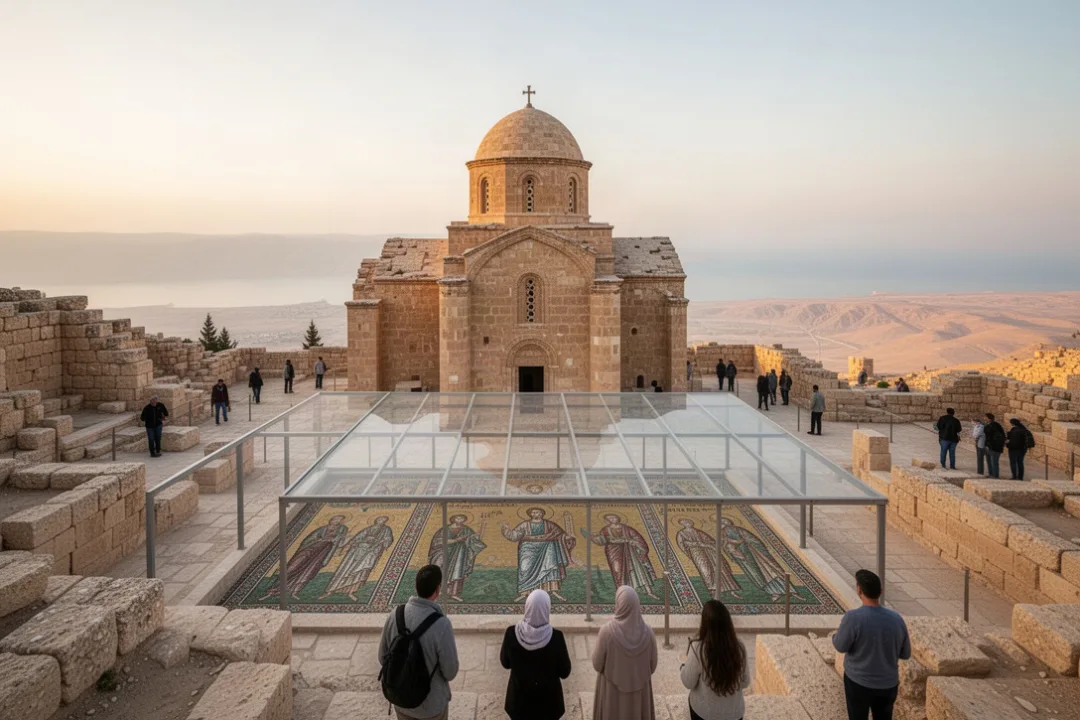
The main visitor area includes the remains of a Christian church and monastic complex. The most prominent structure is the Memorial Church of Moses, also known as the Moses Memorial Church. Its surviving architecture and floor mosaics reveal that the site developed into an important center of Christian worship and pilgrimage.
Much of what you see consists of foundations, low stone walls, columns, and reconstructed sections rather than a complete standing church. The remains are valuable because they show the plan and decoration of a religious complex built and enlarged over time.
Inside or near the church, visitors can view mosaic floors featuring geometric patterns, plants, animals, and scenes associated with daily life. These mosaics are among the site’s most memorable features. Their details also provide evidence about the artistic traditions and social world of the communities that used the complex.
The Memorial Church of Moses
The church is generally dated to the late fourth century in its earliest form, with later additions and renovations during the Byzantine period. Archaeologists and conservation teams have studied the complex over many decades, revealing successive building phases beneath and around the visible remains.
The church’s design reflects the needs of a pilgrimage site. Worshippers could gather in a basilica, while the surrounding monastic buildings supported a religious community. The location also offered symbolic power: pilgrims were visiting a place linked to the last stage of Moses’ life and to a commanding biblical landscape.
Some areas may be protected by modern coverings to shield the mosaics from weather and sunlight. The appearance of the site can change as conservation work continues, so a particular floor or structure may not always be accessible in the same way.
The mosaics are made from small pieces of colored stone and glass set into plaster. Their designs include borders, repeated geometric shapes, vines, birds, animals, and hunting imagery. These subjects were common in late antique mosaic art, and their presence at Mount Nebo shows that religious buildings could contain both sacred and everyday visual themes.
A well-known mosaic includes animals associated with the region, including a giraffe and an elephant. Such images are often discussed in connection with the artistic awareness and trade networks of the period. They also make the floor especially accessible to visitors who may not have a background in archaeology.
Look closely at the workmanship rather than viewing the floor only as a colorful pattern. Individual tesserae vary in shape and color, and the arrangement of small pieces creates outlines, shading, and movement. Even damaged sections can show how carefully the original artists planned the composition.
The Serpentine Cross
Near the lookout stands a large metal cross with a serpent winding around it. The monument is commonly interpreted as a visual reference to the bronze serpent associated with Moses in the biblical Book of Numbers and to the Christian cross.
The sculpture is a modern landmark rather than an ancient ruin. Its position makes it one of the most recognizable images of Mount Nebo, especially when photographed against the Jordan Valley. It also expresses how Christian communities connect different biblical episodes through symbols.
How the landscape explains Mount Nebo’s biblical tradition
The view from Mount Nebo is central to the experience. The ridge rises above the Dead Sea and the Jordan Valley, giving visitors a wide westward perspective over one of the most historically significant landscapes in the region.
On a clear day, you may see the blue-gray surface of the Dead Sea, the Jordan Valley, the hills of the West Bank, and areas associated with Jericho. Depending on atmospheric conditions and visibility, distant highlands may also be visible. Haze, dust, and seasonal weather can reduce the range considerably.
The view is not simply scenic. It helps you understand the narrative geography of the Bible. From this elevated position, the land appears as a connected system of valleys, plateaus, and hills rather than as isolated places on a map.
Mount Nebo’s altitude also changes how the surrounding region feels. The Dead Sea lies far below, while the summit is dry, open, and exposed. The contrast between the high plateau and the deep valley makes the physical setting immediately apparent.
“Moses viewed the land from Mount Nebo before he died.”
This wording is a paraphrase of the account in Deuteronomy 34, not a quotation from a particular Bible translation. The reference is worth reading before your visit because the physical view gives greater meaning to the passage’s description of distance, promise, and separation.
How the site developed after the biblical period
Mount Nebo’s main visible ruins belong to the Christian period rather than the time of Moses. By late antiquity, the mountain had become a place of Christian worship and pilgrimage. Monks and pilgrims were drawn to its association with Moses, while the elevated setting reinforced its spiritual importance.
The church complex was built and expanded over several phases. These changes suggest that the community and the number of visitors grew over time. The monastic settlement likely included spaces for worship, residence, work, and support for travelers.
Archaeological investigation at Mount Nebo became especially significant in the twentieth century. Excavations brought the church remains and mosaics to wider attention, while later conservation helped preserve the fragile floors for public viewing.
The site is cared for by the Franciscan Custody of the Holy Land, which has played a major role in archaeological research, conservation, and visitor access. The complex therefore continues to function as both a religious place and a protected heritage site.
Most visits begin near the archaeological entrance and continue through the church area toward the viewpoint. The route is generally manageable, but the ground can be uneven, and some outdoor sections are exposed to the sun. Allow enough time to move slowly around the mosaics and read any available explanations.
A short visit may take less than an hour, especially if you are traveling with a group. A more useful visit usually takes longer because you will want to examine the church, study the mosaic designs, walk to the lookout, and spend time understanding the relationship between the ruins and the landscape.
The experience changes with the weather. In bright conditions, the valley and Dead Sea may be sharply visible. In hazy conditions, the archaeological remains become the focus, and the distant view may appear as a series of muted ridges.
Mount Nebo is not primarily a hiking destination. Visitors come for the religious history, architecture, mosaics, and viewpoint. If you want an extended walk, ask locally about suitable routes rather than leaving the marked visitor area without guidance.
Practical tips for visiting Mount Nebo
Check opening information before traveling. Hours, entrance arrangements, religious services, and access to individual buildings can change.
Wear shoes with secure soles. Stone surfaces and outdoor paths may be uneven, dusty, or slippery in places.
Bring water and sun protection. Shade can be limited, particularly around the viewpoint and exposed ruins.
Dress respectfully. The site includes an active or historically significant Christian worship setting, so shoulders and knees should generally be covered.
Visit earlier or later in the day when possible. The light can be gentler, temperatures more comfortable, and tour groups less concentrated.
Allow for haze. Do not plan the visit around a guaranteed panoramic view; the weather may conceal distant landmarks.
Protect the mosaics. Follow barriers and instructions, and do not touch or step on protected surfaces.
Pair the visit with Madaba. The city’s religious art and archaeological sites provide useful context for the mosaics at Mount Nebo.
Carry some local currency. Small fees, refreshments, or nearby services may not always accept the payment method you prefer.
Ask before taking photographs indoors. Photography rules can differ between archaeological areas and places used for worship.
Common mistakes to avoid at Mount Nebo
A common mistake is treating Mount Nebo as if it were a confirmed archaeological tomb. The site is strongly connected with Moses through biblical and religious tradition, but no verified grave has been identified there. Using careful language makes the visit more accurate without diminishing its spiritual importance.
Another mistake is rushing past the church to take a photograph at the viewpoint. The mosaics are among the most significant remains on the mountain, and their details reveal more about the site’s later history than the panorama alone.
Visitors sometimes underestimate the sun and wind because the visit is short. The open summit provides little shelter, and temperatures can feel intense even when the air is moving. Water, a hat, and sunscreen are practical necessities rather than optional extras.
Do not assume the distant view will always be clear. Dust and haze are normal in the region.
Do not confuse modern symbols with ancient remains. The Serpentine Cross helps interpret the site but is a modern monument.
Do not walk across restricted areas for a better photograph. Conservation boundaries protect fragile archaeology.
Do not expect a long mountain trek. Mount Nebo is primarily an archaeological and religious site with accessible visitor paths.
Do not ignore local guidance. Staff and guides can explain temporary closures, worship practices, and conservation work.
Best approach: Read Deuteronomy 34 beforehand, then compare the biblical description with the actual terrain. The visit becomes more meaningful when the ruins, symbols, and horizon are considered together.
How Mount Nebo fits into a Jordan itinerary
Mount Nebo works especially well as part of a northern Jordan route. Many travelers visit it from Madaba, a city known for religious sites and mosaic art. Seeing Madaba first can help you recognize the craftsmanship and visual traditions that appear again at the mountain.
The site can also be combined with the Dead Sea. The contrast is striking: Mount Nebo occupies a dry, elevated ridge, while the Dead Sea lies in one of the lowest land areas on Earth. Allow time for the road between these settings, since the change in elevation is part of the experience.
Some itineraries include the Baptism Site on the Jordan River. Its religious significance differs from Mount Nebo’s, but both places are connected to biblical landscapes and Christian pilgrimage. A guide can help explain the traditions associated with each location without treating them as interchangeable.
Travelers with more time may include Mount Nebo on a broader journey through Jordan that also visits Amman, Petra, Wadi Rum, or northern archaeological sites. Because the mountain is relatively close to major routes around Madaba and the Dead Sea, it is often easier to include than a remote destination.
Why the mosaics deserve close attention
The mosaics provide a direct connection to the people who occupied Mount Nebo centuries after the biblical period. They show how a Christian community decorated its sacred spaces and how local materials, artistic conventions, and images from the natural world were combined.
Geometric borders are especially useful for understanding the layout of the church floor. They divide larger scenes into visual sections and lead the eye toward important areas. Repeated patterns also show that the artists worked with a deliberate design system rather than placing each image randomly.
Animal scenes can seem surprising in a religious building, but late antique floors often included a broad range of imagery. At Mount Nebo, these pictures may reflect the wider visual culture of the period as well as the skills of the mosaic workers. They should be viewed as historical evidence, not merely decoration.
Take a moment to compare sections that are complete with those that are damaged or restored. The contrast reveals how vulnerable mosaics are to moisture, foot traffic, weather, and time. Conservation is part of the site’s continuing history.
When to visit Mount Nebo
Mount Nebo can be visited throughout the year, but conditions vary by season. Spring often brings more comfortable temperatures and clearer outdoor walking conditions. Fall can also be pleasant, particularly for travelers combining the mountain with Madaba or the Dead Sea.
Summer visits require more preparation because the exposed ridge can be very hot during the middle of the day. An early visit may be more comfortable and may provide softer light for the landscape and church remains.
Winter can bring cooler temperatures, wind, rain, and occasional changes in access. The mountain is still worthwhile, but bring a layer of clothing and avoid assuming that conditions will match those at the warmer Dead Sea shore.
For photography, morning and late afternoon can produce better shadows across the stone ruins and mosaics. A clear day matters more than a particular season if your main goal is the distant view. Since visibility is unpredictable, treat the panorama as an added benefit rather than the only reason to come.
What Mount Nebo means to different visitors
For Christian pilgrims, Mount Nebo is a place associated with Moses, the Promised Land, and the long history of pilgrimage in the Holy Land. The church and viewpoint invite prayer and reflection, while the biblical tradition gives the landscape a personal and spiritual dimension.
For visitors interested in archaeology, the church complex shows how religious communities developed on the Jordanian plateau during the Byzantine period. The mosaics, architectural remains, and evidence of rebuilding provide a compact example of late antique heritage.
For general travelers, the mountain offers a clear view into how geography, scripture, and history overlap. You do not need to share a particular religious belief to appreciate the site’s importance. Its value lies in the way a real landscape continues to shape memory, worship, art, and travel.
That combination explains Mount Nebo’s lasting appeal. The summit is not important only because of what can be seen from it or what lies beneath its ruins. It is important because generations of people have interpreted the same ridge as a place where a major biblical story reaches its final horizon.
Frequently asked questions
Is Mount Nebo the actual place where Moses died?
Mount Nebo is traditionally identified as the mountain where Moses viewed the Promised Land and died, based on the account in Deuteronomy 34. However, the location is not proven in the modern archaeological sense, and no confirmed tomb has been found there. The site’s importance comes from its longstanding religious tradition and its landscape.
How long should you spend at Mount Nebo?
Plan at least 60 to 90 minutes to see the church ruins, study the mosaics, visit the Serpentine Cross, and spend time at the viewpoint. A quick group stop may be shorter, while travelers interested in archaeology or photography may prefer two hours, especially if the weather is comfortable.
Can you see Jerusalem from Mount Nebo?
Visibility varies greatly with weather, dust, and haze. The view commonly includes the Jordan Valley, the Dead Sea, and hills west of the river. On exceptionally clear days, distant highlands may be visible, but you should not expect to identify Jerusalem reliably from every visit.
Is Mount Nebo suitable for children and older travelers?
Many visitors can manage the main site, since roads reach the archaeological complex and the visit does not require a long hike. However, paths may be uneven, shade is limited, and some areas involve walking over stone surfaces. Comfortable shoes, water, sun protection, and a slower pace make the visit easier.





Leave a Reply