Mount of Olives: history, sites, and visiting guide
Mount of Olives: history, sites, and visiting guide
The Mount of Olives is a historic ridge east of Jerusalem’s Old City, known for its biblical associations, ancient cemetery, churches, and wide views across the city.
From its slopes, you can see the Old City walls, the Temple Mount, the Kidron Valley, and much of Jerusalem’s eastern landscape. The name refers both to the ridge as a whole and, in common travel usage, to the collection of religious and historic sites spread across its slopes.
The Mount of Olives lies on the eastern side of Jerusalem, directly across the Kidron Valley from the Old City. The ridge runs generally from north to south and forms a natural high point above the valley. Its position explains much of its importance: it stands close to Jerusalem while remaining physically distinct from the city’s ancient center.
The western slopes face the Old City and contain many of the best-known Christian and Jewish sites. The eastern side descends toward the towns and villages associated with biblical events, including Bethany, traditionally identified with the modern communities of al-Eizariya and nearby areas.
People sometimes use “Mount of Olives” as if it describes one sharply defined summit. In practice, it is a long ridge with several elevations and neighborhoods. Mount Scopus, farther north, is often treated as a separate landmark, although the wider ridge system is closely connected geographically.
Orientation tip: The Old City is west of the ridge, the Kidron Valley lies between them, and the main Mount of Olives sites are connected by roads and steep walking paths.
Why the Mount of Olives matters in the Bible
The Mount of Olives appears in both the Hebrew Bible and the New Testament, although the emphasis differs among Jewish and Christian traditions. Its location beside Jerusalem made it a place of movement, worship, burial, retreat, and observation rather than an isolated mountain far from the city.
In the Hebrew Bible, the ridge is associated with David’s flight from Jerusalem during Absalom’s rebellion. The account describes David leaving the city and ascending the Mount of Olives in grief. The prophet Zechariah also presents the Mount of Olives in a future vision involving the day of the Lord and the transformation of the mountain.
For Christians, the Mount of Olives is closely linked with the final period of Jesus’ life and ministry in Jerusalem. The New Testament describes Jesus teaching in the area, praying at Gethsemane, entering Jerusalem in a procession associated with Palm Sunday, and ascending to heaven after the resurrection. Different Christian communities interpret and commemorate these events through services, processions, and pilgrimage traditions.
Many Gospel passages mention the Mount of Olives or nearby locations, but the precise identification of every ancient site cannot always be proven archaeologically. A church or chapel may preserve a longstanding tradition even when the exact original location remains uncertain. That distinction helps visitors appreciate both the historical evidence and the role of sacred memory.
How the Mount of Olives connects to Jewish history
The Mount of Olives has been a major Jewish burial ground for centuries. Its significance is tied partly to the ridge’s proximity to Jerusalem and partly to biblical expectations concerning the future redemption and resurrection of the dead. Many Jewish visitors consider burial on the mountain especially meaningful because of the passages associated with the Mount of Olives and the valley below.
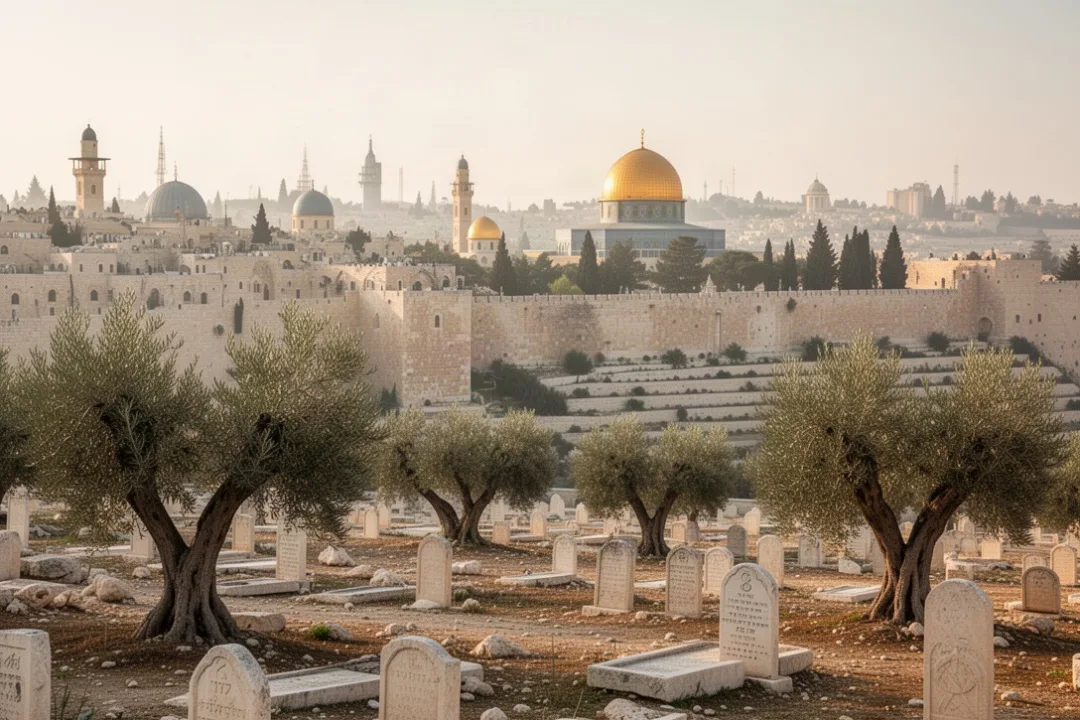
The cemetery stretches across parts of the western and southern slopes. Gravestones vary in age, condition, size, and style, reflecting many periods of Jerusalem’s history. Some are simple slabs; others carry elaborate inscriptions or carved symbols. The density of graves can make the hillside appear almost entirely covered in stone.
Burial on the Mount of Olives was interrupted and damaged during periods of political conflict and changing control of Jerusalem. Tombstones were sometimes broken, removed, or reused, and access to portions of the cemetery was restricted at different times. Later efforts restored some areas, while other sections remain uneven or visibly weathered.
The cemetery is not simply an archaeological display. It remains an active place of mourning, prayer, visitation, and burial. Visitors should therefore behave with the same care they would show at a functioning cemetery: keep voices low, stay on public paths, do not touch graves, and follow instructions from caretakers.
What Christians traditionally visit on the Mount of Olives
The western and southern slopes contain several churches and chapels connected with events in the life of Jesus. They belong to different Christian denominations and religious communities, so opening hours, services, photography rules, and access arrangements may vary.
Garden of Gethsemane and the Church of All Nations
At the foot of the Mount of Olives, beside the Kidron Valley, lies the Garden of Gethsemane. Christian tradition identifies it as the place where Jesus prayed before his arrest. The garden contains ancient-looking olive trees, although dating individual trees with certainty is difficult and the trees may not all have survived continuously from the first century.
The nearby Church of All Nations, also called the Basilica of the Agony, is recognized for its dark interior, rich mosaics, and reverent atmosphere. Its design emphasizes the sadness of Jesus’ prayer before the crucifixion. Visitors often enter quietly, even when the surrounding road and tour groups are busy.
Dominus Flevit
Higher on the slope, the small church of Dominus Flevit commemorates Jesus’ weeping over Jerusalem. Its name comes from Latin and means “the Lord wept.” The building is especially known for a window that frames a view toward the Old City and the Temple Mount.
The site combines religious symbolism with an unusually clear urban panorama. From here, the relationship between the ancient city, the valley, and the ridge becomes easy to understand. The church’s shape and window design turn the view itself into part of the visitor experience.
Church of Pater Noster
The Church of Pater Noster stands on a site associated with Jesus’ teaching, particularly the Lord’s Prayer. Its walls and grounds are known for displays of the prayer in many languages. The tradition connects the location with a period when Jesus taught his disciples on the Mount of Olives.
The site is valuable to visitors interested in the history of Christian devotion and language. The displays show how a central Christian prayer has been translated and used by communities around the world, although the building and its decorations represent later periods rather than a preserved first-century structure.
Chapel of the Ascension
Near the summit is the Chapel of the Ascension, associated with the Christian belief that Jesus ascended into heaven. The small stone building has an unusual history: it was originally a Christian sanctuary, but its present administration reflects later Islamic control of the site. Christian pilgrims continue to visit and pray there.
The chapel’s relatively plain exterior can surprise visitors expecting a large church. Its importance comes primarily from the tradition connected with the location. As with several holy places in Jerusalem, the meaning of the site is shaped by centuries of worship, pilgrimage, architecture, and changing political authority.
Russian Orthodox and other religious sites
The Mount of Olives also includes churches, convents, monasteries, and properties belonging to several Orthodox traditions. The Church of Mary Magdalene, recognizable by its golden domes, is one of the most prominent landmarks on the western slope. Access may be limited, and some religious compounds open only at particular times.
There are also sites associated with the Tomb of the Prophets, ancient burial traditions, and smaller chapels. Not every place is open to casual visitors, and names may appear differently on maps or in guidebooks. Checking current information locally is more reliable than assuming that every marked site operates like a public museum.
What the view from the Mount of Olives shows you
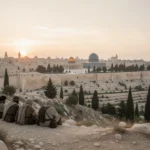
The ridge offers one of the clearest perspectives on Jerusalem’s historic core. Looking west, you can see the Old City walls, the Temple Mount, the Dome of the Rock, and the Al-Aqsa Mosque compound. The view changes with weather, light, and access points, so different terraces and church grounds reveal slightly different angles.
The Kidron Valley below provides a visual boundary between the ridge and the Old City. Beyond it, the eastern walls rise toward the Temple Mount. This landscape helps explain why ancient travelers could approach Jerusalem from the east while still seeing the city as a distinct fortified center.
From the higher points, the panorama extends toward the Judean Desert and the hills east of Jerusalem. In clear weather, the landscape appears dry and open, contrasting with the dense stone buildings of the city. Morning light can be particularly clear, while late afternoon often gives the limestone a warmer color.
Photography is permitted in many outdoor areas, but a good photograph should never take priority over religious observance or cemetery etiquette. Avoid climbing walls, leaning on graves, blocking narrow paths, or using a drone without confirming that it is allowed. Jerusalem has sensitive security and airspace rules.
How to visit the Mount of Olives responsibly
A visit can take a few hours or most of a day, depending on how many churches and cemetery areas you enter. The ridge is not a single attraction with one ticket office. It is a network of religious sites, roads, viewpoints, and residential areas with different operators and access rules.
A west-to-east route generally works well for visitors who want to walk downhill. You can begin near the summit, visit the upper churches, and then descend toward Dominus Flevit, Gethsemane, and the Kidron Valley. The reverse route is much steeper and can be tiring, especially in hot weather.
Check opening times first. Churches may close between services, observe denomination-specific schedules, or restrict entry on religious holidays.
Choose appropriate clothing. Shoulders and knees should generally be covered inside churches and religious compounds.
Wear stable shoes. Pavements, steps, and paths can be uneven, particularly around the cemetery and valley.
Carry water and sun protection. The ridge has exposed sections, and shade may be limited during the middle of the day.
Allow extra time for security and traffic. Roads can be crowded, and access may change during ceremonies or public events.
Public transportation and taxis can reach parts of the ridge, but routes and availability change. A taxi may be helpful for reaching the summit before walking downhill. If you hire a driver, agree on the route and waiting arrangements in advance rather than assuming that every site is immediately accessible by car.
Accessibility warning: The Mount of Olives is challenging for many visitors with limited mobility because of steep slopes, steps, narrow paths, and uneven ground. Confirm accessible entrances and transport options before setting out.
Common mistakes visitors make on the Mount of Olives
The ridge looks compact on a map, but walking distances can feel longer because of steep gradients and the separation between compounds. Visitors who plan only by landmark names may also miss the fact that several sites close at midday or sit behind gates away from the main road.
Trying to see everything in one rushed walk: Select a few priority sites and leave time for prayer, views, and unexpected closures.
Assuming every church is open every day: Denominational schedules can differ, and a service may temporarily limit entry.
Treating the cemetery as a photo backdrop: It is a living sacred place, not merely an old field of monuments.
Ignoring the downhill route: The steep descent can be harder than expected, particularly on hot days or worn stone steps.
Expecting one historical interpretation: Some locations are supported by archaeology, while others rest mainly on longstanding religious tradition.
Entering private or restricted areas: Respect signs, gates, guards, caretakers, and residents.
Visiting without checking the wider situation: Local access, security conditions, and transport can change quickly.
Hiring a knowledgeable local guide can help with orientation and context, especially if you want to understand the relationship among Jewish, Christian, and Muslim traditions. A guide should explain which statements are established historical evidence and which are devotional interpretations. That distinction makes the visit more respectful, not less meaningful.
How to understand history, tradition, and archaeology together
Jerusalem’s sacred sites rarely fit into a simple category such as “proven” or “unproven.” Archaeology can identify ancient roads, tombs, building phases, pottery, and settlement patterns. It cannot always demonstrate that a particular room or tree was the exact place named in a religious narrative.
Many Mount of Olives sites developed through layers of memory. A location may have been revered for centuries, marked by a church in one period, damaged or abandoned in another, and rebuilt later. The current building may therefore be much newer than the event it commemorates.
Several locations also reflect the city’s changing communities and rulers. Christian, Jewish, and Muslim traditions overlap across the ridge, sometimes sharing a landscape while assigning different meanings to it. The Chapel of the Ascension is a clear example of a place whose present administration and historical associations belong to different stages of Jerusalem’s past.
“The Mount of Olives” is best understood as a sacred landscape, not just one isolated summit.
That perspective helps explain why pilgrims, historians, archaeologists, photographers, and local residents may experience the same hillside differently. A visitor can value the religious tradition, examine the physical evidence, and recognize the limits of certainty at the same time.
When to go and what to expect from the weather
Spring and fall are often comfortable seasons for walking in Jerusalem, though conditions can change quickly. Summer days are usually hot and bright, with limited shade on exposed slopes. Winter can bring cool temperatures, rain, and slippery surfaces, but clear days may provide excellent visibility.
Early morning is useful for cooler walking and quieter views. Late afternoon can provide attractive light across the Old City, but make sure you have enough time to descend before darkness. Religious services, holidays, and pilgrimage groups may affect crowd levels more than the day of the week alone.
Plan for a visit that is slower than a normal city walk. You may pause at a viewpoint, wait for a church to open, or take a longer route around a restricted compound. Comfortable shoes, modest clothing, water, and a flexible schedule are more useful than trying to follow a rigid timetable.
How the Mount of Olives fits into a Jerusalem itinerary
The Mount of Olives pairs naturally with the Old City because the two are separated by only the Kidron Valley. Some visitors begin at the ridge and walk down toward the Old City, while others visit the Old City first and cross the valley later. The best order depends on your energy, opening times, and transport plan.
A thoughtful route might include the summit and its churches, a viewpoint over the Old City, the Jewish cemetery, Dominus Flevit, Gethsemane, and the Church of All Nations. You do not need to enter every site to understand the ridge. Several of the most meaningful connections become clear simply by observing how the roads, valley, walls, and slopes fit together.
Give yourself time to pause at the landscape rather than moving only from building to building. The Mount of Olives has served as a place of prayer, burial, teaching, procession, mourning, and remembrance. Its significance comes from the combination of those uses across centuries.
Why the Mount of Olives remains significant
The Mount of Olives remains one of Jerusalem’s most important sacred landscapes because religious tradition, living communities, and visible history meet in one place. Its cemetery continues to receive visitors and burials, its churches continue to host worship, and its roads remain part of everyday Jerusalem.
For Jewish visitors, the ridge carries deep associations with burial, redemption, and the history of Jerusalem. For Christians, it recalls prayer, teaching, the final days of Jesus, and the Ascension. For historians and travelers, it offers a concentrated view of how geography and memory shape a city.
Approached with patience and respect, the Mount of Olives offers more than a scenic overlook. It shows how a hillside beside an ancient city can preserve competing memories, active faith, archaeological questions, and ordinary local life all at once.
Frequently asked questions
Is the Mount of Olives inside Jerusalem’s Old City?
No. The Mount of Olives is east of the Old City, with the Kidron Valley between them. It is part of greater Jerusalem but lies outside the Old City walls. The ridge is close enough to combine with an Old City visit, although the steep terrain and separate sites mean you should allow several hours rather than treating it as a quick side trip.
Can you walk from the Old City to the Mount of Olives?
Yes, many visitors walk from the Old City through or beside the Kidron Valley and up the western slope. The route involves steep sections and uneven surfaces, so it can be demanding in warm weather. A taxi to the upper ridge followed by a downhill walk is often less strenuous than walking uphill from the Old City.
What should women and men wear when visiting the Mount of Olives?
Modest clothing is the safest choice because the area contains churches, chapels, monasteries, and a cemetery. Cover your shoulders and knees when entering religious buildings, and carry a light layer or scarf for flexibility. Individual sites may apply their own rules, so follow posted guidance or instructions from staff.
Are the Mount of Olives churches open to tourists?
Many are open to visitors, but none should be assumed to operate on a standard tourist schedule. Churches may close for worship, midday breaks, holidays, or community events. Check current hours before traveling, and expect some sites to restrict photography or access to certain rooms even when the main grounds are open.





Leave a Reply