Samaria: history, geography, and biblical significance
Samaria: history, geography, and biblical significance
Samaria was the central hill country of ancient Israel and the name of its capital, kingdom, and people. Its history connects the divided kingdoms of Israel and Judah, the Assyrian conquest, the Samaritan community, and several important accounts in the Bible.
The word Samaria can describe more than one place or idea. It first referred to a city built as the capital of the northern kingdom of Israel. Over time, the name also came to mean the surrounding region and, in some contexts, the people associated with it.
The city of Samaria stood in the central highlands, roughly between Galilee to the north and Judea to the south. The wider region included fertile valleys, rocky ridges, and important routes linking the Mediterranean coast with the Jordan Valley. Its location gave it both agricultural value and strategic importance.
In the New Testament period, Samaritans formed a distinct religious and ethnic community. They shared some traditions and scriptures with the Jews but differed over worship, ancestry, and the proper place of the sanctuary. These differences help explain why biblical references often describe tension between Jews and Samaritans.
Essential distinction: Samaria was a city, a region, and the former northern kingdom’s political center. A Samaritan was a member of the distinct community that preserved its own religious traditions.
Where ancient Samaria was located
Ancient Samaria occupied the central part of the land west of the Jordan River. The city itself was built on a prominent hill in the hill country, a position that allowed rulers to oversee surrounding farmland and defend the capital from some approaches.
The ancient city is generally identified with Samaria-Sebaste, near the modern Palestinian town of Sebastia in the northern West Bank. The name Sebaste came later, after the city was rebuilt and renamed during the Roman period. Archaeological remains at the site include traces from Israelite, Assyrian, Hellenistic, Roman, and Byzantine periods.
The region’s geography shaped its history. The highlands were not as open as the coastal plain, but they provided defensible settlements and productive agricultural land. Hills and valleys also created separate local communities, while major roads made the area a natural corridor for armies, traders, and pilgrims.
North: The region bordered Galilee and the Jezreel Valley.
South: It extended toward the hill country of Judah and Jerusalem.
West: Routes led toward the coastal plain and Mediterranean ports.
East: The land descended toward the Jordan Valley and territories beyond the river.
Modern references to Samaria may be geographic, biblical, political, or religious. When reading a particular passage, the surrounding context matters: the term may mean the old kingdom, a district, a city, or the Samaritan population.
How Samaria became the capital of the northern kingdom
After the reign of Solomon, the united monarchy divided into two kingdoms. The northern kingdom retained the name Israel, while the southern kingdom became known as Judah. Jerusalem remained Judah’s capital, but the northern kingdom had several important centers before Samaria was established.
According to 1 Kings 16, King Omri bought a hill from Shemer and built a city there. He named it Samaria, probably reflecting the name of the previous owner. The site became the political capital of the northern kingdom and remained central to Israelite royal power for generations.
Samaria’s location gave the northern kingdom a more defensible royal center than some earlier settlements. Omri and his successors also pursued regional diplomacy and military expansion. The biblical record and archaeological evidence both indicate that the kingdom became a significant power in the Levant during this period.
The Omride dynasty, including Omri, Ahab, and their successors, is associated with major building projects and international relationships. Ahab’s marriage to Jezebel, daughter of the king of Sidon, reflects the kingdom’s ties with Phoenicia. Biblical writers strongly criticized the religious practices associated with the royal court, especially devotion to Baal alongside or against worship of the God of Israel.
How the kingdom of Israel differed from Judah
The northern kingdom and Judah shared Israelite heritage, but they developed separate political and religious identities. Their rulers sometimes fought one another and sometimes cooperated against larger threats such as Aram-Damascus and Assyria.
The biblical books of Kings and Chronicles present the division through a theological lens. They evaluate rulers according to faithfulness to the God of Israel and frequently condemn northern royal shrines at Bethel and Dan. These accounts should be read as religious history as well as records of political events.
Samaria’s rulers controlled a kingdom with its own administration, army, dynasties, and foreign policy. The capital became a symbol of northern independence. At the same time, the city was repeatedly criticized by prophets for injustice, wealth concentrated among elites, exploitation of the poor, and religious unfaithfulness.
Prophets such as Amos, Hosea, Isaiah, and Micah addressed Samaria or the northern kingdom in warnings and accusations. Their messages often joined social injustice and religious corruption: rituals could not compensate for oppression, dishonest trade, or abuse of vulnerable people.
How Assyria conquered Samaria
The Assyrian Empire expanded westward during the eighth century BCE. The northern kingdom became caught between Assyrian demands for tribute, local rebellions, and shifting alliances with neighboring states.
Samaria fell after a prolonged Assyrian campaign. Biblical accounts connect the end of the kingdom with the reign of Hoshea and the Assyrian ruler Shalmaneser V, followed by the completion of the conquest under Sargon II. The fall is commonly dated to about 722 or 721 BCE.
Assyrian imperial policy included deporting portions of conquered populations and resettling people from other regions. Biblical passages such as 2 Kings 17 describe this process and interpret the fall as the result of Israel’s persistent disobedience. Assyrian royal inscriptions also record the conquest and deportation connected with Samaria, although ancient records naturally present events from the empire’s perspective.
The conquest ended the northern kingdom as an independent Israelite state. Judah survived for more than a century afterward, though it remained under changing degrees of Assyrian, Egyptian, Babylonian, and Persian influence.
Why the date matters: The fall of Samaria did not mean that every person in the northern kingdom disappeared. Conquest, deportation, migration, and resettlement produced a complicated population history rather than a single moment of total replacement.
What happened to Samaria after the Assyrian conquest
After the kingdom fell, the area continued to be inhabited and governed. It passed through several imperial systems, including Assyrian, Babylonian, Persian, Hellenistic, and Roman rule. The city remained important even though it no longer served as the capital of an independent Israelite kingdom.
The population history of the region became a subject of dispute. The Bible describes foreign groups being settled in the former kingdom, while later Jewish and Samaritan traditions preserved different accounts of ancestry and religious legitimacy. Modern historians generally treat the population as mixed and changing rather than reducing it to one simple origin story.
Under Persian rule, communities in Samaria interacted with the returning Judean community and the restored temple in Jerusalem. Relations were sometimes cooperative and sometimes hostile. The books of Ezra and Nehemiah describe disputes involving local groups, political authority, intermarriage, and the rebuilding of Jerusalem’s walls and temple.
In the Hellenistic period, Samaria was affected by the rival empires that followed Alexander the Great. Greek political culture and administrative practices influenced the region, while local religious identities continued to develop. The city was later damaged during conflicts involving the Hasmonean state.
The Hasmonean ruler John Hyrcanus captured Samaria in the late second century BCE. Ancient accounts associate this period with the destruction or severe damage of the temple on Mount Gerizim, a central Samaritan sanctuary. The event deepened an already serious divide between Judeans and Samaritans.
Who the Samaritans were
The Samaritans were a community with its own religious tradition, sacred texts, priestly lineage, and place of worship. They regarded Mount Gerizim, near Shechem, as the chosen holy mountain. Jewish tradition instead centered worship on the temple in Jerusalem.
Samaritan tradition accepts the Torah, or the first five books of the Hebrew Bible, as its foundational scripture. The Samaritan version is known as the Samaritan Pentateuch. It resembles the Jewish Torah in many passages but contains textual differences, including readings that support the importance of Mount Gerizim.
The Samaritans also preserved their own account of their origins and religious continuity. They generally identify themselves as descendants of ancient Israelites connected especially with the northern tribes, while Jewish sources often emphasized foreign settlement and religious mixture after the Assyrian conquest.
These competing identities were not merely academic. They affected marriage, worship, political loyalty, access to sacred places, and everyday relations. By the time of Jesus, Jews and Samaritans shared some beliefs but commonly regarded one another with suspicion.
Shared heritage: Both communities traced their faith to the ancient people of Israel.
Shared scripture: Both centered religious life on the Torah, though their textual traditions differed.
Different sanctuary: Samaritans honored Mount Gerizim, while Jews worshiped at Jerusalem.
Separate identity: Each community maintained distinct traditions, leaders, and claims about religious legitimacy.
Why Mount Gerizim mattered to the Samaritans
Mount Gerizim rises near the ancient city of Shechem, an important center in the hill country. For Samaritans, it was the place chosen by God for worship. The mountain’s significance appears in the Gospel of John, where a Samaritan woman discusses the proper location of worship with Jesus.
In John 4, Jesus responds to the dispute by emphasizing worship connected with spirit and truth rather than treating the argument as a simple contest between mountains. The passage does not erase the historical disagreement, but it places the encounter within a broader discussion of revelation, identity, and the scope of salvation.
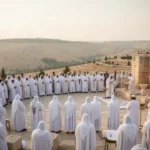
Mount Gerizim remains significant to the Samaritan community today. Samaritan observances connected with Passover are held there, and the mountain continues to serve as a visible center of communal identity. The modern Samaritan population is small, but its traditions have survived across many centuries.
How Samaria appears in the Hebrew Bible
Samaria appears throughout the historical and prophetic books of the Hebrew Bible. Its role changes depending on the passage: it can represent the royal court, the northern kingdom, the region’s people, or the consequences of political and religious failure.
In 1 Kings, Samaria is the capital from which northern kings rule. The accounts of Ahab and Jezebel place the city at the center of conflicts involving prophets, royal power, and Baal worship. The story of Naboth’s vineyard in 1 Kings 21 uses the royal court’s abuse of power to expose the moral failures of the monarchy.
In 2 Kings, Samaria is associated with war, siege, political instability, and eventual conquest. The fall of the city marks the collapse of the northern kingdom. The account also explains the theological interpretation that became influential in later Jewish history: the kingdom’s defeat followed long-term covenant disobedience.
The prophets often use Samaria as a symbol of national arrogance and economic inequality. Amos criticizes affluent people who live comfortably while the poor are mistreated. Hosea describes the northern kingdom’s unfaithfulness through powerful family and marriage imagery. Isaiah and Micah also address Samaria’s political and moral condition.
How Samaria appears in the New Testament
Samaria appears in the Gospels and Acts as a real region populated by a distinct community. The New Testament references reflect the long-standing division between Jews and Samaritans, but they also show that the boundary was not absolute: people traveled through the region, traded with its inhabitants, and interacted with them.
In Luke 9, a Samaritan village refuses to welcome Jesus because he is traveling toward Jerusalem. The disciples respond with hostility, but Jesus rebukes their desire for punishment. The episode presents rejection and prejudice as a spiritual test rather than permission for retaliation.
Luke 10 tells the parable commonly called the Good Samaritan. A Samaritan becomes the compassionate neighbor in a story about caring for an injured man. The choice of a Samaritan is significant because it challenges the listener to recognize moral action from someone regarded as an outsider or religious rival.
In John 4, Jesus speaks with a Samaritan woman near a well. Their conversation addresses social boundaries, worship, messianic expectation, and the woman’s role as a witness to her community. The passage gives a Samaritan woman an unusually prominent place in the Gospel narrative.
Acts 1 and Acts 8 describe the Christian message reaching Samaria. Philip preaches in the region, and many people respond. This movement from Jerusalem into Samaria fits the geographic expansion Jesus outlines in Acts 1:8, where Samaria stands between the Jewish center and the wider Gentile mission.
The phrase Good Samaritan comes from Luke 10. It now commonly describes someone who helps a stranger in need, especially after an accident or emergency. The expression retains the parable’s central reversal: the person treated as an outsider becomes the example of neighborly compassion.
In the parable, the Samaritan does more than feel sympathy. He approaches the injured man, treats his wounds, transports him to shelter, and promises to cover additional expenses. The story defines neighbor love through concrete action rather than shared nationality, religious group, or social status.
Many U.S. states also use the phrase “Good Samaritan law” for legal protections that may apply when a person voluntarily gives emergency aid. The details differ by state, and these laws can contain exceptions. Anyone seeking legal advice should check the law in the relevant state rather than relying on the biblical phrase alone.
How to study Samaria in a biblical passage
Because Samaria can refer to several things, a careful reading begins with the passage’s setting and purpose. The same word may describe a capital city in one chapter, a political kingdom in another, and a religious community in a Gospel account.
Identify the time period. Ask whether the passage concerns the divided monarchy, the Assyrian conquest, the Persian era, the New Testament, or a later period.
Identify the meaning of the name. Determine whether Samaria refers to the city, the surrounding region, the former kingdom, or its people.
Check the neighboring locations. References to Jerusalem, Galilee, Judea, Shechem, Mount Gerizim, or the Jordan can clarify the setting.
Look for the main conflict. The issue may involve kingship, worship, ethnic identity, political loyalty, or treatment of outsiders.
Read the passage’s moral emphasis. Biblical writers often connect Samaria with questions about justice, faithfulness, compassion, and the consequences of power.
It also helps to avoid treating “Samaritan” as a generic insult or assuming that every biblical reference has the same tone. Some passages present Samaria as a rebellious kingdom, while others highlight Samaritan faith, generosity, or openness to a message.
How Samaria’s history still matters
Samaria matters because it shows how geography, political power, religious identity, and memory shape one another. A capital city became the name of a kingdom; the kingdom’s fall produced new population patterns; and those patterns contributed to a lasting divide between communities that still shared important traditions.
The history also warns against oversimplified accounts of ancient peoples. The Assyrian conquest involved both destruction and resettlement. The Samaritan community cannot be explained by a single sentence about foreign colonists, nor can the relationship between Jews and Samaritans be reduced to simple hatred.
For biblical readers, Samaria provides a setting for major themes: the danger of unjust leadership, the limits of religious pride, the consequences of imperial violence, and the possibility of compassion across social boundaries. Its significance is historical, geographic, theological, and human.
The ancient city declined after later political changes, but the name continued through the region and its people. Archaeological remains, biblical texts, Samaritan traditions, and modern communities each preserve part of Samaria’s story. Taken together, they show why this central highland region remains one of the most significant places in the history of the biblical world.
Frequently asked questions
Is Samaria the same as Israel?
Not exactly. Samaria was the capital of the northern kingdom, which was commonly called Israel after the united monarchy divided. The name later referred to the surrounding region as well. “Israel” can also describe the broader ancient people, the modern State of Israel, or several different biblical entities, so the exact meaning depends on context.
Are Samaritans Jewish?
Samaritans and Jews share ancient Israelite roots and both preserve the Torah, but they are distinct religious communities. Samaritans follow their own priestly tradition, version of the Pentateuch, and worship centered on Mount Gerizim. Jewish tradition centers worship on Jerusalem. Samaritans continue to maintain a separate communal identity today.
Where was Jesus’ Samaria located?
Jesus’ Samaria was the central hill-country region between Galilee and Judea, west of the Jordan River. It included the area around ancient Shechem and Mount Gerizim, as well as the former capital city of Samaria. The region’s location explains why travelers between Galilee and Jerusalem sometimes passed through it.
Why did Jews and Samaritans have tension?
Their conflict involved several overlapping issues: ancestry, political history, religious authority, the correct place of worship, and the aftermath of conquest and resettlement. Each community preserved a different account of Israel’s history and religious legitimacy. By the first century, those disputes had produced strong social boundaries, even though contact still occurred.








Leave a Reply