Jeroboam explained: the biblical kings and wine bottle
Jeroboam explained: the biblical kings and wine bottle
If you have seen Jeroboam in a Bible passage or on a wine list, you may wonder whether the word refers to a person, a bottle, or both. The answer depends entirely on the context: Jeroboam is the name of two kings of ancient Israel and also a traditional name for a large-format wine bottle.
The biblical name is usually connected with the divided monarchy after the reign of Solomon. The wine term belongs to a naming tradition that uses names from the Bible for unusually large bottles. Because bottle sizes vary by region and wine style, a Jeroboam does not always hold the same amount.
Jeroboam is the English form of a Hebrew royal name. Its exact meaning is not completely certain, but it is commonly connected with ideas such as “the people contend” or “the people increase.” The name appears in the historical books of the Hebrew Bible, especially 1 Kings and 2 Kings.
Two different rulers carried the name. Jeroboam I founded the northern kingdom of Israel after the united kingdom split, while Jeroboam II ruled that same kingdom generations later. They were not father and son, and the second king inherited the name rather than the throne directly from the first.
The easiest way to tell them apart is by their position in Israel’s history:
Jeroboam I ruled soon after Solomon and led the northern tribes away from the house of David.
Jeroboam II ruled much later, during a period of territorial expansion and economic prosperity in Israel.
Both are judged negatively in the biblical books because the northern kingdom continued religious practices associated with Jeroboam I.
The phrase “the sin of Jeroboam” appears repeatedly in the biblical account of Israel’s kings. It does not usually mean that every later king repeated every action of Jeroboam I. Instead, it refers mainly to the continuing worship system established at Bethel and Dan, which the biblical writers present as a serious departure from worship centered in Jerusalem.
Quick distinction: In a biblical passage, Jeroboam is a king’s name. On a wine menu, a Jeroboam is a large bottle, although the bottle’s capacity depends on the region and type of wine.
Who Jeroboam I was and why he became king
Jeroboam I first appears during the reign of Solomon. According to 1 Kings, he was the son of Nebat from the town of Zeredah in the hill country of Ephraim. The text describes him as capable and industrious, and Solomon placed him in charge of forced labor from the tribes descended from Joseph.
That position gave Jeroboam influence among the northern tribes. Solomon’s large building projects brought prestige to the kingdom, but they also required heavy taxation and compulsory labor. The biblical narrative presents Jeroboam as a figure who came to represent northern resistance to the royal policies of Jerusalem.
The prophet Ahijah of Shiloh then met Jeroboam and used a torn garment as a symbolic message. The prophet tore the garment into pieces and gave Jeroboam ten pieces, representing the ten northern tribes that would be separated from Solomon’s successor. The story links this division to Solomon’s unfaithfulness and to the burdens placed on the people.
Jeroboam fled to Egypt after Solomon sought to kill him. He remained there until Solomon died. When Solomon’s son Rehoboam became king, the northern tribes invited Jeroboam to take part in negotiations about the kingdom’s future.
How the kingdom split under Rehoboam
The people asked Rehoboam to reduce the labor demands and taxes imposed under Solomon. Older advisers urged him to respond with service and moderation, but younger advisers encouraged a harsher answer. Rehoboam followed the latter advice and threatened to increase the people’s burdens.
That response triggered the political division. The northern tribes rejected the house of David and made Jeroboam their king. The southern kingdom, centered on Jerusalem and ruled by Rehoboam, became associated primarily with Judah, while the northern kingdom retained the name Israel.
The split was not simply a religious disagreement. It involved regional identity, royal authority, taxation, labor, and access to political power. The biblical account, however, interprets the event through both political and religious causes. It presents the division as permitted within a larger divine judgment on Solomon’s rule.
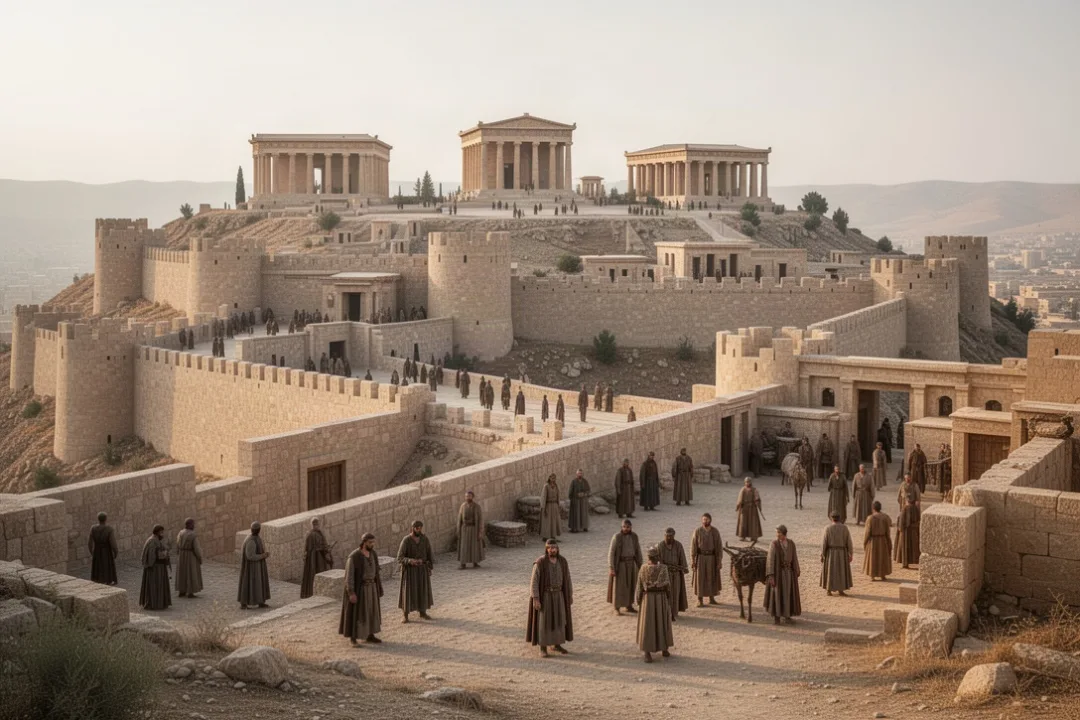
Jeroboam established important centers at Shechem and later Penuel. Shechem had deep historical significance in the central hill country, and its location helped give the new kingdom a political center separate from Jerusalem.
Why Jeroboam I established worship centers at Bethel and Dan
Jeroboam faced a practical political problem. Jerusalem, the main sanctuary of the Davidic kingdom, remained in the southern territory. If his subjects continued to travel there for major religious festivals, he feared that their loyalty might gradually return to Rehoboam.
To strengthen the northern kingdom, Jeroboam established worship centers at Bethel in the south and Dan in the north. The biblical account says he placed golden calf images at both sites and presented them as places where Israel could worship. This arrangement gave people accessible alternatives to Jerusalem.
From Jeroboam’s political perspective, the locations created a religious network that matched the geography of the new kingdom. From the perspective of the biblical writers, however, the decision was a grave error. The problem was not only the use of images. It was also the creation of an alternative national worship system outside the Jerusalem-centered order associated with the temple and the Davidic monarchy.
Jeroboam also appointed priests who were not limited to the traditional Levitical priesthood and set a festival date that differed from the major festival calendar associated with Judah. These changes helped the northern kingdom function independently, but they also made the religious break permanent.
That is why later accounts repeatedly describe a king as walking in “the way of Jeroboam”. The phrase points to the institutions he created, particularly the shrines at Bethel and Dan. Even when a later king avoided some other forms of wrongdoing, the biblical writers often treated the continuation of this system as a fundamental failure.
The story of Jeroboam’s altar at Bethel in 1 Kings 13 reinforces this judgment. A man of God announces that a future ruler named Josiah will act against the altar. The passage belongs to the biblical narrative’s prophetic interpretation of northern worship; it should not be read as a neutral administrative record of the kingdom’s religious policy.
Historical lens: Jeroboam’s religious reforms can be understood as a way to secure the new northern state. The biblical books evaluate those reforms from the standpoint of loyalty to Jerusalem, the temple, and Israel’s covenant traditions.
What happened to Jeroboam I and how he is remembered
Jeroboam I ruled the northern kingdom for roughly two decades, although ancient dates are reconstructed and may vary depending on the chronology used. His reign was marked by conflict with Judah, the challenge of governing a newly independent state, and the effort to create institutions that could rival those of Jerusalem.
The biblical narrative does not give a long account of his final years. It records that he died and that his son Nadab succeeded him. Nadab’s reign was brief. He was killed by Baasha, who then took the throne and eliminated Jeroboam’s remaining royal line.
Jeroboam’s legacy in the biblical books is therefore more than the story of a successful revolt. He is remembered as the king who made political separation durable through religious separation. By establishing sanctuaries that competed with Jerusalem, he created a pattern that later northern rulers inherited.
The phrase “the sin of Jeroboam” also shows how biblical writers explain national decline. Rather than blaming each king’s failure only on personal character or military weakness, they identify an institutional decision at the beginning of the northern monarchy. That decision becomes a recurring measure against which later kings are judged.
At the same time, readers should distinguish biblical theology from every detail of political history. The books of Kings are not modern biographies. They select events and interpret them to explain why Israel and Judah eventually experienced conquest, exile, and the loss of their monarchies.
Who Jeroboam II was and how he differed from Jeroboam I
Jeroboam II ruled the northern kingdom of Israel much later, during the eighth century BCE. He was the son of Joash, also called Jehoash, and belonged to the dynasty founded by Jehu. He should not be confused with Jeroboam I, even though the biblical books often use the same royal name.
Jeroboam II came to power after a period when Israel had been weakened by pressure from neighboring Aramean kingdoms. The biblical account says that he restored Israel’s borders, and the prophet Jonah son of Amittai is associated with this period. The expansion brought Israel greater strength and influence.
His reign is described in 2 Kings as politically successful. The kingdom recovered territory in the north and east, and the capital Samaria became the center of a prosperous state. Archaeological evidence from the wider period, including monumental construction and luxury goods, is consistent with a time when at least parts of the northern elite accumulated substantial wealth.
Prosperity did not reach everyone equally. The prophets Amos and Hosea spoke during or near this era and condemned exploitation, corruption, dishonest commerce, social inequality, and religious unfaithfulness. Their messages suggest that economic growth could coexist with severe hardship for farmers, debtors, and other vulnerable people.
Why the second Jeroboam is still judged negatively
Jeroboam II was a capable political ruler, but the biblical evaluation remains unfavorable. Like the kings before him, he is said to have continued the sins of Jeroboam son of Nebat. This formula refers to the northern worship centers and does not mean that the two men were equally successful as rulers.
The distinction matters because the Bible can describe a king as militarily effective while still judging his reign as religiously wrong. Political success and moral approval are separate categories in the narrative. Jeroboam II expanded the kingdom, but he did not remove the institutions that earlier writers believed had led Israel away from proper worship.
Jeroboam II died after a long reign, and his son Zechariah succeeded him. Zechariah ruled for only a short time before being assassinated by Shallum. His death ended the dynasty of Jehu, fulfilling the biblical account’s earlier limit on that family’s rule.
Jeroboam II is especially important for understanding the setting of the prophetic books. The warnings of Amos and Hosea are not abstract comments about religion. They address a society in which national power and personal wealth could conceal unfair courts, land loss, forced dependence, and neglected obligations to the poor.
What a Jeroboam bottle is and how large it can be
In the wine world, a Jeroboam is a large-format bottle named as part of a broader tradition of using biblical names for oversized vessels. A standard wine bottle holds 750 milliliters, but the capacity of a Jeroboam depends on the wine region and the style being bottled.
For many sparkling wines, especially Champagne, a Jeroboam holds 3 liters. That equals four standard 750-milliliter bottles. A 3-liter bottle is large enough for a substantial gathering, but it is still more manageable than the much larger formats used for major celebrations or extended aging.
For some still wines, especially in Bordeaux-related usage, Jeroboam can refer to a 4.5-liter bottle. That equals six standard bottles. In other wine regions, the same name may be used differently, which is why the stated volume on a retailer’s listing or producer’s label matters more than the name alone.
The common capacities can be expressed this way:
3-liter Jeroboam: four standard 750-milliliter bottles.
4.5-liter Jeroboam: six standard 750-milliliter bottles.
6-liter bottle: often called an Imperial for some still wines or a Methuselah for some sparkling wines, depending on regional terminology.
9-liter bottle: commonly called a Salmanazar in many naming systems.
These names are not perfectly standardized across all producers. A bottle labeled Jeroboam in a Champagne context may therefore be substantially smaller than one labeled Jeroboam by a producer using a Bordeaux convention.
The name’s connection to the biblical king is part of a wider sequence that includes Rehoboam, Methuselah, Salmanazar, Balthazar, and Nebuchadnezzar. The terms are memorable, but they can create confusion because different wine traditions assign different volumes to some names.
Why large-format bottles are used
A Jeroboam offers more than extra servings. Wine in a larger bottle generally has a lower ratio of oxygen exposure to liquid than wine in a standard bottle, because the neck and closure are proportionally similar while the volume increases. This can support slower development, although storage conditions and the quality of the wine remain crucial.
Large bottles are also practical for group service. A 3-liter Jeroboam provides roughly 20 five-ounce pours before accounting for spillage and serving variation. A 4.5-liter version provides roughly 30 such pours. Actual serving sizes vary, and sparkling wine is often poured in smaller or more frequent servings.
Restaurants and collectors may choose a Jeroboam for weddings, milestone dinners, holiday celebrations, auctions, or cellaring. The large format makes the bottle a centerpiece, but it also requires planning: it is heavier, harder to pour, more difficult to chill, and often more expensive than buying the same volume in standard bottles.
For storage, keep the bottle in a cool, dark, stable environment with minimal vibration. If it has a cork closure and is intended for long-term aging, follow the producer’s guidance on position and handling. A large bottle should be opened with particular care because its size makes sudden movement more difficult to control.
When buying one, ask three specific questions:
What is the exact volume? Do not rely on the word Jeroboam alone.
Is it still or sparkling wine? The style often indicates which naming convention the seller is using.
How many standard bottles does it replace? This helps with cooling, serving, and budgeting.
How to tell which meaning of Jeroboam a source intends
Context usually makes the meaning clear. Words such as king, Israel, Rehoboam, Bethel, Dan, Solomon, or prophet indicate the biblical figure. Words such as Champagne, Bordeaux, vintage, bottle, cellar, magnum, or liters indicate the wine term.
Some references may mention both meanings because wine-bottle names were drawn from biblical characters and rulers. Even then, a historical discussion of Jeroboam I or II is not describing the origin of the bottle’s contents, and a wine listing is not making a claim about the king’s life.
Pronunciation can vary slightly by speaker, but in common American English the name is often pronounced juh-ROH-boh-am. The emphasis usually falls on the second syllable. The same pronunciation is generally used for the biblical name and the bottle term.
In a Bible study, identify which king is being discussed by checking the surrounding names and events. Solomon, Rehoboam, and the kingdom’s division point to Jeroboam I. Joash, Jonah son of Amittai, Amos, Hosea, or the northern kingdom’s eighth-century expansion point to Jeroboam II.
In a wine shop, confirm the size in liters before purchasing. A seller who uses the term according to Champagne convention may mean 3 liters, while another may use it for 4.5 liters. Asking for the exact capacity avoids confusion and helps you plan the number of guests, the storage space, and the serving equipment.
Frequently asked questions
Were Jeroboam I and Jeroboam II related?
The Bible does not present them as members of the same immediate family. Jeroboam I founded the northern kingdom after Solomon’s reign, while Jeroboam II ruled several generations later as a member of a different royal dynasty. They shared a royal name, and later biblical writers connected both with the northern kingdom’s religious practices, but they were separate historical rulers.
Is a Jeroboam always a 3-liter bottle?
No. In Champagne and many sparkling-wine contexts, a Jeroboam generally holds 3 liters, equal to four standard bottles. Some still-wine traditions use Jeroboam for a 4.5-liter bottle, equal to six standard bottles. Check the listed volume, especially when buying from a producer or retailer associated with Bordeaux, Burgundy, or another regional naming convention.
Why did Jeroboam build worship centers at Bethel and Dan?
The biblical account presents the decision as both political and religious. Jeroboam wanted the northern tribes to have national sanctuaries within his kingdom rather than continue traveling to Jerusalem, where loyalty to the southern king might grow. The biblical writers condemn the move because they viewed it as a rival worship system and a breach of proper allegiance to Jerusalem.
Which books of the Bible mention Jeroboam II?
Jeroboam II is discussed mainly in 2 Kings, where his reign and territorial expansion are recorded. His era also provides important historical context for Amos and Hosea, whose prophecies criticize the social injustice and religious failures of the northern kingdom. He is different from Jeroboam I, whose story begins during Solomon’s reign and continues through the kingdom’s division.









Leave a Reply