Zachariah in the Bible: people, meaning, and lessons
Zachariah in the Bible: people, meaning, and lessons
Zachariah is a biblical name shared by several people, most notably the priest who became the father of John the Baptist.
The name appears in several English spellings, including Zachariah, Zechariah, and Zacharias. These forms come from related Hebrew and Greek transliterations, so a person called Zachariah in one Bible may be called Zechariah in another. The spelling can change, but the underlying name is connected with the idea that the Lord remembers.
The best-known New Testament Zachariah is introduced in Luke 1 as a priest married to Elizabeth. He and Elizabeth were righteous before God, but they had no child and were advanced in age. An angel later announced that they would have a son, John, who would prepare people for the arrival of Jesus.
Reading the surrounding passage is essential because the Bible refers to more than one person with this name. The New Testament priest appears in Luke, while the prophetic book commonly spelled Zechariah belongs to the Old Testament. Other men named Zechariah or Zachariah appear in the historical books.
Zachariah, father of John the Baptist: a priest in Luke 1 whose prayer was answered with the birth of John.
Zechariah the prophet: the postexilic prophet associated with the Book of Zechariah and the rebuilding of the temple.
Zechariah son of Jehoiada: a priest who confronted Judah’s unfaithfulness and was killed, according to 2 Chronicles 24.
Zechariah, king of Israel: a short-reigning king from the northern kingdom described in 2 Kings 15.
Other men with the same name: genealogies, lists, and historical narratives mention additional Zachariahs and Zechariahs.
These people should not be merged into one character. When someone asks about “Zachariah,” the most useful first question is which passage they mean. Luke 1 points to John’s father; the Book of Zechariah points to the prophet; and passages in Kings and Chronicles describe other individuals.
What happened to Zachariah, the father of John the Baptist?
Zachariah appears at the beginning of Luke’s Gospel. He belonged to the priestly division of Abijah, and his wife Elizabeth was descended from Aaron. Luke presents the couple as devoted to God, yet they carried the painful burden of childlessness.
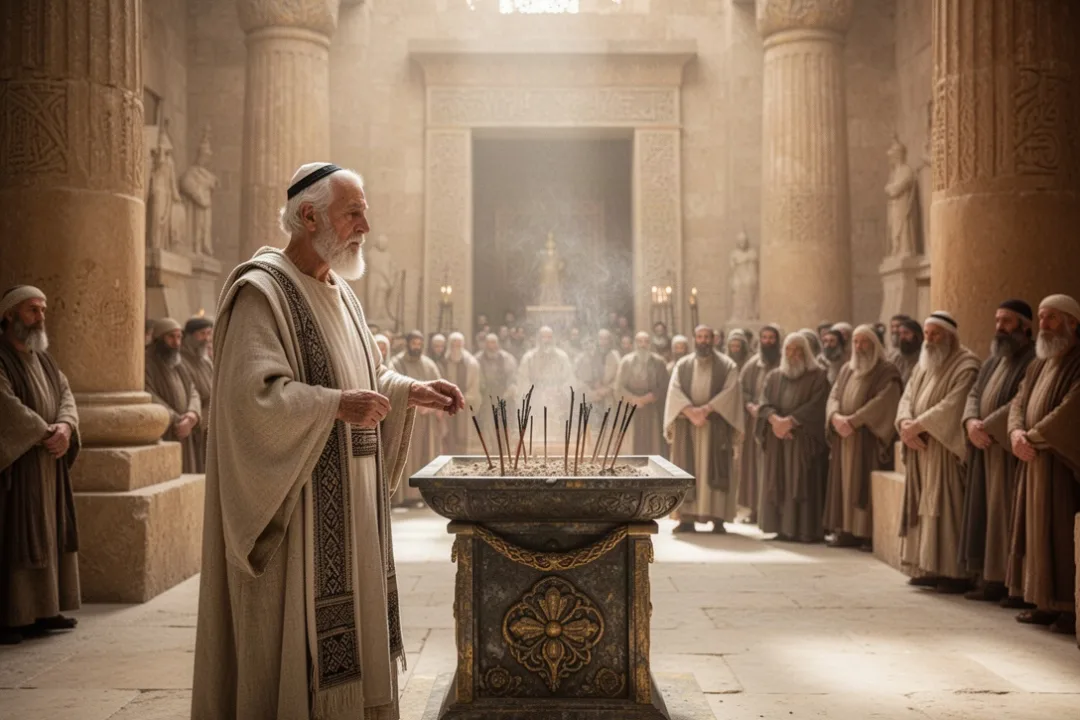
While serving in the temple, Zachariah was chosen to burn incense. This was a significant priestly duty, performed in the sanctuary while worshipers prayed outside. During that service, the angel Gabriel appeared and told him that Elizabeth would have a son.
The angel gave the child a name—John—and described his future calling. John would bring joy to his parents, turn many people toward God, and go before the Lord with the spirit and role associated with Elijah. Luke 1 connects these words with John’s ministry as the one who called Israel to repentance and prepared the way for Jesus.
Zachariah asked how he could know this would happen because he and Elizabeth were old. His question reflected the circumstances he could see, but Gabriel explained that the message came from God. As a sign, Zachariah became unable to speak until the promise was fulfilled.
Key distinction: Zachariah’s silence was not a permanent punishment or a sign that he had been rejected by God. In Luke 1, it functions as a temporary sign connected with the angel’s announcement and ends when the child is named.
When Elizabeth gave birth, relatives assumed the baby would be named after his father. Elizabeth corrected them and said that the child would be called John. The relatives then asked Zachariah, using gestures or writing, what name he wanted. He wrote that the child’s name was John, and immediately his speech returned.
Zachariah responded by praising God. His words, traditionally called the Benedictus from the first word of its Latin form, celebrate God’s faithfulness, mercy, covenant promises, and coming salvation. He also spoke directly about John’s role: the child would be a prophet who prepared people to recognize God’s saving work.
A step-by-step way to read Luke’s account
Luke 1 contains several movements, and following them in order makes the story easier to understand. The account is not only about an unexpected birth. It also links John to Israel’s hopes and places his ministry immediately before Jesus’ public work.
Begin with the couple: Zachariah and Elizabeth are described as faithful, but they have no child. Their situation creates the human tension in the story.
Notice the temple setting: Zachariah is carrying out priestly service when Gabriel appears. The announcement comes during worship, not through a political or military event.
Read the promise carefully: the angel identifies the child’s name, character, calling, and influence. John’s mission is larger than the private happiness of his parents.
Observe Zachariah’s response: he asks for confirmation, and his temporary inability to speak becomes a visible sign for the people waiting outside.
Track Elizabeth’s role: she recognizes God’s kindness and receives the pregnancy as an answer to her long-standing sorrow.
Watch the naming scene: Zachariah obeys the angel’s instruction, and his speech returns.
Interpret the prophecy: his praise looks beyond his family and points toward God’s promised redemption and John’s preparatory ministry.
This sequence also shows why Zachariah matters even though he is not the central figure of the Gospel. His experience provides the first extended response to Gabriel’s announcements in Luke. His family becomes the setting in which God’s promise about John begins to take visible form.
Zachariah’s silence follows his request for evidence. Gabriel had announced an event that seemed humanly impossible: Elizabeth would bear a son despite her age and long history of infertility. Zachariah did not simply ask what name to give the child; he questioned how the promise could be trusted.
Luke presents the silence as both discipline and confirmation. It marks the seriousness of doubting the angelic message, but it also gives the waiting worshipers a sign that something extraordinary has happened inside the sanctuary. Zachariah’s inability to speak lasts until the birth and naming of John.
The episode does not require the conclusion that Zachariah had no faith at all. Luke describes both Zachariah and Elizabeth positively before the announcement. His reaction shows that faithful people can still struggle to accept a promise when circumstances appear to make it impossible.
There is also a strong contrast between Zachariah and Mary in Luke 1. Both receive announcements about miraculous births and both ask questions. Their questions are worded differently and receive different responses. Mary’s question seeks to understand how the promise will happen; Zachariah’s response is treated as a demand for proof. The passage invites readers to pay attention not only to questions themselves but also to the posture behind them.
What does Zachariah’s prophecy mean?
After John’s birth, Zachariah praises God for remembering his people and acting according to ancient promises. Luke 1:67-79 does not present a private speech of relief alone. It is a prophetic song about God’s covenant, deliverance, forgiveness, and guidance.
The first part looks toward God’s work for Israel. Zachariah speaks of a powerful deliverer from the house of David and recalls the promises made through the prophets. Christians understand this section as pointing forward to Jesus, whose birth and ministry are the focus of Luke’s Gospel.
The second part addresses John directly. John is called a prophet of the Most High who will go ahead of the Lord. His work will help people understand salvation through the forgiveness of sins. Luke describes this mission as preparation, not as an attempt to make John the center of the story.
The final image is one of light reaching people who sit in darkness and guiding their feet toward peace. This language summarizes the hope of the prophecy: God’s mercy will bring direction, reconciliation, and life where people are lost or threatened.
Luke 1 presents John as the messenger who prepares the way, while Zachariah’s song interprets that preparation as part of God’s larger promise of salvation.
Zachariah’s song is therefore valuable for understanding the relationship between John and Jesus. John is not the Messiah, but his birth is not incidental. His calling belongs to the prophetic preparation that surrounds Jesus’ arrival.
What can Zachariah’s story teach about delayed answers?
The account of Zachariah and Elizabeth treats childlessness as a deep sorrow without reducing their lives to that sorrow. Luke says they had prayed and waited, yet the answer came at a time they no longer expected. Their story reflects the tension between long faithfulness and unresolved longing.
That does not mean every delayed prayer will receive the same kind of answer. The passage should not be used to promise that a particular outcome will happen if someone waits long enough. Its emphasis is on God’s purposes in one specific story, not on a formula for obtaining everything a person requests.
Several details make the account especially human:
Zachariah and Elizabeth are portrayed as faithful before their circumstances change.
Their age makes the promise difficult to accept, even for a priest familiar with Scripture.
Elizabeth experiences both personal joy and relief from social shame.
Zachariah’s silence gives him time before he publicly speaks about what God has done.
The child’s identity is defined by God’s calling rather than by family expectations.
The story can encourage careful prayer without encouraging simplistic answers. It acknowledges that faithfulness does not eliminate grief and that an answered prayer may carry a purpose extending beyond the people who first asked.
Zechariah the prophet belongs to the period after some of the Jewish exiles had returned to Jerusalem. The Book of Zechariah places his ministry alongside Haggai’s, during the reign of the Persian king Darius. The central historical concern is the rebuilding of the temple and the spiritual renewal of the returned community.
Zechariah 1 begins with a call to return to God. The prophet reminds the people that earlier generations ignored the prophets and suffered the consequences. The message is direct: the community must not repeat the rebellion of its ancestors.
The first major section of the book contains a series of visions. These visions use symbolic images such as horsemen, horns, craftsmen, a measuring line, a lampstand, olive trees, a flying scroll, and a woman in a basket. Their details can be difficult, but their broad concerns include God’s presence, judgment on evil, restoration of Jerusalem, and the cleansing of the people.
Two figures receive particular attention in the visions: Joshua the high priest and Zerubbabel, the governor. Joshua is portrayed in a scene involving accusation and cleansing, while Zerubbabel is encouraged in the work of rebuilding. Zechariah 4 emphasizes that the task will be accomplished not by human force alone but through God’s Spirit.
Later chapters address fasting, justice, Jerusalem’s future, the coming king, shepherd imagery, and the purification of God’s people. Some passages are frequently read in Christian interpretation as pointing toward Jesus, including references to a humble king and a pierced figure. The exact interpretation of individual images has been debated, so readers should distinguish the text’s original setting from later theological applications.
How the Book of Zechariah is organized
The book is often read in two broad sections, although its literary development and historical setting have been discussed by scholars. Chapters 1–8 focus strongly on visions, repentance, temple restoration, and questions about fasting. Chapters 9–14 contain further prophetic oracles with vivid images of kingship, conflict, judgment, and restoration.
Zechariah 1: a call to return to God and the beginning of the night visions.
Zechariah 2–6: symbolic visions concerning Jerusalem, the temple, leadership, cleansing, and God’s judgment.
Zechariah 7–8: teaching about fasting, ethical responsibility, truth, compassion, and restored worship.
Zechariah 9–11: oracles about nations, a humble king, deliverance, and troubled leadership.
Zechariah 12–14: images of conflict, mourning, purification, the Lord’s reign, and the transformation of Jerusalem.
The visions should not be treated as a simple timetable of modern events. They arose in a particular setting and use prophetic symbolism. Good interpretation asks what the images communicated to the returned community before applying their themes to later faith and practice.
What does the name Zachariah mean?
Zachariah comes from a Hebrew name commonly transliterated as Zekharyah or Zekharyahu. It is generally understood to mean “the Lord remembers” or “Yahweh has remembered.” The name is especially fitting in biblical narratives where God remembers a covenant, a prayer, or a people in distress.
“Remember” in the Bible does not mean that God had forgotten information and suddenly recovered it. It often describes God turning attention toward a person or group in a way that leads to action. When Scripture says God remembers, the emphasis is on faithfulness and intervention.
That meaning resonates with Luke’s story. Zachariah and Elizabeth have waited for a child, and his prophetic song celebrates God’s remembrance of covenant promises. It also fits the prophetic book, where God remembers Jerusalem and calls the returned community back to faithful worship.
Who was Zechariah son of Jehoiada?
Another important figure appears in 2 Chronicles 24:20-22. This Zechariah was the son of Jehoiada the priest. After Jehoiada’s death, King Joash and the leaders of Judah turned away from the Lord and adopted idolatrous practices. Zechariah was empowered by God’s Spirit to confront the people over their unfaithfulness.
According to Chronicles, the king ordered that Zechariah be stoned in the temple courtyard. As he died, Zechariah called on God to see and judge what had happened. The account presents his death as a severe example of rejecting prophetic correction.
This Zechariah is not the same person as the father of John the Baptist. They lived in different periods and appear in different biblical settings. Some readers also connect him with Jesus’ reference to “Zechariah” in Matthew 23:35, where Jesus speaks of righteous people killed between Abel and Zechariah. Because the Gospel wording and the historical references have prompted discussion, it is best to identify the possible connection carefully rather than treating it as completely settled.
Zechariah, king of Israel, is described in 2 Kings 15:8-12. He was the son of Jeroboam II and ruled the northern kingdom for only a short period. His reign ended when Shallum son of Jabesh conspired against him, struck him down, and took the throne.
The account links his reign with the continuation of the dynasty of Jehu, fulfilling a prophetic word that Jehu’s descendants would sit on Israel’s throne for four generations. This king should not be confused with the prophet Zechariah or with the priest in Luke.
His brief reign illustrates why names alone are not enough when studying biblical history. The same name can belong to a priest, a prophet, a king, and several less prominent people. The passage, family connection, location, and historical period establish the person’s identity.
How should you study passages about Zachariah?
Start by recording the exact reference, then identify the book’s historical setting. A name search may gather every occurrence together, but it can also make unrelated people appear connected. Context prevents that mistake.
Check the spelling and translation: Zachariah and Zechariah may represent the same underlying name, while Zacharias is a Greek form used in some New Testament contexts.
Identify relatives: phrases such as “son of Jehoiada,” “son of Jeroboam,” or “husband of Elizabeth” immediately narrow the possibilities.
Locate the role: ask whether the person is a priest, prophet, king, ancestor, official, or witness.
Read the full scene: the verses before and after the name usually reveal the person’s purpose in the narrative.
Separate description from interpretation: first observe what the passage says, then consider how later Christian or Jewish interpretation applies it.
Compare translations carefully: spelling differences do not necessarily indicate different people.
For the New Testament figure, read Luke 1 as a complete narrative rather than isolating the silence or the prophecy. For the prophet, read the Book of Zechariah alongside the postexilic concerns of Haggai. For the historical figures, compare the immediate context in Kings and Chronicles.
Why Zachariah matters in the larger biblical story
Zachariah’s significance depends on which figure is meant, but a common theme connects many of the references: God’s faithfulness amid human weakness. The priest struggles to believe a promise. The prophet speaks to a discouraged community rebuilding after national catastrophe. The priest son of Jehoiada confronts people who have abandoned their commitments. The king’s short reign shows the instability of a divided kingdom.
The father of John the Baptist also helps connect the Old and New Testaments. His priestly identity places him within Israel’s worship tradition, while his prophecy interprets John’s birth through the promises of Israel’s Scriptures. John’s ministry then prepares the way for Jesus, making Zachariah part of the opening movement of Luke’s Gospel.
The prophet Zechariah contributes a different kind of connection. His visions speak to a community rebuilding the temple and waiting for renewed blessing. Later biblical writers and Christian readers revisit his images when reflecting on the Messiah, the kingdom of God, judgment, and restoration.
For that reason, the name Zachariah is more than a simple search term. It opens several biblical windows: one looks toward John the Baptist, another toward postexilic prophecy, and others toward the troubled history of Israel and Judah. Careful reading keeps those windows distinct while allowing the larger themes of promise, repentance, worship, and hope to come into view.
Frequently asked questions
Is Zachariah the same person as Zechariah in the Bible?
Sometimes the spellings refer to the same name, but not always to the same person. English translations use different transliterations of the Hebrew name, and the Greek New Testament uses a related form. You must identify the individual from the passage. Zachariah in Luke 1 is John the Baptist’s father, while Zechariah in the prophetic book is a postexilic prophet.
What happened to Zachariah after John the Baptist was born?
Luke records Zachariah’s prophecy after John’s birth but does not give a detailed account of his later life or death. The Gospel focuses on his role in recognizing John’s calling and praising God’s faithfulness. Later traditions make various claims, but those should not be presented as details directly stated by the biblical text.
What is the main message of the Book of Zechariah?
The book calls the returned community to renewed faithfulness while encouraging hope for God’s presence, restored worship, righteous leadership, and future deliverance. Its visions use symbolism rather than a simple chronological forecast. The book also emphasizes that restoration depends on God’s Spirit and should be accompanied by justice, truth, compassion, and repentance.
Why did Zachariah doubt the angel’s message?
Luke presents Zachariah as an older man whose wife had been unable to have children, so the promise seemed impossible under ordinary circumstances. He asked how he could know it would happen, and Gabriel responded by making him unable to speak temporarily. The narrative treats this as a serious failure to trust the message, while still showing Zachariah as part of God’s unfolding plan.







Leave a Reply