John the Baptist: His life, message, and lasting significance
John the Baptist: His life, message, and lasting significance
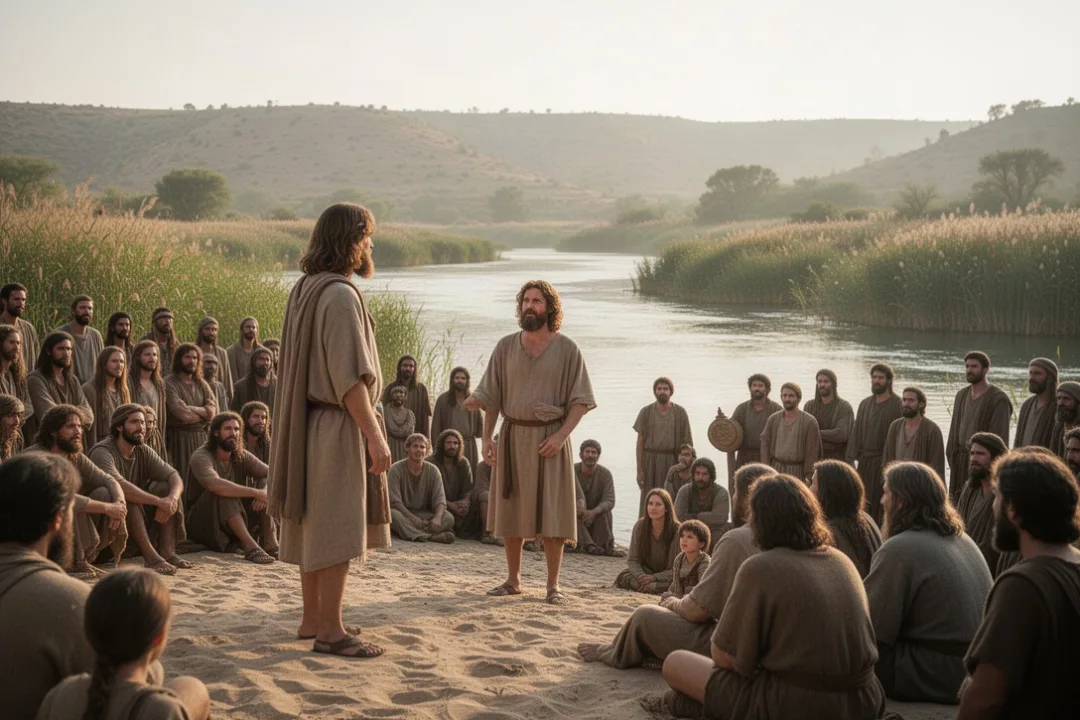
When people read about Jesus’ ministry, they often encounter John the Baptist first and wonder why he matters so much. John was not one of Jesus’ disciples, and he did not perform his work from a palace, synagogue, or established religious office. He preached in the wilderness, called people to turn back to God, baptized them in the Jordan River, and announced that someone greater was coming.
John’s role was to serve as a prophet and forerunner of Jesus. He prepared people spiritually for the Messiah, identified Jesus publicly, challenged corruption and hypocrisy, and remained faithful even when his ministry led to imprisonment and death. His story connects the promises of Israel’s Scriptures with the beginning of Jesus’ public work.
John was the son of Zechariah, a Jewish priest, and Elizabeth, a relative of Mary, the mother of Jesus. Luke presents his birth as extraordinary because Elizabeth had been unable to have children and both parents were advanced in age. An angel announced that their son would have a special mission, and that he would be filled with the Holy Spirit from before birth (Luke 1).
John’s birth is closely connected with Jesus’ birth in Luke’s account. Before Mary became pregnant with Jesus, the angel Gabriel told her that Elizabeth was also expecting a child. When Mary visited Elizabeth, the unborn John responded to Mary’s greeting, and Elizabeth recognized that God was doing something significant through Mary’s child.
The Gospels do not describe John’s entire childhood. Instead, they move from his birth announcement to his appearance as an adult preacher in the Judean wilderness. Luke says that John grew and became strong in spirit before beginning his public ministry in the region around the Jordan River.
John’s clothing and diet reflected the austere character of his calling. He wore clothing made from camel’s hair with a leather belt and ate locusts and wild honey, according to the Gospel accounts. These details recall the prophet Elijah, who was also associated with distinctive clothing and a bold confrontation with religious and political power.
John’s identity in one sentence: He was the prophetic messenger who called Israel to repentance and prepared people to recognize and receive Jesus as the promised Messiah.
Why John preached in the wilderness
John’s ministry began in the wilderness, a setting with deep meaning in the Bible. The wilderness was where Israel had traveled after leaving Egypt, where God shaped the nation, and where prophets sometimes met people away from the centers of power. John’s location emphasized that his message did not depend on the approval of Jerusalem’s religious authorities or Herod’s royal court.
His preaching was direct: people needed to repent, meaning to turn away from sinful patterns and turn back toward God. Repentance was not merely an emotional reaction or a private feeling of regret. John connected it with changed conduct, honest relationships, generosity, and responsible use of power.
The crowds who came to John included ordinary people, tax collectors, and soldiers. He did not tell everyone to leave their work or abandon society. Instead, he confronted the ways their work could become exploitative or violent. His instructions made repentance concrete rather than abstract.
To the crowds, John taught that people with extra clothing or food should share with those who lacked basic necessities. To tax collectors, he said they should collect no more than the amount required. To soldiers, he warned against extortion, false accusations, and using their position to obtain money. These teachings appear in Luke 3 and show how John connected spiritual preparation with ethical behavior.
What John’s baptism meant
John baptized people in the Jordan River as a visible sign of repentance. Ritual washing was already familiar within Jewish religious life, but John’s baptism had a distinctive public character. It represented a person’s acknowledgment of sin, desire for forgiveness, and commitment to a changed way of living.
The phrase “John the Baptist” refers to this practice. “Baptist” means one who baptizes; it is not a surname. John’s work was so closely associated with baptism that the title became the standard way the Gospels identify him.
John’s baptism also carried an urgent sense of preparation. He warned that God’s judgment was approaching and that outward religious identity could not substitute for genuine faithfulness. In Matthew 3, John challenges those who rely on being descendants of Abraham rather than showing the fruit of a transformed life.
John did not present baptism as a way to earn God’s favor through a ceremony alone. The physical act mattered because it expressed an inward response. His message required people to acknowledge their need for mercy and then demonstrate that response through their choices.
Christian baptism later developed in connection with Jesus’ death, resurrection, and the gift of the Holy Spirit. John’s baptism therefore belongs to the transition between the prophetic ministry of Israel and the new stage opened by Jesus. The two practices are related, but the New Testament presents them as having different settings and meanings.
How John prepared people for Jesus
John’s most important task was not to gather permanent followers for himself. He directed attention away from himself and toward the one who would come after him. The Gospel writers describe him as fulfilling prophetic expectations about a messenger who would prepare the way for the Lord.
Mark begins his Gospel with John’s ministry, presenting him as the messenger described through the words of Isaiah. Matthew, Luke, and John also connect him with prophetic promises. The imagery of preparing a road or making a path straight communicates the removal of obstacles so that people can respond to God.
John repeatedly emphasized that he was not the Messiah. In John 1, he denies being the Christ and explains that his own role is subordinate to the one who comes after him. He also rejects the idea that he is Elijah returned in a literal sense, while Jesus later identifies John as fulfilling the expected Elijah-like role described in prophecy (Matthew 11 and 17).
John’s humility was not weakness or uncertainty about his calling. He understood that his work was significant precisely because it pointed beyond himself. His message had authority, but he refused to claim the central place that belonged to Jesus.
The Gospel of John uses rich images to describe this relationship. John calls Jesus the Lamb of God, pointing toward Jesus’ role in dealing with sin, and describes himself as a witness rather than the light. In another image, John compares himself to the friend of a bridegroom who rejoices when the bridegroom arrives. The point is clear: John’s success meant that people recognized Jesus.
What happened when John baptized Jesus
Jesus came from Galilee to the Jordan and asked John to baptize him. At first, John recognized that Jesus had no need to confess sin in the way the crowds did, and Matthew records John’s hesitation. Jesus nevertheless insisted that the baptism should take place as part of fulfilling God’s righteous purpose (Matthew 3).
After Jesus was baptized, the Gospels describe a public confirmation of his identity. The Spirit descended upon him like a dove, and a voice from heaven identified him as God’s beloved Son. Mark, Matthew, and Luke all connect this event with the beginning of Jesus’ public ministry.
Jesus’ baptism does not mean that he needed forgiveness for personal wrongdoing. It shows him identifying with the people he came to save and accepting the mission given by the Father. It also marks a transition: John’s preparatory ministry leads directly into Jesus’ proclamation of God’s kingdom.
John’s Gospel does not narrate the baptism in the same sequence as the other three Gospels, but it records John’s witness to the Spirit coming upon Jesus. John says that God had given him a sign so he could recognize the one who would baptize with the Holy Spirit. This testimony establishes Jesus’ authority from the start.
What John taught about judgment and the Messiah
John’s preaching combined hope and warning. He announced that God’s reign was near, but he also warned that people could not treat that announcement casually. The coming Messiah would bring decisive separation between genuine faithfulness and empty religious claims.
Matthew 3 and Luke 3 use images of an ax at the root of trees, a winnowing fork, and fire. These are pictures of judgment, not predictions that every detail should be read as a literal sequence. John was warning that God sees beneath appearances and will address injustice, hypocrisy, and unrepentant sin.
John also made clear that Jesus would be greater than he was. John baptized with water, while the coming one would baptize with the Holy Spirit and fire. The exact emphasis of “fire” is discussed by Christian interpreters, but the larger message is consistent: Jesus would bring a deeper work of renewal and judgment than John’s preparatory ministry.
John’s message challenged the common assumption that religious heritage guaranteed safety. Being connected to Abraham, belonging to the covenant people, or participating in a public ritual was not enough. God desired a life that produced visible fruit: justice, generosity, truthfulness, restraint, and mercy.
How John confronted Herod Antipas
John’s courage became especially visible in his confrontation with Herod Antipas, the ruler of Galilee and Perea. Herod had taken Herodias, his brother’s wife, and John publicly condemned the relationship as unlawful. John did not soften his message because the person involved held political authority.
Herod responded by imprisoning John. The Gospel accounts describe Herod as afraid of John and also intrigued by him; he recognized that John was righteous and holy, yet he did not release him. This mixture of fascination, fear, and resistance reveals how a person can respect a moral voice without surrendering control.
John’s imprisonment became a difficult period of uncertainty. From prison, he sent disciples to ask Jesus whether he was truly the expected one or whether they should look for someone else. Jesus answered by pointing to the works taking place: the blind received sight, the lame walked, people with serious illnesses were cleansed, the deaf heard, the dead were raised, and good news was preached to the poor, as reported in Matthew 11 and Luke 7.
Jesus did not dismiss John’s question. He gave evidence connected with Isaiah’s prophetic hopes and then spoke highly of John to the crowd. Jesus described John as more than a prophet and affirmed his unique place in salvation history, while also saying that participation in God’s kingdom involved a new privilege and responsibility.
How John the Baptist died
John’s death followed a banquet held for Herod’s birthday. According to Matthew 14 and Mark 6, Herodias’s daughter performed a dance that pleased Herod and his guests. Herod made a rash promise to grant her whatever she requested. Prompted by her mother, she asked for John’s head on a platter.
Herod was distressed because he feared John and knew that the request was wrong, but he also feared losing face before his guests. He ordered the execution, and John’s disciples later took his body and buried it. Luke mentions John’s death briefly after reporting Herod’s confusion about Jesus’ growing reputation.
The accounts emphasize the danger of unchecked power, public pressure, and impulsive promises. Herod had authority to stop the killing, but concern for his reputation became stronger than concern for justice. John’s death also shows that faithfulness does not guarantee protection from suffering or a long earthly ministry.
John’s ministry ended before Jesus’ ministry reached its climax, yet the Gospels portray his work as complete in its purpose. He had announced the coming one, called people to repentance, identified Jesus, and remained truthful before a ruler who could punish him.
How John differs from Jesus
John and Jesus preached closely related messages, but the Gospels distinguish their ministries. John lived an ascetic life in the wilderness, while Jesus regularly ate with a wide range of people and ministered in villages, homes, synagogues, and cities. Jesus’ opponents even criticized him for eating and drinking more freely than John (Matthew 11 and Luke 7).
John’s central work was preparation. Jesus announced and embodied the arrival of God’s kingdom. John baptized with water as a sign of repentance; Jesus gave the Holy Spirit and established the foundation of Christian faith through his death and resurrection.
John was a witness to Jesus, not a rival. Some of John’s followers continued to identify strongly with him, and the New Testament occasionally encounters people who knew only John’s baptism. Acts 18 and 19 show early Christian workers explaining that John’s ministry pointed forward and that followers needed to learn about Jesus and the Holy Spirit.
These distinctions protect the central Christian claim about Jesus. John was an important prophet, but he was not the source or center of salvation. His greatness consisted partly in recognizing the limits of his own role.
Common mistakes when reading about John the Baptist
John’s story is familiar, but several misunderstandings can obscure its meaning. Keep these points in mind when studying the Gospel accounts:
Do not treat John as Jesus’ first disciple. John had his own prophetic mission and directed people toward Jesus, although some of his followers later became Jesus’ followers.
Do not reduce repentance to feeling sorry. John connected repentance with practical changes in behavior, especially honesty, generosity, and the responsible use of authority.
Do not assume John’s baptism and Christian baptism are identical. They share the symbolism of water and repentance, but the New Testament places Christian baptism after Jesus’ completed saving work and in connection with the Holy Spirit.
Do not overlook John’s political courage. His message was not limited to private spirituality. He confronted a ruler over public wrongdoing and accepted the consequences.
Do not interpret John’s doubts as proof that his ministry failed. His question from prison reflects real suffering and uncertainty, while Jesus still honored John’s calling.
Do not confuse John with the apostle John. John the Baptist is the wilderness preacher and forerunner of Jesus. The apostle John appears among Jesus’ disciples and is associated with the Gospel of John, the letters of John, and Revelation in Christian tradition.
Practical ways to study John’s message
John’s ministry becomes clearer when you read the relevant passages together rather than relying on a single familiar scene. The accounts emphasize different details, but they share a coherent picture of his character and purpose.
Read Luke 1 first. Notice the promises surrounding John’s birth, his relationship to Elizabeth and Zechariah, and the prophetic language describing his future work.
Read Mark 1 and Matthew 3. Compare John’s clothing, location, baptism, preaching, and interaction with Jesus.
Read Luke 3 slowly. Focus on the specific instructions John gives to crowds, tax collectors, and soldiers.
Read John 1. Observe how John identifies Jesus and repeatedly refuses to make himself the center of attention.
Read Matthew 11 and Mark 6. Consider John’s prison question, Jesus’ response, and the events leading to John’s death.
Ask what repentance looks like in daily life. Apply John’s themes to money, work, authority, truthfulness, relationships, and care for vulnerable people.
A useful study habit is to separate what the text says from later traditions or artistic images. The Bible gives substantial information about John’s family, preaching, baptism, relationship with Jesus, confrontation with Herod, imprisonment, and execution. It gives far less information about his childhood and private life, so confident claims about those areas should be treated cautiously.
A practical question for reflection: If John’s message were addressed to your ordinary responsibilities, what would honest repentance change in the way you use money, treat people, speak about others, or exercise authority?
Why John the Baptist still matters
John matters because he shows what faithful preparation looks like. He did not try to build a permanent personal brand, preserve his own influence, or compete with Jesus. His work was successful when people moved beyond him and listened to the one he announced.
He also shows that spiritual preparation includes moral repair. John did not present worship as separate from economic conduct, professional behavior, or public justice. His questions still expose the gap that can exist between religious language and daily choices.
John’s life offers a balanced picture of courage and vulnerability. He spoke fearlessly to a ruler, yet he experienced uncertainty in prison. He trusted his calling, yet he asked for reassurance. The Gospel accounts do not hide this tension, which makes his faithfulness more credible and more human.
Most of all, John directs attention to Jesus. His clothing, location, baptism, preaching, opposition, and death all serve the same central purpose: to prepare people for the Messiah. Understanding John means understanding the threshold he represents—the moment when the prophetic promise gives way to Jesus’ public ministry.
Frequently asked questions
Was John the Baptist related to Jesus?
Yes. Luke presents John’s mother, Elizabeth, as a relative of Mary, Jesus’ mother. The exact degree of their family relationship is not specified, so it is safer to say that John and Jesus were related rather than assign them a precise modern family term. Their ministries were also closely connected from the beginning.
Did John the Baptist recognize Jesus immediately?
The Gospel of John presents John as receiving a divine sign that enabled him to identify Jesus as the one associated with the Holy Spirit. The other Gospels also portray John as recognizing Jesus’ greater status when Jesus came for baptism, although Matthew includes John’s initial hesitation about baptizing him.
Why did John question Jesus while he was in prison?
John’s question likely arose from the hardship and uncertainty of imprisonment. He expected the Messiah to bring decisive judgment, while Jesus’ ministry unfolded through healing, teaching, and mercy before final judgment. Jesus answered with evidence from his works and then affirmed John’s importance rather than condemning him for asking.
Where can I read the main passages about John the Baptist?
The principal accounts are Luke 1 and 3, Matthew 3, 11, and 14, Mark 1 and 6, and John 1 and 3. Acts 18 and 19 also mention people connected with John’s baptism. Reading these passages together shows both the shared themes and the distinctive details in each Gospel.








Leave a Reply