Who Was Simon in the Bible? The Different Men Named Simon
Who Was Simon in the Bible? The Different Men Named Simon
Simon in the Bible refers to several different men, not one person. The best-known is Simon Peter, the fisherman who became one of Jesus’ closest disciples and a leading figure in the early church. Other Simons include Simon the Zealot, Simon of Cyrene, Simon the Pharisee, Simon the leper, Simon the magician, and several people named Simon in the book of Acts.
The name appears in different settings across the New Testament, so the surrounding description matters. A reference to Simon Peter points to an apostle, while “Simon of Cyrene” identifies the man compelled to carry Jesus’ cross. These men should not be combined into one biography.
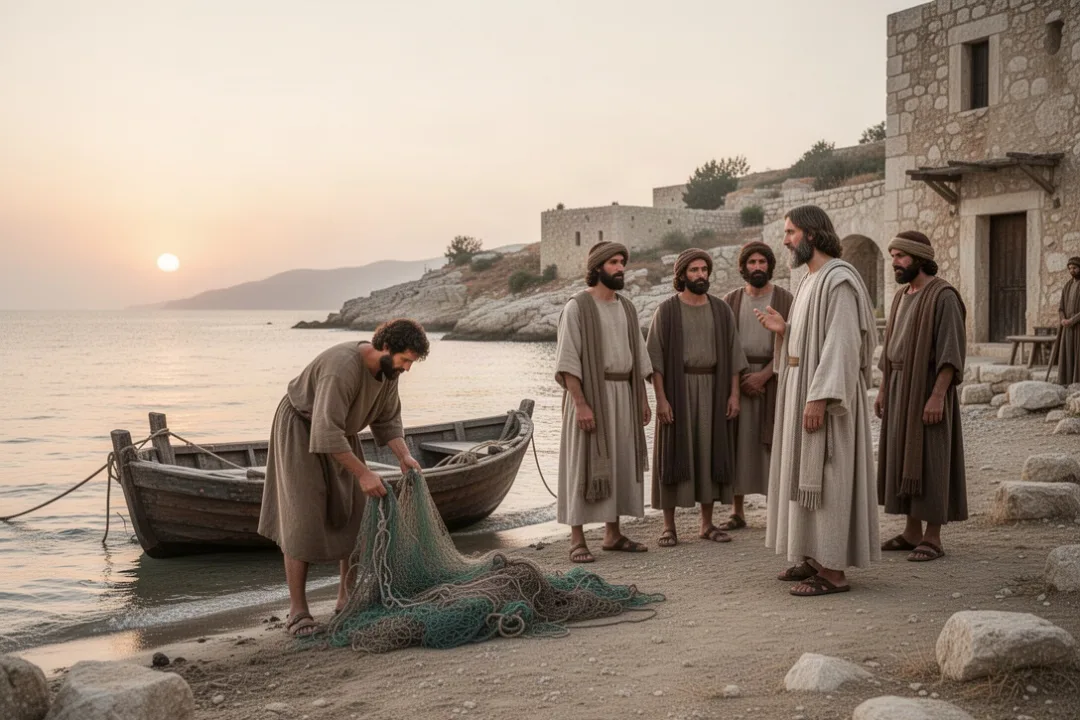
Simon Peter began as a Galilean fisherman and became one of Jesus’ twelve apostles. The Gospels identify him as the son of Jonah or John, depending on the passage and translation. His brother was Andrew, who introduced him to Jesus in the opening chapters of John’s Gospel.
Jesus gave Simon the name Peter, from a word connected with rock or stone. John also records the Aramaic form Cephas. The different names do not describe different people: Simon, Peter, and Cephas refer to the same apostle.
Peter’s character is shown through bold actions, strong faith, misunderstanding, and failure. He was often the disciple who spoke first. He stepped from a boat toward Jesus on the water, confessed that Jesus was the Messiah, and later objected when Jesus spoke about suffering and death.
Peter belonged to Jesus’ closest circle along with James and John. He witnessed significant events such as the raising of Jairus’s daughter, the Transfiguration, and Jesus’ prayer in Gethsemane. These scenes show both Peter’s privileged access and his continuing need to understand Jesus’ mission.
A useful distinction: Simon Peter is not the same person as Simon the Zealot. Both were among the twelve apostles, but the Gospels present them as separate disciples.
Peter’s confession and misunderstanding
At Caesarea Philippi, Jesus asked the disciples who people believed he was. Simon Peter answered with a confession that identified Jesus as the Messiah and Son of God, as recorded in Matthew 16. Jesus responded by speaking about Peter’s role among the disciples and the foundation of the church.
Peter’s confession was important, but it did not mean he understood everything immediately. When Jesus explained that the Messiah would suffer, be rejected, and be killed, Peter resisted the idea. His reaction shows a common expectation in that period: many people hoped for a powerful ruler who would restore Israel, not a suffering servant.
Peter also wanted to protect Jesus during the arrest. According to John 18, he used a sword and wounded the high priest’s servant. Jesus stopped the violence and accepted the path of suffering instead. Peter’s courage was real, but it needed to be reshaped by Jesus’ teaching.
Peter denied Jesus and was restored
Peter promised that he would remain loyal even if the other disciples failed. Yet during Jesus’ trial, Peter denied knowing him three times. The Gospels connect the denials with Jesus’ earlier warning and with the crowing of a rooster.
Peter’s denial is one of the clearest examples of the gap between sincere intention and human weakness. He was not portrayed as permanently disqualified. After the resurrection, Jesus met Peter beside the Sea of Galilee and asked him three times whether he loved him, corresponding to the three denials.
Jesus then told Peter to care for his followers. The restoration did not erase the failure, but it gave Peter a renewed responsibility. In John 21, his future included both service and suffering, showing that restored discipleship involves faithful care rather than personal prominence.
Peter’s role in Acts
The book of Acts presents Peter as a major leader in the earliest Christian community. He preached at Pentecost, participated in healing and public teaching, and helped guide the church through disagreements and persecution. His speeches repeatedly centered on Jesus’ death, resurrection, and exaltation.
Peter also received a vision that challenged his assumptions about Gentiles. Soon afterward, he visited the household of Cornelius, a Roman centurion. Acts 10 presents this meeting as a major step in recognizing that God’s good news was not limited to one ethnic group.
Paul later referred to Peter by the name Cephas when discussing a disagreement in Antioch, as described in Galatians 2. This passage shows that Peter was highly respected but not beyond correction. His story includes leadership, growth, mistakes, restoration, and service.
Simon the Zealot was another apostle of Jesus
Simon the Zealot appears in the lists of the twelve apostles. Matthew and Mark call him “the Cananaean,” while Luke and Acts use “the Zealot.” These descriptions identify the same disciple, not two separate Simons.
The Bible gives little personal information about him. Unlike Peter, he does not receive extended scenes in the Gospel narratives. His title distinguishes him from Simon Peter and indicates an association with the term zealot, which conveyed strong devotion or passionate commitment.
It is wise not to assign details that the biblical text does not provide. Some later traditions offer stories about Simon the Zealot’s ministry and death, but those traditions are not described in the New Testament itself. The secure biblical facts are that he was one of Jesus’ chosen apostles and remained part of the group after the resurrection.
His inclusion beside people with very different backgrounds is significant. Matthew had worked as a tax collector, while Simon carried the title Zealot. The Gospels do not explain every detail of their political views, but placing them in one group shows that following Jesus created a community that crossed former divisions.
Simon Peter is the apostle who became a leading witness and church leader.
Simon the Zealot is a separate member of the twelve.
Judas Iscariot is also connected to a man named Simon, who is identified as his father in John’s Gospel.
Other Simons who appear in the Gospels
The Gospels mention several men named Simon outside the twelve apostles. Their stories occur in different places and serve different purposes. Paying attention to their descriptions prevents confusion, especially when a passage simply says “Simon” without using a surname.
Simon of Cyrene carried Jesus’ cross
Simon of Cyrene was compelled to carry Jesus’ cross on the way to the place of crucifixion. Cyrene was a city in North Africa, so this description identifies him by geographic origin. Matthew 27, Mark 15, and Luke 23 all mention him.
Mark identifies Simon as the father of Alexander and Rufus. The text does not explain their full story, but naming them may suggest that they were known to the Christian readers who first received Mark’s Gospel. The brief account gives Simon an unexpected role in the final hours before Jesus’ death.
Simon did not volunteer for this task according to the Gospel accounts; Roman authorities compelled him. His experience illustrates the physical burden of Jesus’ execution and the way ordinary people could be drawn into events they did not plan.
Simon the Pharisee hosted Jesus
Luke 7 describes Simon the Pharisee, who invited Jesus to a meal. During the meal, a woman known publicly as a sinner approached Jesus, expressed sorrow, and showed him an unusual level of honor. Simon questioned Jesus’ acceptance of her.
Jesus answered with a story about two debtors who were forgiven different amounts. He used the story to contrast Simon’s limited hospitality with the woman’s abundant expression of love. The point was not that Simon had no need for forgiveness, but that he did not recognize his need as clearly as she did.
This Simon is not identified as one of Jesus’ disciples, and he should not be confused with Simon Peter. His encounter raises questions about judgment, forgiveness, hospitality, and gratitude. The account also shows that a person can be outwardly religious while remaining resistant to the mercy Jesus offers.
Matthew 26 and Mark 14 describe a meal at the home of Simon the leper in Bethany. During the meal, a woman poured expensive perfume on Jesus. Some people criticized the apparent waste, but Jesus defended her action and connected it with preparation for his burial.
The Bible does not say whether Simon still had leprosy when the meal took place or explain how he received that designation. It may have been a former condition or the name by which he was known. The text also does not say that Simon the leper was the same man as Simon the Pharisee.
The setting is important because the meal takes place shortly before Jesus’ crucifixion. The woman’s action becomes a meaningful act of honor, while the criticism around her reveals how people can evaluate devotion mainly through cost and practical usefulness.
Simon Iscariot was Judas’ father
John’s Gospel refers to Judas Iscariot as the son of Simon Iscariot. This Simon does not appear as an active character in the Gospel story. His name is included to identify Judas more precisely.
Judas Iscariot was one of the twelve disciples and later betrayed Jesus. The repeated identification of Judas as the son of Simon helps distinguish him from other people named Judas, but it gives no additional information about Simon Iscariot’s life or beliefs.
Simons in Acts include a magician, a tanner, and church leaders
The name Simon continues to appear in Acts, which records the growth of the early Christian movement. These references include both prominent and ordinary people. Their stories show the variety of settings in which the early believers lived and worked.
Simon the magician sought spiritual power
Simon the magician, often called Simon Magus, appears in Acts 8. He practiced magic in Samaria and impressed many people, who considered him powerful. After hearing Philip preach about the kingdom of God and seeing signs performed in Jesus’ name, Simon professed belief and was baptized.
Simon then saw the apostles laying hands on people so they received the Holy Spirit. He offered money for the ability to give this power to others. Peter rebuked him sharply and told him to repent, because he had treated God’s gift as something that could be bought.
The account emphasizes the difference between faithful conversion and the desire to acquire spiritual influence. Simon was fascinated by power, but the apostles made clear that the Holy Spirit was not a commodity. Acts does not clearly state what happened to him afterward, so later claims about his life should be separated from the biblical account.
Reading Acts 8 carefully: Simon’s story is not mainly about magical technique. It is a warning against turning religious authority, spiritual gifts, or ministry into possessions that can be purchased or controlled.
Simon the tanner welcomed Peter
Acts 9 introduces Simon the tanner, who lived in Joppa and hosted Peter. Peter stayed at his house for some time before receiving the vision that prepared him to meet Cornelius.
Tanning involved treating animal hides, a trade that could carry social and ceremonial concerns for some Jewish people. The passage does not condemn Simon’s occupation. Instead, it quietly places Peter in the home of a working tradesman and makes that household the setting for an important stage in the church’s mission to Gentiles.
The reference to Simon the tanner is brief, but it provides a valuable detail about early Christian life. Hospitality was not limited to famous leaders. Ordinary believers opened their homes, and those homes became places where teaching, prayer, discernment, and mission developed.
Simon called Niger served at Antioch
Acts 13 lists Simon called Niger among the prophets and teachers in the church at Antioch. The word Niger is Latin for “black” or “dark,” and it may have been a distinguishing nickname. The passage does not provide enough information to determine his ethnic background with certainty.
Simon Niger served alongside Barnabas, Saul, Lucius of Cyrene, and Manaen. While the New Testament does not tell us much about his later work, his inclusion in this leadership group shows that the Antioch church contained people from varied backgrounds.
The church leaders were worshiping and fasting when the Holy Spirit directed them to set apart Barnabas and Saul for missionary work. Simon Niger was part of that worshiping community. His brief mention places him near a decisive moment in the expansion of the Christian message.
What the different Simons show about biblical names and identity
Simon comes from the Hebrew name Shimon, commonly understood in connection with hearing or being heard. It was a common Jewish name in the first century, which explains why the New Testament uses additional descriptions to distinguish one Simon from another.
Those descriptions might refer to a father, a hometown, a trade, a religious association, or a nickname. Examples include Simon Peter, Simon of Cyrene, Simon the Zealot, Simon the tanner, and Simon called Niger. The label is not a decorative detail; it often helps readers understand where the person came from or what role he played.
Several practical reading habits can help when you encounter the name Simon:
Check the surrounding passage. A Simon in the Gospels may be an apostle, host, Pharisee, leper, or cross-bearer.
Look for the identifying description. “Peter,” “of Cyrene,” “the Zealot,” and “the tanner” point to different individuals.
Compare parallel Gospel accounts. Matthew, Mark, Luke, and John sometimes use different forms of a name or provide different identifying details.
Separate biblical facts from later tradition. Later Christian writings may describe a Simon’s ministry, but those claims are not automatically part of Scripture.
The many Simons also provide a broader lesson about discipleship. Simon Peter shows that a flawed person can be restored and entrusted with serious responsibility. Simon the Zealot shows that people with different histories can belong to one community. Simon of Cyrene shows how an otherwise unknown person can become part of the Gospel story through one difficult act of service.
Simon the Pharisee and Simon the magician present different warnings. One struggled to recognize his need for forgiveness, while the other tried to obtain spiritual authority for personal purposes. Simon the tanner and Simon Niger represent quieter forms of faithfulness: hospitality, shared leadership, and participation in the life of the church.
So, when someone asks, “Who was Simon in the Bible?” the most accurate answer is: there were several men named Simon. Simon Peter is the central figure, but the other Simons add important perspectives on failure, mercy, religious ambition, service, hospitality, and the diverse people who surrounded Jesus and the early church.
Frequently asked questions
Is Simon Peter the same person as Simon the Zealot?
No. Simon Peter and Simon the Zealot were separate members of Jesus’ twelve apostles. Simon Peter was the fisherman who became a prominent leader in the early church. Simon the Zealot is listed among the apostles but receives far less individual attention in the New Testament. The similar first name is the main source of confusion.
Why did Jesus call Simon “Peter”?
Jesus gave Simon the name Peter, which is related to the idea of a rock or stone. John also uses the name Cephas, an Aramaic equivalent. These names identify the same apostle. The new name marked Simon’s particular role among Jesus’ followers, although Peter still had to grow through misunderstanding, fear, failure, and restoration.
Was Simon the magician one of Jesus’ disciples?
No. Simon the magician appears in Acts 8 in Samaria, after Jesus’ resurrection and the beginning of the church’s public mission. He was baptized after hearing Philip’s preaching, but he later tried to buy the apostles’ authority to give the Holy Spirit. Peter condemned that ambition and urged him to repent.
What did Simon of Cyrene do?
Simon of Cyrene was compelled to carry Jesus’ cross on the way to the crucifixion. He came from Cyrene, a city in North Africa, and Mark identifies him as the father of Alexander and Rufus. The Gospel accounts do not provide a longer biography, but his brief appearance highlights the physical burden Jesus endured.










Leave a Reply